Private Equity Compensation in 2026: Pay Structures, Lawsuits, and What Professionals Earn
Quick Answer
- Operating partners at $25B+ funds earn $1M to $1.75M+ in cash plus $10M to $60M+ in carry.
- Carry participation among senior operating professionals now reaches 80% to 92%, approaching deal team parity.
- A former BlackRock director is suing for $12.4M in promised but unpaid carried interest.
If you work in private equity or are considering a move into the industry, understanding how compensation actually works matters more than ever. The gap between what firms promise and what they deliver has become a legal battleground.
This article breaks down verified 2026 compensation data across fund sizes and roles, the structural shift toward operating talent, and the lawsuits that reveal what happens when carried interest promises go unpaid.
The Facts
| Case Type | Industry compensation data; individual employment litigation |
| Key Litigation | Dignum v. BlackRock (N.Y. Supreme Court); Hg equal pay case (London tribunal) |
| Status | Compensation rising; litigation active on carry disputes |
| Fund Size | Not applicable; compensation varies by AUM and role |
| Est. Per Person | $1M to $1.75M+ cash (operating partners at $25B+ funds); carry adds $10M to $60M+ |
| Claim Deadline | Varies by employment contract and jurisdiction |
| Administrator | None; disputes proceed through court or arbitration |
| Proof Needed | Employment contracts, term sheets, compensation agreements |
Is Private Equity Compensation Legit?
Private equity compensation is legitimate and among the highest in finance, but the structure varies dramatically by firm size, role, and seniority. What you’re promised in an offer letter isn’t always what you receive.
The industry pays through three main channels: base salary, annual bonus, and carried interest. Carry is a share of investment profits and often makes up the bulk of senior professionals’ total compensation. At the managing partner level, carry can account for 84% or more of total pay according to industry surveys .
But carry isn’t guaranteed. It vests over years, and firms can structure agreements so that departing employees forfeit unvested amounts. That’s where lawsuits start.
Reality Check: Your offer letter is not a guarantee. If your compensation agreement doesn’t specify carry terms in writing, you may have no legal claim if the firm later refuses to pay. Always get compensation promises documented in a signed contract.
How Much Do Private Equity Professionals Make in 2026?
Private equity compensation in 2026 varies dramatically by role, fund size, and seniority. Operating partners at the largest funds now earn $1M to $1.75M+ in total cash compensation, with carry adding $10M to $60M+ in value at work .
Verified Compensation by Role and Fund Size:
| Role | Fund Size | Total Cash Compensation | Carry |
|---|---|---|---|
| Operating Partner | $25B+ AUM | $1.0M to $1.75M+ | $10M to $60M+ |
| Principal | Top-tier firm | $300K to $350K base + 100-150% bonus | Varies |
| Analyst (International PE, Brazil) | Various | R$323,400 median total (approx. $65K USD) | Bonus exceeds 100% of base |
At firms serving the top of the market, a principal’s base salary ranges from $300,000 to $350,000 with a bonus of 100% to 150% . That means total cash can reach $525,000 to $875,000 before carry.
Operating partners at $25B+ funds have closed the gap with investment teams. Carry eligibility among senior operating professionals has expanded to 80% to 92%, approaching parity with deal teams .
How Does Carried Interest Work in Private Equity?
Carried interest is a share of a fund’s investment profits, typically 20%, paid to professionals as a performance incentive. It vests over years and can represent the majority of senior compensation.
The standard structure uses an 8% hurdle rate, meaning the firm only takes carry after investors receive an 8% annual return . This structure remains deeply embedded across the market despite changes in fundraising conditions.
Carry vests over time, often four to ten years. If you leave before vesting completes, you may forfeit unvested amounts. Some firms also include “bad leaver” provisions that strip carry from employees who resign or join competitors.
Common Carry Terms:
- Vesting schedule: Typically 4 to 10 years
- Hurdle rate: 8% preferred return to investors
- Forfeiture provisions: Bad leaver clauses can cancel unvested carry
- Acceleration: Some agreements accelerate vesting on termination without cause
Key Takeaway: Carried interest is the largest component of senior PE compensation, but it’s also the most heavily negotiated and litigated; get every promise in writing before you sign.
Why Is BlackRock Being Sued for $12.4M in Unpaid Carry?
A former BlackRock director is suing for $12.4 million in carried interest he claims the firm promised but never paid. The case could force BlackRock to reveal its secretive compensation structure .
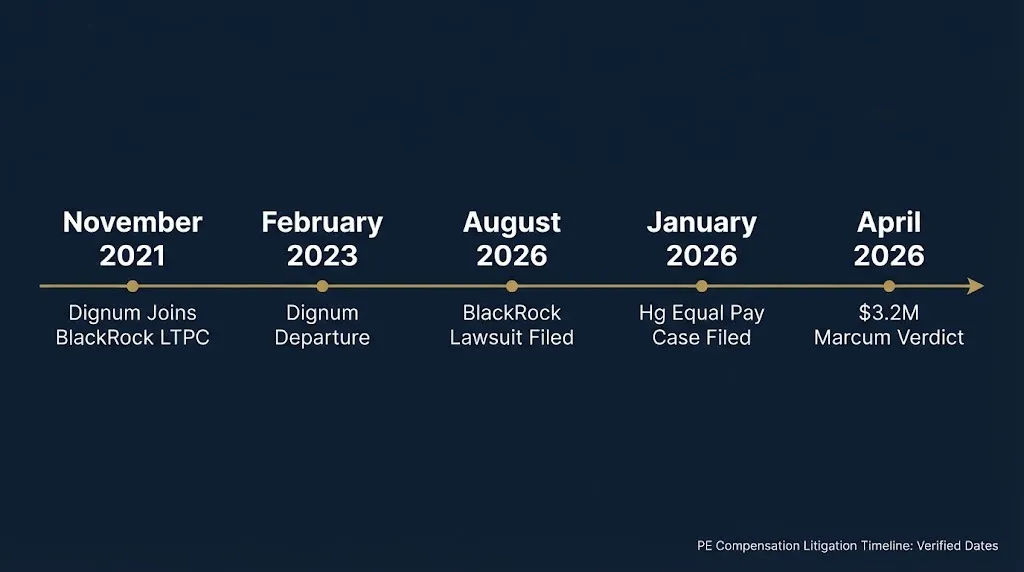
Neal Dignum worked in BlackRock’s Long Term Private Capital fund from November 2021 to February 2023. His lawsuit alleges the firm deliberately never created a written compensation agreement documenting the carry he was promised.
The complaint includes an offer letter and term sheet that broke down the carried interest details, which Dignum’s lawyers say was used “as a means of inducing him to accept the Firm’s offer” .
Dignum wants the details made public. He’s requesting BlackRock be ordered to argue for sealing if it wants anything redacted. If BlackRock fails to show the information contains trade secrets or confidential business information, its compensation structure could be revealed in court .
What Other PE Compensation Lawsuits Are Active in 2026?
Several high-profile compensation lawsuits are active in 2026, covering equal pay claims, gender discrimination, and shareholder oppression. These cases offer rare glimpses into how private equity and asset management firms structure pay.
Verified Active Cases:
| Case | Court | Claim | Amount |
|---|---|---|---|
| Dignum v. BlackRock | N.Y. Supreme Court | Unpaid carried interest | $12.4M |
| Wallace v. Hg | London Tribunal | Equal pay and forfeited carry | £10M ($13.8M) |
| Eldridge v. Marcum Wealth | Ohio Court of Common Pleas | Gender discrimination, shareholder oppression | $3.2M awarded |
Elizabeth Wallace, former head of portfolio talent at Hg, claims she was paid less than male colleagues and had to forfeit up to £700,000 in carried interest due to an Hg policy that treats staff as “bad leavers” if they begin an employment dispute .
Wendy Eldridge won $3.2 million from Marcum Wealth in April 2026 on claims of retaliation and breach of fiduciary duty after she complained of gender discrimination and shareholder oppression .
How Do You Negotiate Private Equity Compensation?
Negotiating PE compensation means getting every promise documented, understanding vesting schedules, and knowing what’s market. Verbal promises aren’t enforceable.
Steps to Negotiate Effectively:
- Get the term sheet in writing before you accept any offer. An unsigned draft is not a contract.
- Understand carry vesting. Ask how many years until full vesting, what triggers forfeiture, and whether acceleration applies.
- Check for bad leaver provisions. These can strip unvested carry if you resign or join a competitor.
- Negotiate the hurdle rate. An 8% hurdle is standard, but some firms use different structures.
- Clarify what happens on termination. Get termination provisions in writing, including whether “without cause” triggers acceleration.
- Consider co-investment rights. Some firms allow professionals to invest alongside the fund, creating additional upside.
- Review the arbitration clause. Many PE employment contracts require arbitration instead of court, which limits your options.
The BlackRock case shows why documentation matters. Dignum’s lawyers allege the firm “deliberately never put pen to paper” on his carry agreement .
What Is the Operating Partner Compensation Structure?
Operating partners earn through a combination of cash compensation and carried interest, with total packages at large funds reaching $1M to $1.75M+ in cash plus $10M to $60M+ in carry dollars at work .
The role has professionalized significantly. PE-to-PE operating partner movement has tripled, now representing 21% of new hires compared to 7% in 2022. CEO hires into operating roles dropped from 26% to 17%, signaling that running one company doesn’t translate to scaling twenty .
Operating improvements now drive roughly half of private equity returns, up from about 30% in the 1980s. Financial engineering has declined to around 25%. Firms need credible operators who can demonstrably drive better IRR .
Compensation reflects that shift. Operating partners now have investment committee participation, pre-deal involvement, and carry eligibility approaching deal team levels.
What Happens Next in Private Equity Compensation Litigation
Pending: Dignum v. BlackRock proceeds in N.Y. Supreme Court; BlackRock has not yet argued for sealing.
Ongoing: Wallace v. Hg continues before London tribunal judges.
Expected late 2026: MM&K PE/VC Compensation Report for UK and Europe publishes, providing updated benchmark data.
Ongoing: Industry surveys track whether carry structures and vesting schedules shift in response to litigation.
Frequently Asked Questions
How much do private equity operating partners make?
Operating partners at $25B+ funds earn $1M to $1.75M+ in total cash compensation.
Carry adds $10M to $60M+ in carried interest dollars at work.
Compensation varies by fund size, role, and individual negotiation.
What is carried interest in private equity?
Carried interest is a share of investment profits, typically 20%.
It vests over years and often makes up the majority of senior compensation.
At the managing partner level, carry can exceed 84% of total pay.
Can my firm refuse to pay promised carried interest?
If you have a signed compensation agreement, the firm must honor it.
Without written documentation, your legal claim is much weaker.
The BlackRock lawsuit centers on whether a written agreement existed.
What is a bad leaver provision in PE compensation?
Bad leaver provisions allow firms to strip unvested carry if you resign or join a competitor.
Some firms also classify employees who file disputes as bad leavers.
The Hg lawsuit alleges this policy cost the plaintiff £700,000 in carry.
How long does carry take to vest in private equity?
Vesting schedules typically run 4 to 10 years.
Some firms use cliff vesting, where nothing vests until a certain date.
Others use graded vesting, where a percentage vests each year.
What happens to my carry if I leave private equity?
It depends on your agreement and whether you’re a good or bad leaver.
Vested carry is usually yours; unvested carry may be forfeited.
Get termination provisions reviewed by an employment attorney before signing.
What You Should Do Now
If you’re negotiating private equity compensation, get every promise documented in a signed agreement. Verbal assurances about carry mean nothing in court. Review vesting schedules, forfeiture provisions, and termination clauses before you accept.
If you believe your firm has withheld compensation you were promised, consult an employment attorney. The BlackRock case shows that even the largest firms can face lawsuits over unpaid carry. Document everything.