Marital Settlement Agreement Template 2026: Why the Free Form Fails and What a Real MSA Must Contain
Quick Answer
- A marital settlement agreement template is a fill-in-the-blank starting point. It is not a finished legal document and does not protect you by itself.
- No template can know your assets, debts, children, or state rules. Every clause must be rewritten to match your situation.
- The most important protection is independent legal review before you sign. Rushed signatures without review are the top red flag in failing agreements.
A marital settlement agreement template is a pre-written document that outlines the sections a divorce settlement should cover. It gives you headings for property division, debts, custody, and support. It does not give you a legally sound agreement for your specific marriage.
This matters because the stakes are permanent. Once a judge approves an MSA, most terms are difficult or impossible to change . Signing a template without review is like filing your own taxes with a form you found online: the boxes look right, but the numbers and the rules are yours to get wrong.
This article covers what a template actually provides, the clauses that hold up in court, the six red flags that sink agreements, the difference between an MSA and a divorce decree, and the enforcement rules that decide whether your agreement has teeth. One detail worth knowing upfront: in some states, how your agreement is “incorporated” versus “merged” into the divorce judgment determines whether you can enforce it as a contract or only as a court order.
The Facts
| Item | Verified Detail |
|---|---|
| Document Type | Written contract between spouses, binding after judge approval |
| Common Names | Marital settlement agreement, separation agreement, property settlement agreement |
| Binding Status | Enforceable after both spouses sign and a judge approves it |
| Can It Be Changed? | Property division is generally final. Child-related terms remain modifiable |
| Key Enforcement Risk | Vague clauses and missing details create post-divorce litigation |
| Template Weakness | Cannot account for state rules, hidden assets, or specific family needs |
| Independent Review | Strongly recommended. Courts look for voluntary, informed consent |
Is a marital settlement agreement template legally binding?
A marital settlement agreement template is not legally binding by itself. It becomes binding only after you and your spouse fill it out, sign it, and a judge approves it. A blank template has no legal effect.
The binding force comes from the signatures and the court’s approval, not the template. Once approved, the agreement is typically incorporated into the final divorce decree and becomes an enforceable court order . If one spouse violates it later, the other can return to court to enforce the terms.
There is one important exception. Child-related provisions, such as custody, visitation, and child support, are never truly final. Courts retain authority over those issues because they involve the child’s best interests . An agreement that says custody can never be modified is a red flag and likely unenforceable.
Key Takeaway: A template is not binding. Signatures plus judge approval create the obligation. Child-related terms stay modifiable regardless of what the document says.
What should a marital settlement agreement template include?
A usable marital settlement agreement template should include specific sections for property, debts, children, support, and enforcement. If your template is missing any of these sections, it is incomplete.
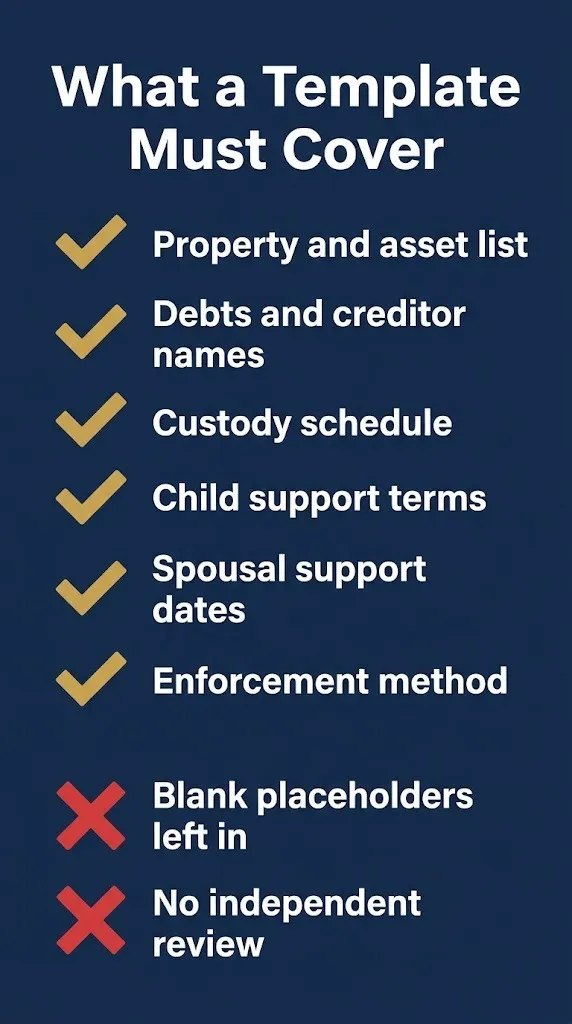
Here are the core sections a template must cover:
- Property division: Every asset, its value, who keeps it, and any loan attached to it. Vague phrases like “personal property” create fights later .
- Debts: Each creditor, account number, balance, who pays, and the deadline. Joint debts need a hold-harmless clause because creditors can still pursue either spouse .
- Custody and parenting time: Regular schedule, holiday rotations, exchange locations, decision-making rules, and communication methods .
- Child support: Amount, payment method, date, health insurance, uncovered medical expenses, and tax dependency claims .
- Spousal support: Amount, duration, end date, terminating events (remarriage, cohabitation), and whether it is modifiable .
- Enforcement: How payments are made, how proof is documented, and what happens if a deadline is missed .
A template that covers these headings is a useful checklist. A template that fills them with boilerplate language is a trap. Courts enforce what is written, not what you intended .
Key Takeaway: A template is a checklist of sections, not a substitute for specific drafting. Every clause must name who acts, what they must do, when, and how it is proven.
How much does a marital settlement agreement cost in 2026?
A marital settlement agreement costs whatever you pay for legal review, plus court filing fees. A free template costs nothing upfront, but the risk of an unenforceable clause is the hidden cost. Attorney review fees vary by market and complexity. No national average for MSA review alone is verified in the 2026 sources checked.
Court fees are separate and fixed. In England and Wales, a consent order to make an agreement legally binding costs £60, while the divorce application itself is £628 . Those are UK figures, not U.S. fees. U.S. filing fees vary by state and county.
The cost comparison that matters is review versus repair. A short legal review before signing can catch a missing deadline, an unclear asset description, or an unenforceable child support waiver. Fixing those problems after a judge signs the agreement can require a new lawsuit.
Reality Check: A free template is not a free agreement. The money you save on drafting can become the money you spend on enforcement. A single vague clause about a retirement account or a house can cost more to litigate than the review would have cost upfront.
What are the biggest red flags in a marital settlement agreement?
The biggest red flags in a marital settlement agreement are rushing, one-sided terms, boilerplate language, lack of specificity, hidden assets, and missing enforcement details. These are the patterns that lead to post-divorce court fights.
Here are six verified red flags:
- Pressure to sign quickly: Urgency without a legitimate reason is a warning sign. An agreement that cannot survive careful review is not ready to sign .
- One-sided or illegal terms: Child support cannot be waived. Custody cannot be permanently locked. Courts will reject unlawful provisions, but they will not fix unfair ones for you .
- Boilerplate language: Generic parenting clauses and financial provisions that do not match your actual arrangement create ambiguity. Courts enforce the words, not the intent .
- Lack of specificity: “Husband will pay a fair share” is unenforceable. A clause must name the account, the percentage, the deadline, and the method .
- Hidden or missing assets: If a spouse hides assets, the agreement may be challenged as fraudulent. Undervaluing disclosed assets is also fraud .
- No independent review: If you did not have your own attorney read it, you may not understand what rights you are giving up .
Key Takeaway: The red flags are not about the template’s font or formatting. They are about specificity, voluntariness, and independent review. Rushing and vagueness are the two biggest risks.
What is the difference between a marital settlement agreement and a divorce decree?
A marital settlement agreement is a contract between spouses. A divorce decree is the court order that dissolves the marriage and makes the agreement enforceable. You need both to complete a divorce.
The MSA alone does not end the marriage. It resolves the terms: who gets what, who pays what, and how children are raised. The decree is the judge’s order that adopts those terms and legally ends the marriage .
In some states, the distinction between “incorporated” and “merged” matters for enforcement. If an agreement is incorporated but not merged into the divorce judgment, it remains an independent contract. You can enforce it as a contract and as a court order. If it is merged, the agreement is absorbed into the judgment, and enforcement may be limited to the judgment itself .
This is not a detail a generic template will explain. It depends on your state’s rules and the drafting choices in your agreement.
Key Takeaway: The MSA is the deal. The decree is the court order that makes it stick. The enforcement route depends on how your state treats incorporation and merger.
How do you use a marital settlement agreement template correctly?
You use a marital settlement agreement template correctly by treating it as a checklist, not a finished document. Fill every section with your specific facts. Delete clauses that do not apply. Have your own attorney review the final draft before anyone signs.
Here are the steps:
- Download a template for your state if available. Another state’s form may use rules that do not apply where you file .
- List every asset and debt. Include account numbers, balances, values, and who is responsible for each.
- Draft parenting terms with exact schedules. Name exchange times, locations, holidays, and decision-making rules.
- State support terms with dates and methods. Amount, payment date, duration, and terminating events.
- Delete inapplicable clauses. Leaving placeholder text in a signed agreement can make a clause unenforceable .
- Have your own attorney review it. Your spouse’s attorney does not represent you and does not protect your interests .
- Sign and notarize where required. Then file it with the court for the judge’s approval.
Key Takeaway: A template saves formatting time. It does not save you from missing a deadline, an asset, or a legal rule. The review is the protection.
What happens next if you are drafting a marital settlement agreement?
Here is the timeline of steps to take:
- Now: Gather financial documents. Bank statements, retirement account statements, mortgage statements, pay stubs, and tax returns.
- Before drafting: Decide whether mediation is right for you. A mediated agreement is more likely to reflect what both parties can live with.
- Before signing: Have your own attorney review the draft. This is the step most people skip and later regret.
- At signing: Confirm notarization requirements in your state. Some agreements require it, some do not.
- After signing: File the agreement with the court for the judge’s approval. The judge will review it for compliance with state law.
Frequently Asked Questions
Is a free marital settlement agreement template safe to use?
A free template is safe as a starting checklist, not as a final document. It cannot account for your state’s rules, your specific assets, or your children’s needs. Have your own attorney review the final draft before signing.
Can I write my own marital settlement agreement without a lawyer?
You can draft your own agreement, but independent legal review is strongly recommended. Courts look for informed, voluntary consent. If you did not understand what you were signing, the agreement may be challenged later.
What happens if my spouse violates the marital settlement agreement?
You can ask the court to enforce the agreement. If it was incorporated into the divorce decree, the court can hold the violating spouse in contempt. If it was merged, enforcement may be limited to the judgment itself .
Can a marital settlement agreement be changed after signing?
Property division is generally final after the judge approves it. Child-related terms, such as custody and support, can be modified if circumstances change and the modification serves the child’s best interests .
Does a marital settlement agreement need to be notarized?
Notarization requirements vary by state. Some states require it, some do not. Check your state’s rules or ask your attorney before signing.
What is the difference between an MSA and a separation agreement?
The names vary by state. A marital settlement agreement, separation agreement, and property settlement agreement can all refer to the same type of document. The legal effect depends on state law and court approval, not the name .
Can I use an online template for my divorce settlement?
You can use an online template as a starting point. Do not sign it without independent review. Online templates often use boilerplate language that does not match your situation and may omit required clauses.
What is the biggest mistake people make with a marital settlement agreement?
The biggest mistake is signing without independent legal review. Rushing to finish the divorce can lock in terms that are vague, one-sided, or unenforceable. A short review before signing can prevent years of enforcement problems.
Gather your financial documents now. Decide whether mediation fits your situation. And before you sign anything, even a template you filled out yourself, have your own attorney read it. The judge’s approval makes the agreement binding. The review makes it fair.