Can You Be Notified of a Lawsuit by Phone? 2026 Rules and Scam Warnings
Quick Answer
- No, a phone call alone cannot notify you of a lawsuit. Courts require formal delivery of a summons and complaint.
- Process servers may call to coordinate a delivery time, but they will never threaten you or demand payment.
- If you get a threatening call about a lawsuit, hang up and check your local court records directly.
What Does Proper Service of Process Mean in 2026?
Proper service of process means delivering a summons and complaint through court-approved methods, not a phone call. The law requires notice that gives you a fair chance to respond, and a voicemail cannot accomplish that.
Federal Rule of Civil Procedure 4 governs service in federal courts. For individuals, the rules allow hand delivery to you personally, delivery to a responsible adult at your home, delivery to an authorized agent, or service by any method allowed under the law of the state where the court sits. Some states allow service by mail under specific conditions, but never by phone alone.
A process server’s job is to deliver documents, not to warn you that a case exists. The server files a proof of service with the court after delivery. That document is what creates the legal record of notice.
Think of it like a certified letter that requires a signature. The signature proves you got it. A phone call leaves no signature, no record, and no proof. Courts do not accept it.
Key Takeaway: Valid lawsuit notice requires physical delivery of court documents through approved methods. A phone call cannot substitute for a summons and complaint.
Can a Process Server Legally Call You About a Lawsuit?
A process server may call you about a lawsuit, but only to coordinate delivery, not to serve you. Legitimate calls are logistical, not threatening.
The server might call to confirm your address, ask when you will be home, or arrange a time to hand you the papers. That is the entire scope of a legitimate process server call. They are paid by the party filing the case, not by you. They have no power to dismiss a case, negotiate a settlement, or make a lawsuit disappear for a fee.
If the caller claims you must pay to “stop service” or “clear your name,” that is a scam. Real process servers never ask for money. They never demand your Social Security number or bank account details. They never threaten arrest.
| Legitimate Process Server Call | Scam Process Server Call |
|---|---|
| Coordinates delivery time | Demands immediate payment |
| Provides case details if asked | Refuses to give case number or court |
| No threats or pressure | Threatens arrest, wage garnishment |
| Never asks for money | Requests gift cards, wire transfers |
| Paid by the filing party | Pressures you to pay to “stop” service |
Key Takeaway: A real process server may call to arrange delivery. A scammer calls to scare you into paying or sharing personal information.
Reality Check
No legitimate process server threatens you with arrest over the phone. No court sends a text message about a lawsuit. No government agency demands payment via gift card to stop legal action. If you get a call like this, it is a scam. Hang up. Do not call back. Do not give them any information. Check your local court’s public records yourself, using a phone number or website you look up independently.
How Do You Verify If a Lawsuit Has Actually Been Filed Against You?
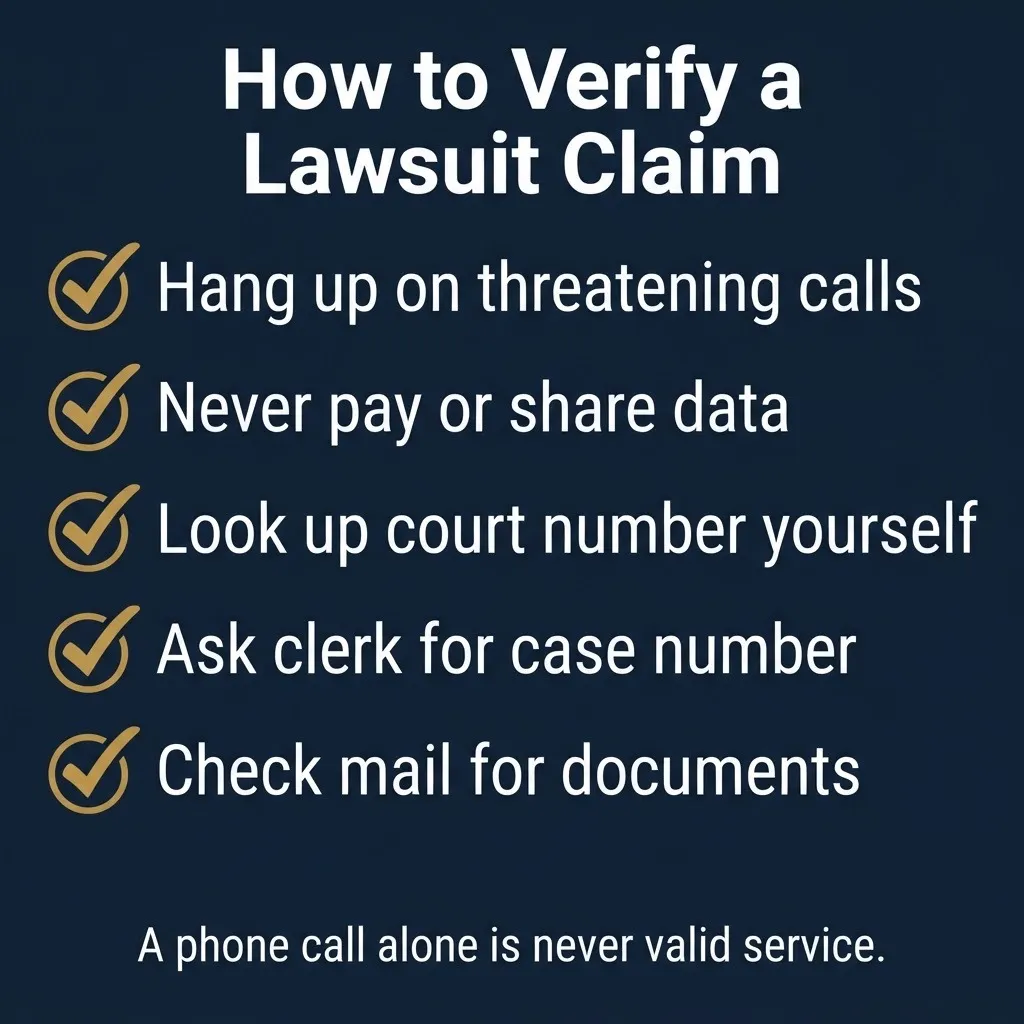
You can verify a lawsuit by checking your local court’s public records yourself. Do not trust any phone number or website the caller gives you.
Here are the steps to check:
- Get the court name and case number from the caller if they have it. If they refuse, that is a red flag.
- Look up the court’s official phone number independently. Do not use a number the caller provides.
- Call the clerk of court and ask if a case exists with your name as a defendant.
- Search online court records if your county or state offers a public portal.
- Check your mail for a summons or complaint. Real lawsuits arrive in writing, not just by phone.
The FTC has shut down phantom debt collection schemes that called consumers claiming lawsuits were imminent. One operation used names like Blackrock Services and threatened wage garnishment and arrest over fake debts. The FTC filed suit and a federal court froze the operation’s assets in March 2025.
If no case exists in the court records, the call is almost certainly a scam.
Key Takeaway: Always verify a lawsuit claim through the court’s official records, not through the caller. Real cases have case numbers you can look up yourself.
What Are the Most Common Fake Lawsuit Phone Scams in 2026?
Fake lawsuit phone scams follow predictable patterns built on fear and urgency. Scammers want you to act before you think.
The most common tactics include threatening voicemails claiming you are being served, demands for immediate payment to “stop” legal action, requests for your Social Security number or bank details to “verify” your identity, and claims that a warrant has been issued for your arrest. Some scammers spoof caller ID to make it look like the call is from a courthouse or law firm.
The Better Business Bureau reports that scammers are targeting elderly consumers especially, taking both money and personal information. One process server told a Texas news outlet that an in-person visit is far more likely than a phone call if real service is needed.
A newer twist involves fake “settlement” notifications. The scammer claims you are owed money from a class action and needs your bank account to deposit it. That is a phishing attack, not a settlement. The FTC has warned about similar schemes that steal personal data through fake legal notices.
Key Takeaway: The most common fake lawsuit scam demands payment to stop legal action. Real courts never operate that way. Hang up and verify independently.
What Should You Do If You Get a Threatening Call About a Lawsuit?
Hang up and do not engage. The safest response to a threatening lawsuit call is to end the conversation immediately and verify the claim independently.
Never give the caller your Social Security number, bank account information, or payment details. Never pay with gift cards, wire transfers, or cryptocurrency. These payment methods are untraceable and are the clearest sign of fraud.
If the caller claims to be from a specific court, look up that court’s number yourself and call the clerk directly. If the caller claims to be from a law firm, search the firm’s name and call its published number. Do not call any number the caller provides.
You can report the scam to the FTC, your state attorney general, and the BBB. The FTC tracks these schemes and has taken action against phantom debt collectors who used fake legal threats to extract millions from consumers.
If you are worried that a real lawsuit might exist, check your mail. A real case will produce paperwork. If nothing arrives and the court has no record, the call was a scam.
Key Takeaway: Hang up first, verify later. Never pay or share personal information based on a phone call alone.
What Happens If You Ignore a Real Lawsuit Because You Thought It Was a Scam?
Ignoring a real lawsuit can lead to a default judgment against you. If you are properly served and fail to respond, the court can rule in the plaintiff’s favor without hearing your side.
This is why verification matters. The risk is not that you check too carefully. The risk is that you dismiss a real case because a scammer made you cynical. Real service will produce documents with a court name, case number, and deadline for your response. If you get those documents, take them seriously.
Federal rules generally give you 21 days to respond to a complaint after being served. If you waived formal service by signing a waiver, you get 60 days. Missing that deadline can waive your defenses.
If you receive a real summons and complaint, contact an attorney or your local legal aid office. Do not ignore court papers just because you also received a scam call. The two are separate events.
What Happens Next
Ongoing 2026: The FTC and state attorneys general continue enforcement against phantom debt collection operations that use fake lawsuit threats.
Expected 2027: Scammers will likely adapt to new consumer awareness campaigns by shifting to text message and email variations of the same fraud.
Ongoing: Court systems will continue expanding online public access portals so consumers can verify cases without calling the clerk.
Ongoing: The BBB and consumer protection agencies will continue warning elderly consumers, who are the primary targets of these scams.
Frequently Asked Questions
Can you be served a lawsuit by phone?
No. A phone call is not valid legal service. Courts require delivery of a summons and complaint through approved methods like personal delivery or certified mail.
Why did I get a call saying I’m being sued?
It is almost certainly a scam. Real process servers do not call to threaten you or demand payment. They may call to coordinate a delivery time, but that is the only legitimate reason.
What should I do if a process server calls me?
Ask for their name, the court name, and the case number. Then hang up and verify independently. Do not give them money or personal information.
How do I check if I’m actually being sued?
Call your local court clerk using a number you look up yourself. Ask if a case exists with your name. You can also search online court records if your jurisdiction offers a public portal.
Can a scammer serve me with fake court papers?
Scammers can send fake documents that look official. Real service comes with a case number you can verify with the court. If the case number does not exist, the papers are fake.
What if the caller threatens to arrest me?
That is a scam. Process servers are not police officers and cannot arrest you. No legitimate legal notice involves an arrest threat over a civil lawsuit.
Should I pay to stop a lawsuit from being served?
Never. No legitimate process server or court demands payment to stop service. If someone asks for money to make a lawsuit go away, it is fraud.