Settlement After IME 2026: How Long It Takes and What Actually Happens Next
Quick Answer
- An IME report typically takes one to four weeks to be written and delivered to the insurance company.
- Settlement discussions often begin after the IME confirms you’ve reached Maximum Medical Improvement (MMI).
- Timelines vary widely: simple stipulated settlements can close in a few weeks, complex cases can take several months.
What Is an IME and Why Does It Trigger Settlement Talks?
An Independent Medical Examination is a medical evaluation requested by the workers’ compensation insurance company, not by you. The insurer selects the doctor, pays for the exam, and uses the resulting report as evidence to shape your claim .
The term “independent” is misleading. The IME doctor is paid by the insurance company, often between $500 and $1,000 per exam, and their report frequently supports the insurer’s position rather than your treating physician’s view . This is not a neutral second opinion. It is the insurer building its case.
Once the IME is complete, the doctor writes a report that typically includes a review of your medical records, objective exam findings, a causation analysis, and an impairment rating if you’ve reached Maximum Medical Improvement . That report becomes the centerpiece of settlement negotiations.
Key Takeaway: An IME is the insurer’s tool to evaluate your claim and often to justify a lower settlement. Understanding what the report says is the first step to protecting your interests.
How Long Does It Take to Get the IME Report Back?
Most IME reports arrive within one to four weeks after your exam. Simple cases may produce a report in days. Complex injuries that require the doctor to review extensive imaging or additional records can take longer .
The report goes directly to the insurance company or the party that requested the exam, not to you first . Your attorney receives a copy and should review it for accuracy before any settlement discussions proceed.
If weeks pass and you’ve heard nothing, that silence can mean different things. In some cases, the insurer may not intend to use the IME against you. In others, the adjuster is still evaluating the report or waiting on additional documentation .
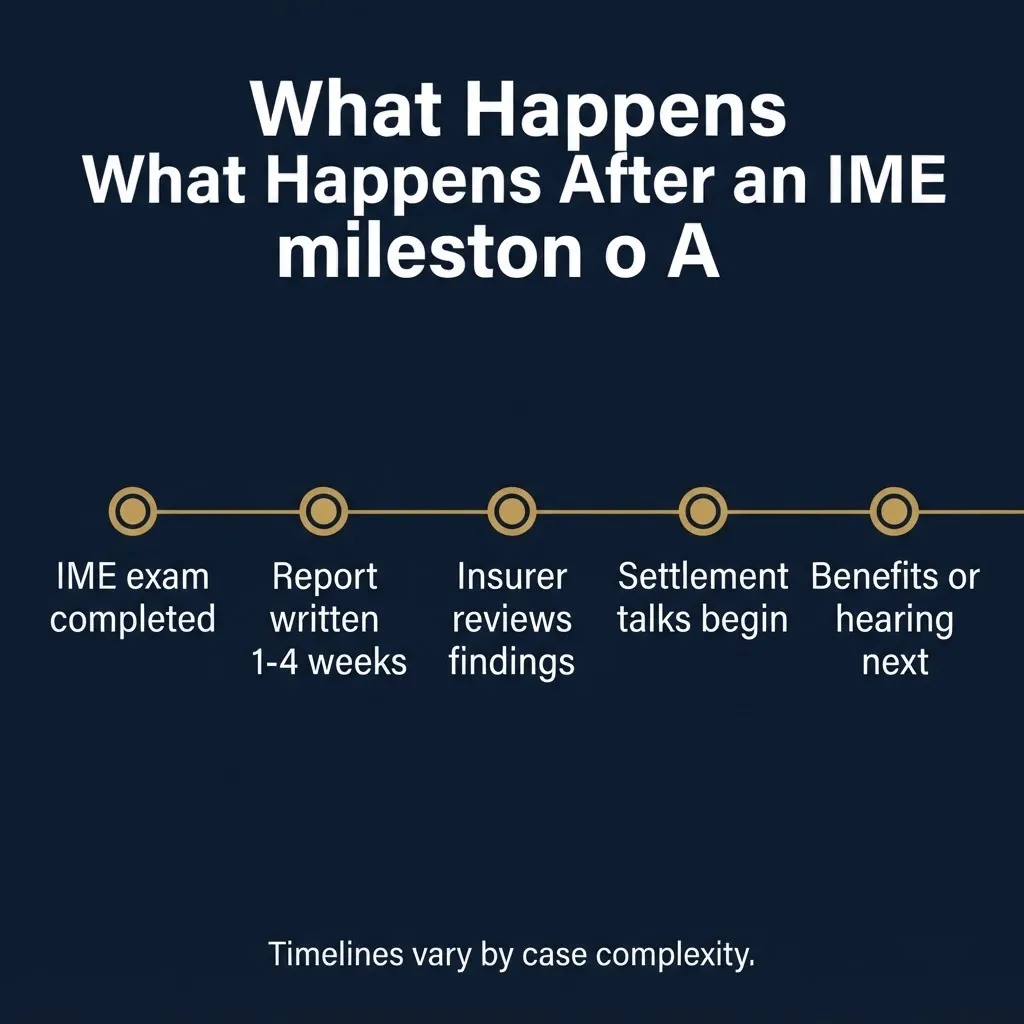
Here is what the post-IME timeline looks like:
| Stage | Typical Timeline |
|---|---|
| IME exam completed | Day 0 |
| Report written and sent to insurer | 1 to 4 weeks |
| Insurer reviews and reassesses claim | 1 to 2 weeks after report |
| Settlement offer or negotiations begin | Varies by case complexity |
Key Takeaway: The IME report itself is not the settlement. It is the evidence the insurer uses to decide whether to offer one, and how much.
Reality Check
No one sends you a settlement check just because you attended an IME. The exam is a step in the process, not a payout trigger. If someone contacts you claiming an IME guarantees a settlement or promising a specific dollar amount based on the exam, that is not how workers’ compensation works. Your impairment rating, your average weekly wage, and your state’s benefit schedule determine the numbers.
Does the IME Report Automatically Lead to a Settlement Offer?
No. An IME report does not automatically produce a settlement offer. The insurer may use the report to reduce benefits, dispute treatment, or deny your claim entirely .
What the IME actually does is give the insurer a clearer picture of your medical future. If the IME doctor says you’ve reached MMI with a permanent impairment, the insurer knows what your claim is likely worth. That certainty often motivates an offer .
A favorable IME report can increase your settlement value. If the doctor acknowledges ongoing limitations and the need for future care, the insurer may be more willing to negotiate fairly to avoid a hearing . A mixed or unfavorable report usually means the insurer will push a lower number or try to terminate benefits.
The report is evidence, not a verdict. Your treating physician’s records still matter, and in many jurisdictions, judges find treating doctors more credible because they have a longer relationship with you .
How Long After IME Report Do Settlements Usually Happen?
Settlement timelines after an IME range from a few weeks to several months. The single biggest factor is whether you’ve reached Maximum Medical Improvement, because no settlement can be finalized until your condition stabilizes .
Simple stipulated settlements, where both sides agree on the numbers, can close in a few weeks after the IME. Complex full and final settlements that require court approval or resolve disputed issues can take several months .
The negotiation phase itself can last weeks or months depending on the gap between the insurer’s offer and your demand . If your treating doctor and the IME doctor disagree sharply, expect delays while your attorney gathers rebuttal evidence.
Here is a realistic timeline breakdown:
| Case Type | Timeline After IME Report |
|---|---|
| Stipulated settlement with agreement on impairment | 2 to 6 weeks |
| Negotiated settlement with minor disputes | 1 to 3 months |
| Disputed case with conflicting medical opinions | 3 to 6+ months |
| Case heading to hearing or trial | 6 months to over a year |
Key Takeaway: The faster both sides agree on your impairment rating and future medical needs, the faster you get paid. Disagreement between doctors is the main source of delay.
What Happens If the IME Doctor Says You’ve Reached MMI?
If the IME doctor determines you’ve reached Maximum Medical Improvement, the insurer will likely move toward closing your claim. MMI means your condition has stabilized and no further significant recovery is expected, even with continued treatment .
Reaching MMI does not mean you’re fully healed. It means your doctors agree that more treatment won’t make you better. At that point, your temporary disability benefits typically stop, and the focus shifts to permanent disability benefits if you have lasting limitations .
The IME doctor will assign an impairment rating using the AMA Guides to the Evaluation of Permanent Impairment. That rating becomes the foundation for your permanent partial disability award. Higher ratings mean higher settlement values .
An MMI finding from an IME is a turning point. The insurer now has a number to work with, and settlement discussions usually accelerate. But you do not have to accept the IME doctor’s rating without question.
What Should You Do If You Disagree With the IME Report?
You can challenge an unfavorable IME report, and you should if it misrepresents your condition. Your attorney can gather rebuttal evidence from your treating physician, point out contradictions or omissions in the IME report, or schedule a deposition to question the IME doctor directly .
In many states, the treating physician’s opinion carries significant weight, especially if the IME doctor conducted a brief exam or ignored relevant medical records. The IME doctor’s credibility can be challenged if their exam was rushed, if they downplayed symptoms, or if they focused narrowly on imaging while ignoring functional limitations .
Do not accept a settlement offer based solely on an IME report that contradicts your treating doctor. Settlement is voluntary, and you have the right to negotiate or proceed to a hearing where a judge weighs all the evidence.
What Happens Next
Within 1 to 4 weeks: The IME doctor completes and submits the written report to the insurance company.
Within 1 to 2 weeks after report: The insurer reviews the report, reassesses reserves, and determines its settlement strategy.
Weeks to months after: Settlement negotiations begin if both sides see value in resolving the claim.
Months after: If negotiations fail, the case may proceed to a formal hearing before a workers’ compensation judge.
Frequently Asked Questions
How long after an IME will I get a settlement?
There is no fixed timeline. Simple cases can settle within weeks of the report. Complex cases with disputed medical opinions can take several months or longer.
Does an IME always lead to a settlement offer?
No. An IME can lead to a settlement, reduced benefits, or a dispute depending on what the doctor concludes. It is evidence the insurer uses to decide its next move.
Can I refuse to attend an IME?
In most states, refusing an IME can result in suspension or termination of your benefits. You are generally required to attend if the insurer properly requests it.
What happens if the IME doctor says I can return to work?
The insurer may try to stop or reduce your benefits. If you disagree, you can challenge the finding with your treating doctor’s records and may need a hearing to resolve the dispute.
How long does it take to get the IME report?
Most reports arrive within one to four weeks. Complex cases that require review of extensive records can take longer.
Can I settle my workers’ comp case before the IME?
Yes, settlements can happen at any point, but most insurers wait until after MMI because that is when your future needs are clearer.
What if the IME report is unfair?
You can challenge it. Your attorney can use your treating doctor’s records to rebut the IME findings and negotiate a fairer outcome.