Minimum Compensation Requirement 2026: Federal Salary Thresholds, State Wages and Legal Standards
Quick Answer
- The federal minimum wage is $7.25 per hour, but 30 states plus DC have higher minimums ranging from $8.75 to $17.13 .
- Exempt employees must earn at least $684 per week ($35,568 annually) under the restored 2019 DOL salary threshold rules .
- There is no single “minimum compensation requirement” deadline. Compliance is continuous and varies by jurisdiction and employee classification.
You searched for “minimum compensation requirement” and want a straight answer. Maybe you’re an employer checking whether your pay structure is legal. Maybe you’re an employee wondering if you’re being underpaid. Or maybe you’re trying to understand the difference between minimum wage and salary thresholds for exempt workers.
Here’s the reality: “minimum compensation requirement” means different things depending on context. For hourly workers, it means the minimum wage floor set by federal, state, or local law. For salaried exempt employees, it means the salary level test under the Fair Labor Standards Act. For workers’ compensation cases, it means the minimum weekly benefit rate.
This article breaks down all three. You’ll see the current federal thresholds, the state-by-state wage landscape for 2026, and the salary requirements that determine whether an employer can legally classify someone as exempt from overtime.
The Facts
| Item | Details |
|---|---|
| Federal Minimum Wage | $7.25 per hour |
| Highest State Minimum Wage | $17.13 per hour (Washington) |
| Exempt Salary Threshold | $684 per week ($35,568 annually) |
| Highly Compensated Threshold | $107,432 annually |
| State Minimum Wage Increases in 2026 | 18 states plus many localities |
| Effective Date (Most Increases) | January 1, 2026 |
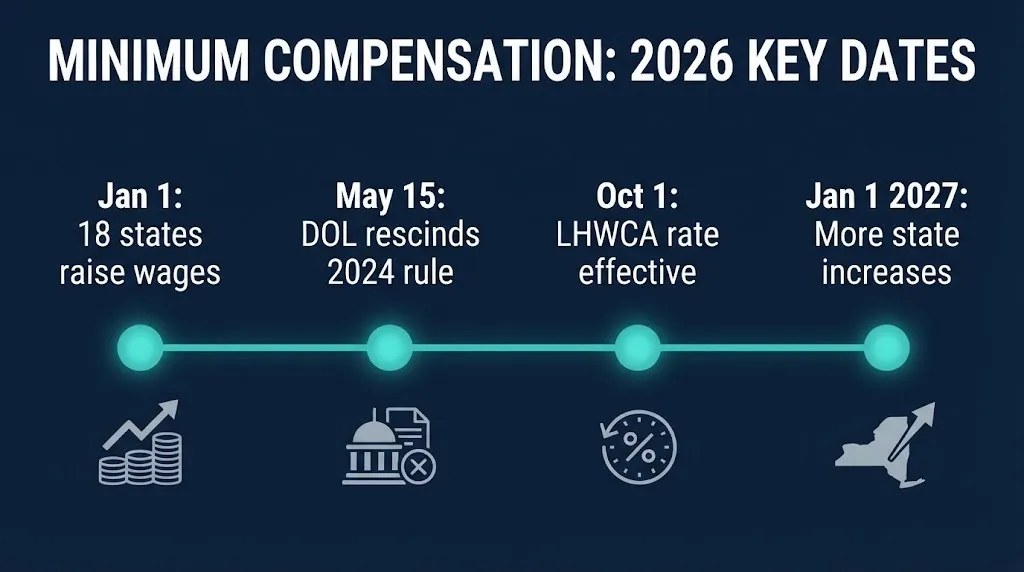
| DOL Rule Rescission | May 15, 2026 |
What is the minimum compensation requirement in 2026?
The minimum compensation requirement in 2026 depends on the type of worker and the jurisdiction. For hourly employees, it means the highest applicable minimum wage rate, which is $7.25 federally but can reach $21.65 in some localities. For exempt salaried employees, it means at least $684 per week under federal law.
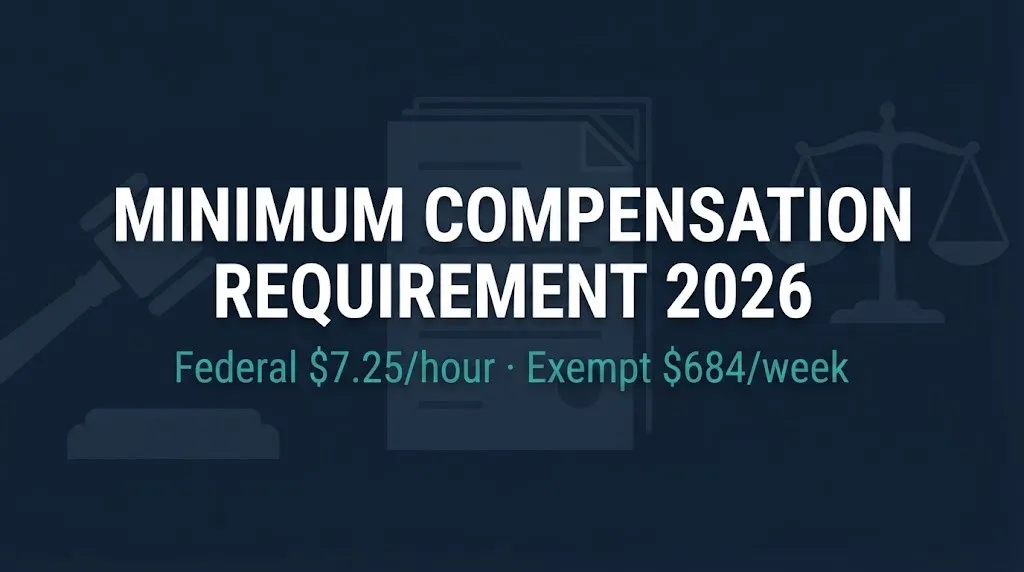
The federal minimum wage has not changed since 2009. It remains at $7.25 per hour . However, most workers in the United States are covered by state or local minimum wage laws that set higher rates.
As of January 1, 2026, 18 states plus many cities and counties raised their minimum wages . The wage floor varies dramatically depending on where you work. A worker in Seattle earns at least $21.30 per hour. A worker in rural Montana may earn as little as $10.85 .
For salaried employees classified as exempt under the executive, administrative, or professional exemptions, the federal salary floor is $684 per week, equivalent to $35,568 annually . This threshold was restored in May 2026 after the DOL rescinded the 2024 overtime rule that would have raised it to $58,656 .
Key Takeaway: The “minimum compensation requirement” is not one number. It is a matrix of federal, state, and local rules that vary by worker classification and location.
What are the 2026 state minimum wage rates?
The 2026 state minimum wage rates range from $7.25 per hour in states with no state minimum to $17.13 per hour in Washington state, with many cities setting even higher local rates.
Here is a snapshot of the highest and lowest state minimum wages effective January 1, 2026:
| State | 2026 Minimum Wage | Change from 2025 |
|---|---|---|
| Washington | $17.13 | +$0.47 |
| California | $16.90 | +$0.40 |
| Connecticut | $16.94 | +$0.59 |
| New Jersey | $15.92 | +$0.43 |
| Arizona | $15.15 | +$0.45 |
| Colorado | $15.16 | +$0.35 |
| Maine | $15.10 | +$0.45 |
| Hawaii | $16.00 | +$2.00 |
| Missouri | $15.00 | +$1.25 |
| Virginia | $12.77 | +$0.36 |
| Montana | $10.85 | +$0.30 |
| Ohio | $11.00 | +$0.30 |
Several states still have no minimum wage above the federal rate, including Alabama, Georgia, Louisiana, Mississippi, South Carolina, Tennessee, and Wyoming .
Local rates can be significantly higher. Seattle’s minimum wage is $21.30 per hour. Tukwila, Washington, requires $21.65. West Hollywood, California, sets it at $20.25 .
A delayed tax refund works the same way: the amount you’re owed depends on which jurisdiction processes your return, and some pay faster and more generously than others.
How much must exempt employees be paid in 2026?
Exempt employees must be paid at least $684 per week ($35,568 annually) to qualify for the executive, administrative, or professional exemptions under federal law, according to the DOL’s restored 2019 rule .
The May 2026 rescission of the 2024 overtime rule means the higher thresholds that were set to take effect under the Biden administration are gone. The 2024 rule would have raised the standard salary level to $844 per week ($43,888 annually) on July 1, 2024, and then to $1,128 per week ($58,656 annually) on January 1, 2025 . A federal court in Texas vacated that rule, and the DOL withdrew its appeal before formally rescinding it on May 15, 2026.
Here are the current federal thresholds:
- Standard salary level: $684 per week ($35,568 annually)
- Highly compensated employee (HCE) threshold: $107,432 annually, including at least $684 per week on a salary or fee basis
- Computer employee hourly rate: $27.63 per hour
- Guam, Puerto Rico, U.S. Virgin Islands, CNMI: $455 per week
- American Samoa: $380 per week
Up to 10 percent of the standard salary amount may be satisfied by nondiscretionary bonuses, incentives, and commissions .
Reality Check: Being paid a salary does not automatically make you exempt. You must also meet the duties test and the salary basis test. An employer that pays you $700 per week but classifies you as exempt when your job is primarily manual labor is violating the FLSA, and you may be owed overtime back pay.
Which states have higher salary thresholds for exempt employees?
Several states set salary thresholds for exempt employees that exceed the federal $684 per week floor, and employers must satisfy the higher of the applicable state or federal requirement.
California requires exempt executive, administrative, and professional employees to earn at least twice the state minimum wage for a 40-hour workweek. With California’s 2026 minimum wage at $16.90 per hour, the exempt salary threshold is approximately $1,352 per week ($70,304 annually) .
New York’s threshold varies by region. In New York City, Nassau, Suffolk, and Westchester, the salary threshold is higher than in the remainder of the state.
Alaska, Colorado, Maine, and Washington also adjust their exempt salary thresholds based on their minimum wage rates .
Employers operating in these states must comply with the stricter standard. Paying an employee $700 per week and calling them exempt may satisfy federal law but violate California or New York law.
What is the minimum compensation rate for workers’ compensation?
The minimum compensation rate for workers’ compensation under the Longshore and Harbor Workers’ Compensation Act (LHWCA) is $520.68 per week for the period October 1, 2025 through September 30, 2026, based on 50 percent of the National Average Weekly Wage .
This rate applies to total disability cases under the LHWCA, which covers maritime workers, harbor workers, and certain other federal employees. The maximum compensation rate is $2,082.70 per week .
State workers’ compensation systems set their own minimum and maximum rates, which vary widely. The LHWCA rate is specifically for federal maritime workers and does not apply to state workers’ compensation claims.
For a typical injured worker, the minimum weekly benefit is usually a percentage of the state’s average weekly wage, often around 50 percent, with a floor that prevents extremely low payments for part-time or low-wage workers.
What happens next for minimum compensation requirements in 2026?
The next steps depend on whether you are tracking federal rules, state wage increases, or local ordinances. The federal landscape is settled for now, but state and local changes continue throughout the year.
Ongoing 2026: Additional state and local minimum wage increases take effect throughout the year, particularly in California, Washington, and Minnesota .
January 1, 2027: More states scheduled to raise minimum wages, including Michigan ($15.00 per hour) .
January 1, 2027: The cap on unfair dismissal compensatory awards in the UK is scheduled to be removed, though this does not affect U.S. employers .
No deadline: The federal minimum wage has no scheduled increase. Congress has not passed a raise since 2007.
Future rulemaking: The DOL has authority to set salary thresholds and could propose new rules, but the Fifth Circuit upheld that authority in 2024 .
Employers should review their pay structures annually and check both federal and state requirements before classifying employees as exempt or setting wage rates.
Frequently Asked Questions
What is the minimum compensation requirement in 2026?
The minimum compensation requirement depends on the context. Federal minimum wage is $7.25 per hour. Exempt employees must earn at least $684 per week federally. State and local rates may be higher.
What is the federal minimum wage in 2026?
The federal minimum wage remains $7.25 per hour in 2026. It has not changed since 2009, though 30 states and DC set higher minimums .
How much must salaried employees be paid to be exempt?
Exempt employees must earn at least $684 per week ($35,568 annually) under federal law. Highly compensated employees must earn at least $107,432 annually .
Which state has the highest minimum wage in 2026?
Washington state has the highest state minimum wage at $17.13 per hour. Several cities have higher rates, including Seattle at $21.30 and Tukwila at $21.65 .
What is the minimum compensation rate for workers’ comp?
The LHWCA minimum compensation rate is $520.68 per week for October 2025 through September 2026. State workers’ comp rates vary .
Did the DOL raise the salary threshold in 2026?
No. The DOL rescinded the 2024 overtime rule in May 2026, restoring the 2019 salary threshold of $684 per week. The higher thresholds under the 2024 rule are no longer in effect .
Do states have higher salary thresholds than the federal level?
Yes. California, New York, Alaska, Colorado, Maine, and Washington set salary thresholds for exempt employees that exceed the federal $684 per week requirement .
Check Your Rates, Review Your Classifications, Comply Before You’re Audited
Minimum compensation requirements are not optional. Whether you are an employer setting pay rates or an employee checking whether you are owed back wages, the rules are clear and enforceable.
Review your pay structure against both federal and state thresholds. If you classify employees as exempt, confirm they meet the salary level, salary basis, and duties tests. The federal floor is $684 per week, but your state may require more.