Homeaglow Lawsuit 2026: What’s Confirmed, What’s Still Pending, and What Workers Should Know
Quick Answer
- Yes, Homeaglow lawsuits are real: one already settled for $2.25 million, while a worker misclassification case is still active.
- The confirmed settlement amount applies only to the Washington consumer case, not to worker misclassification claims.
- No claim deadline exists yet for Homeaglow cleaners, since the misclassification case hasn’t reached a certified class or settlement.
Homeaglow, also marketed as Dazzling Cleaning, is a residential cleaning platform that connects customers with cleaners it classifies as independent contractors. Two distinct legal fights are unfolding around the company right now, and they involve different plaintiffs, different courts, and different claims.
The confirmed one: Washington’s attorney general sued Homeaglow over its subscription and advertising practices, and that case settled for $2.25 million, requiring the company to change how it discloses membership terms. The unresolved one: current and former cleaners argue Homeaglow misclassifies them as contractors when they function like employees, a case that’s been through arbitration fights, a dismissal, and a Ninth Circuit appeal, but still has no certified class or payout figure attached to it.
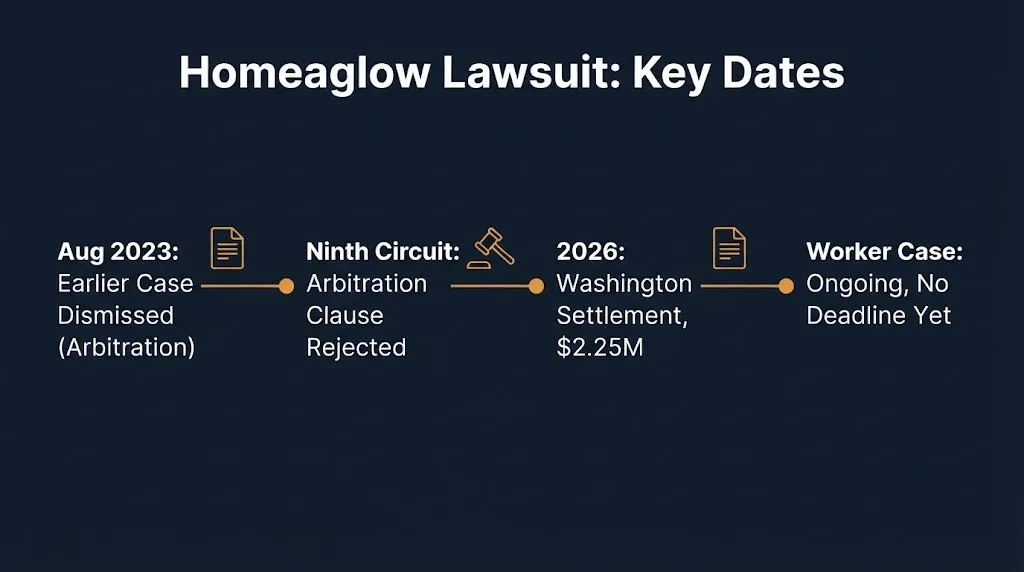
This guide keeps those two cases separate, since conflating them is where a lot of coverage on this topic goes wrong. One surprising detail: an earlier version of the misclassification case was thrown out entirely in August 2023 over an arbitration clause, before the current case found a way back into court.
The Facts
| Case (consumer, confirmed) | State of Washington v. Homeaglow Inc., et al. |
| Case (consumer) status | Settled |
| Case (consumer) fund | $2.25 million |
| Court (consumer case) | King County Superior Court, Washington |
| Case number (consumer) | 26-2-15488-1 |
| Case (worker misclassification) | Active litigation, exact case name and citation not independently confirmed from a primary court docket |
| Misclassification case status | Ongoing, no certified class, no settlement fund confirmed |
| Est. per-worker payout | Not yet determined |
| Claim deadline (misclassification) | Not applicable yet, no claims process exists |
| Administrator | Not yet appointed for either case beyond the Washington AG’s office |
Is the Homeaglow Lawsuit Legit?
Yes, and it’s actually two legitimate but separate lawsuits, not one case with two names. The Washington consumer case is fully documented with a case number and a resolved settlement. The worker misclassification litigation is active and has generated real appellate rulings, even though it hasn’t produced a settlement fund.
Some sites covering this topic online blend both cases into a single narrative and describe settlement negotiations for workers that aren’t confirmed by any court filing this article could independently verify. If you’ve seen claims that a worker settlement notice is going out in “mid to late 2026,” treat that as speculation rather than a confirmed date, since it doesn’t trace to any Homeaglow settlement website or court order.
Key Takeaway: Homeaglow faces two real but separate lawsuits, and only the Washington consumer case has a confirmed settlement amount as of September 2026.
How Much Money Is Involved in the Homeaglow Settlement?
The only confirmed dollar figure tied to a Homeaglow case is the $2.25 million Washington state settlement, and that money resolves consumer subscription claims, not worker pay claims. There is no confirmed settlement fund for the misclassification lawsuit.
Confirmed Homeaglow Legal Outcomes
| Case | Type | Outcome | Amount |
|---|---|---|---|
| Washington v. Homeaglow | Consumer/subscription practices | Settled | $2.25 million |
| Worker misclassification litigation | Employment | Active, unresolved | Not yet determined |
Not yet determined is the honest answer for what a cleaner could recover from the misclassification case, because there’s no certified class, no negotiated fund, and no court order establishing damages. Any number you see claiming to be a per-worker payout for misclassification claims right now isn’t backed by a public settlement record.
How Do You File a Claim in the Homeaglow Case?
There is currently no consumer claim form to file for the Washington settlement, since that case was resolved through the attorney general’s office rather than a public claims process, and there’s no claim form for the misclassification case either, since it hasn’t reached settlement. If you’re a current or former Homeaglow cleaner and believe you were misclassified, here’s what actually helps your position right now:
- Save every pay statement and payment record from your work with Homeaglow.
- Document your work schedule and how much control the platform exercised over it.
- Keep records of any expenses you paid out of pocket, like cleaning supplies or mileage.
- Note any arbitration agreement you signed and when you signed it.
- Consult an employment attorney familiar with gig economy misclassification cases.
- Watch for any future court-approved claim form if the case reaches a settlement.
Key Takeaway: There’s no active claim form for Homeaglow workers right now, so the most useful step is documentation, not filing anything.
What Is the Deadline to Join the Homeaglow Lawsuit?
There is no claim deadline yet, because the misclassification case has not been certified as a class action or resolved through settlement. Deadlines only get set once a court approves a class and a claims process, and neither has happened here as of September 2026.
If a settlement is eventually reached, a real deadline will come from the official settlement website or a court-approved notice, not from a third-party blog estimating a date. Watch for that kind of official notice rather than relying on predicted timelines.
Why Is Homeaglow Being Sued Over Worker Classification?
Cleaners argue Homeaglow controls their work closely enough that they should legally count as employees, not independent contractors. The lawsuit claims the platform sets prices, manages scheduling, and can remove workers from the platform, functions typically associated with an employer.
Under California labor law, that level of control matters because it can trigger the “ABC test,” which presumes worker status as an employee unless the company proves otherwise. If cleaners are reclassified as employees, they’d become eligible for minimum wage guarantees, overtime pay, and expense reimbursement they currently don’t receive as contractors.
Homeaglow has denied wrongdoing and maintains that its cleaners chose independent contractor status for the flexibility it offers. The company hasn’t moved to dismiss the current case outright, according to legal trackers following the litigation.
What Happened With the Arbitration Dispute?
An earlier version of this lawsuit was dismissed in August 2023 after a court found the cleaners had agreed to individual arbitration, blocking a group lawsuit. Arbitration clauses in worker contracts are a common tool gig companies use to prevent class action claims.
The current case found new footing after the Ninth Circuit Court of Appeals reportedly ruled Homeaglow couldn’t enforce that arbitration requirement, finding the terms weren’t presented clearly enough to workers. That procedural ruling matters because it’s what allowed the misclassification claims to move forward in court again rather than being forced into individual arbitration.
Key Takeaway: The misclassification case only exists in its current form because of an appellate ruling against Homeaglow’s arbitration clause, not because of a settlement or trial verdict.
What Was the Washington State Case About?
Washington’s attorney general sued Homeaglow over how it marketed and billed its subscription service, alleging deceptive practices around membership terms and cancellation. That case, filed in King County Superior Court under case number 26-2-15488-1, settled for $2.25 million.
As part of the settlement, Homeaglow agreed to clearly disclose membership terms and simplify how customers cancel. This case is entirely separate from the worker misclassification litigation and doesn’t provide any compensation to cleaners.
Reality Check: no one is texting or emailing Homeaglow cleaners or customers with a “claim your settlement money” link right now, because no public claims process exists for either case. Any message claiming otherwise, especially one asking for a fee to “process” your claim, should be treated as a scam, since legitimate settlement claims never require an upfront payment.
Who Is Covered by the Homeaglow Misclassification Lawsuit?
Coverage isn’t finalized because no class has been certified, but the underlying claims center on current and former cleaners who worked through Homeaglow’s platform, primarily in California. If a class is eventually certified, it would likely be defined around a specific time period and work relationship, similar to how other gig-economy misclassification cases have been structured.
Comparable cases give a sense of scale: a $6.5 million settlement between Lowe’s and a class of home improvement contractors, resolved after contractors argued they’d been misclassified in a similar way. That case took years from filing to resolution, which is a reasonable expectation for how long the Homeaglow case could still take.
What Happens If Homeaglow Loses the Misclassification Case?
A ruling against Homeaglow could force the company to reclassify cleaners as employees, which would mean minimum wage guarantees, overtime eligibility, and reimbursement for job-related expenses going forward. It could also expose the company to back pay claims for the period covered by the lawsuit.
That outcome would echo settlements other gig platforms have already reached over similar misclassification claims. It’s part of why legal analysts describe this case as relevant beyond Homeaglow itself, since a ruling could influence how other cleaning and gig-service platforms structure worker relationships.
What Happens Next
- Resolved: The Washington state consumer case settled for $2.25 million, with Homeaglow required to change its subscription disclosures.
- Ongoing: The worker misclassification case remains in active litigation following the Ninth Circuit’s arbitration ruling.
- Pending: Class certification for the misclassification case has not been confirmed as finalized based on available public records.
- Not yet confirmed: Any settlement fund, per-worker payout, or claim deadline tied to the misclassification case.
- Expected: Further court filings and possible settlement discussions are likely to continue through the rest of 2026, though no official timeline has been confirmed.
Frequently Asked Questions
Is the Homeaglow lawsuit real?
Yes, there are two separate real lawsuits: a settled Washington consumer case and an active worker misclassification case.
They involve different plaintiffs, different courts, and different claims.
How much is the Homeaglow settlement worth?
The only confirmed settlement amount is $2.25 million, from the Washington consumer protection case.
No settlement fund has been confirmed for the worker misclassification lawsuit.
Can Homeaglow cleaners file a claim right now?
No, there’s no active claims process for the misclassification case since it hasn’t reached a certified class or settlement.
Documenting your work history and pay records now can help if a claims process opens later.
Why was an earlier Homeaglow lawsuit dismissed?
An earlier case was dismissed in August 2023 because cleaners had signed arbitration agreements requiring individual claims instead of a class action.
The current case moved forward after an appellate ruling found that arbitration clause unenforceable.
Does the Washington settlement apply to Homeaglow workers?
No, that settlement resolves consumer complaints about subscription billing and advertising, not worker pay.
Cleaners seeking compensation for misclassification are part of a separate, unresolved case.
What is Homeaglow accused of regarding workers?
Homeaglow is accused of misclassifying cleaners as independent contractors while controlling their schedules, pricing, and platform access like an employer would.
That classification denies workers minimum wage guarantees, overtime pay, and expense reimbursement under California labor law.
When will the Homeaglow worker lawsuit be resolved?
There is no confirmed resolution date, since the case has not reached class certification or a settlement agreement.
Comparable misclassification cases against other gig companies have taken multiple years to resolve.
If you’re a current or former Homeaglow cleaner, the most useful step right now is keeping your pay and work records organized in case a claims process opens later. Watch for updates from a verified court filing or official settlement website rather than predicted timelines from unrelated sites.