Asbestos Class Action Lawsuit 2026: What’s Real, What’s Not, and What to File Instead
Quick Answer
- No open nationwide asbestos class action settlement was confirmed as of September 28, 2026.
- Class action payout per person: not determined, because no class settlement fund was confirmed.
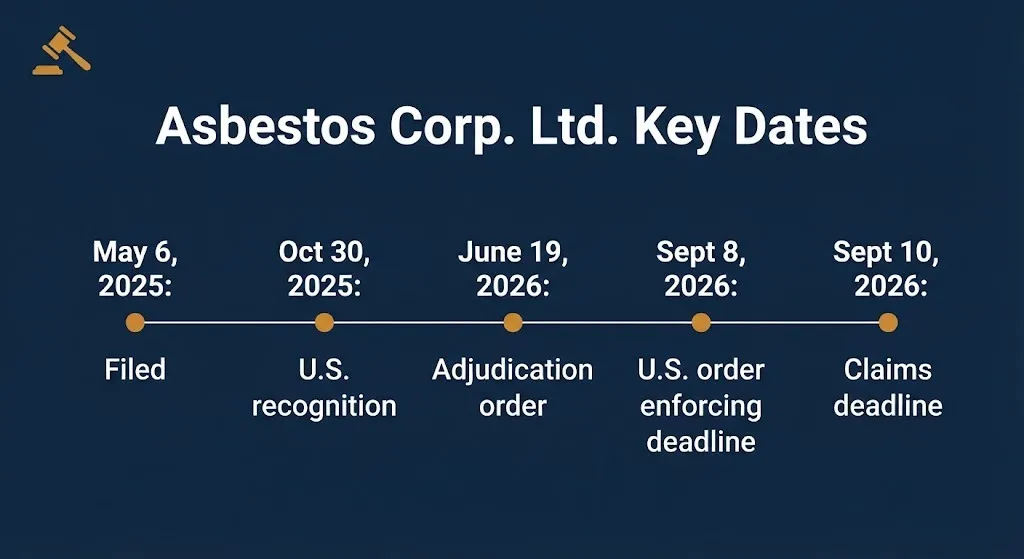
- The Asbestos Corporation Limited proof-of-claim deadline was September 10, 2026, at 5:00 p.m. Eastern.
There is no open asbestos class action lawsuit you can join today. Asbestos.com states that these cases aren’t actively being filed in U.S. courts in 2026.
That doesn’t mean the money is gone. Sick workers and families still recover through individual lawsuits and bankruptcy trust funds. Each path has its own clock, and most state filing windows run 2 to 3 years.
This guide explains why class actions faded, what replaced them, and how to spot a fake one. One surprising detail: the Supreme Court effectively shut the old model down in 1997.
| The Facts | |
|---|---|
| Case | No active nationwide asbestos class action confirmed |
| Status | Individual suits and trust claims continue; no class settlement open |
| Fund Size | Not yet confirmed (no class fund exists) |
| Est. Per Person | Not yet determined |
| Claim Deadline | None for a class action; Asbestos Corporation Limited deadline passed Sept. 10, 2026 |
| Administrator | None for a class action; Kroll and Raymond Chabot Inc. run the ACL claims process |
| Proof Needed | Diagnosis records and exposure history; varies by trust or court |
Is there an asbestos class action lawsuit in 2026?
No open asbestos class action settlement with a claims process could be verified as of September 28, 2026. Asbestos.com calls these cases very rare. Sokolove Law says most mesothelioma lawsuits are now filed individually.
Read that with one eye open. Every one of those sites belongs to a law firm that earns fees from individual cases. They have a reason to steer you away from class actions.
The court record backs up the core claim, though. Two Supreme Court rulings, covered below, made large asbestos class settlements very hard to certify.
Here’s what is open and what isn’t:
| Claim path | Open today? | Where to check |
|---|---|---|
| Individual lawsuit | Yes, until your state deadline | State court records |
| Bankruptcy trust claim | Yes, trust by trust | Each trust’s own claims office |
| Asbestos Corporation Limited proof of claim | No, closed Sept. 10, 2026 | The court-appointed Monitor |
| Nationwide asbestos class action | None confirmed | Federal court dockets |
Is an asbestos class action lawsuit legit or a scam?
A message promising an asbestos class action payout is unverified until you confirm it on a court docket or an official administrator site. Real class settlements name a court, a case number, and a claims administrator. Scams name none of them.
Many pages ranking for this search term are law firm marketing pages. Some use “class action” as the hook, then route you to an intake line for an individual case. That isn’t illegal, but it isn’t a class action either.
Use this quick legitimacy check:
- A named federal or state court and a case number you can look up
- A named claims administrator with a phone line and mailing address
- A stated claim deadline, opt-out deadline, and final approval hearing date
- No fee to file, ever
- No request for your Social Security number by text
If a message fails even one of these, treat it as unverified. Skip any link in the message and search the court’s own records instead.
How much money can you get from an asbestos class action lawsuit?
Not yet determined. No open class settlement fund was confirmed, so no per-person figure exists.
When class actions did exist, the structure worked against the sickest members. Sokolove Law notes that class members typically receive equal shares of a group settlement. A person with terminal mesothelioma and a person with mild pleural changes could see similar checks.
Asbestos.com makes the same point: one settlement split evenly, regardless of individual circumstances. That is why individual cases usually pay more for cancer patients.
| Feature | Class action | Individual lawsuit |
|---|---|---|
| Payout basis | Shared fund, split by formula | Based on your diagnosis and exposure |
| Control | Lead plaintiff and class counsel decide | You and your attorney decide |
| Attention | Group-level | Case-level |
| Availability in 2026 | None confirmed | Open until your state deadline |
Key Takeaway: No asbestos class action fund is open in 2026, so any promised class payout amount is unverified.
How much do asbestos lawsuit settlements actually pay in 2026?
Industry guides report average mesothelioma settlements of roughly $1 million to $1.4 million. One guide attributes that range to the Mealey’s Asbestos Litigation Report. It comes from individual cases, not a class fund.
Averages hide a wide spread. Exposure length, the number of liable companies, and your diagnosis all move the number. Treat any single figure as a rough marker, not a promise.
Lung cancer claims run lower in one 2026 guide, which puts averages between $100,000 and $400,000. Asbestosis, a scarring lung condition, generally sits in a lower tier than cancer. No verified dollar range was found for asbestosis.
| Diagnosis | Reported average range | Source type |
|---|---|---|
| Mesothelioma | $1M to $1.4M | Industry guides citing Mealey’s |
| Lung cancer | $100,000 to $400,000 | Lung Cancer Center guide |
| Asbestosis | Not yet confirmed | No verified figure |
Verdicts can run far higher. Goldberg Segalla’s case tracker reports that an Illinois appeals court affirmed a $45 million verdict for the estate of Theresa Garcia in a talc and asbestos case.
How much do asbestos trust funds pay?
A trust pays a set percentage of a scheduled claim value, and that percentage varies widely. Section 524(g) of the Bankruptcy Code lets asbestos companies in Chapter 11 fund trusts for current and future claims.
Here’s the math. A $100,000 scheduled value at a 25 percent payment percentage pays $25,000. That example is illustrative, not a real trust.
LegalClarity reports these 2026 payment percentages:
| Trust | Reported payment percentage |
|---|---|
| NARCO | 100% |
| DII Industries and Halliburton | 60% |
| Johns-Manville | 5.1% |
| Owens Corning | 4.7% |
| Babcock & Wilcox | 4.7% |
Sources conflict on how much money is left. Many guides cite $30 billion in remaining assets. ELSM Law says $17 billion remains of roughly $30 billion originally established. Check each trust’s own figures.
Claimants can often file with several trusts. ELSM Law says totals above $300,000 are common, and some claims pay within 90 days.
Reality Check: Nobody legitimate texts you first with settlement money. Filing a claim with a court or trust never requires an upfront fee to a “claim helper.” If someone asks for a processing payment, walk away and verify the case yourself.
What can you do instead of joining an asbestos class action?
You have four main paths, and you can often use more than one. A 2026 guide from WikiMesothelioma lists lawsuits, trust claims, VA disability benefits, and workers’ compensation.
- Individual lawsuit: Filed against solvent companies that made or supplied asbestos products.
- Trust claim: Filed with bankruptcy trusts set up by former asbestos manufacturers.
- VA disability benefits: For veterans exposed during military service.
- Workers’ compensation: For workplace exposure, with rules that vary by state.
The employment angle matters. In many states, workers’ compensation limits suits against your direct employer. Claims against the companies that made the asbestos products often run through separate lawsuits or trusts.
Think of it like a warranty claim. The store that sold you the product isn’t always the company that owes you the repair.
Key Takeaway: Instead of one class action, asbestos victims typically combine lawsuits, trust claims, and benefit programs.
Who may qualify to file an asbestos claim?
You may qualify if you have an asbestos-related diagnosis and can connect it to exposure. Qualifying diseases include mesothelioma, asbestos-related lung cancer, and asbestosis. Amounts and eligibility depend on the court or trust.
A family member or estate representative can usually file after a death. Those wrongful death claims often carry their own deadlines, running from the date of death.
Lawfold notes that a claim rests on two proofs: a diagnosed asbestos disease and specific defendants who caused your exposure. The National Cancer Institute says symptoms can take 10 to 40 years or more to appear. A diagnosis in 2026 can trace to exposure in the 1970s.
That gap is normal. It doesn’t weaken a case.
You may have a claim if you can check most of these:
- A written diagnosis from a physician
- A work history at job sites with asbestos products
- Military service records, if exposure happened there
- Household exposure, such as washing a worker’s dusty clothes
- A named product or manufacturer, even a partial one
How do you file an asbestos claim step by step?
You file by documenting your diagnosis and exposure, checking your deadline, and then submitting to a court, a trust, or both. Trust deadlines run separately from lawsuit deadlines.
- Get your diagnosis confirmed in writing.
- Write down your diagnosis date, because that date usually starts the clock.
- List every job site, employer, and product you can remember.
- Gather medical records, pay stubs, union files, and military records.
- Look up your state’s filing deadline.
- Ask an asbestos attorney to review your case.
- File the lawsuit and any trust claims.
Firms advertise no upfront costs, and Sokolove Law states it directly. Confirm the fee percentage in writing before you sign.
Some trusts accept electronic filings. Others still require paper. Each trust sets its own criteria, so one approved claim doesn’t guarantee another.
What is the deadline to file an asbestos claim?
Your deadline depends on your state and runs from your diagnosis date or the date of death. State windows range from 1 year to 6 years, and most states fall in the 2 to 3 year range.
WikiMesothelioma lists Kentucky and Tennessee at 1 year. It lists Maine at 6 years for personal injury. Sources disagree on some states, including California, so confirm against your state’s statute.
The discovery rule starts the clock when you learn of the disease, not when exposure happened. It’s like a warranty that starts when you find the defect, not when you bought the item.
Trust deadlines run under each trust’s own procedures. WikiMesothelioma says they typically run 2 to 3 years from diagnosis or death.
| Situation | Typical window |
|---|---|
| Kentucky, Tennessee (personal injury) | 1 year |
| Most states | 2 to 3 years |
| Maine (personal injury) | 6 years |
| Wrongful death | Separate clock from date of death |
Key Takeaway: Your state’s filing deadline, tied to your diagnosis date, is the deadline that matters most.
Can you still file in the Asbestos Corporation Limited case?
The proof-of-claim deadline in the Asbestos Corporation Limited (ACL) insolvency was September 10, 2026. As of September 28, 2026, whether late claims will be accepted is not yet confirmed.
This is not a class action. It’s an insolvency claims process. ACL, a Canadian company that formerly operated asbestos mines, filed under Canada’s Companies’ Creditors Arrangement Act in the Superior Court of Québec on May 6, 2025.
A Chapter 15 case was filed the same day in the U.S. Bankruptcy Court for the Southern District of New York. That court recognized the Canadian case as a foreign main proceeding on October 30, 2025.
Two dates matter most:
- September 8, 2026: The U.S. Bankruptcy Court recognized and enforced the bar date orders.
- September 10, 2026, 5:00 p.m. Eastern: The claims bar date, per the Monitor’s certificate.
The notice warned that missing the deadline could cost you the right to seek compensation from ACL and certain related parties, including General Dynamics Corporation and its affiliates. Kroll Restructuring Administration and Raymond Chabot Inc. run the process.
If you think you missed it, call the Monitor’s claims line listed in its notice: 1-877-788-0179. Payout amounts are not yet determined.
What is the latest asbestos litigation news in 2026?
Mesothelioma filings rose in 2025, and talc has become a larger share of asbestos cases. Sokolove Law, citing KCIC data, reports more than 2,000 mesothelioma filings in 2025. That was the first time above 2,000 since 2019, and it made up 48 percent of all asbestos lawsuits that year.
The same data shows about 40 percent of 2025 mesothelioma filings alleged talc exposure. That’s up from 17 percent in 2021.
Johnson & Johnson made news on July 27, 2026. TortAdvisor reports the company proposed a $5.5 billion resolution of ovarian cancer talc claims. It’s conditioned on claimants representing at least 95 percent of remaining claims agreeing.
That proposal does not cover mesothelioma. J&J says it has already settled about 95 percent of filed mesothelioma suits. That’s the company’s own claim, so treat it as unverified by a docket.
| Development | Date | Verified detail |
|---|---|---|
| J&J ovarian talc proposal | July 27, 2026 | $5.5B, excludes mesothelioma |
| ACL adjudication order | June 19, 2026 | Granted by the Canadian court |
| ACL bar date | Sept. 10, 2026 | Passed |
Why did asbestos class actions stop?
The Supreme Court made them nearly impossible to certify. In Amchem Products, Inc. v. Windsor (1997), the Court refused a nationwide asbestos settlement class. The problem: it lumped together people already sick and people merely exposed.
Those groups wanted different things. Sick claimants needed money now. Exposed-only claimants needed money reserved for the future.
In Ortiz v. Fibreboard Corp. (decided June 23, 1999), the Court rejected another proposed asbestos class. The fund was limited only by the parties’ agreement. Members had no way to opt out.
Picture one refund policy for two shoppers: one whose laptop already died, and one whose laptop might fail in ten years. Neither gets a fair deal from a single formula.
Federal courts have generally not welcomed asbestos class settlements involving future claimants since then. That is why the group model gave way to individual suits and bankruptcy trusts.
Key Takeaway: Amchem in 1997 and Ortiz in 1999 are the reason asbestos claims moved from class actions to individual cases and trusts.
What should you do if a real asbestos class settlement is announced?
Verify it on the court docket, read the release, and note three dates: your claim deadline, your opt-out deadline, and the final approval hearing. Never rely on an ad or a text alone.
If a class settlement does surface, follow this checklist:
- Confirm the court and case number on the court’s own records.
- Identify the claims administrator and call its listed phone line.
- Read the release language, because it may limit future claims.
- Decide whether to stay in or opt out to keep your right to sue.
- Note any leftover-fund plan, since cy pres awards can send unclaimed money to charity.
Asbestos diseases can appear decades later. A release signed today could affect a diagnosis in 2040. Ask an attorney to explain exactly which claims you would give up.
Why are so many asbestos companies in bankruptcy?
Asbestos liability overwhelmed many manufacturers, and Section 524(g) gave them a path to resolve it. The first trust, the Manville Personal Injury Settlement Trust, was created in 1988 by Johns-Manville.
A judge approves each trust and its payment structure. A channeling injunction then sends asbestos claims to the trust instead of the reorganized company.
By 2002, Sokolove Law says more than $70 billion had been spent on court costs, fees, and settlements. That scale explains the bankruptcies.
Some cases remain contested. LegalClarity reports that as of early 2026 the Fourth Circuit affirmed that DBMP’s filing serves a legitimate purpose under Section 524(g). The bankruptcy court ordered mediation, and the plan and trust are still under development.
That “Texas Two-Step” structure lets a healthy company move asbestos liability into a shell that files for bankruptcy. Critics see it as a way to delay claims. For you, it means DBMP-related payouts are not yet determined.
What Happens Next
- Ongoing: The ACL claims adjudication process continues under the June 19, 2026 order. Later dates are not yet confirmed.
- Ongoing: Bankruptcy trusts review payment percentages periodically. One guide lists updates as of August 20, 2026.
- Expected, date not confirmed: J&J’s ovarian talc proposal needs 95 percent claimant participation to move forward.
- Expected, date not confirmed: The DBMP reorganization plan and trust remain under development.
- Your own clock: State filing deadlines keep running from your diagnosis or date of death.
Frequently Asked Questions
Is there a class action lawsuit for asbestos exposure?
No open nationwide asbestos class action settlement was confirmed as of September 28, 2026.
Asbestos.com says these cases are very rare today.
Individual lawsuits and trust claims are the main paths.
Can I join a mesothelioma class action lawsuit?
Not currently, based on the sources checked.
Sokolove Law says most attorneys file mesothelioma suits individually.
Check court dockets before trusting any ad claiming otherwise.
How much is the average asbestos settlement?
Industry guides report roughly $1 million to $1.4 million for mesothelioma settlements.
Your amount depends on diagnosis, exposure, and the defendants.
These figures come from individual cases, not a class fund.
Did the Asbestos Corporation Limited deadline pass?
Yes, the proof-of-claim deadline was September 10, 2026, at 5:00 p.m. Eastern.
Whether late claims will be accepted is not yet confirmed.
Call the Monitor’s claims line listed in its notice.
How long do I have to file an asbestos lawsuit?
State deadlines range from 1 to 6 years, and most fall between 2 and 3 years.
The clock usually starts at diagnosis, or at death for wrongful death claims.
Confirm your state’s deadline before you wait.
Can family members file after a loved one dies?
Yes, an immediate family member or estate representative can usually bring a wrongful death or survival claim.
These claims often run on a separate deadline from the date of death.
Is filing an asbestos claim free?
Firms advertise no upfront costs and take fees from any recovery.
Confirm the percentage in writing before you sign.
Never pay a “claim helper” to file for you.
If you got a message about an asbestos class action, check the court docket before responding. Don’t pay anyone to “unlock” a payout.
If you have a diagnosis, write down the date today and look up your state’s deadline. The date that matters most is the one that starts your own filing clock.