Ohio Deferred Compensation in 2026: 457 Plan Rules, Login Access, and Lawsuit Risks
Quick Answer
- Ohio Deferred Compensation is a legitimate 457(b) retirement plan for Ohio public employees.
- It is not a lawsuit or settlement, so no payout or claim deadline exists.
- Account access runs through the official Ohio DC login portal, not third-party sites.
Ohio Deferred Compensation is not a class action. It is not a settlement. It is a retirement savings program run by the state for public employees, and it is one of the largest 457(b) plans in the country. If you searched this term, you probably work for a school district, a city, a county, or the state itself.
You may have questions about how the plan works, how to log in, how it differs from a 401(k), and whether your money is safe. Some people also wonder if Ohio DC faces lawsuits. The short answer: the program is solvent and operating normally in 2026.
This article explains what Ohio Deferred Compensation actually is, how the 457 plan works, how to access your account, what the fees are, and how it compares to other retirement options. One fact most people miss: you can contribute to a 457(b) and a 401(k) or 403(b) at the same time, doubling your tax-deferred savings.
The Facts
| Item | Detail |
|---|---|
| Case | Not a lawsuit, a state retirement program |
| Status | Active, accepting contributions |
| Fund Size | Over $18 billion in assets |
| Est. Per Person | Depends on individual account balance |
| Claim Deadline | None, it is not a claim process |
| Administrator | Ohio Deferred Compensation Board |
| Proof Needed | Employee status with a participating employer |
Is Ohio Deferred Compensation Legit?
Yes, Ohio Deferred Compensation is legitimate. It is a government-sponsored retirement plan created under Section 457(b) of the Internal Revenue Code. The Ohio Deferred Compensation Board oversees it, and the plan has operated for decades.
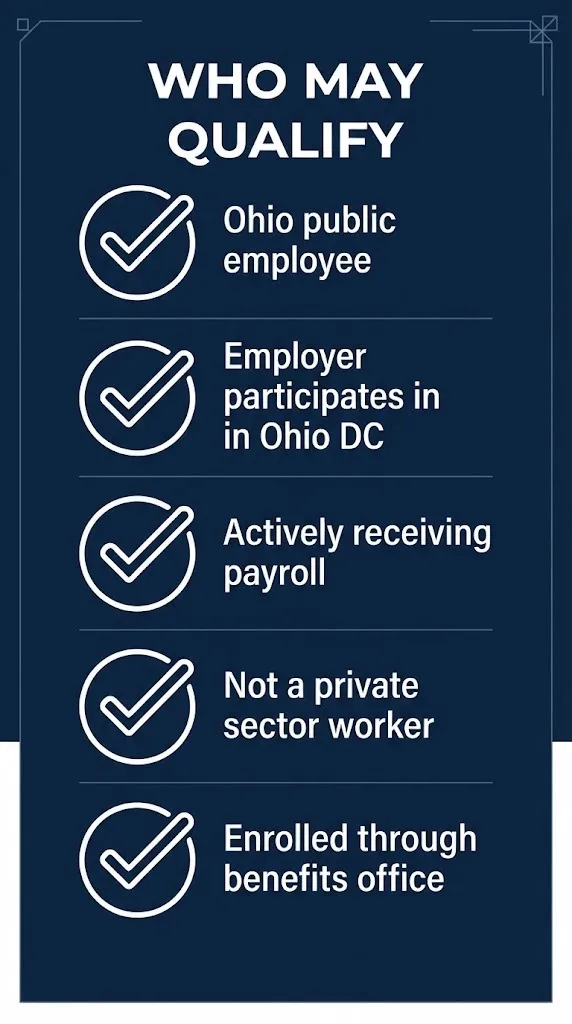
The plan serves Ohio public employees including state workers, teachers, municipal employees, and some public hospital staff. It is not available to private-sector workers. If you work for a participating employer, you can join.
The plan is not a scam. It is not an insurance product with hidden fees. It is a tax-deferred savings vehicle similar to a 401(k) but with some key differences, including no early withdrawal penalty when you leave your job.
Ohio DC is audited regularly. Its board publishes annual reports. Its investment options are publicly listed. The program’s assets exceed $18 billion as of the most recent reporting period, though that figure is subject to market changes.
Key Takeaway: Ohio Deferred Compensation is a real, state-run retirement plan, not a lawsuit, settlement, or private investment scheme.
What Is a 457 Deferred Compensation Plan?
A 457 deferred compensation plan is a retirement savings account for state and local government employees, plus some non-profit workers. Contributions are made pre-tax. Earnings grow tax-deferred until withdrawal.
The key feature that sets a 457(b) apart is the withdrawal rule. You can take money out without the 10 percent federal early withdrawal penalty once you leave your employer, regardless of your age. That is different from a 401(k), which imposes a penalty before age 59 and a half.
This makes the 457(b) attractive for public employees who plan to retire early or change careers. You can access your money before traditional retirement age without paying the penalty.
Ohio Deferred Compensation is a governmental 457(b) plan. That means your contributions are held in trust for you, not subject to the claims of the employer’s creditors. That is a major protection you do not get with a non-governmental 457(b), which some private tax-exempt employers offer.
How Much Can I Contribute to Ohio Deferred Compensation in 2026?
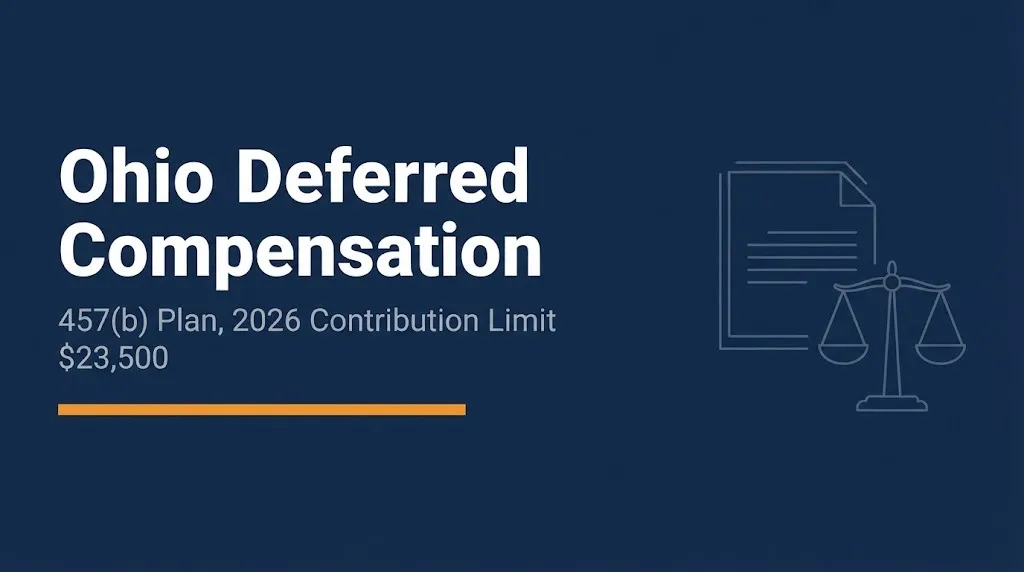
The 2026 contribution limit for 457(b) plans is $23,500. That matches the 401(k) and 403(b) elective deferral limit for 2026. If you are 50 or older, you can contribute an additional $7,500 as a catch-up contribution.
Ohio DC also offers a special catch-up provision. In the three years before your normal retirement age, you may contribute up to double the standard limit, or $47,000 in 2026. This special 457 catch-up is unique and lets long-time public employees accelerate savings near the end of their careers.
| Contribution Type | 2026 Limit |
|---|---|
| Standard elective deferral | $23,500 |
| Age 50 catch-up | $7,500 |
| Total with age 50 catch-up | $31,000 |
| Special 457 pre-retirement catch-up | Up to $47,000 |
You cannot use both the age 50 catch-up and the special 457 catch-up in the same year. You must choose one. Most people near retirement choose the special catch-up because it allows more.
How Do I Access the Ohio Deferred Compensation Login?
You access the Ohio Deferred Compensation login through the official Ohio DC participant portal. The portal lets you check your balance, change contribution amounts, update beneficiaries, and review investment performance.
The official login is on the Ohio Deferred Compensation website. You will need your username and password. If you have not registered for online access, you can do so with your participant information.
Here are the steps to access your account:
- Go to the official Ohio Deferred Compensation website.
- Click the participant login or account access button.
- Enter your username and password.
- Complete any two-factor authentication step.
- Review your account dashboard for balance and contribution details.
- Contact Ohio DC support if you cannot reset your password.
Do not use third-party sites that claim to offer Ohio DC login. Phishing sites sometimes mimic the official portal to capture login credentials. Always check the URL carefully.
How Do I Enroll in Ohio Deferred Compensation?
You enroll in Ohio Deferred Compensation through your employer’s payroll or benefits office. You cannot sign up independently unless your employer participates in the program.
The enrollment process usually takes a few minutes online or by paper form. You choose a contribution amount, either a percentage of pay or a flat dollar amount. You also pick your investments from the plan’s menu.
Here are the steps to enroll:
- Confirm your employer participates in Ohio DC.
- Go to the official Ohio DC enrollment portal.
- Choose your contribution amount or percentage.
- Select your investment options from the plan lineup.
- Name a beneficiary for your account.
- Submit the enrollment and verify it takes effect on your next paycheck.
Your first contribution typically starts within one or two pay periods. You can change your contribution amount at any time, subject to payroll deadlines.
Key Takeaway: Ohio DC enrollment is simple, but only if your employer participates. The plan is not open to the general public.
What Investment Options Does Ohio Deferred Compensation Offer?
Ohio Deferred Compensation offers a menu of target date funds, index funds, actively managed funds, and a stable value option. The lineup is designed for retirement savers at different stages.
The plan’s target date funds are the default option for many participants. These funds automatically adjust their asset allocation as you approach retirement. They are simple and require no ongoing management.
Index funds in the plan offer low-cost exposure to broad stock and bond markets. Active funds are also available for those who want professional management. The stable value option provides principal preservation with modest returns.
Fees are a key consideration. Ohio DC publishes its fee disclosures annually. The plan’s administrative fees are generally considered low compared to private 403(b) plans, but investment-specific fees vary. Check the fund fact sheets on the official site.
What Are the Fees in Ohio Deferred Compensation?
Ohio Deferred Compensation charges an administrative fee, plus the expense ratios of the underlying investment funds. The administrative fee is typically small and disclosed in the plan documents.
The exact fees depend on your investment choices. Index funds usually carry lower expense ratios than actively managed funds. The stable value option has its own crediting rate and fee structure.
Ohio DC is known for being a relatively low-cost plan. The board has negotiated institutional share classes for many funds, which reduces costs for participants. But you should still review the fee disclosures.
A small difference in fees compounds over decades. A plan charging 0.2 percent versus 1.0 percent saves you thousands by retirement. Ohio DC’s fees are competitive, but your fund selection matters.
Is Ohio Deferred Compensation Better Than a 401(k)?
Ohio Deferred Compensation is not automatically better or worse than a 401(k). It depends on your situation. The 457(b) has one major advantage: no early withdrawal penalty after you leave your employer.
A 401(k) has other advantages. It is more widely understood. Your employer may match contributions, which Ohio DC does not do for most participants. A 401(k) also offers Roth options more consistently, though Ohio DC has added Roth 457 options for some participants.
The best strategy for many public employees is to contribute to both. You can put $23,500 into a 457(b) and another $23,500 into a 403(b) or 401(k) in 2026. That gives you $47,000 of tax-deferred space before catch-up contributions.
This is the double contribution advantage. It is one of the most underused features of public retirement planning. If your employer offers both, consider funding both.
Can I Withdraw from Ohio Deferred Compensation Early?
Yes, you can withdraw from Ohio Deferred Compensation early without the 10 percent federal penalty, but only after you leave your employer. If you separate from service, you can access your 457(b) money at any age without the penalty.
If you are still working for the same employer, withdrawals are restricted. You generally cannot take money out while still employed unless you meet specific hardship criteria or reach age 70 and a half with no longer contributing.
Withdrawals are taxed as ordinary income. The money went in pre-tax, so it comes out taxable. That is true whether you withdraw at 45 or 75.
This flexibility is the biggest reason public employees choose the 457(b) over a 403(b) or 401(k). It gives you options if you retire early or leave government work.
Key Takeaway: The 457(b) penalty-free withdrawal after separation is a major advantage, but withdrawals are still taxable.
Reality Check
Ohio Deferred Compensation is not a settlement, and no one from the plan will ever call you asking for your password or demanding a fee to release your account. If you get a message claiming your Ohio DC account is locked and you need to pay to unlock it, that is a scam. The official plan never charges participants to access their own money.
Is There a Lawsuit Against Ohio Deferred Compensation?
No verified active lawsuit against Ohio Deferred Compensation has produced a class action settlement or claim deadline as of August 27, 2026. The plan has faced occasional participant complaints and regulatory scrutiny, but no major payout event exists.
Like all large retirement plans, Ohio DC occasionally handles participant disputes over account errors, beneficiary designations, or investment disclosures. Those disputes are handled administratively or in small individual cases, not class actions.
If you receive a notice about an Ohio Deferred Compensation lawsuit settlement, verify it carefully. Scam artists sometimes send fake settlement notices to government employees. Check the official court docket or the plan’s official communications before responding.
The Ohio Deferred Compensation Board operates under Ohio law and federal ERISA exemptions for governmental plans. It is not subject to ERISA in the same way private plans are, which affects how disputes are handled.
How Does Ohio Deferred Compensation Compare to OPERS and STRS?
Ohio Deferred Compensation is a supplemental savings plan. OPERS and STRS are defined benefit pension systems. They serve different purposes.
OPERS covers most state and local government employees. STRS covers teachers. Both provide a traditional pension based on years of service and final average salary. Ohio DC is a voluntary savings plan that sits on top of the pension.
Many Ohio public employees have both. The pension provides a base income in retirement. Ohio DC lets you save extra money on a tax-deferred basis. Together, they create a more secure retirement.
The pension is mandatory for many public employees. Ohio DC is optional. You choose whether to participate and how much to contribute.
What Happens to My Ohio Deferred Compensation If I Change Jobs?
If you change jobs within Ohio public employment, you can usually keep your Ohio DC account and continue contributing if your new employer participates. If your new employer does not participate, you can leave the money in the account or roll it over.
You can roll your 457(b) into another eligible retirement plan, including a 401(k), 403(b), or IRA. You can also leave the money with Ohio DC, where it continues to grow tax-deferred.
If you leave public employment entirely, you can access the money without the 10 percent penalty. That is the key advantage of the 457(b). But you will owe income tax on any withdrawal.
You cannot roll a 457(b) into a Roth IRA without paying tax. The conversion is taxable in the year you do it.
What Is the Ohio Deferred Compensation Phone Number and Support?
The official Ohio Deferred Compensation participant services phone number is available on the plan’s website. The number connects you to plan representatives who can help with login issues, contribution changes, and account questions.
Do not use phone numbers found in social media posts or unsolicited emails. Scammers sometimes list fake support numbers for public retirement plans. Use only the number on the official Ohio DC website or in the plan’s printed materials.
The plan also offers email support through a secure portal. If you have a simple question, the portal is often faster than calling.
For login-specific problems, the website has a password reset tool. You do not need to call unless the reset tool fails.
Key Takeaway: Official support is available, but only use contact information from the Ohio DC website to avoid phishing scams.
What Are the Ohio Deferred Compensation Withdrawal Rules in 2026?
Ohio Deferred Compensation withdrawal rules in 2026 follow IRS 457(b) regulations. You can withdraw after separation from service, at any age, without the 10 percent federal penalty. Withdrawals are taxed as ordinary income.
Required minimum distributions begin at age 73 for most participants, based on current IRS rules. If you are still working for the same employer, you may be able to delay RMDs on the 457(b) until after you retire.
You can choose a lump sum, partial withdrawals, or periodic payments. The choice affects your tax bill. A lump sum may push you into a higher bracket. Periodic payments spread the tax hit.
Plan rules may require certain minimum balances for partial withdrawals. Check the official plan document for specifics.
What Happens Next: Ohio Deferred Compensation in 2026 and 2027
- September 2026: Ohio DC continues accepting enrollment and contribution changes for the 2026 tax year.
- November 2026: Participants can adjust contributions for the 2027 limit of $24,000, if the IRS announces that amount.
- December 2026: Deadline for final 2026 contribution elections through payroll.
- January 2027: New contribution limits take effect, including updated catch-up amounts.
- July 2027: Ohio DC publishes updated fee disclosures and investment performance reports.
Frequently Asked Questions
Is Ohio Deferred Compensation a good retirement plan?
Yes, it is a low-cost, flexible 457(b) plan with no early withdrawal penalty after separation.
Can I have both a 457(b) and a 403(b)?
Yes, you can contribute the maximum to both in the same year, doubling your tax-deferred savings.
How do I check my Ohio Deferred Compensation balance?
Log in to the official Ohio DC participant portal using your username and password.
Is Ohio Deferred Compensation the same as OPERS?
No, Ohio DC is a supplemental savings plan. OPERS is a pension system.
What is the Ohio Deferred Compensation 2026 contribution limit?
The standard limit is $23,500, with a $7,500 age 50 catch-up available.
Can I withdraw from my 457(b) before 59 and a half?
Yes, after you leave your employer, you can withdraw without the 10 percent federal penalty.
Does Ohio Deferred Compensation have a Roth option?
Yes, the plan offers a Roth 457 option for some participants, subject to plan rules.
Is my Ohio Deferred Compensation money safe from creditors?
Governmental 457(b) assets are held in trust for participants and generally protected from employer creditors.
Closing
Ohio Deferred Compensation is not a lawsuit. It is a state-run retirement plan with real advantages for Ohio public employees. The key facts for 2026 are the $23,500 contribution limit and the penalty-free withdrawal after you leave your employer.
If you have an account, log in to the official portal and review your contribution rate and investment choices. If you do not have an account, check with your employer about enrolling. The sooner you start, the more time your money has to grow.