How Employee Benefits Affect Total Employment Compensation: The 2026 Breakdown
Quick Answer
- Employee benefits add roughly 30 percent on top of wages, according to federal data.
- Private employers spent $14.07 per hour on benefits versus $32.82 on wages in June 2026.
- Benefits are not extra money in your pocket; they are the full value of what your employer pays for you.
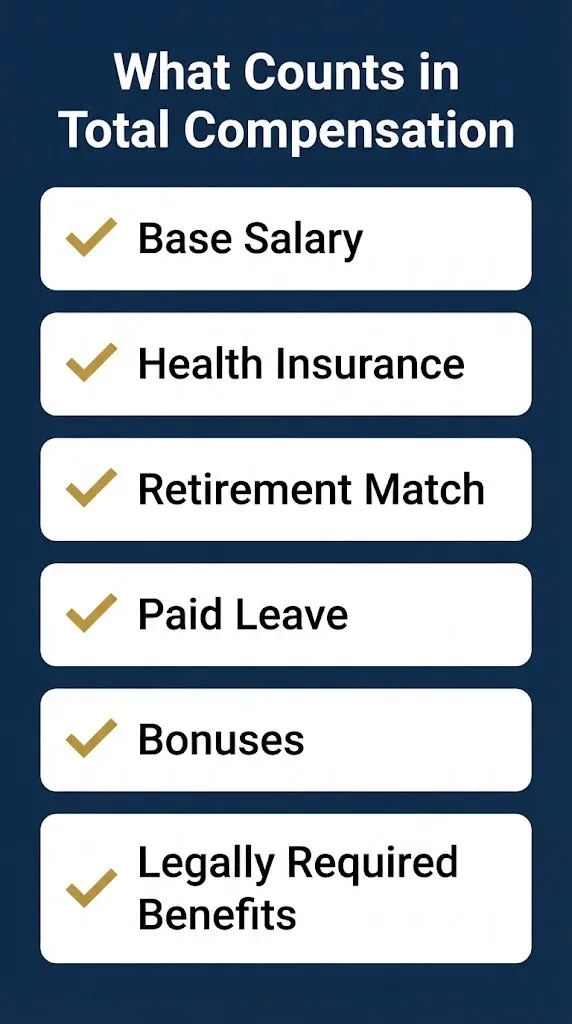
The way employee benefits affect total employment compensation is straightforward: they add about 30 percent to the value of your wages. When the Bureau of Labor Statistics measures employer costs, it separates wages from benefits. The benefits side includes insurance, retirement contributions, paid leave, and legally required programs. That $14.07 per hour figure is what your employer actually spends on benefits for the average private industry worker.
If you are comparing job offers or trying to understand your real worth, this matters. A $70,000 salary with strong benefits can be worth more than an $80,000 salary with none. The federal data proves it. Benefits are not a bonus on top of your pay. They are a core part of your compensation.
This article breaks down exactly how benefits change the total compensation equation, what the dollar figures look like in 2026, and how to calculate your own package value. One number that surprises most people: state and local government employers spend $25.59 per hour on benefits, nearly double the private sector rate.
The Facts
| Case | Employee Benefits and Total Compensation (employment concept) |
|---|---|
| Status | Standard employment practice, not a legal case |
| Fund Size | Not applicable |
| Est. Per Person | Benefits average $14.07/hour in private industry |
| Claim Deadline | Not applicable |
| Administrator | Not applicable |
| Proof Needed | Request a total compensation statement from HR |
How Do Employee Benefits Affect Total Employment Compensation?
Employee benefits increase total employment compensation by roughly 30 percent on top of wages, according to Bureau of Labor Statistics data from June 2026. Private industry employers spent an average of $46.89 per hour worked on total compensation. Wages and salaries accounted for $32.82 of that. Benefits accounted for the remaining $14.07. The math is simple: benefits are a measurable, substantial addition to what you earn.
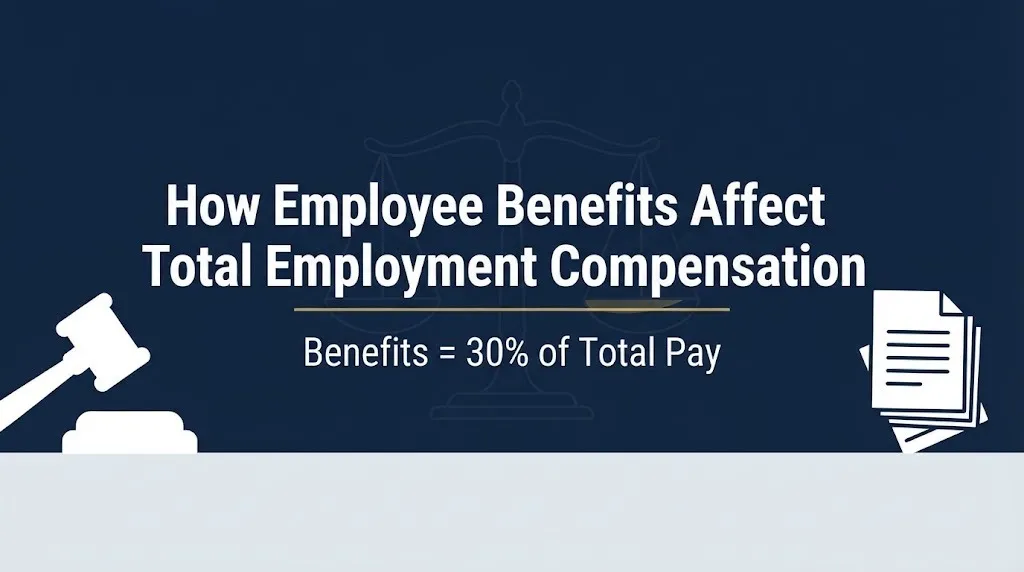
That percentage holds steady across recent quarters. The Bureau of Labor Statistics reports that wages and salaries made up 70.0 percent of employer costs in June 2026, with benefits at 30.0 percent. This ratio has been consistent for years. It is not a temporary spike or a pandemic-era anomaly. It is the structural reality of how employers pay for labor in the United States.
For you, this means the salary number on your offer letter is never the full story. The real question is what your employer spends on your behalf. The Bureau of Labor Statistics tracks that spending through its Employer Costs for Employee Compensation program, which surveys businesses quarterly. The data is public, and it shows exactly what benefits add to the equation.
Key Takeaway: Employee benefits are not a small add-on. They represent roughly 30 percent of total compensation costs, a figure that holds across economic conditions.
What Is the Dollar Value of Employee Benefits in 2026?
The dollar value of employee benefits in 2026 averages $14.07 per hour for private industry workers and $25.59 per hour for state and local government workers. Those figures come from the Bureau of Labor Statistics Employer Costs for Employee Compensation data for June 2026. They represent what employers actually spend, not what employees perceive.
The breakdown of that $14.07 in private industry shows where the money goes:
| Benefit Category | Private Industry Cost Per Hour (June 2026) |
|---|---|
| Paid leave | $3.54 |
| Supplemental pay | $1.71 |
| Insurance | $3.41 |
| Retirement and savings | $1.57 |
| Legally required benefits | $3.38 |
| Total benefits | $14.07 |
State and local government workers see a different mix. Their benefits cost $25.59 per hour, driven largely by retirement contributions of $8.83 per hour. That is more than five times the private sector retirement rate. Government health insurance also costs more per hour, at $7.52 compared to $3.41 in private industry.
The gap between private and public sector benefits is one of the largest single factors in total compensation differences. A government job with a lower salary can still deliver higher total compensation because the benefit load is so much heavier.
Key Takeaway: Benefits add $14.07 per hour in private industry and $25.59 per hour in government. The mix matters as much as the total.
How Do You Calculate Total Compensation From Benefits?
To calculate total compensation, add your employer’s hourly or annual benefit spending to your wages. The Bureau of Labor Statistics provides the framework: total compensation equals wages plus benefits. You can apply the same math to your own offer.
Start with your annual salary. Then request the employer’s cost for each benefit. Most large employers can provide a total compensation statement that shows these figures. If they cannot, you can estimate using national averages, though your specific employer may differ significantly.
Here is a practical example for a private industry worker earning $65,000 per year:
| Component | Annual Value |
|---|---|
| Base salary | $65,000 |
| Paid leave (3.54/hr x 2,080 hrs) | $7,363 |
| Supplemental pay (overtime, bonuses) | $3,557 |
| Insurance (health, life, disability) | $7,093 |
| Retirement match | $3,266 |
| Legally required benefits | $7,030 |
| Total compensation | $93,309 |
That is over $28,000 more than the salary alone. If the employer offers a pension instead of a 401(k) match, the retirement line grows substantially. If health insurance is fully covered, the insurance line grows. The total can easily exceed 40 percent above salary in high-benefit sectors.
Key Takeaway: Total compensation is salary plus every benefit cost. Request the employer’s actual figures, not estimates, whenever possible.
How Do Benefits Affect Job Offer Comparisons?
Benefits can flip a job offer comparison entirely, because a lower salary with strong benefits can beat a higher salary with weak benefits. Consider two offers: $80,000 with no benefits versus $72,000 with comprehensive benefits. Using national averages, the second offer’s total compensation exceeds the first.
The Nasdaq illustrated this exact scenario. Job A pays $80,000 with no additional benefits. Job B pays $75,000 but includes $10,000 in health insurance value, a $5,000 bonus, and a 5 percent 401(k) match. Job B’s total compensation is higher despite the lower salary.
Here is how that comparison looks using actual Bureau of Labor Statistics averages:
| Component | Job A ($80K, no benefits) | Job B ($72K, full benefits) |
|---|---|---|
| Base salary | $80,000 | $72,000 |
| Paid leave value | $0 | $7,363 |
| Insurance value | $0 | $7,093 |
| Retirement match | $0 | $3,266 |
| Legally required benefits | $0 | $7,030 |
| Total value | $80,000 | $96,752 |
Job B wins by nearly $17,000. The salary gap of $8,000 is erased by benefit value. This is why asking for a total compensation breakdown during negotiations is essential. The biggest number on the offer letter is not always the best offer.
Key Takeaway: A lower salary with strong benefits can deliver higher total compensation. Always compare the full package, not just the paycheck.
Reality Check: Your employer’s benefit contributions are not cash you can spend. You cannot deposit a health insurance premium into your bank account. The dollar value of benefits matters for comparing offers and understanding your economic worth, not for monthly budgeting. Treat total compensation as a comparison tool, not as disposable income.
What Benefits Are Tax-Free and How Does That Affect Total Compensation?
Many employee benefits are tax-free, which increases their real value beyond the dollar figure your employer spends. Employer-paid health insurance premiums, 401(k) matches within limits, and certain other benefits are excluded from your taxable wages. That means you receive the full value without paying income tax on it.
The tax treatment varies by benefit type. Health insurance premiums paid by your employer are generally excluded from federal income tax withholding and FICA taxes. Your employer reports the value in Box 12 of your W-2 using Code DD, but it is not added to your taxable wages. The same applies to 401(k) employer matches within annual limits.
Other benefits are taxable. Personal use of a company car, gift cards above IRS limits, and most non-qualified perks are treated as wages. They appear in Box 1 of your W-2 and are subject to income tax withholding and FICA.
| Benefit Type | Taxable to You? | W-2 Reporting |
|---|---|---|
| Employer-paid health insurance | No | Box 12 (Code DD) |
| 401(k) match (within limits) | No | Box 12 (Code D) |
| Personal use of company car | Yes | Box 1 |
| Gift cards over IRS limits | Yes | Box 1 |
The tax-free status of major benefits is a significant factor in total compensation. A dollar spent on tax-free health insurance is worth more to you than a dollar of taxable salary, because you keep the full value without a tax bite.
Key Takeaway: Tax-free benefits deliver more real value than their dollar figure suggests, because you avoid income tax and FICA on those amounts.
How Do Employer Retirement Contributions Affect Long-Term Compensation?
Employer retirement contributions add a long-term financial component to total compensation that can exceed their annual dollar value over time. The Bureau of Labor Statistics reports that private industry employers spend $1.57 per hour on retirement and savings, while state and local government employers spend $8.83 per hour. Those contributions compound.
A 401(k) match of 4 percent on a $70,000 salary adds $2,800 per year. Over 30 years with average market returns, that annual contribution can grow into a six-figure sum. A defined benefit pension is even more valuable because the employer bears the investment risk and guarantees a lifetime payout.
Reddit users on personal finance forums frequently discuss this calculation. One commenter valued a defined benefit pension at 35 percent of salary when comparing job offers. That estimate is not universal, but it reflects the real weight retirement benefits carry in total compensation.
The vesting schedule matters. A 401(k) match that vests immediately is worth more than one that takes five years. A pension that requires 10 years of service before you qualify has no value if you leave at year three. When comparing offers, check both the contribution rate and the vesting timeline.
Key Takeaway: Retirement contributions are part of total compensation that compounds over decades. Vesting schedules determine whether you actually keep that value.
How Do You Ask for a Total Compensation Statement?
To get an accurate picture of your total compensation, ask your HR department for a total compensation statement. Many employers provide these annually or on request. The statement should list your salary, the employer’s cost for each benefit, and the total value.
Here are the specific items to request:
- Employer cost of health, dental, and vision premiums
- Retirement contribution amount and vesting schedule
- Annual value of paid leave (vacation, sick, personal days)
- Bonus target and whether it is guaranteed
- Value of any life or disability insurance coverage
If your employer cannot provide a statement, calculate it yourself using the Bureau of Labor Statistics framework. Request the individual cost figures for each benefit. Most HR departments track these numbers for budgeting and compliance purposes.
Reddit users on career advice forums consistently recommend this approach. One commenter noted that getting a total compensation statement from both your current and prospective employer is “really the only way to compare the compensation.” That advice holds in 2026.
Key Takeaway: Ask for the employer’s actual cost figures, not estimates. A written total compensation statement is the most reliable comparison tool.
What Happens Next
Ongoing: Request a total compensation statement from HR. Review it annually or whenever your benefits change.
During job searches: Ask prospective employers for their total compensation breakdown before accepting any offer.
Annually: Use Bureau of Labor Statistics Employer Costs for Employee Compensation data to benchmark your package against national averages.
During negotiations: Use the benefit dollar values to negotiate salary, retirement contributions, or paid leave with concrete numbers.
Frequently Asked Questions
How much do employee benefits add to total compensation?
Employee benefits add about 30 percent to total compensation on average. The Bureau of Labor Statistics reports benefits accounted for 30.0 percent of employer costs in June 2026.
What is the average dollar value of benefits per hour?
Private industry employers spent $14.07 per hour on benefits in June 2026. State and local government employers spent $25.59 per hour.
Does a higher salary always mean better total compensation?
No. A lower salary with strong benefits can deliver higher total compensation. You must compare the full package value, not just the salary number.
How do I calculate my total compensation?
Add your salary to the employer’s cost for each benefit. The Bureau of Labor Statistics uses this formula: total compensation equals wages plus benefits.
Are employer-paid benefits taxable?
Most major benefits are tax-free, including health insurance and 401(k) matches within limits. Some perks, like personal use of a company car, are taxable.
What benefits should I compare between job offers?
Compare health insurance value, retirement match and vesting, paid leave days, bonuses, and any equity or profit-sharing. Request actual dollar figures from HR.
Why do government jobs have higher total compensation?
State and local government employers spend more on benefits, particularly retirement contributions ($8.83/hour) and health insurance ($7.52/hour), which raises total compensation above private sector levels.
Can I negotiate benefits as part of my compensation?
Yes. Paid leave, retirement contributions, and bonuses are often negotiable. Ask for the dollar value of each benefit before you accept an offer.