Credit Acceptance Lawsuit 2026: $694M Settlement, Eligibility and What Happens Next
Quick Answer
- Yes: Credit Acceptance settled with New York and 40 other attorneys general for $694 million in consumer relief.
- No claim form exists. Debt relief is automatic. Restitution amounts are not yet determined.
- No claim deadline exists. Debt relief must be applied by November 2, 2026.
The Credit Acceptance lawsuit ended in a settlement on September 17, 2026. New York and 40 other attorneys general settled claims that the subprime auto lender made loans borrowers couldn’t afford.
It affects certain borrowers with high-risk car loans made between November 2015 and November 2025. You don’t file a claim. Credit Acceptance must apply the relief itself, and the company says fewer than 3% of its open accounts qualify.
This guide covers who qualifies, what the money means, and what to do now. One surprise: this is not a class action, and the lender still says it needs no material operational changes.
| The Facts | |
|---|---|
| Case | People of the State of New York v. Credit Acceptance Corporation, No. 1:23-cv-00038-JMF (S.D.N.Y.), plus consent judgments with 40 other attorneys general |
| Status | Settled. Proposed consent order filed September 17, 2026. Effective November 2, 2026 |
| Fund Size | $694 million in consumer relief ($634 million debt forgiveness, $60 million cash restitution), plus $15.5 million paid to the states |
| Est. Per Person | Not yet determined. Debt relief erases the remaining loan balance. Restitution amounts not announced |
| Claim Deadline | None. No claim form exists |
| Administrator | For restitution, chosen by the attorneys general. Not yet announced |
| Proof Needed | None. Credit Acceptance or the administrator will contact eligible borrowers |
Is there a Credit Acceptance lawsuit in 2026?
Yes, and it just settled. The lead case is People of the State of New York v. Credit Acceptance Corporation, No. 1:23-cv-00038-JMF, in the U.S. District Court for the Southern District of New York.
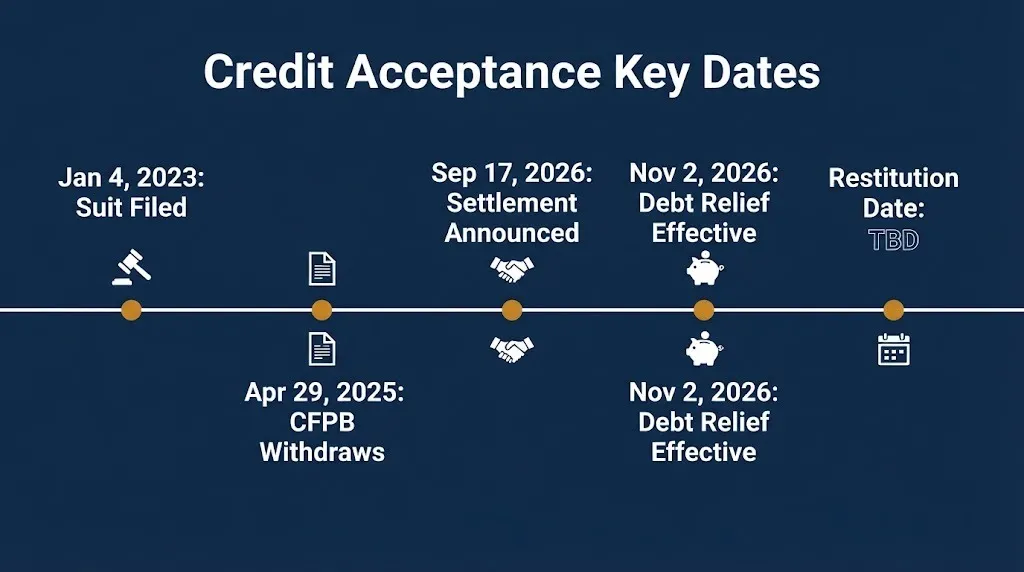
The Consumer Financial Protection Bureau and New York Attorney General Letitia James filed the suit on January 4, 2023. It alleged that Credit Acceptance, an indirect auto lender, hid loan costs and set borrowers up to fail. Judge Jesse M. Furman now presides.
On September 17, 2026, the parties filed a proposed consent order and judgment. A bipartisan group of 41 attorneys general announced the action the same day. The multistate consent judgments carry the same core terms, according to a settlement report.
Other matters exist too:
- A 2020 securities class action by investors, which settled for $12 million.
- A June 2026 data breach, now the subject of law firm investigations.
- State investigations that ran about six years before the deal.
Is the Credit Acceptance settlement real or a scam?
The settlement is real, and Credit Acceptance confirmed it in a September 17, 2026 press release. The company said it entered or will enter consent judgments with New York and 40 other attorneys general.
The terms appear in the proposed New York consent order, Document 98, filed September 17, 2026. The attorneys general of Maryland, New Jersey, Connecticut and Utah published their states’ details.
Here’s what’s verified and what isn’t:
- Verified: a $694 million consumer relief package, plus $15.5 million paid to the states.
- Verified: debt relief is due by November 2, 2026, with no claim form.
- Verified: Credit Acceptance denied the allegations and admitted no wrongdoing.
- Not verified: the restitution administrator, payment amounts or payment dates.
The scam risk is real. Credit Acceptance warns customers to be careful with unexpected letters, texts, emails or calls about “settlement money.” Eligible borrowers will hear directly from the company or a state-selected administrator.
Is there a class action lawsuit against Credit Acceptance?
No class action covers the 2026 settlement. It’s a government enforcement settlement, not a private class action.
Attorneys general sued on behalf of their states, and consent judgments resolve the claims. You don’t opt in, opt out or file a claim. The CFPB’s case summary lists “Class Action Sought: No.”
Private class actions have existed. A 2020 securities class action, Palm Tran, Inc. v. Credit Acceptance Corporation, No. 20-cv-12698 (E.D. Mich.), alleged the company misled investors. It settled for $12 million, and the claim deadline was December 2, 2022, according to a law firm’s litigation page. That’s closed.
Some pages claim other consumer class actions are active in 2026. I found no docket, notice or administrator for any. One page lists settlement ranges and calls them “illustrative,” which means estimates, not facts.
Key Takeaway: The 2026 Credit Acceptance settlement is an attorney general deal, so there’s no class to join and no form to file.
How much is the Credit Acceptance settlement worth?
The settlement is valued at $694 million in consumer relief, plus $15.5 million paid to the states. That’s roughly $710 million in total payments, which explains why some outlets cite $710 million.
| Component | Amount |
|---|---|
| Debt forgiveness, repossessed or surrendered cars | $388 million (estimated) |
| Debt forgiveness, borrowers who kept their cars | $246 million (estimated) |
| Cash restitution | $60 million |
| Consumer relief total | $694 million |
| Paid to the states | $15.5 million |
The debt relief figures are estimates of the balances to be waived. The $60 million restitution goes into a trust run by a settlement administrator that the attorneys general select.
Credit Acceptance said the monetary terms are covered by amounts it had already accrued. It also said the resolution “does not require material changes to the Company’s operations.”
That statement doesn’t match the conduct rules in the consent order. Those include a price cap, an income check and add-on protections, covered below.
How much will each borrower get from the Credit Acceptance settlement?
Not yet determined for restitution, and the debt relief equals your remaining balance if you qualify. No per-person cash figure has been announced.
For debt relief, Credit Acceptance must waive the entire remaining balance. That amount differs for every borrower. Nobody can quote a standard number.
For restitution, the states’ executive committee has sole discretion over who gets money and how much. It described recipients as consumers who received particularly risky loans. No payment amount or date has been announced.
State announcements give a sense of scale:
| State | Reported share |
|---|---|
| New Jersey | More than $28.5 million, including about $2.2 million restitution and $25.6 million debt relief |
| Utah | 124 residents share $177,935 restitution plus about $1.6 million debt relief |
| Connecticut | Eligible residents up to $2 million |
Think of it like a delayed tax refund. The total is public, but your amount depends on a review you can’t speed up.
Reality Check: Nobody can text you Credit Acceptance settlement money first, and no claim form exists. Eligible borrowers are contacted by Credit Acceptance or a state-selected administrator. Anyone charging a fee to “file your claim” is running a scam.
Who qualifies for Credit Acceptance debt relief?
You may qualify if your loan fits a narrow set of conditions in the consent order. Credit Acceptance, not you, decides who qualifies.
Both relief groups share these conditions:
- The loan was made between November 1, 2015 and November 30, 2025.
- The loan was still open on December 1, 2025.
- The borrower had a Credit Acceptance Score below 56.
- The monthly car payment was 13% or more of monthly income when the loan was made.
The groups split by what happened to the car:
| Group | Relief |
|---|---|
| Car repossessed or voluntarily surrendered and sold within 18 months of the loan | Entire remaining balance waived |
| Certain other qualifying borrowers who kept the car | Balance waived, lien released, title sent if held |
You can’t look up your own score. Credit Acceptance says there’s nothing to check or apply for.
Credit Acceptance must also stop credit reporting on these accounts, ask the three major bureaus to delete the trade lines, stop collections, and never sue on or sell them.
Key Takeaway: Debt relief is limited to high-risk loans from 2015 to 2025, and Credit Acceptance decides who qualifies and tells them directly.
How do you claim Credit Acceptance settlement relief?
You don’t claim it. Credit Acceptance must apply the relief automatically and notify you. There’s no claim form and no website to sign up on.
Law Compensate isn’t a law firm. This is the process as reported, not legal advice.
Here’s what to do:
- Keep your current mailing address, email and phone number up to date with Credit Acceptance.
- Watch for a letter, email or text after November 2, 2026.
- Verify any notice by calling the number on your account statement.
- Check the company’s official settlement information page for account questions.
- Save every notice you receive.
- Pull your credit reports a few weeks after notice to confirm deletion.
- Report any request for payment or fees to your state attorney general.
Think of it like a store return without a receipt. You don’t need paperwork to receive relief, but saved notices help if something goes wrong.
If you’re in the $60 million restitution group, a settlement administrator will notify you. The states will identify recipients using names, last known addresses and account numbers supplied by Credit Acceptance.
Should you keep paying your Credit Acceptance loan?
Yes, keep paying unless Credit Acceptance contacts you with different instructions. The company says the settlement doesn’t change existing contracts.
Stopping payments on your own could lead to default and repossession. That could hurt your credit and your finances. The relief only covers loans that fit the consent order’s conditions.
Here’s why caution matters:
- Fewer than 3% of open accounts are affected by the debt forgiveness, per Credit Acceptance.
- You can’t self-check eligibility, so you won’t know if you qualify.
- Relief arrives by notice, which comes after November 2, 2026.
- Missed payments can trigger collection steps now.
If you’re struggling to pay, call Credit Acceptance and ask about options. Document every call.
If you got a notice that your account is closed and nothing is owed, follow that notice. Keep a copy. Don’t rely on a text or email you can’t verify.
Key Takeaway: Keep making scheduled payments until Credit Acceptance tells you otherwise in a message you’ve verified.
What if you aren’t covered but think your Credit Acceptance loan was predatory?
You may have other options, but the settlement doesn’t create new claims for you. Whether you do depends on your loan’s facts and your state’s law.
Here are steps you can take:
- Gather your retail installment contract and payment history.
- Look for add-on charges such as service contracts or GAP coverage.
- Compare the sale price to the car’s book value.
- Check your loan’s dates against the November 2015 to November 2025 window.
- File a complaint with your state attorney general.
- File a complaint with the CFPB.
- Consider a consultation with a licensed attorney.
Your state attorney general may be one of the 41. A state press release can tell you how your state’s residents are treated.
I can’t tell you whether you have a claim. Time limits can apply. An attorney can review your contract and dates.
Don’t sign a release without understanding it. Don’t pay anyone upfront for “debt relief” services tied to this settlement.
Key Takeaway: If you fall outside the settlement groups, your options are complaints and a possible individual claim, not a claim form.
What is the latest in the Credit Acceptance lawsuit?
The latest is a September 17, 2026 settlement announcement with a proposed consent order filed in New York. I couldn’t confirm that the court has entered the final judgment.
Here’s the record:
| Date | Event |
|---|---|
| Jan. 4, 2023 | CFPB and New York AG file suit in S.D.N.Y. |
| Apr. 29, 2025 | Court grants the CFPB’s motion to withdraw as plaintiff |
| Jan. 28, 2026 | Case reassigned to Judge Jesse M. Furman |
| Jun. 5, 2026 | Parties say material terms are agreed |
| Jun. 6, 2026 | Court dismisses without prejudice, with a 60-day right to reopen |
| Jul. 23, 2026 | Court extends the reopen deadline by 45 days |
| Sep. 17, 2026 | Proposed consent order filed. 41 AGs announce the action |
The June dismissal was conditional. It let the parties finish paperwork and line up the New York deal with the multistate matter.
The multistate consent judgments are being entered in each attorney general’s own court. Check your state’s announcement for local status.
When will Credit Acceptance debt relief take effect?
Debt relief takes effect November 2, 2026. That’s the Effective Date in the proposed consent order.
Credit Acceptance must apply the relief on or before that date. It must then notify each covered borrower by letter, email or text. The notice must say the account is closed, nothing more is owed and any lien is released.
Other deadlines in the order:
- 90 days after November 2: monetary terms must be carried out, unless the order sets another deadline.
- 120 days after November 2: the company must report to the states that the relief, credit reporting and notice steps are complete.
- Six months after the court enters judgment: Credit Acceptance must use reasonable best efforts to put the conduct changes in place.
The restitution timeline isn’t set. No administrator, payment amount or distribution date has been announced.
So expect debt relief notices first. Expect restitution later, and watch for an announcement from your attorney general.
What happened to the CFPB lawsuit against Credit Acceptance?
The CFPB withdrew from the case in 2025, and New York carried it forward. The court granted the Bureau’s unopposed motion on April 29, 2025.
According to Credit Acceptance’s quarterly filing, the Bureau filed the motion on April 24, 2025. After that, the Bureau was no longer a plaintiff.
The New Jersey attorney general said the CFPB dropped its case in 2025 and the states continued without it. A coalition group noted that 41 state attorneys general stepped in after the company received what it called a “corporate pardon” from the federal government. That’s an advocacy group’s framing, not a court finding.
This is the gap to notice. A federal agency exited, and the states finished the job. The result was $694 million in consumer relief.
For you, the takeaway is simple. State attorneys general are the route for relief now, and your state’s office is the place to check.
Key Takeaway: The CFPB left the case in April 2025, and 41 attorneys general delivered the settlement.
What did the attorneys general accuse Credit Acceptance of?
They alleged Credit Acceptance made loans it knew or should have known borrowers couldn’t afford. None of the allegations was proven in court.
According to the states, Credit Acceptance gives every loan it buys a proprietary score. The score forecasts how much it expects to collect, including from repossession. The states say the company approved many low-scoring loans where its own forecast showed the borrower wouldn’t repay even the principal.
They also alleged:
- Dealer pay and weak oversight pushed dealers to pack loans with service contracts and GAP coverage.
- Buyers didn’t know they were paying for add-ons, or were told they had to buy them.
- Many borrowers defaulted, and their cars were repossessed and sold at auction.
- New Jersey alleged targeting of credit-challenged, low-income buyers with credit-repair offers, then aggressive collections.
The 2023 complaint estimated that 90% of loans carried an add-on and that add-ons added thousands of dollars to what borrowers owed.
Credit Acceptance denied the allegations and settled without admitting any fact, violation or liability.
What does Credit Acceptance say about the settlement?
Credit Acceptance says the deal gives it certainty and requires no material operational changes. That claim sits uneasily with the conduct rules in the order.
CEO Vinayak Hegde said the agreement “provides certainty for our business, our dealer partners and the customers we serve.” The company said the requirements are “broadly consistent” with its existing practices.
The consent order says otherwise on several points. Most conduct terms run for seven years:
| Rule | What it requires |
|---|---|
| Price cap | For buyers with a credit score below 600, price can’t exceed 109% of highest retail book value |
| Contract length | No used-car contracts longer than 75 months, or the industry average plus 12 months if longer |
| Income | Credit Acceptance must verify income |
| Add-ons | Buyers sign a form saying service contracts and GAP are optional, and can cancel |
| Off ramp | For new high-risk loans repossessed quickly, 95% of the deficiency is waived |
| Oversight | Annual compliance reports to a monitoring committee for five years |
Maryland Attorney General Anthony G. Brown said the settlement “erases hundreds of millions of dollars in debt for borrowers struggling under loans that should never have been made.”
A company’s press release and a court order are different things. The order is the one that binds.
What is the Credit Acceptance data breach, and is there a class action?
Credit Acceptance disclosed a data security incident in June 2026, and I found no filed class action. Law firms are investigating.
The company determined on June 4, 2026, that some personal information was affected. A notice was filed with the Massachusetts Attorney General on June 30, 2026. The information involved first and last names and Social Security numbers.
A law firm page says affected people were offered 24 months of Kroll identity monitoring. The total number of people affected wasn’t disclosed in the sources I reviewed. The Massachusetts filing lists one Massachusetts resident.
The firms Shamis & Gentile and Dapeer Law describe investigations into potential class actions. An investigation isn’t a lawsuit. No settlement or claim form exists for the breach.
If you got a breach letter, keep it and consider a credit freeze. This breach is separate from the debt relief settlement. Getting one doesn’t mean you qualify for the other.
Key Takeaway: The data breach has law firm investigations but no confirmed class action, and it’s separate from the $694 million settlement.
What happens next in the Credit Acceptance lawsuit?
The next steps are the November 2 effective date and the restitution rollout. Here’s the expected path:
November 2, 2026: Debt relief must be applied. Credit Acceptance must then notify covered borrowers.
Expected, date not set: Announcement of a settlement administrator for the $60 million restitution fund.
Within 90 days after November 2: Monetary terms must be carried out, unless the order sets another deadline.
Within 120 days after November 2: Credit Acceptance reports to the states that relief, credit reporting and notices are done.
Within six months of judgment: Conduct changes must be in place.
Frequently Asked Questions
Do I need to file a claim for the Credit Acceptance settlement?
No. There’s no claim form.
Credit Acceptance must apply debt relief by November 2, 2026.
It must then notify covered borrowers.
How much will I get from the Credit Acceptance settlement?
The amount is not yet determined for restitution.
Debt relief erases your remaining balance if you qualify.
No per-person cash figure has been announced.
Is the Credit Acceptance settlement a class action?
No. It’s a settlement with 41 attorneys general.
You don’t opt in or file a claim.
A past securities class action settled for $12 million in 2022.
Which Credit Acceptance loans qualify for debt relief?
Loans made from November 2015 to November 2025 that were still open on December 1, 2025.
The borrower’s score must be below 56 and the payment 13% or more of income.
Credit Acceptance decides who qualifies.
Will the settlement affect my credit report?
For covered accounts, Credit Acceptance must stop reporting and ask the bureaus to delete the trade lines.
It can’t sue, collect or sell those accounts.
Check your reports after you get notice.
Did Credit Acceptance admit wrongdoing?
No. It denied the allegations and admitted no fact, violation or liability.
The allegations weren’t decided in court.
The company says it requires no material operational changes.
Will I get a text or email about Credit Acceptance settlement money?
You may get a notice if you qualify, but verify it first.
Credit Acceptance warns about unexpected texts and calls.
Call the number on your account statement.
Start by confirming your contact details with Credit Acceptance so a notice can reach you. Keep making payments unless you get a verified message saying otherwise.
Then mark November 2, 2026. That’s the date the debt relief takes effect.