Workers Compensation 2026: Benefits, Average Settlement Payouts, Filing Deadlines, and How the System Works
Quick Answer
- Is it legit? Yes. Workers comp is a real, legally required insurance system in every state except Texas.
- How much? National average settlement is around $20,000, but serious injuries can exceed $100,000.
- Key deadline? Reporting deadlines range from 24 hours to 90 days; filing deadlines range from 90 days to 6 years.
Workers compensation is a state-mandated insurance program that pays medical bills and partial lost wages when you get hurt on the job. The average workers compensation settlement in the U.S. sits around $20,000, but that number swings wildly depending on your injury and your state. A lower back injury might settle for about $36,822, while a head or central nervous system injury can average $90,043 . The system exists to protect you and your employer: you get guaranteed benefits, and in exchange, you generally cannot sue your boss for the injury.
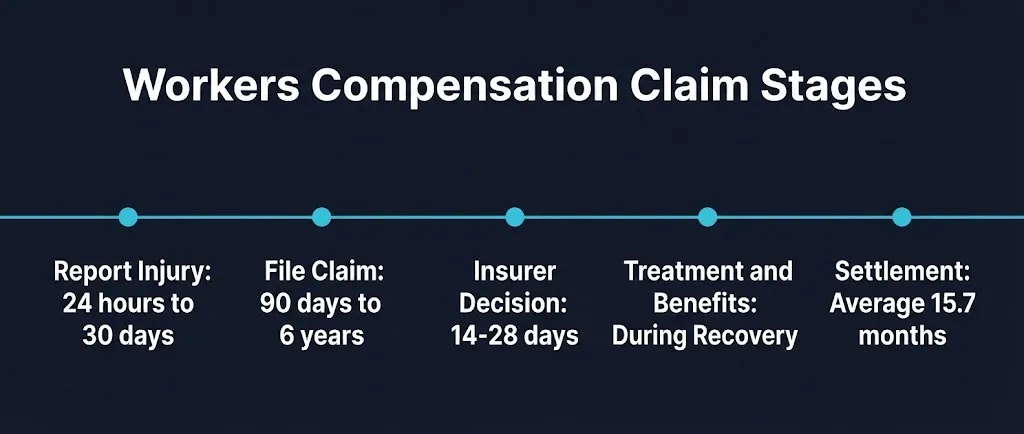
If you were hurt at work, the clock is already running. Most states require you to report your injury within 30 days, and some give you as little as 24 hours. The formal filing deadline is longer, ranging from 90 days in Nevada to 6 years in Wisconsin, Utah, and Vermont . Miss either deadline and you risk losing benefits entirely.
This article breaks down how the workers comp system actually works, what benefits you can expect, how settlements are calculated, and the filing deadlines you cannot afford to miss. One fact that surprises most people: workers compensation benefits are generally not taxable under federal law, but there is a Social Security offset trap that can make part of your settlement taxable if you also receive SSDI .
The Facts
| Program | State or federal workers compensation insurance |
|---|---|
| Status | Active, no-fault system covering most employees |
| Fund Size | Not applicable (insurance-based, not a settlement fund) |
| Est. Per Person | $20,000 national average; $47,316 average claim cost |
| Claim Deadline | Reporting: 24 hours to 90 days. Filing: 90 days to 6 years |
| Administrator | State workers comp board or private insurer |
| Proof Needed | Medical records, incident report, wage documentation |
Is workers compensation real or a scam?
Workers compensation is a real and legally required insurance system in every U.S. state except Texas. If you are an employee and you get hurt on the job, your employer is almost certainly required to carry workers comp coverage. The federal government established the first workers comp plan in 1908 for dangerous jobs, and by 1921, nearly every state had its own program .
This is not a settlement fund or a class action. It is an insurance system. Your employer pays premiums, and when you get hurt, the insurance company pays your medical bills and a portion of your lost wages. You do not need to prove your employer was at fault. That is the “no-fault” part of the system.

Scammers do target injured workers. If someone calls you demanding payment to “process your workers comp claim” or asks for your Social Security number upfront, that is fraud. The real process is free. You file through your employer and their insurer, not through a third-party service that charges fees.
How much is the average workers compensation settlement?
The average workers compensation settlement is around $20,000 nationally, but that figure is misleading because it averages together minor strains and catastrophic injuries . The actual amount depends on your injury, your wages, and your state’s benefit formula.
Here is a breakdown of average payouts for common workplace injuries:
| Injury Type | Average Settlement |
|---|---|
| Lower back injuries | $36,822 |
| Head injuries | $1,000 to $60,000+ |
| Eye injuries | $1,000 to $48,000 |
| Neck injuries | $56,000+ |
| Hip, thigh, or pelvis | $59,758 |
The National Safety Council reports that the average cost of a workers comp claim in 2022–2023 was $47,316. Serious injuries cost far more: amputations average $125,058, motor vehicle incidents average $91,433, and head or central nervous system injuries average $90,043 .
Your settlement is usually calculated based on your average weekly wage before the injury, multiplied by a disability rating assigned by a doctor. Most states pay about two-thirds (66.67%) of your lost wages, up to a state-set maximum . The final number also depends on whether your disability is temporary or permanent, total or partial.
Key Takeaway: The national average settlement is $20,000, but your actual payout depends on your injury, your wages, and your state’s formula. Serious injuries routinely exceed $100,000.
Who is eligible for workers compensation?
Most employees are eligible for workers compensation, but the system does not cover everyone. Only employees are automatically eligible. Independent contractors, gig workers, and some agricultural workers often fall outside the system .
Your eligibility depends on three things:
- You must be an employee, not a contractor. Some states require businesses to cover independent contractors in high-risk industries like construction, but many do not.
- Your injury must be work-related. It has to happen on the job or while you are doing something for your employer.
- You must report it on time. Deadlines vary by state, and missing them can disqualify you entirely.
Federal employees have a separate system through the U.S. Department of Labor’s Office of Workers’ Compensation Programs (OWCP). If you work for the federal government, you file through OWCP, not your state board .
If you are unsure whether you qualify, check your state’s workers compensation board website or contact your employer’s HR department. Do not assume you are covered. Verify before you need it.
What benefits does workers compensation cover?
Workers compensation covers medical expenses, wage replacement, disability benefits, and death benefits for dependents. The exact package depends on your state and the severity of your injury, but most programs include the following .
Medical expenses include emergency treatment, doctor visits, hospital stays, surgery, prescription medications, medical equipment, and physical therapy. If your claim is accepted, you should not pay out of pocket for these services .
Wage replacement pays a portion of your lost income while you recover. Most states pay about two-thirds of your average weekly wage, up to a maximum. These payments are typically not taxed.
Disability benefits kick in if your injury keeps you from working long-term. There are four types:
- Temporary total disability (TTD): You cannot work at all while recovering.
- Temporary partial disability (TPD): You can work reduced hours or lighter duties.
- Permanent total disability (PTD): You can never return to any work.
- Permanent partial disability (PPD): You have lasting limitations but can still work.
Death benefits go to dependents if a worker dies from a job-related injury or illness.
How do you file a workers compensation claim?
You file a workers compensation claim by reporting your injury to your employer immediately, seeking medical treatment, and submitting the required forms to your employer and their insurer. Most states have strict deadlines, so do not wait.
Here are the steps:
- Report the injury to your supervisor or HR immediately. Do it in person, in writing, or by email. Most states require this within 30 days, and some give you as little as 24 hours .
- Seek medical treatment right away. Tell the doctor the injury happened at work. Get a written medical report or certificate of capacity .
- Complete the workers compensation claim form. Your employer must provide it. If they do not, you can often download it from your state board’s website .
- Submit the form and medical certificate to your employer. Keep copies of everything you submit.
- Your employer sends the claim to their insurer. In most states, they must do this within 3 to 10 days .
- The insurer accepts or denies the claim. You should receive written notice within a set timeframe, often 14 to 28 days .
- If denied, appeal. You have the right to appeal a denial. Deadlines vary by state, but you usually have weeks, not months.
Reality Check: No legitimate workers comp administrator asks you to pay a fee to file a claim. The process is free. If someone demands payment to “expedite” your benefits or asks for your bank information upfront, it is a scam.
What is the workers compensation filing deadline in your state?
The workers compensation filing deadline varies by state, ranging from 90 days in Nevada to 6 years in Wisconsin, Utah, and Vermont . Most states fall between 1 and 3 years.
Two deadlines matter. The reporting deadline is how quickly you must tell your employer. The filing deadline is how long you have to formally file a claim with the state board. The reporting deadline is almost always shorter. Treat it as the real deadline.
| State | Filing Deadline |
|---|---|
| Nevada | 90 days |
| Kansas | 200 days |
| Wisconsin, Utah, Vermont | 6 years |
| Massachusetts | 4 years |
| Most other states | 1 to 3 years |
For occupational diseases like carpal tunnel or hearing loss, the clock usually starts when you discovered the condition was work-related, not when you were first exposed .
If you miss the deadline, your claim will almost certainly be denied as time-barred. You typically cannot re-file. That is why you should report your injury immediately, even if you are not sure it is serious.
How long does a workers compensation case take?
The average workers compensation case takes about 15.7 months from start to finish, according to a Martindale-Nolo Research study . That is nearly a year and a half. But some cases resolve in weeks, and others drag on for years.
Several factors affect the timeline:
- Legal representation: Hiring a lawyer can speed things up by cutting through insurer delays, but it can also extend the case if disputes arise.
- Negotiations: Back-and-forth settlement talks add time.
- Hearings and appeals: If your claim is disputed, hearings and appeals can add months or years.
- Permanent disability disputes: If you and the insurer disagree about your disability rating, the case takes longer .
The good news is that you do not have to wait for a settlement to get money. If you cannot work, you can receive temporary disability payments while your case is pending. These payments replace part of your lost wages during recovery .
What happens if your workers compensation claim is denied?
If your workers compensation claim is denied, you have the right to appeal. A denial is not the end. You can challenge the decision, and many workers win on appeal.
You will receive a written decision explaining why the claim was denied. The reasons vary. Sometimes the insurer disputes that the injury happened at work. Sometimes they question the severity. Sometimes they claim you missed a deadline .
Steps to appeal a denial:
- Read the denial letter carefully. It should explain the reason and the appeal deadline.
- Request a reason for decision letter if you need more detail. You usually have about 20 business days to ask .
- File your appeal with the state workers comp board or the independent review body. Deadlines vary, but you often have three months from the decision .
- Gather evidence. Medical records, witness statements, and your incident report support your appeal.
- Attend the hearing. Appeals are usually handled by an independent reviewer, not a court.
- Wait for the decision. The reviewer can overturn the denial, ask for more information, or confirm the original decision.
If your claim is denied and you cannot work, look into other options: private health insurance, income protection through your superannuation or retirement fund, or state disability programs .
What happens next in your workers compensation case?
The next stage depends on where you are in the process. If you just got hurt, the next step is reporting the injury and filing your claim. If your claim is pending, the insurer has a set time to accept or deny it. If you are already receiving benefits, your case may be heading toward a settlement or a hearing.
Here is the typical sequence:
- Immediate: Report injury and seek medical treatment.
- Within 3 to 10 days: Employer sends claim to insurer.
- Within 14 to 28 days: Insurer decides to accept or deny .
- During recovery: You receive temporary disability payments if you cannot work.
- When you reach maximum medical improvement: Your doctor assigns a permanent disability rating.
- Settlement negotiation: You and the insurer negotiate a final payout.
- If disputed: Hearing or appeal before the state board.
Frequently Asked Questions
Is workers compensation taxable?
No. Workers compensation benefits are generally not taxable under federal law. IRC § 104(a)(1) excludes them from gross income .
How long do I have to report a work injury?
Reporting deadlines range from 24 hours to 90 days depending on your state. Most states require it within 30 days.
Can I sue my employer for a work injury?
Generally, no. Workers compensation is the exclusive remedy for most workplace injuries. You cannot sue your employer in court if you accept workers comp benefits.
What if my employer doesn’t have workers comp insurance?
Most states require employers to carry coverage. If your employer is uninsured, you may be able to file a claim through a state fund or sue your employer directly.
How is my workers comp settlement calculated?
It is based on your average weekly wage, your disability rating, and your state’s benefit formula. Most states pay about two-thirds of your lost wages .
Do I need a lawyer for my workers comp claim?
Not always. Simple claims with clear injuries often resolve without a lawyer. But if your claim is denied or your injury is serious, a lawyer can help.
What is the average workers comp settlement?
The national average is around $20,000, but serious injuries can exceed $100,000 .
What should you do right now?
Report your injury to your employer immediately, even if you think it is minor. The reporting deadline is the one that catches people off guard. Missing it can disqualify your entire claim.
Gather your documents: medical records, incident reports, pay stubs showing your wages, and any correspondence with your employer or their insurer. Keep copies of everything.
The single most important fact to remember: the national average settlement is $20,000, but your actual payout depends on your injury and your state. Report the injury today, not tomorrow.