1983 Lawsuit 2026: Section 1983 Civil Rights Claims, Payouts, Deadlines, and How to Sue the Government
Quick Answer
- Is it legit? Yes. Section 1983 is a real federal law dating to 1871 that lets you sue state officials.
- How much? No fixed amount. Compensatory, punitive, and attorney’s fees are all recoverable.
- Key deadline? Statutes of limitations vary by state, usually 1 to 3 years. Check your state’s personal injury deadline.
A 1983 lawsuit is a federal civil rights claim filed under 42 U.S.C. § 1983, a law passed in 1871 that lets you sue state and local government officials who violate your constitutional rights . The statute does not create new rights. It gives you a way to enforce rights you already have under the Constitution and federal law . You can sue for excessive force, unlawful arrest, denial of medical care in custody, retaliation for protected speech, and more.
If you were mistreated by police, a prison guard, a school official, or another government employee, this is the legal tool you would use. The average award in these cases varies wildly. A 1986 Chicago Tribune analysis of Cook County data found average awards jumping from $138,981 in 1982-83 to $261,141 in 1983-84, though those figures are decades old and not adjusted for inflation . Modern payouts range from tens of thousands to millions depending on the severity of the violation.
This article breaks down who you can sue, what you must prove, how qualified immunity works, the biggest recent Supreme Court ruling, and the filing deadlines you cannot miss. One fact that surprises most people: you generally cannot sue the state itself under Section 1983, only individual officials or local governments with specific policies that caused the harm .
The Facts
| Statute | 42 U.S.C. § 1983 (Civil Rights Act of 1871) |
|---|---|
| Status | Active federal law, frequently litigated |
| Fund Size | Not applicable (individual claims, no settlement fund) |
| Est. Per Person | Varies widely; compensatory, punitive, and attorney’s fees recoverable |
| Claim Deadline | State personal injury statute of limitations (typically 1-3 years) |
| Administrator | Not applicable |
| Proof Needed | Evidence of state action, constitutional violation, and resulting harm |
Is a 1983 lawsuit real or a scam?
A 1983 lawsuit is real and grounded in federal law. 42 U.S.C. § 1983 has been on the books since 1871, originally passed as the Ku Klux Klan Act to protect newly freed slaves from oppressive state governments . Congress later expanded its application to cover a wide range of constitutional violations.
The statute provides a cause of action against any person who, acting under color of state law, deprives you of rights guaranteed by the U.S. Constitution or federal statutes . You must show three things: the defendant acted in their official capacity, they violated a federal right, and that violation caused you harm .
This is not a class action or a settlement fund. It is an individual lawsuit. You file it in federal court, and you sue for damages, injunctive relief, or both. If you see a website promising “Section 1983 settlement payouts” or asking for payment to “process your civil rights claim,” that is a scam. The real process involves filing a complaint in court, not submitting a claim form to an administrator.
Who can you sue under Section 1983?
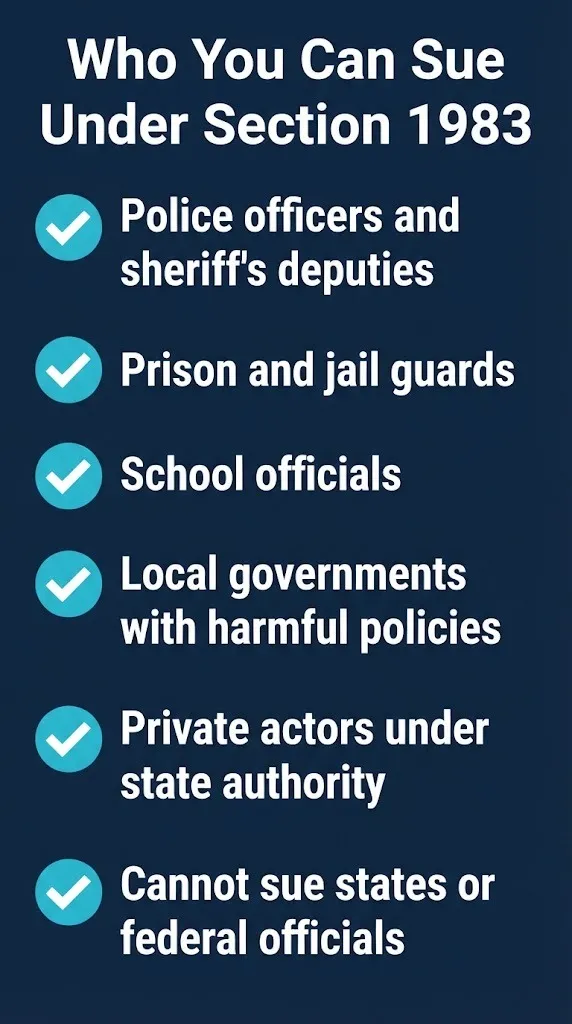
You can sue individual government officials, local government entities, and in limited cases, private individuals acting under state authority. States and state agencies are generally immune under the Eleventh Amendment, and the federal government is not covered by Section 1983 at all .
Here is who falls into each category:
- Individual officials: Police officers, prison guards, sheriffs, school officials, and other government employees who violate your rights while acting in their official capacity .
- Local governments: Cities, counties, and municipalities can be sued, but only if the violation resulted from an official policy, custom, or practice, not just a single employee’s misconduct .
- Private individuals: Only in narrow circumstances where they were acting under color of state law or jointly performing a government function .
- Judges and prosecutors: Generally have absolute immunity for actions within their official duties .
- Federal officials: Cannot be sued under Section 1983. You would need a Bivens action, which is much narrower and increasingly restricted by the Supreme Court .
The key distinction is state versus federal. If a state or local official violates your rights, Section 1983 applies. If a federal official does, you face a much harder path.
How much can you get from a 1983 lawsuit?
There is no fixed payout amount for a 1983 lawsuit. Compensatory damages, punitive damages, and attorney’s fees are all recoverable, and the final amount depends entirely on the facts of your case .
Compensatory damages cover physical injuries, emotional harm, and economic losses like lost wages or medical bills . Punitive damages are available when the defendant’s conduct was especially egregious or malicious. In Smith v. Wade, the Supreme Court held that punitive damages can be awarded under Section 1983 even when the plaintiff cannot show compensable injury . That means you can win punitive damages without proving a dollar amount of harm.
A recent example: in May 2026, the State of California agreed to pay $38,000 to settle a Section 1983 claim brought by an inmate who alleged sexual harassment by a prison guard . The settlement was a 15-fold increase over the state’s prior offer and among the largest the state has paid for that type of claim.
Attorney’s fees are a major factor in Section 1983 litigation. Under federal law, prevailing plaintiffs can recover their attorney’s fees and costs, which often exceed the damages award itself . That provision makes these cases financially viable for plaintiffs who might otherwise not be able to afford federal litigation.
What must you prove to win a Section 1983 claim?
You must prove three elements to win a Section 1983 claim: the defendant acted under color of state law, the defendant’s actions deprived you of a federal right, and that deprivation caused you harm .
The burden of proof is on you, the plaintiff. You must show that the official was acting in their official capacity, not as a private citizen. You must identify the specific constitutional or federal right that was violated. And you must connect that violation to actual harm, whether physical, emotional, or economic .
Common constitutional claims include:
- First Amendment: Retaliation for protected speech, assembly, or petition .
- Fourth Amendment: Unlawful search and seizure, false arrest, excessive force .
- Eighth Amendment: Cruel and unusual punishment, denial of medical care in custody .
- Fourteenth Amendment: Due process violations, equal protection claims, discrimination .
Evidence matters enormously. Body camera footage, medical records, witness statements, and official reports all play a role. In excessive force cases, the totality of the circumstances is now the legal standard, not just the final seconds before force was used, thanks to the Supreme Court’s 2025 ruling in Barnes v. Felix .
Key Takeaway: You must prove state action, a constitutional violation, and actual harm. The burden is on you, and evidence like body camera footage and medical records is critical.
What is qualified immunity and how does it affect your case?
Qualified immunity is a judicial doctrine that protects government officials from personal liability unless their conduct violated a clearly established constitutional right that a reasonable official would have known about .
This is the biggest hurdle in most Section 1983 cases. Courts analyze whether the right at issue was clearly established at the time of the conduct. If the law was unclear, the official may be shielded from liability even if they violated your rights .
To defeat qualified immunity, you must point to prior court rulings or legal standards that made the unlawfulness of the specific conduct apparent . Evidence that the conduct deviated significantly from accepted training or policies can also help.
In January 2025, Congress introduced S.122, the Qualified Immunity Act of 2025, which would provide statutory authority for qualified immunity protections for law enforcement officers . The bill remains pending as of September 2026. If passed, it would make qualified immunity harder to overcome by codifying the judicial doctrine into federal law.
Qualified immunity is a frequent focus of litigation because it can resolve cases at an early stage before trial. If the court grants qualified immunity, your case ends. That is why detailed legal briefing and a well-developed factual record are essential.
What is the Barnes v. Felix ruling and why does it matter?
Barnes v. Felix is a unanimous 2025 Supreme Court decision that rejected the “moment-of-threat” rule in excessive force cases. The Court held that courts must consider the totality of the circumstances of a police encounter, not just the final seconds before deadly force was used .
The case arose from a Houston traffic stop. An officer initiated a stop for outstanding toll violations. Less than two minutes into the encounter, the driver turned on the ignition with the door open and attempted to drive away. The officer jumped onto the doorsill, shouted “Don’t move!” and fired two shots, killing the driver. The Fifth Circuit dismissed the Section 1983 suit, focusing only on the final seconds. The Supreme Court reversed, ruling that the broader context matters .
What does this mean for you? If you file an excessive force claim, the court must examine the entire encounter, including what happened before the threat. Prior interactions, the officer’s conduct leading up to the force, and the full situational context can now be scrutinized . This ruling makes it harder for officers to win early dismissal based solely on a split-second justification.
Law enforcement agencies are updating policies and training to reflect this broader analysis. For plaintiffs, it is a meaningful expansion of the evidence courts must consider.
Reality Check: No one texts you money from a civil rights lawsuit. Filing a Section 1983 claim means going to federal court, not submitting a form to an administrator. If someone demands payment to “file your civil rights claim,” it is a scam.
How do you file a Section 1983 lawsuit?
You file a Section 1983 lawsuit by preparing a complaint, filing it in federal district court, and serving the defendants. The process is formal and technical, and most plaintiffs need an attorney to navigate it.
Here are the steps:
- Document everything. Gather police reports, medical records, witness statements, body camera footage, and any other evidence .
- Identify the defendants. Determine who violated your rights and whether they acted under color of state law.
- Check the statute of limitations. Section 1983 deadlines are governed by your state’s personal injury statute, typically 1 to 3 years .
- Prepare a complaint. The complaint must state the constitutional right violated, the facts showing the violation, and the harm you suffered.
- File in federal district court. Section 1983 claims go to federal court, not state court.
- Serve the defendants. The defendants must be formally notified of the lawsuit.
- Litigate or settle. Many cases settle before trial, but qualified immunity motions often decide cases early.
Filing fees apply, and service costs add up. Attorney’s fees are recoverable if you win, but you have to fund the case upfront unless you find a lawyer who takes it on contingency.
How long do you have to file a Section 1983 claim?
The deadline for filing a Section 1983 claim is governed by your state’s personal injury statute of limitations, not a single federal deadline . That means the time limit varies by state, typically ranging from 1 to 3 years.
In Washington, for example, the statute of limitations for Section 1983 claims has been addressed in cases like Robinson v. Seattle, where the court confirmed that tolling is controlled by state law . The continuing wrong doctrine can also extend the accrual period when there is a continuous chain of events .
Because deadlines vary and tolling rules are technical, you should consult an attorney as soon as possible after the violation. Missing the deadline almost certainly bars your claim. Unlike a tax refund that you can claim late with a penalty, a late Section 1983 filing is usually dismissed outright.
What happens next in a Section 1983 lawsuit?
The next stage depends on where you are in the process. If you just experienced a violation, the next step is documenting evidence and consulting an attorney. If your case is filed, the next stage is usually a motion to dismiss or a qualified immunity motion.
Here is the typical sequence:
- Immediate: Document the incident and seek medical or psychological care if needed.
- Within the statute of limitations: File your complaint in federal court.
- Early litigation: Defendants file motions to dismiss or claims of qualified immunity.
- Discovery: Both sides exchange evidence and take depositions.
- Settlement or trial: Most cases settle, but some go to trial.
- Appeal: Qualified immunity rulings can be appealed immediately, which can extend the timeline.
Frequently Asked Questions
What is a 1983 lawsuit?
A 1983 lawsuit is a federal civil rights claim filed under 42 U.S.C. § 1983 against state or local officials who violated your constitutional rights.
Who can be sued under Section 1983?
You can sue individual government officials and local governments. States and federal officials are generally immune.
How much can I get from a Section 1983 lawsuit?
There is no fixed amount. Compensatory, punitive, and attorney’s fees are recoverable depending on the facts.
What is qualified immunity?
Qualified immunity protects government officials from liability unless they violated a clearly established constitutional right.
How long do I have to file a Section 1983 claim?
The deadline follows your state’s personal injury statute of limitations, typically 1 to 3 years.
Can I sue the police for excessive force?
Yes, if the force was unreasonable under the Fourth Amendment. The Barnes v. Felix ruling expanded the context courts must consider.
Do I need a lawyer for a Section 1983 lawsuit?
You can file pro se, but these cases are complex. An experienced civil rights attorney greatly improves your chances.
What should you do right now?
Document everything about the incident while your memory is fresh. Gather police reports, medical records, witness names, and any video footage. Evidence disappears over time, and the burden of proof is on you.
Contact a civil rights attorney in your state to review your case and confirm the filing deadline. The statute of limitations varies, and missing it ends your claim permanently.
The single most important fact to remember: Section 1983 gives you a way to hold state and local officials accountable for constitutional violations, but qualified immunity and short deadlines make prompt action essential.