Tax Settlement in 2026: How IRS Debt Settlement Works, What It Costs, and Who Gets Approved
Quick Answer
- An IRS Offer in Compromise is real. It is not a class action, and no settlement fund exists.
- Not fixed. The IRS accepts an offer that matches what it can collect from your income and assets.
- No program deadline. If the IRS rejects your offer, you have 30 days to appeal.
A tax settlement with the IRS is called an Offer in Compromise, and it is real. It settles a tax bill for less than you owe. You must prove you can’t pay in full.
This affects anyone carrying back taxes they can’t afford. There is no deadline to apply. But the IRS decides slowly and rejects most offers. Experts told CNBC that lower-income households feel the drop most.
One surprise: accepted offers fell 57 percent between fiscal 2023 and fiscal 2025. Filings rose 29 percent over the same stretch. This guide covers costs, odds, steps, and scams.
| The Facts | |
|---|---|
| Case | Not a class action. IRS Offer in Compromise program. Related: FTC and State of Nevada v. American Tax Service LLC |
| Status | Program open. FTC settlement announced June 2, 2026, as a proposed order |
| Fund Size | None for the IRS program. FTC case: over $8 million in cash plus assets, nearly $10 million total |
| Est. Per Person | Not yet determined. Depends on your income, expenses, and asset equity |
| Claim Deadline | None to apply. Appeal a rejection within 30 days |
| Administrator | The IRS, through offer examiners and offer specialists |
| Proof Needed | Form 656, Form 433-A (OIC) or 433-B (OIC), and financial documents |
Is an IRS tax settlement legit in 2026?
Yes. The IRS runs a real settlement program called the Offer in Compromise.
The IRS calls it a legitimate option if you can’t pay your full bill. It also fits cases where payment would cause financial hardship. The agency weighs your ability to pay, income, expenses, and asset equity.
Here’s the catch. Each decision is case by case, and it’s not a benefit you claim. The IRS even tells you to explore every other payment option first.
Two versions exist:
- Doubt as to collectibility: You agree you owe the tax but can’t pay it all. This is the common version, filed on Form 656.
- Doubt as to liability: You dispute the debt itself. It uses Form 656-L, needs a written explanation, and can’t be an offer of zero.
The IRS won’t consider a liability offer for debt fixed by a final court judgment. Only the IRS decides, and no private company can promise your approval.
Are tax relief companies that promise IRS debt settlement legit?
Treat any “pennies on the dollar” pitch with suspicion. The IRS put Offer in Compromise mills on its 2026 Dirty Dozen scam list.
Mills oversell the program to people who don’t qualify. They charge steep fees for applications the IRS then rejects. You can check eligibility yourself, for free, with the IRS Pre-Qualifier tool.
The FTC says no company can guarantee a tax relief result. It warns against paying the full fee upfront. Its August 2026 alert says only the IRS or a state agency decides eligibility.
Red flags to watch:
- A promise to settle for a fraction before reviewing your finances
- A guarantee that you “qualify”
- A demand for the full fee upfront
- Letters or calls that look like they come from the government
- A countdown clock that pressures you to pay today
Licensed attorneys, CPAs, and enrolled agents can legitimately represent you. Check credentials first, because the IRS urges you to verify any tax professional’s qualifications.
How much can you settle IRS debt for?
No fixed percentage exists. The IRS says yes when your offer equals what it can realistically collect.
That number is your Reasonable Collection Potential, or RCP. In most cases, the IRS won’t accept less. Tax practitioners describe RCP as net asset equity plus a multiple of monthly disposable income.
Think of it like a car trade-in. The dealer pays what the car can fetch, not what you still owe.
Here’s a hypothetical using that simplified formula:
| Item | Amount |
|---|---|
| Cash and asset equity | $2,000 |
| Monthly disposable income | $50 |
| Income multiple in this example | 12 months |
| Approximate RCP | $2,600 |
A homeowner with the same balance and real equity would face a much higher RCP. The IRS lets you claim standard amounts for food, clothing, housing, and transportation. Housing and transportation cap at the lesser of your actual spending or the standard.
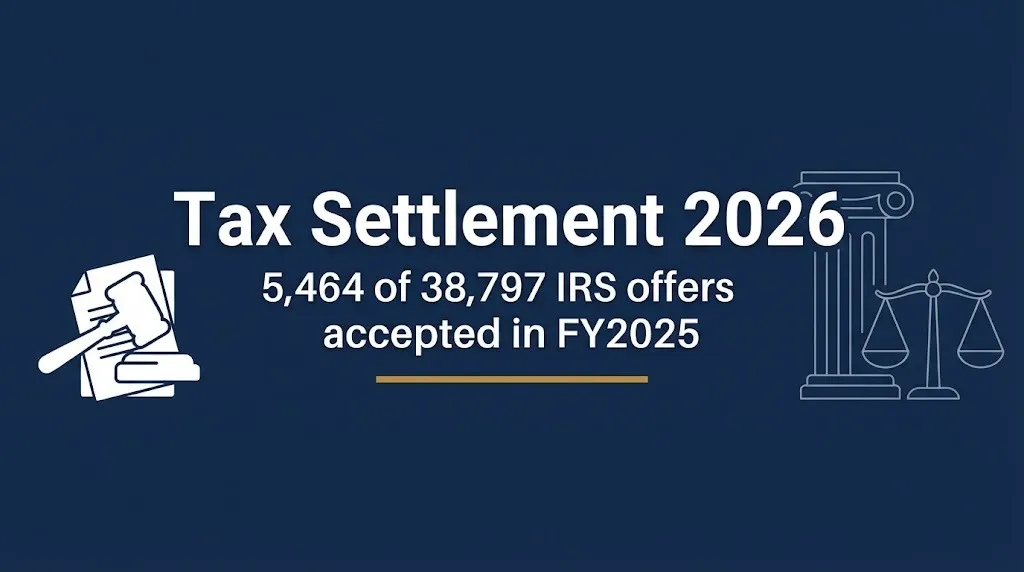
In fiscal 2025, the IRS accepted $98.1 million across 5,464 offers. That averages about $18,000 per offer. It’s the offer amount, not your discount.
Key Takeaway: Your offer must match what the IRS can collect, not a fixed percentage.
What does an IRS debt settlement application cost?
Applying costs a non-refundable $205 fee plus an initial payment, unless you qualify as low income.
Your initial payment depends on the option you pick:
| Option | Due with your application | Due after |
|---|---|---|
| Lump sum | $205 fee plus 20% of your offer | Balance in five or fewer payments after acceptance |
| Periodic payment | $205 fee plus your first installment | Monthly payments during review and after acceptance |
| Low-income certification | $0 fee, $0 initial payment | No payments while the IRS reviews |
The fee and initial payment are non-refundable. The IRS applies them to your tax debt, and you choose the tax year. You can’t redirect the application fee.
Low-income status depends on your adjusted gross income from your latest return. A chart on Form 656 sets the cutoff by family size and location. Over the line? You can request a waiver based on household gross monthly income times 12.
If you mail your package, send two separate checks payable to the United States Treasury. One covers the fee. One covers the initial payment. If the IRS can’t process it, the fee comes back and your payment hits your balance.
Reality Check: No one texts you a tax settlement check, and no company can guarantee approval. The IRS says promoters falsely claim their services are necessary to apply. You can check eligibility and file on your own, and only the IRS decides.
What are the odds the IRS accepts an offer in 2026?
The IRS accepted 5,464 of 38,797 offers in fiscal 2025, about 14 percent.
Those figures come from the IRS Data Book. Here’s how three years compare:
| Fiscal year | Offers received | Offers accepted | Same-year ratio | Value accepted |
|---|---|---|---|---|
| 2023 | Not confirmed | About 12,700 | Roughly 42% | $214.5 million |
| 2024 | 33,591 | 7,199 | 21.4% | Not confirmed |
| 2025 | 38,797 | 5,464 | 14.1% | $98.1 million |
That ratio isn’t your personal probability. Offers accepted in a year aren’t always that year’s filings. Still, the direction is clear.
Some 2026 guides still quote a 33 to 40 percent approval rate. The fiscal 2025 data doesn’t support that.
Tax practitioners say most rejections come from offers below RCP or incomplete paperwork. Former National Taxpayer Advocate Nina Olson told CNBC: “I’ve never seen a number that low.”
Who qualifies for an IRS debt settlement?
You may qualify if you can’t pay in full and you’re current on filing and payments.
The IRS sets these threshold rules:
- You filed all required tax returns.
- You made all required estimated tax payments.
- You aren’t in an open bankruptcy.
- You hold a valid extension, if applying for the current year.
- You made federal tax deposits for the current and past two quarters, if you’re an employer.
- You received a bill for at least one tax debt in the offer.
If you can full-pay through an installment plan or equity, you generally won’t qualify.
An open audit or a pending innocent spouse claim can stall your offer. The IRS may return it without refunding your fee or payments.
The Pre-Qualifier tool doesn’t cover partnerships, corporations, territory residents, foreign residents, or APO and FPO addresses. Those filers go straight to the booklet.
Key Takeaway: File every return and stay current on payments, or the IRS won’t process your offer.
How do you apply for an IRS debt settlement?
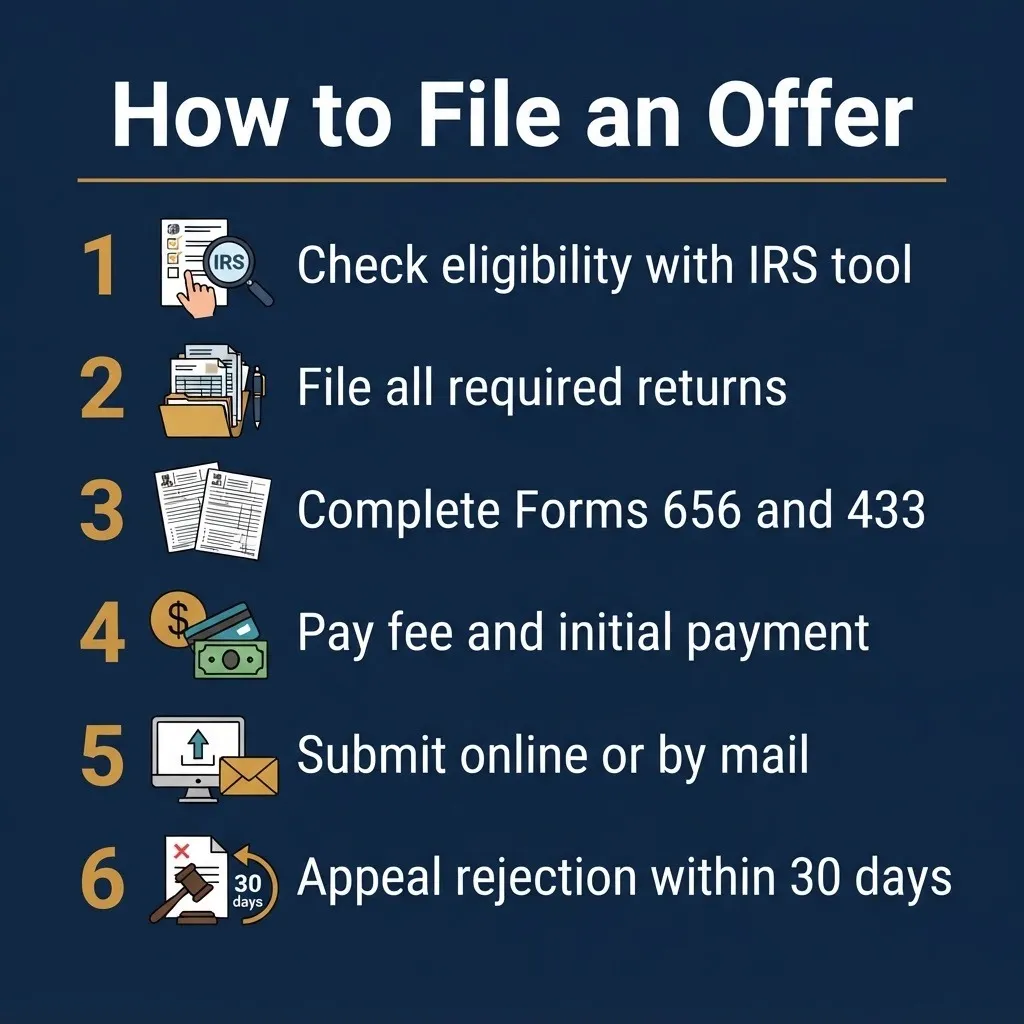
You apply with Form 656, a Form 433 statement, the $205 fee, and an initial payment.
- Run the free Pre-Qualifier tool, or check your Individual Online Account.
- File every missing return and pay current estimated taxes.
- Download the Form 656-B booklet, which holds Form 656 and instructions.
- Complete Form 433-A (OIC) for individuals or 433-B (OIC) for businesses.
- Pick lump sum or periodic payment and calculate your offer.
- Pay the $205 fee and initial payment, or check the low-income box.
- File through your Individual Online Account, or mail the package.
- Keep paying while the IRS reviews, and answer every request fast.
Business owners must mail Form 656 and Form 433-B (OIC). You can pay a business offer online through your Business Tax Account. Individual and business debts go on separate Forms 656, each with its own fee and payment.
Download the newest booklet. The forms carry an April 2026 revision date, and outdated versions can slow processing. If a representative will speak for you, they need Form 2848, not Form 8821.
What documents does an IRS settlement require?
You need Form 656, a Form 433 statement, and proof of income, expenses, and assets.
The IRS says to attach all documentation listed on the forms. Tax professionals point to pay stubs, bank statements, and monthly expense records as the core items. Ask your assigned examiner how to send follow-up files electronically.
Think of it like a mortgage application. Every line gets checked against a statement.
Three details trip people up:
- Household income: Include your spouse’s income even if they don’t owe the tax.
- Household expenses: List actual monthly costs for everyone who contributes to them.
- Asset equity: Report it accurately, because it drives your RCP.
If you skip requested information, the IRS may return your offer without appeal rights. False statements count as fraud and can bring civil or criminal penalties.
What happens if the IRS rejects your offer?
You have 30 days from the date on the rejection letter to appeal.
File Form 13711, or send a letter with the required details. The IRS Independent Office of Appeals then reviews the decision.
Before a rejection, you can ask for a phone conference with the offer manager. Certain disputes may qualify for Fast Track Mediation. That option ends once a rejection letter issues.
If your offer is too low, the IRS calculates the correct amount and may let you raise it. If you don’t, it rejects the offer.
| Outcome | What it means | Your next step |
|---|---|---|
| Rejected | The IRS decided against your offer | Appeal within 30 days, pay in full, or request an installment agreement |
| Returned | The IRS couldn’t process or finish it | Call the number on the letter within 30 days if you think it’s an error |
Some returns get no reconsideration: open bankruptcy, missed compliance, delay-only offers, or other pending investigations.
A 2018 IRS study, cited by the Taxpayer Advocate Service, tracked rejected offers. In 71 percent of cash offers, the IRS later collected more than offered. That’s history, not a forecast.
Key Takeaway: Apply only when you meet the filing rules, and appeal a rejection within 30 days.
What are the alternatives to an IRS debt settlement?
A payment plan, hardship status, or the ten-year collection clock may fit better.
| Option | Who it fits | What to know |
|---|---|---|
| Short-term payment plan | You owe less than $100,000 | Up to 180 days to pay in full |
| Long-term payment plan | You owe $50,000 or less and filed every return | Interest and penalties keep running |
| Currently Not Collectible | Payments would cause financial hardship | Collection pauses, but interest continues and the clock keeps running |
| Offer in Compromise | You can’t pay in full | Settles for less, with five years of compliance |
The IRS charges 7 percent interest, compounded daily. That rate holds for the quarter starting October 1, 2026. Some taxpayers qualify for penalty relief, so ask about it before you decide.
The IRS generally has ten years from assessment to collect. A pending offer pauses that clock, so a failed offer can hand the IRS extra time.
How long does an IRS settlement take in 2026?
A full offer investigation can take up to 24 months, the IRS says.
If the IRS makes no decision within two years of receiving your offer, it’s automatically accepted. That count excludes any appeal period. Tax practitioners say few cases reach that point.
Some tax firms report about eight months for straightforward cases in early 2026. That’s a private estimate, not an IRS figure. Waiting on an offer feels like waiting on a warranty claim with no tracking number.
| Stage | Timing |
|---|---|
| IRS screens your package | Letter with an estimated contact date follows |
| Examiner investigates | Up to 24 months in total |
| No decision | Offer accepted automatically at two years |
| Rejection | 30 days to appeal |
Your file goes to an offer examiner in a centralized office or an offer specialist in a field office. Either one may contact you by phone or mail.
What happens to liens, levies, and interest while your offer is pending?
The IRS suspends other collection activity while your offer is pending.
- Liens: The IRS may file a Notice of Federal Tax Lien. It normally waits until a final decision.
- Levies: A levy served before you filed isn’t automatically released. The IRS may lift one placed after it received your offer.
- Installment agreements: You can pause payments. If the offer fails and you owe nothing new, the plan resumes at no added fee.
- Interest: It keeps building until the IRS accepts your offer, then stops.
- Collection clock: It extends while your offer is pending.
Lien release speed depends on how you make the final payment:
| Payment method | Lien release timing |
|---|---|
| Cashier’s check, money order, or online payment | Immediately upon receipt |
| Personal or business check | 30 days after receipt |
| Debit card | 100 days after receipt |
| Credit card | 120 days after receipt |
Choose the method carefully if you’re racing a home sale or refinance.
Key Takeaway: A pending offer pauses most collection but extends the IRS clock, and interest runs until acceptance.
What happens after the IRS accepts your offer?
You must pay the offer and stay in filing and payment compliance for five years.
- The IRS keeps any refund, with interest, for periods through the acceptance date.
- You waive your right to contest the tax debt later.
- The IRS releases your lien once you pay the agreed amount.
- Offer terms can’t change, and you can’t add a new balance to the offer.
- You can request a one-time extension on an offer payment within 24 months.
Default is costly. The IRS can levy or sue for the original debt, less what you paid. Penalties and interest come back.
On joint offers, your ex-spouse’s violation won’t default you if you keep the terms. Certain accepted-offer details go into a public inspection file, so they aren’t fully private.
Can you get money back if a tax relief company took your fees?
Possibly. The FTC says the surrendered cash and assets will return money to consumers. No claim process is confirmed yet.
| Detail | Verified information |
|---|---|
| Case | FTC and State of Nevada v. American Tax Service LLC, et al. (FTC matter 252-3026) |
| Court | U.S. District Court for the District of Nevada |
| Announced | June 2, 2026, as a proposed stipulated order |
| Operators | Terrance Selb and Tyler Bennett |
| Judgment | $77.7 million, mostly suspended for inability to pay |
| Payment | Over $8 million in cash plus assets, nearly $10 million total |
| Period covered | February 2022 to 2025 |
| Bans | Debt relief, tax preparation, most telemarketing, impersonation |
| Corporate defendants | Litigation ongoing, default judgment motion filed May 7, 2026 |
| Court case number | Not yet confirmed |
The FTC alleged the operators impersonated the IRS and promised pennies-on-the-dollar relief. It says they targeted older consumers with add-on services, often costing tens of thousands of dollars. Letters demanded calls by a set date or threatened property seizure.
A stipulated order carries the force of law only after the judge approves and signs it. We couldn’t confirm that step, so treat the final terms as pending.
If you paid this company, you may be eligible for redress once the FTC announces a process. Gather contracts, receipts, and letters now. Report the company to the FTC, the CFPB, and your state attorney general.
Why is the IRS accepting fewer offers in 2026?
The IRS hasn’t said why, and experts told CNBC the cause is unclear.
The workforce shrank sharply. A June 2026 Treasury Inspector General for Tax Administration report counts about 31,000 fewer IRS workers, a 28 percent drop. The period runs from January 2025 to January 2026. Tax examiners and revenue agents each fell by about a third.
The National Taxpayer Advocate says staff fell from about 102,000 to 74,000 in 2025. Reviewing an offer takes people. Staff assess finances, vet forms, and check filing history. It’s a return desk with fewer clerks and a longer line.
Advocates worry the drop hits lower-income taxpayers hardest. Meanwhile, the IRS still describes the program as a legitimate option on its website.
Key Takeaway: Filings are up and approvals are down, so a complete, accurate offer matters more than ever.
What Happens Next
October 1, 2026: The IRS underpayment interest rate holds at 7 percent for the fourth quarter.
Within 30 days of a rejection letter: Your window to appeal on Form 13711 closes.
Up to 24 months after the IRS receives your offer: The offer is accepted automatically if the IRS hasn’t decided, not counting appeals.
Five years after acceptance: Your compliance period ends if you filed and paid on time.
Expected Q2 2027: The IRS Data Book for fiscal 2026 should show whether acceptances rebounded.
Not yet confirmed: Court approval of the FTC order and any refund process for American Tax Service customers.
Frequently Asked Questions
Is an IRS tax settlement the same as a class action settlement?
No. There’s no fund, no claim form, and no payout to you.
If the IRS accepts your offer, you pay it less than you owe.
The related FTC case is a government enforcement action, not a class action.
Can the IRS wipe out my tax debt completely?
Not on request.
The IRS generally has ten years from assessment to collect.
Once that period ends, collection stops, unless the clock was extended.
Does an offer in compromise stop wage garnishment?
It suspends other collection activity while pending.
Levies served before you filed aren’t automatically released.
The IRS may lift levies placed after it received your offer.
What is the IRS acceptance rate for offers in compromise?
It was about 14 percent in fiscal 2025, or 5,464 of 38,797 offers.
That’s down from 21.4 percent in fiscal 2024.
It isn’t your personal chance, because accepted offers don’t always match that year’s filings.
Do I have to pay while my offer is pending?
Usually yes, unless you qualify for low-income certification.
Lump sum filers pay 20 percent upfront, and periodic filers pay monthly.
Low-income filers pay no fee, no initial payment, and no installments during review.
Can I settle IRS debt without a tax relief company?
Yes. Eligible taxpayers can apply directly with Form 656 or their Individual Online Account.
The Pre-Qualifier tool is free.
Hire a professional only if you want help, and verify credentials first.
What if the IRS never answers my offer?
If the IRS doesn’t decide within two years of receiving it, the offer is automatically accepted.
The two years exclude any appeal period.
Keep every letter and confirmation so you can prove the receipt date.
Where can I get free help with IRS tax debt?
The Taxpayer Advocate Service offers free help at 877-777-4778.
You may qualify if the IRS problem causes financial difficulty or you couldn’t resolve it yourself.
Low Income Taxpayer Clinics help people below certain income levels.
Start with the free IRS Pre-Qualifier tool before you pay anyone. Gather your income, expense, and asset records, and confirm every return is filed.
Only the IRS decides your outcome. If it rejects your offer, you have 30 days from the letter date to appeal.