How Much Will Medicaid Take From My Settlement 2026: The Ahlborn Formula Explained
Quick Answer
- Medicaid cannot take your entire settlement. Federal law limits recovery to the portion allocated to past medical expenses paid by Medicaid .
- If your case settled for less than full value, the lien shrinks proportionally. A case worth $1 million settling for $250,000 means a $100,000 lien falls to roughly $25,000 .
- The most important step is filing a petition to challenge the state’s default calculation before funds are distributed .
You searched for “how much will Medicaid take from my settlement” because you or someone you love received a personal injury settlement while on Medicaid. Maybe the state sent a letter demanding repayment. Maybe your attorney mentioned a lien. Or maybe you’re trying to figure out how much of the money you’ll actually keep.
Here’s the reality: Medicaid does not get to take everything. Federal law sets hard limits on what the state can recover. The Supreme Court decided this nearly twenty years ago in Ahlborn. The rules are clear, but states often demand more than they’re entitled to. Your job is to know the formula and challenge the overreach.
This article breaks down exactly how Medicaid liens work, the formula courts use to reduce them, and the steps you must take to protect your settlement money.
The Facts
| Item | Details |
|---|---|
| Governing Law | 42 U.S.C. § 1396a(a)(25) and § 1396p(a)(1) |
| Key Supreme Court Cases | Ahlborn (2006), Wos (2013), Gallardo (2022) |
| What Medicaid Can Reach | Only past medical expenses paid by Medicaid |
| What Medicaid Cannot Reach | Pain and suffering, lost wages, future medical care |
| Reduction Formula | Settlement Value ÷ Full Case Value = Recovery Percentage |
| Deadline | Varies by state; must file challenge before distribution |
| Typical Lien Reduction | Medical liens reduce net recovery by 20% to 40% |
Is the Medicaid lien on my settlement real or a scam?
The Medicaid lien on your settlement is real, but the amount the state demands is often wrong. Federal law permits the state to recover only the portion of your settlement that represents past medical expenses that Medicaid paid on your behalf .
The legal basis is a federal assignment. When you enrolled in Medicaid, you assigned to the state your right to recover past medical expenses from a liable third party . That assignment is limited. It does not cover your entire lawsuit or settlement.
The Supreme Court made this clear in Ahlborn. Heidi Ahlborn suffered catastrophic injuries in a car crash. Arkansas Medicaid paid $215,645 for her care. She settled her case for $550,000, roughly 16.5% of its estimated full value. Arkansas demanded its entire $215,645 back. The Supreme Court said no. The state could recover only 16.5% of what it paid, or about $35,581 .
That principle still governs in 2026. If your case settled for less than full value, the state’s recovery shrinks by the same percentage.
Key Takeaway: Medicaid’s lien is limited to past medical expenses. If your settlement was discounted, the lien should be discounted too.
How much will Medicaid actually take from my settlement?
Medicaid will take the lesser of the full amount it paid for your past medical care, or the portion of your settlement attributable to those past medical bills after applying the Ahlborn formula. In practice, most liens get reduced.
Here is the formula courts use:
| Step | Calculation | Example |
|---|---|---|
| Step 1: Full Case Value | Estimated jury verdict | $1,000,000 |
| Step 2: Settlement Amount | Actual settlement received | $250,000 |
| Step 3: Recovery Ratio | Step 2 ÷ Step 1 | 25% |
| Step 4: Medicaid Paid | Total past medical expenses | $100,000 |
| Step 5: Reduced Lien | Step 3 × Step 4 | $25,000 |
In this example, Medicaid demanded $100,000. Under Ahlborn, it can only recover $25,000. The remaining $75,000 stays in your pocket .
Florida uses a statutory formula: the lesser of the full lien or half the net settlement after deducting 25% for attorney fees and costs. That formula is rebuttable. You can challenge it with evidence that it exceeds the amount recovered for medical expenses .
The Gallardo decision in 2022 expanded state recovery to include future medical expenses in some circumstances, which complicates the analysis. An attorney should review your specific case .
What can Medicaid NOT take from my settlement?
Medicaid cannot take any portion of your settlement allocated to non-medical damages. That means your money for pain and suffering, lost wages, loss of earning capacity, and future medical care is off-limits .
The federal anti-lien statute prohibits states from placing liens on your property, including your personal injury settlement. The only exception is the narrow assignment of past medical expense recovery .
The Utah Supreme Court addressed future medical expenses directly in Latham v. Office of Recovery Services. The court held that Medicaid cannot recover from settlement funds allocated to future medical care because federal law authorizes reimbursement only for payments already made .
If your settlement documents do not allocate between past medical expenses and other damages, the state may try to claim a larger share. That is why proper allocation in the settlement agreement matters.
Reality Check: No one texts you settlement money first. Filing a challenge to a Medicaid lien is a legal process, not a fee-for-service product. Any “lien resolution company” charging you a percentage to “negotiate” a lien you could challenge yourself is taking money you may not need to spend.
How do you challenge a Medicaid lien on your settlement?
You challenge a Medicaid lien by filing a petition with the appropriate state agency or court, presenting evidence of your case’s full value and the settlement’s discount from that value. The process varies by state.
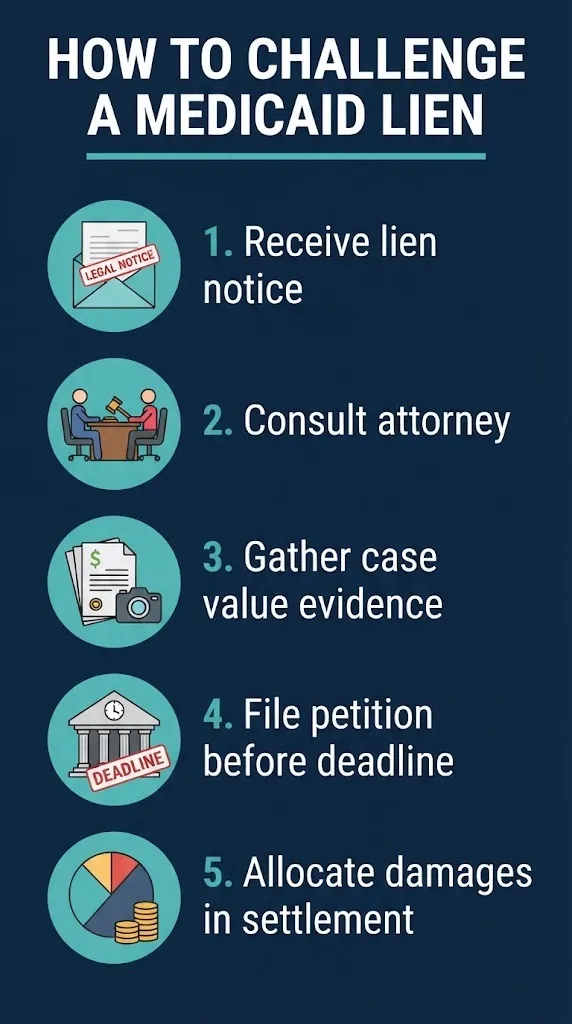
Here are the general steps:
- Receive the lien notice from your state Medicaid agency.
- Consult a personal injury attorney who handles lien disputes in your state.
- Gather evidence of your case’s full value: medical records, expert opinions, comparable verdicts.
- File a petition with the agency or court within the state’s deadline.
- Present evidence that the statutory formula exceeds the amount recovered for past medical expenses.
- Negotiate or litigate the reduction before settlement funds are distributed.
- Ensure the settlement agreement allocates damages between medical and non-medical categories.
Florida gives beneficiaries the right to contest the statutory amount by filing a petition with the Division of Administrative Hearings. To succeed, the beneficiary must prove by clear and convincing evidence that the portion of the recovery allocable to medical expenses is less than the agency’s calculation .
What is the statute of limitations for challenging a Medicaid lien?
The deadline for challenging a Medicaid lien depends on your state’s administrative procedures, not the original statute of limitations for your injury claim. The challenge must be filed before settlement funds are distributed.
In Florida, the petition must be filed with the Division of Administrative Hearings within the time specified in the agency’s notice . Other states have similar administrative deadlines.
If you miss the deadline, the state’s calculation becomes final. You lose the right to challenge it.
Your personal injury attorney should identify the lien issue early in the case, ideally before settlement negotiations conclude. Waiting until the settlement check arrives leaves little time to file a proper challenge.
What happens next with a Medicaid lien?
The next steps depend on whether you are challenging the lien, negotiating a reduction, or resolving it at settlement. The process should begin before the settlement funds are distributed.
Immediately: Notify your attorney that Medicaid paid for treatment related to the injury. Provide any lien notices you receive.
Within days: Your attorney should request a lien payoff statement from the state Medicaid agency.
Before settlement: Calculate the Ahlborn reduction using your case’s full value and the settlement amount.
If the state demands more: File the administrative challenge within the deadline.
At settlement: Ensure funds are allocated between past medical expenses and other damages in the settlement agreement.
After resolution: Medicaid gets paid from the medical expense portion. The rest goes to you.
Frequently Asked Questions
How much can Medicaid take from my personal injury settlement?
Medicaid can take only the portion of your settlement representing past medical expenses it paid. The amount is reduced proportionally if your case settled for less than full value .
Does Medicaid take a percentage of my settlement?
No. Medicaid does not take a fixed percentage. It can recover only what it actually paid for past medical care, subject to the Ahlborn reduction formula .
Can Medicaid take my pain and suffering money?
No. Federal law prohibits Medicaid from recovering any portion of your settlement allocated to pain and suffering, lost wages, or future medical care .
What is the Ahlborn formula?
The Ahlborn formula reduces Medicaid’s lien proportionally when your case settles for less than full value. If your case was worth $1 million and settled for $250,000, Medicaid can only recover 25% of what it paid .
How do I challenge a Medicaid lien?
File a petition with the state Medicaid agency or administrative court before funds are distributed. You must present evidence that the state’s demand exceeds the amount recovered for past medical expenses .
Does Medicaid take from future medical expenses?
Under Gallardo (2022), Medicaid may be able to recover from portions of a settlement allocated to future medical expenses in some jurisdictions. This is a complex issue requiring attorney review .
What happens if I don’t challenge the Medicaid lien?
If you do not challenge the lien within the deadline, the state’s calculation becomes final. You lose the right to reduce the amount owed .
Get an Attorney, Calculate the Formula, Challenge the Overreach
A Medicaid lien can take a huge bite out of your settlement if you let it. But federal law puts limits on what the state can recover. The Ahlborn formula reduces the lien proportionally when your case settles for less than full value.
Do not accept the state’s first demand. Consult an attorney who understands Medicaid lien law. Calculate the formula. File the challenge before the deadline. Your settlement money is yours, and the law protects most of it.