Nursing Home Bed Sores Lawsuit 2026: Settlement Amounts, Stage 4 Verdicts & How to File
Quick Answer
- Yes, you can sue a nursing home for bedsores if you can prove the facility’s negligence caused the injury .
- Settlement amounts vary widely: $450,000 for a concealed Stage 4 case , $1.7 million for a 78-year-old victim , and $4.25 million for a Stage IV case with infections .
- The most important deadline is your state’s statute of limitations, which ranges from 1 to 6 years depending on the state .
You searched for “nursing home bed sores lawsuit” because someone you love developed pressure ulcers in a care facility. Maybe you saw the wound yourself. Maybe the staff tried to hide it. Or maybe you’re just trying to understand whether this is something you can actually hold them accountable for.
Here’s the reality: bedsores are not a normal part of aging. In nursing homes, they are almost always preventable with proper care . Their presence often signals neglect: staff failing to reposition immobile residents, ignoring skin breakdown, or leaving people in soiled conditions for extended periods.
This article breaks down what these cases are actually worth, how to prove negligence, and the deadlines that decide whether you can file at all. You’ll see real settlement figures from 2024 through 2026 and the evidence that makes or breaks these claims.
The Facts
| Item | Details |
|---|---|
| Case Type | Nursing home neglect / personal injury or wrongful death |
| Typical Settlement Range | $450,000 to $4.25 million depending on severity |
| Stage 4 Outcomes | Six and seven-figure recoveries; verdicts can reach $12.8 million |
| Statute of Limitations | 1 to 6 years depending on state |
| Key Evidence | Medical records, photographs, staffing records, expert testimony |
| Common Defendants | Facility, management company, ownership entities |
Is a nursing home bed sores lawsuit real or a scam?
A nursing home bed sores lawsuit is real and represents one of the most common types of elder abuse litigation in the United States . These are civil negligence claims, not class action settlements, and each case is filed individually on behalf of the injured resident or their estate.
The legal basis is straightforward. Nursing homes have a duty to prevent bedsores. When they breach that duty through understaffing, failure to reposition residents, or failure to treat existing wounds, they can be held liable .
The presence of a bedsore alone does not automatically prove a case. You must establish a causal link between the facility’s negligence and the injury . That’s why documentation matters so much.
This is not a scam or a get-rich-quick scheme. These are serious cases involving real harm, sometimes death. The settlements and verdicts reflect the severity of the injuries and the facilities’ failures.
How much can you get from a nursing home bed sores lawsuit?
Settlement and verdict amounts in nursing home bedsore cases range from several hundred thousand dollars to multiple millions, depending on the stage of the wound, complications, the resident’s age, and the strength of the negligence evidence.
Here are verified outcomes from recent cases:
| Outcome | Amount | Key Facts |
|---|---|---|
| Concealed Stage 4 bedsore | $450,000 | Wrongful death; settled before litigation |
| Stage 4 with infections | $4.25 million | Multiple pressure sores, severe decline, understaffing alleged |
| 78-year-old victim | $1.7 million | Settled within one year of filing |
| Fatal bone infection | $1.5 million | Baltimore jury verdict; failure to reposition |
| Michigan AG settlement | $4.5 million | Six nursing homes; systemic neglect including bedsores |
The $4.25 million settlement involved a resident who developed multiple pressure sores including a foul-smelling Stage IV coccyx ulcer, life-threatening infections, major weight loss, and severe physical decline. The lawsuit alleged chronic understaffing and failure to treat wounds .
The Baltimore verdict is particularly instructive. A jury awarded $1.5 million to the estate of a resident who developed a Stage 4 pressure ulcer that led to a fatal bone infection. The facility’s failure to reposition the resident was the key negligence .
Key Takeaway: Stage 3 and Stage 4 bedsores that lead to infection, hospitalization, or death produce the highest recoveries. The more severe the wound and the clearer the negligence, the higher the value.
How do you prove a nursing home bedsore claim?
You prove a nursing home bedsore claim by establishing four elements: duty, breach, causation, and damages. You must show the facility owed a duty to prevent bedsores, breached that duty, and that the breach caused the bedsore and resulting harm .
Here is the evidence that builds a case:
- Medical records documenting the development and progression of the bedsore
- Photographs of the wound, taken from multiple angles with scale references and date stamps
- Expert witness testimony about how the bedsore developed and its lifetime costs
- Eyewitness statements from staff, other residents, and family members
- Nursing home staffing records to show whether understaffing contributed
- The facility’s policies and procedures for bedsore prevention
- Care plan and repositioning logs showing whether required care was actually provided
The gap between what the care plan required and what actually happened often forms the core of the negligence claim .
Family members play a critical role in documentation. Journal entries noting the date, time, wound condition, staff responses, and names of people you spoke with can become powerful evidence .
Reality Check: No one texts you settlement money first. Filing a lawsuit is not free, but reputable attorneys handle these cases on contingency. You pay nothing unless they recover money for you. Any “claim helper” asking for upfront fees is a scam.
What are the stages of bedsores and why do they matter legally?
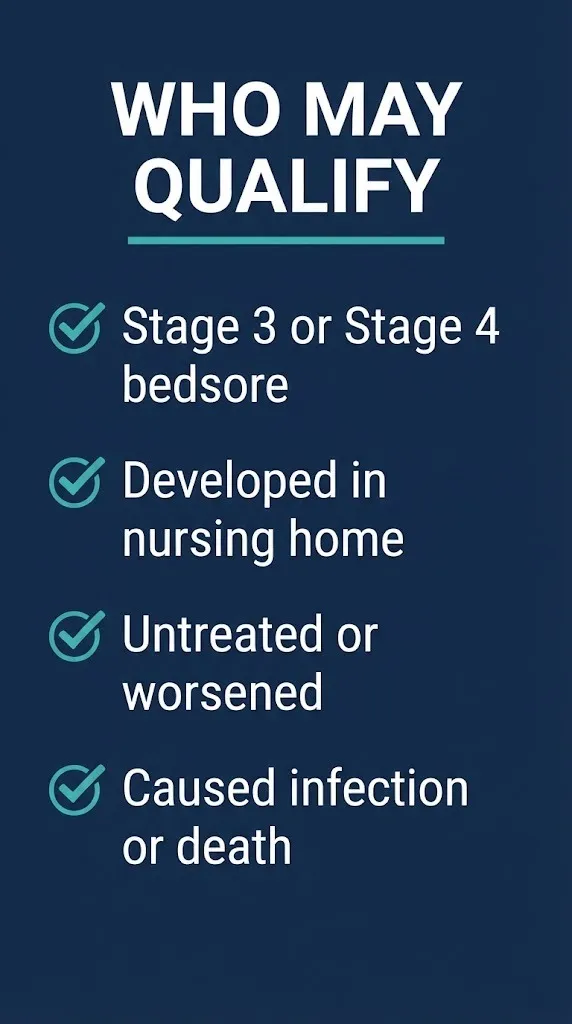
The stage of a bedsore directly affects the value of a lawsuit. Stage 3 and Stage 4 wounds carry the highest settlement and verdict potential because they represent full-thickness tissue loss and life-threatening risk.
Here is the staging system:
- Stage 1: Red or pink skin, no open wound. May feel tender, warm, or firm .
- Stage 2: Shallow wound with pink or red base; skin loss, abrasions, or blisters .
- Stage 3: Wound extends into the fatty layer beneath the skin .
- Stage 4: Wound penetrates all layers of skin, exposing muscle, tendon, or bone .
Stage 3 and Stage 4 bedsores are “nearly always preventable in care settings” and may be evidence of neglect . They take months to heal and can lead to sepsis, bone infection, amputation, or death .
Worldwide, bedsores lead to the deaths of more than 24,000 people each year . The mortality rate for bedsore-related bacteremia is 60% .
How long does a nursing home bedsores lawsuit take?
Most nursing home negligence cases resolve within 12 to 18 months, though complex cases or those that go to trial can take 2 to 3 years or longer . Approximately 90 to 95% of these cases settle before trial .
Here is the typical timeline:
| Stage | Typical Duration | Key Activities |
|---|---|---|
| Case Evaluation | 1-2 weeks | Initial consultation, fee agreement |
| Pre-Suit Investigation | 30-120 days | Medical records, expert review |
| Filing Lawsuit | 1-2 weeks | Complaint drafting, filing, service |
| Discovery | 4-9 months | Depositions, document requests |
| Mediation/Settlement | Variable | Negotiations, settlement discussions |
| Trial | 12-24+ months from filing | Jury trial (3-14 days) |
Stage 3 and Stage 4 cases may take longer because they involve extensive medical records, expert review, and disputes over whether the wound was preventable .
What happens next in a nursing home bedsores lawsuit?
The next steps depend on whether you are gathering evidence, filing a claim, or in active litigation. The most urgent action is preserving evidence and confirming your state’s deadline.
Immediately: Take photographs of the wound. Request complete medical records. Keep a journal of observations .
Within days: Contact a nursing home abuse attorney for a case evaluation. Most work on contingency.
Within weeks: Your attorney will send spoliation letters to preserve records and evidence .
Within 30-120 days: Pre-suit investigation, expert review, and settlement demand.
If settlement fails: File the lawsuit. Discovery follows, then mediation, then trial if necessary.
Before the deadline: Your state’s statute of limitations is the hard cutoff. Missing it almost always bars your claim permanently .
Frequently Asked Questions
Can you sue a nursing home for bedsores?
Yes, you can sue if you can prove the bedsores developed because the facility failed to provide proper care. The presence of a bedsore alone is not enough; you must establish negligence .
How much is a stage 4 bedsore lawsuit worth?
Stage 4 bedsore cases often produce six- and seven-figure recoveries. Verified outcomes include $450,000, $1.7 million, and $4.25 million depending on complications and negligence .
What is the statute of limitations for a nursing home bedsores lawsuit?
The deadline ranges from 1 to 6 years depending on your state. Tennessee is 1 year; Mississippi, Missouri, and North Dakota allow up to 5-6 years. Most states allow 2-3 years .
What evidence do you need to prove a bedsore claim?
Medical records, photographs of the wound, staffing records, care plans, and expert testimony. Documentation of the wound’s progression and the facility’s response is critical .
Do bedsores qualify as wrongful death?
Yes, if the bedsores caused or contributed to death. Families can file wrongful death claims seeking compensation for loss of companionship, funeral expenses, and other damages .
How long does a bedsore lawsuit take to settle?
Most cases resolve in 12 to 18 months. Cases that go to trial can take 2-3 years or longer .
What are the signs of nursing home neglect related to bedsores?
Signs include wounds that are not treated, staff ignoring requests for repositioning, residents left in soiled clothing, unexplained weight loss, and infections that go unaddressed .
Document the Wound, Confirm the Deadline, Act Before Time Runs Out
A nursing home bedsore lawsuit is not about revenge. It is about accountability. The facilities that let these wounds develop and fester need to answer for it.
If you have photographs, medical records, or even just your own memory of what you saw, that is a starting point. Contact a nursing home abuse attorney in your state. Confirm the statute of limitations. Do it now, before the deadline passes and the evidence fades. The most important date is your state’s filing deadline. Missing it means losing your chance forever.