Worker Compensation Claim 2026: How to File, What You Get, and Key Deadlines
Quick Answer
- A worker compensation claim is a no-fault insurance system that pays medical bills and lost wages when you’re hurt on the job.
- Benefits typically replace about two-thirds of your average weekly wage, tax-free, up to your state’s maximum rate.
- The most important deadline is reporting your injury immediately, often within 7 to 30 days, or you risk losing benefits.
You searched for “worker compensation claim” and want a straight answer. Maybe you got hurt at work and don’t know where to start. Maybe your employer or their insurer is giving you the runaround. Or maybe you’re trying to understand what you’re actually entitled to before you sign anything.
Here’s the reality: workers’ compensation is not one federal program. It’s a state-by-state system with different rules, deadlines, benefit rates, and dispute processes. What works in New Jersey may not work in California or Texas. The core promise is the same everywhere: you give up the right to sue your employer in exchange for guaranteed benefits, no matter who was at fault.
This article breaks down how the system works, what you can actually get paid, and exactly how to file a claim before deadlines wipe out your rights.
The Facts
| Item | Details |
|---|---|
| System Type | State-administered, no-fault insurance |
| Benefit Rate | Typically 66 2/3% of average weekly wage |
| New Jersey Max (2026) | $1,598.66 per week |
| New York Max (2026) | $1,281.50 per week |
| Reporting Deadline | Varies: 7 days (Nevada) to 30 days (many states) |
| Filing Deadline | Varies: 1 to 2 years from injury or manifestation |
| Proof Needed | Medical records linking injury to work |
| Administrator | State workers’ compensation board or commission |
What is a worker compensation claim?
A worker compensation claim is a request for benefits filed with your employer’s workers’ compensation insurance carrier after you suffer a work-related injury or illness. The system pays medical expenses and replaces a portion of your lost wages without requiring you to prove your employer was at fault.

Every state except Texas requires most employers to carry workers’ compensation insurance . The coverage is typically mandatory from the first employee hired, though specific rules vary by state.
The system operates as an exclusive remedy. That means you generally cannot sue your employer in civil court for a work injury. In exchange, you get benefits faster and without the burden of proving negligence .
Your claim covers two main categories of benefits: medical care for the work-related condition, and wage replacement if you cannot work while recovering. Some states also provide permanent disability payments if your injury leaves lasting impairment .
Key Takeaway: Workers’ compensation is a trade-off: no lawsuit against your employer, but guaranteed benefits regardless of fault.
How much does a worker compensation claim pay in 2026?
A worker compensation claim typically pays about two-thirds of your average weekly wage, tax-free, up to your state’s maximum rate. The exact amount depends on your earnings before the injury and the state where you work.
Here are the confirmed 2026 maximum weekly rates for several states:
| State | 2026 Max Weekly Benefit | Rate Calculation |
|---|---|---|
| New Jersey | $1,598.66 | 70% of average earnings |
| Pennsylvania | $1,394.00 | 66 2/3% of average earnings |
| New York | $1,281.50 | 2/3 of average weekly wage |
| California | Varies by injury date | Statewide average weekly wage |
New Jersey also has a minimum weekly rate of $320.00, and Pennsylvania pays a flat $697.00 per week for workers earning between $774.44 and $1,045.50 .
Your actual benefit is calculated using your gross earnings for the 52 weeks before your injury, including overtime and other compensation . If you were earning $900 per week in New York, your benefit would be approximately $600 per week, capped at the state maximum.
Workers’ compensation payments are not taxed. That’s a significant difference from regular wages .
How do you file a worker compensation claim?
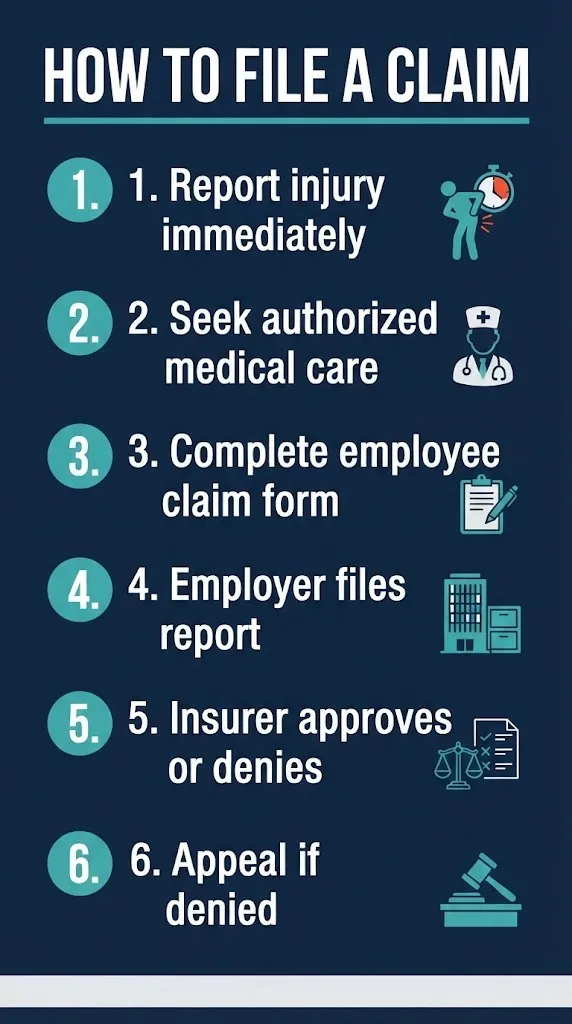
You file a worker compensation claim by reporting your injury to your employer immediately, then seeking authorized medical treatment and ensuring the proper forms get submitted to the insurance carrier.
Here are the standard steps:
- Report the injury to your employer right away. Most states require written notice within 7 to 30 days. Nevada requires written notice within 7 days .
- Seek medical treatment from an authorized provider. Some states require you to see a doctor from the employer’s network. Others let you choose.
- Complete the employee claim form. This is often called a C-4 form or First Report of Injury. Your doctor may need to sign it .
- Ensure the employer files their report. The employer typically has a set number of days (Nevada: 6 working days) to file their report with the insurer .
- Wait for the insurer’s determination. In Nevada, the insurer has 30 days to approve or deny the claim .
- Appeal if denied. Deadlines for appeals vary. Nevada gives 70 days to appeal a denial .
- Keep copies of everything. Every form, every medical record, every communication with the insurer.
If your employer fails to file the claim, you can often file directly with the state workers’ compensation board .
Reality Check: No one texts you workers’ comp money first. Filing a claim is always free. If any “claim helper” asks for a fee to process your workers’ compensation paperwork, that’s a scam. State workers’ compensation boards and insurance carriers process claims without charging you.
What is the deadline to file a worker compensation claim?
The deadline to file a worker compensation claim varies by state, but most fall within 1 to 2 years from the date of injury or from when you knew the injury was work-related. Missing the deadline almost always bars your claim permanently.
Here are the confirmed deadlines from state rules:
- Hawaii: 2 years from when effects of the injury became manifest, and 5 years from the accident
- Nevada: 90 days to seek medical treatment; 7 days to report the injury in writing
- Alberta, Canada: 1 year from injury or diagnosis
- Newfoundland and Labrador: 3 months from injury; 6 months for death claims
The two-prong Hawaii rule is a good example of how courts interpret these deadlines. The clock starts when you reasonably should recognize the nature, seriousness, and probable compensable character of your injury .
Some states allow late filing if you have a justifiable reason for the delay. But don’t count on that exception. Report immediately, file as soon as possible.
What happens if your worker compensation claim is denied?
If your worker compensation claim is denied, you have the right to appeal, but the deadline is strict and varies by state. You must file the appeal with the correct administrative body, not a civil court.
In Nevada, you have 70 days from the date on the denial letter to appeal to the Department of Administration’s Hearings Division . In Arizona, you have 90 days to request a hearing after a Notice of Claim Status .
The appeal process typically works like this:
- File a written request for hearing with the state workers’ compensation board.
- The case goes to an administrative law judge who hears evidence from both sides .
- The judge issues a decision on whether benefits should be paid.
- Either side can appeal to a higher board or court of appeals .
Your medical records are critical at this stage. If your doctor says the injury is work-related and the insurer’s doctor disagrees, the judge weighs the evidence .
Tennessee law provides a useful example of the standard. At an expedited hearing, you must show you would likely prevail at trial to get benefits continued while the case proceeds .
What happens next in a worker compensation claim?
The next steps depend on whether your claim is approved, denied, or disputed. Most claims follow a predictable path from reporting to resolution.
Immediately: Report the injury and seek authorized medical care.
Within 7 to 30 days: Complete and submit the employee claim form and ensure your employer files their report.
Within 30 days (varies): The insurer issues an approval or denial.
If approved: Medical bills get paid and wage benefits begin. You may need to attend independent medical examinations if the insurer requests one .
If denied: File an appeal within your state’s deadline, often 60 to 90 days.
If you reach maximum medical improvement: The doctor determines whether you have permanent impairment and whether you qualify for additional benefits .
If you cannot return to your old job: Some states provide vocational rehabilitation or retraining benefits.
Keep tracking your medical appointments, wage payments, and any communications from the insurer. Documentation wins disputes.
Frequently Asked Questions
What is a worker compensation claim?
A worker compensation claim is a request for medical and wage benefits after a work-related injury or illness. It is filed with your employer’s workers’ compensation insurance carrier.
How much does workers’ compensation pay?
Workers’ comp typically pays about two-thirds of your average weekly wage, tax-free, up to your state’s maximum. New Jersey’s 2026 maximum is $1,598.66 per week .
What is the deadline to file a workers’ compensation claim?
Deadlines vary by state. Most require reporting the injury within 7 to 30 days and filing a formal claim within 1 to 2 years. Hawaii allows 2 years from manifestation and 5 years from the accident .
Can I sue my employer instead of filing workers’ comp?
Generally, no. Workers’ compensation is the exclusive remedy for work injuries. You give up the right to sue in exchange for guaranteed benefits .
What happens if my workers’ comp claim is denied?
You can appeal the denial to your state’s workers’ compensation board. Deadlines vary. Nevada gives 70 days to appeal; Arizona gives 90 days .
Do I need a lawyer for a workers’ compensation claim?
You can file without a lawyer, but many people hire one if the claim is denied or disputed. Attorneys typically work on contingency, meaning they get paid a percentage of your recovery.
What is an independent medical examination?
An IME is a medical evaluation requested by the insurance company, not by you. The doctor examines you and reports to the insurer. You have the right to be treated with dignity during the exam .
Report Immediately, Document Everything, Appeal Before the Deadline
A worker compensation claim is not complicated, but it is deadline-driven. The system rewards people who report fast, document thoroughly, and follow the rules. It punishes people who wait.
If you get hurt at work, tell your employer today. Seek authorized medical care. Keep every piece of paper. If your claim gets denied, appeal before the deadline passes. The clock starts the moment you’re injured, not when you decide to file.