Asbestos Litigation in 2026: Trust Fund Payouts, Claim Deadlines, and What Victims Need to Know
Quick Answer
- Asbestos litigation refers to legal claims filed by people diagnosed with mesothelioma, lung cancer, and other asbestos-related diseases after exposure to asbestos-containing products.
- Compensation varies widely: trust fund payouts range from a few thousand dollars to over $300,000 depending on the disease and number of trusts involved.
- The most urgent deadline passed was February 11, 2026, for Tronox trust future claims, but other trusts remain open with different timelines.
Introduction to Asbestos Litigation
Asbestos litigation is the legal process through which people harmed by asbestos exposure seek compensation from the companies that made or sold asbestos-containing products. This system operates through two main channels: bankruptcy trust funds and traditional lawsuits against companies that have not filed for bankruptcy.
If you or a loved one has been diagnosed with an asbestos-related disease, the path to compensation depends on proving where and how the exposure happened. The companies responsible may have set up trust funds during bankruptcy, or they may still be active defendants in court.
This article explains how asbestos litigation works in 2026, what each trust pays for different diseases, how to file a claim, and what the current deadlines mean for you. One detail that surprises many people: the first asbestos bankruptcy trust was created in 1982 by Johns-Manville, and it still pays claims today .
The Facts
| Item | Detail |
|---|---|
| Case Type | Asbestos bankruptcy trust claims and personal injury lawsuits |
| Status | Active. Over 60 trusts accepting claims. Tronox future claims window closed Feb. 11, 2026. |
| Fund Size | More than $30 billion remaining across all trusts |
| Est. Per Person | $300,000 to $400,000 average total from all trusts, though individual trust payouts are often much lower |
| Claim Deadline | Varies by trust. Statutes of limitations typically 1 to 3 years from diagnosis. |
| Administrator | Individual trustees for each trust. Contact info on each trust’s official website. |
| Proof Needed | Medical diagnosis of asbestos-related disease plus evidence of exposure to a specific company’s products |
Is Asbestos Litigation Legitimate in 2026?
Yes, asbestos litigation is a legitimate and active area of law in 2026. The system has paid out more than $17 billion to claimants since the first trust was established in 1988 .
The legal framework is built on Section 524(g) of the U.S. Bankruptcy Code. This law allows companies overwhelmed by asbestos liability to reorganize and create trusts that compensate current and future victims . A federal bankruptcy judge must approve each trust and its payment structure.
One major development came in 2024 when the U.S. Supreme Court decided Truck Insurance Exchange v. Kaiser Gypsum. That ruling reinforced insurance companies’ rights to participate in asbestos trust bankruptcy proceedings, which affects how some trusts manage their assets and payment percentages .
For claimants, the practical reality is this: the system is real, the money exists, but the process requires documentation. No one hands out settlement checks without proof of diagnosis and exposure.
Key Takeaway: Asbestos litigation is legitimate, government-supervised, and still paying claims, but every payout requires documented proof of disease and exposure.
How Much Can You Get from Asbestos Trust Funds?
Payouts from asbestos trust funds vary dramatically. The average total compensation across all trusts falls between $300,000 and $400,000, but that figure combines payments from multiple trusts .
Individual trust payouts are calculated using a “payment percentage.” This percentage is applied to a scheduled value assigned to each disease. For example, if a trust has a 5% payment percentage and your mesothelioma claim has a scheduled value of $600,000, you receive $30,000 .
Here are current payment percentages and scheduled values from real trusts:
| Trust | Payment % | Mesothelioma Scheduled Value |
|---|---|---|
| SEPCO Asbestos PI Trust | Varies | $53,076 |
| Shook & Fletcher | 58% | $22,000 (AL/MS) or $10,000 (other states) |
| Johns Manville | 5.1% | Varies |
| DII Industries (Halliburton) | 60% | Varies |
| WRG Asbestos PI Trust (W.R. Grace) | 30.1% | Varies |
| NARCO Asbestos Trust | 12.2% | Varies |
Most people qualify for claims against three or more trusts based on their work history . That’s why total compensation can reach into six figures even when individual trust payouts are modest.
For a complete breakdown of the SEPCO scheduled values effective January 1, 2026, mesothelioma claims are valued at $53,076, severe asbestosis at $12,738, and lung cancer claims ranging from $5,309 to $18,046 depending on severity .
Reality Check
No legitimate settlement administrator or trust will ever text you first asking for your Social Security number or bank details to “release your funds.” Filing a trust claim is free, though attorneys typically work on contingency and take a percentage of any recovery. Third-party “claim helpers” who charge upfront fees are unnecessary. You can file directly with a trust or work with an attorney who only gets paid if you do.
How Do You Qualify for an Asbestos Trust Fund Claim?
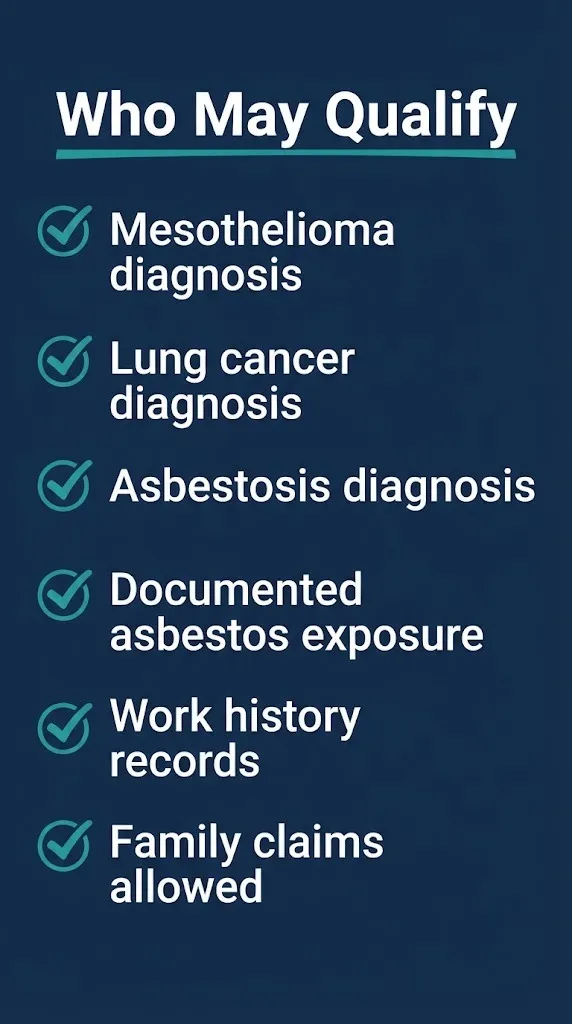
You may qualify for an asbestos trust fund claim if you have a documented asbestos-related disease and can prove exposure to products made by a company that has an active trust. The two core requirements are medical and occupational.
The medical requirement means a confirmed diagnosis of mesothelioma, lung cancer, asbestosis, or another recognized asbestos-related condition. The trust will review your medical records against its specific disease criteria .
The exposure requirement means showing that you worked with or around products from a specific company. This could be through direct handling, working near others who handled asbestos materials, or even household exposure from a family member’s work clothes .
Here’s a checklist of what most trusts require:
- Medical records confirming your diagnosis, including pathology reports and physician statements
- Work history detailing where you worked, when, and what products you handled
- Product identification linking your exposure to a specific trust’s company
- Proof of exposure duration showing meaningful contact with the products
- For family claims: death certificate, autopsy report, and proof of relationship
Family members of people who died from mesothelioma may also file claims on behalf of the estate . The trust will evaluate whether the deceased person would have qualified during their lifetime.
How Do You File an Asbestos Trust Claim?
Filing an asbestos trust claim involves gathering evidence, submitting a claim form, and responding to any requests for additional documentation. The process is similar to filing an insurance claim after a car accident: you need proof, and the adjuster will review it.
Here are the steps to file:
- Gather your medical records showing the asbestos-related diagnosis and treatment history.
- Document your exposure history with employment records, union records, or witness statements.
- Identify which trusts apply to the companies you were exposed to. There are over 60 trusts.
- Complete the trust’s claim form available on the official trust website.
- Submit supporting documentation including medical reports and exposure evidence.
- Respond to trust inquiries if they request additional information.
- Receive a determination and, if approved, a payment based on the trust’s percentage.
- Track filing deadlines because each trust has its own statute of limitations rules.
Most trusts allow electronic filing. Some offer “expedited review” for claims that meet certain criteria, which can speed up processing. Working with an attorney familiar with asbestos trusts can help you file with every trust you qualify for, maximizing your total recovery.
What Are the Current Asbestos Trust Claim Deadlines?
Each asbestos trust sets its own filing deadlines, though most follow state statutes of limitations that typically range from one to three years after diagnosis . There is no single national deadline.
However, some trusts have closed their doors to new claims. The Tronox Incorporated Tort Claims Trust set February 11, 2026, as its final deadline for future tort claims . After that date, no new Category A asbestos claims can be filed against that trust. The trust noted that approved claims would receive “less than half of 1%” of their scheduled value because of the overwhelming number of filings .
For trusts still accepting claims, the deadlines generally work like this:
| Situation | Typical Deadline |
|---|---|
| Living claimant diagnosed with mesothelioma | 1 to 3 years from diagnosis |
| Family claim after death | 1 to 3 years from date of death |
| Lung cancer or asbestosis | 1 to 3 years from diagnosis |
| Tronox future claims | CLOSED Feb. 11, 2026 |
If you are considering a claim, contact the specific trust directly or work with an attorney to confirm the deadline that applies to your situation. Missing a deadline usually means losing the right to compensation permanently.
What Is the Current State of Asbestos Lawsuits in Court?
Asbestos lawsuits against non-bankrupt companies continue to produce significant verdicts in 2026. These cases proceed in state and federal courts and can result in much larger awards than trust fund claims.
In February 2026, a Los Angeles jury awarded $33.38 million to George Stephenson, an 80-year-old former Hollywood cameraman who developed mesothelioma after decades of working around asbestos-containing lighting equipment made by Mole-Richardson . The jury found the company 100% liable and included a finding of malice.
In another California case from February 2026, a judge entered a $24.6 million default judgment in an asbestos-talc suit after the defendant company failed to maintain legal representation .
Not all cases favor plaintiffs. In April 2026, an Illinois jury returned a defense verdict for Merck in a talc-related mesothelioma case, finding that the plaintiff’s genetic mutation, not talc exposure, caused his disease . That case showed that causation remains a contested battleground in asbestos litigation.
These court verdicts matter for trust claimants because they establish the value of asbestos diseases and influence how trusts set their scheduled values.
Key Takeaway: Court verdicts in 2026 range from $24 million to over $33 million for mesothelioma plaintiffs, but defense verdicts still happen when causation evidence is weak.
What Happens Next in Asbestos Litigation?
The asbestos litigation landscape will continue evolving through 2026 and beyond. Here are the key stages to watch:
Expected late 2026: Tronox trust finalizes processing of all Category A claims .
Expected 2027: Tronox trust begins making payments to approved Category A claimants, though legal challenges could delay this .
Ongoing: Other asbestos trusts continue accepting and processing claims. Payment percentages may be adjusted as trusts review their remaining assets.
Ongoing: State attorneys general continue enforcing asbestos regulations. Massachusetts secured a $220,000 settlement in June 2026 from two asbestos services companies for Clean Air Act violations .
Expected 2026-2027: Courts will continue hearing mesothelioma and asbestos-talc cases with significant verdicts likely in plaintiff-friendly jurisdictions.
Frequently Asked Questions
What is asbestos litigation?
Asbestos litigation is the legal process for seeking compensation after exposure to asbestos causes mesothelioma, lung cancer, asbestosis, or other diseases. Claims go through bankruptcy trust funds or lawsuits against solvent companies.
How much can I get from an asbestos trust fund?
Average total compensation across all trusts is $300,000 to $400,000, but individual trust payouts are often lower. Payouts depend on your disease, the trust’s payment percentage, and how many trusts you qualify for.
Can I file a claim if the company went bankrupt?
Yes. Companies that filed for bankruptcy because of asbestos liability were required to create trust funds. You file a claim with the trust instead of suing the company directly.
What proof do I need for an asbestos trust claim?
You need medical records confirming an asbestos-related diagnosis and evidence linking your exposure to a specific company’s products. Work history and product identification are key.
How long does it take to get paid from an asbestos trust?
Processing times vary by trust, but most claims take several months to a year. Some trusts offer expedited review for qualifying claims. Payment follows approval and any required releases.
Is there a deadline for filing an asbestos claim?
Yes. Statutes of limitations generally range from one to three years after diagnosis or death. Some trusts have closed entirely, like Tronox, which stopped accepting future claims on February 11, 2026.
Can family members file an asbestos claim after a loved one dies?
Yes. Spouses, children, and estate representatives can file claims on behalf of someone who died from an asbestos-related disease, provided they have documentation and file within the deadline.
Do I need a lawyer to file an asbestos trust claim?
You can file directly with a trust, but most claimants work with attorneys who specialize in asbestos claims. Attorneys typically work on contingency and can identify all trusts you qualify for.