Litigation and Appeals Lawyer 2026: What They Do, When You Need One, and What It Costs
Quick Answer
- A litigation and appeals lawyer handles both trial-level disputes and post-trial appeals, preserving issues for review and arguing before higher courts.
- Costs vary widely: hourly rates dominate, and appellate work is often billed separately from trial representation.
- Most cases never reach appeal, but the ones that do require different skills than trial work.
If you’re searching for a litigation and appeals lawyer, you’re probably facing a dispute that’s either heading to court or already past a verdict. The question is whether you need one lawyer for both stages, or two.
Litigation and appeals are related but distinct skill sets. Trial lawyers present evidence to juries. Appellate lawyers argue legal errors to panels of judges. Some attorneys do both, but many specialize.
The distinction matters because appellate work is about the record, not new evidence. If you lost at trial, you can’t introduce new facts on appeal. You can only argue that the trial judge made a legal mistake that affected the outcome.
Here’s what a litigation and appeals lawyer actually does, how the process works, and what it costs to hire one.
The Facts
| Role | Representation in trial court and appellate proceedings |
| Key Skills | Legal research, brief writing, oral argument, issue preservation |
| Appellate Salary Range | $106,689 to $340,000 depending on experience |
| Trial vs Appeal | Different skill sets; some attorneys handle both |
| Issue Preservation | Critical for appeal; trial counsel must object properly |
| Timeline | Appeals can take months to years after trial |
What is a litigation and appeals lawyer?
A litigation and appeals lawyer is an attorney who represents clients in both trial-level disputes and appellate proceedings. They handle courtroom litigation, negotiate settlements, and argue cases before appellate courts.
Litigation involves preparing and filing lawsuits, conducting discovery, examining witnesses, and presenting cases to judges or juries. Appeals involve reviewing trial records for legal errors, drafting briefs, and presenting oral arguments to higher courts.
Some attorneys focus on one or the other. A trial specialist may hand off the case to an appellate specialist after a verdict. Others maintain practices that cover both stages.
The State of North Carolina classifies this work as providing “legal support in areas characterized by tested statutes and available case law” while also conducting “courtroom and administrative litigation” and arguing “cases before the appellate courts” .
The key distinction is what happens after a verdict. Trial work is about convincing a fact-finder. Appellate work is about convincing a panel of judges that the trial court made a legal mistake.
How much does a litigation and appeals lawyer cost?
Litigation and appeals lawyer costs vary by experience, location, and case complexity. Hourly rates dominate, and appellate work is often billed separately from trial representation.
International benchmarks show a wide range. Insurance litigation senior associates earn median salaries of $185,000, while commercial litigation partners earn $245,000 . In-house counsel roles can reach $198,000 .
Public-sector appellate positions pay less. Federal Defenders of New York posted an appeals attorney role in March 2026 with a salary range of $106,689 to $197,100 .
Private-firm appellate roles at the senior level command more. Seyfarth Shaw posted an appellate counsel position in California with a range of $255,000 to $340,000 . Lewis Brisbois listed an appellate associate role in San Diego at $145,000 to $170,000 .
These figures reflect salaries, not billing rates. When you hire an appellate lawyer, you’re often paying for their time at rates that reflect their experience and the stakes of the appeal.
Reality Check: No one calls you first and offers to appeal your case for a fee. Court clerks don’t refer you to “approved” appellate lawyers. If someone contacts you claiming your case was mishandled and offers to “fix it” for an upfront fee, that’s a scam. Appeals require a court record, not a payment.
What’s the difference between a litigation lawyer and an appeals lawyer?
A litigation lawyer handles the trial phase, including evidence, witnesses, and jury arguments. An appeals lawyer handles the post-trial phase, focusing on legal errors and written arguments to appellate judges.
The skills required are different. Trial lawyers need quick thinking, witness examination skills, and persuasive storytelling to a jury. Appellate lawyers need deep legal research, precise writing, and the ability to argue legal doctrine to judges.
California’s state bar explains that appellate specialists “strategize, draft legal pleadings, manage motions, and prepare jury instructions” while also handling “post-trial motions and stays” and “preparing briefs and petitions” .
The California bar notes that “success in appeals often hinges on trial court outcomes” and that “establishing a strong appellate record is key to securing a final victory” .
This means trial counsel and appellate counsel need to work together. If the trial lawyer fails to object to evidence or preserve an issue, the appellate lawyer may be barred from raising it later.
How do you prepare for an appeal?
You prepare for an appeal by preserving issues during trial, ordering transcripts, and filing a notice of appeal within strict deadlines. Missing a deadline can forfeit your right to appeal entirely.
Here are the key steps:
- Preserve issues at trial. Your trial lawyer must object to errors and make offers of proof.
- Order the trial transcript. The appellate court reviews the record, not new evidence.
- File a notice of appeal. Deadlines are typically 30 days from judgment in federal court.
- Identify appealable issues. Not every error is grounds for reversal.
- Draft the appellate brief. This is the core of the appeal, not oral argument.
- Prepare for oral argument. Some courts hear argument; others decide on briefs alone.
- Await the decision. Appellate courts can affirm, reverse, or remand for a new trial.
The appellate process is written-heavy. Briefs are the primary vehicle for persuasion. Oral argument, when it happens, is often brief and focused on specific questions from the panel.
Key Takeaway: The most important thing you can do for an appeal happens before the verdict, when your trial lawyer preserves issues for review.
What does an appellate lawyer actually do?
An appellate lawyer reviews trial records, identifies legal errors, drafts briefs, and argues before appellate courts. They also assess whether an appeal has merit and is worth pursuing.
The job is analytical, not dramatic. Clyde & Co describes appellate attorneys as handling “appeals in state and federal courts, including drafting appellate briefs, motions, and petitions” and working “closely with trial attorneys to identify and preserve appellate issues throughout all stages of litigation” .
A significant part of the role is evaluating cases. The California bar notes that appellate specialists assess “writ petitions and appeals” and determine “when there’s a high chance of improving the outcome, and when it’s unlikely,” which helps “conserve resources and uphold credibility” .
This means a good appellate lawyer will sometimes tell you not to appeal. If the trial was fair and the law was applied correctly, an appeal is just an expensive delay.
How long does the appeals process take?
The appeals process typically takes six months to two years, depending on the court and complexity. Federal circuit courts average about six months from filing to decision. State courts vary widely.
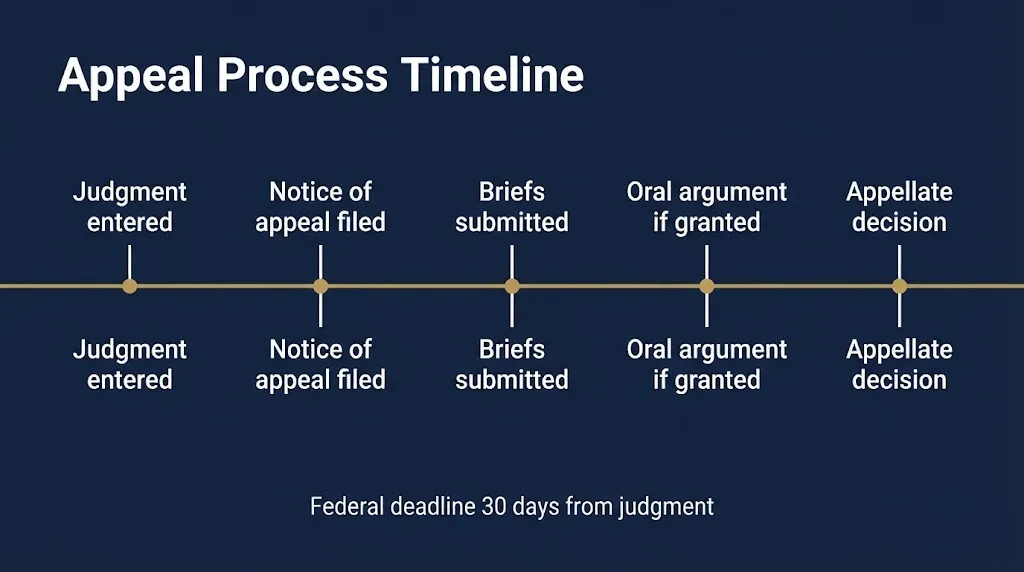
The timeline starts with the notice of appeal, which is filed shortly after judgment. The record is then assembled, including transcripts. Briefing follows, with the appellant filing first, then the appellee responding, and the appellant possibly filing a reply.
Oral argument, if granted, comes after briefing. The court then issues a decision, often months later. Further review by a higher court, such as a state supreme court or the U.S. Supreme Court, adds additional time.
The appeal doesn’t stay the underlying judgment automatically. A stay requires a separate motion and often a bond. This means you might be appealing while the other side is trying to collect.
What happens next in your appeal?
Immediately: File the notice of appeal within the deadline, which is often 30 days in federal court.
Within weeks: Order the trial transcript and assemble the record.
Expected 1 to 3 months: Draft and file the appellant’s brief.
Expected 3 to 6 months: Appellee’s brief and appellant’s reply, if any.
Expected 6 to 12 months: Oral argument (if granted) and decision.
Frequently Asked Questions
What does a litigation and appeals lawyer do?
A litigation and appeals lawyer represents clients in trial court and appellate proceedings. They handle courtroom litigation, negotiate settlements, draft appellate briefs, and argue cases before higher courts.
How much does an appeals lawyer cost?
Appeals lawyer salaries range from $106,689 to $340,000 depending on experience and location . Hourly billing rates vary by firm and case complexity, and appellate work is often billed separately from trial representation.
Do I need a different lawyer for an appeal?
Not always, but appellate work requires different skills than trial work. Some attorneys handle both stages. Others specialize, and trial counsel may hand off the case to an appellate specialist after a verdict.
What is the deadline to file an appeal?
In federal court, the notice of appeal is typically due 30 days after judgment. State deadlines vary. Missing the deadline can forfeit your right to appeal entirely.
Can I introduce new evidence on appeal?
No. Appellate courts review the trial record for legal errors. New evidence is generally not allowed. This is why preserving issues during trial is critical.
How long does an appeal take?
Federal circuit courts average about six months from filing to decision. State courts vary widely. Complex cases and further review by higher courts can extend the timeline to two years or more.
What happens if I win my appeal?
If the appellate court reverses, it may remand for a new trial, order entry of judgment in your favor, or take other action. The outcome depends on the nature of the error and the relief sought.
Gather your trial record and note the date of judgment. That date starts the clock for your notice of appeal. If you’re considering an appeal, consult an appellate lawyer before the deadline passes, because missing it ends the case.