Structured Settlement Attorney 2026: Why You Need One Before Selling Your Payments
Quick Answer
- What is it? An attorney who reviews structured settlement transfer petitions, ensures court approval, and protects you from unfair discount rates.
- How much do they cost? Fees vary. Independent brokers often split annuity commissions with defendant-selected brokers at no cost to you.
- Key deadline: Court approval is mandatory. Any transfer without a judge’s order is unenforceable under state law.
If you receive structured settlement payments and someone offers you cash now, you need a structured settlement attorney. Not a broker. Not a factoring company’s “representative.” An attorney who works for you.
The structured settlement factoring industry buys roughly $1 billion in future payments each year . The companies that dominate this market spend heavily on advertising and aggressive sales tactics. Their offers often carry discount rates that exceed 50% per year . Courts have called these deals exploitative for decades.
But the law gives you a shield. Every state except New Hampshire has a Structured Settlement Protection Act . These laws require court approval before any transfer. The judge must find the deal is in your best interest and that the discount rate is fair. An attorney is your best tool for surviving that process.
This article breaks down what a structured settlement attorney actually does, how the court approval process works, why discount rates matter more than the lump sum you’re offered, and how to tell the difference between legal advice and a sales pitch.
The Facts
| Item | Detail |
|---|---|
| What It Is | Legal representation for reviewing, negotiating, or challenging a structured settlement transfer |
| Governing Law | State Structured Settlement Protection Acts (SSPAs) |
| Federal Tax Rule | IRC § 5891 imposes a 40% excise tax on transfers without court approval |
| Court Approval | Mandatory in every state except New Hampshire |
| Key Finding Required | Transfer must be in the payee’s “best interest” and discount rate “fair and reasonable” |
| Fee Structure | Often paid through commission splitting between brokers; no cost to payee |
What does a structured settlement attorney do?
A structured settlement attorney represents you in the court process required to sell or transfer your future payments, and advises you on whether the deal is fair. They are not the same as the factoring company’s lawyer.
The factoring company will have its own attorney. That lawyer works for the buyer, not for you. Their job is to get the transfer approved at the highest possible discount rate. Your attorney’s job is to scrutinize the deal.
Here is what a structured settlement attorney does:
- Reviews the transfer agreement: Checks the discount rate, fees, and net advance amount against what the law requires.
- Prepares or responds to the court petition: Files the required documents in the county where you live.
- Advises on “best interest”: Explains how the transfer affects your long-term financial security and your dependents.
- Ensures statutory compliance: Verifies the disclosure statement was provided at least 10 days before you signed .
- Represents you at the hearing: Presents your position to the judge.
In New York, the court requires that you be advised in writing to seek independent professional advice. You must either receive that advice or knowingly waive it . A structured settlement attorney is the professional advice the statute contemplates.
Key Takeaway: A structured settlement attorney works for you, not the buyer. Their job is to ensure the deal meets legal standards and protects your interests.
How much does a structured settlement attorney cost?
A structured settlement attorney often costs you nothing out of pocket, because plaintiff’s brokers and defendant’s brokers can split the annuity commission. This is a critical distinction that most factoring companies won’t explain.
The court rules in New York explicitly state that when both a plaintiff’s broker and a defendant’s broker are involved, “both brokers can be compensated by a splitting of the annuity commission so there is no cost to the plaintiff or the attorney” .
That arrangement applies during the original settlement, not the factoring transaction. But it shows the industry norm: commissions are built into the annuity cost, not billed separately.
For transfer petitions, the factoring company typically pays the filing fees and court costs. Your attorney’s fee may be deducted from the net advance amount, or you may pay hourly. You need to ask upfront.
What you should never do is pay a factoring company a fee to “process” your transfer. The court process is mandatory. The buyer bears the cost of complying with it.
Key Takeaway: Commission splitting can make attorney involvement cost-neutral. Always ask who pays what before signing anything.
How does the court approval process work?
Court approval is mandatory in every state except New Hampshire. A judge must find the transfer is in your best interest and the discount rate is fair and reasonable.
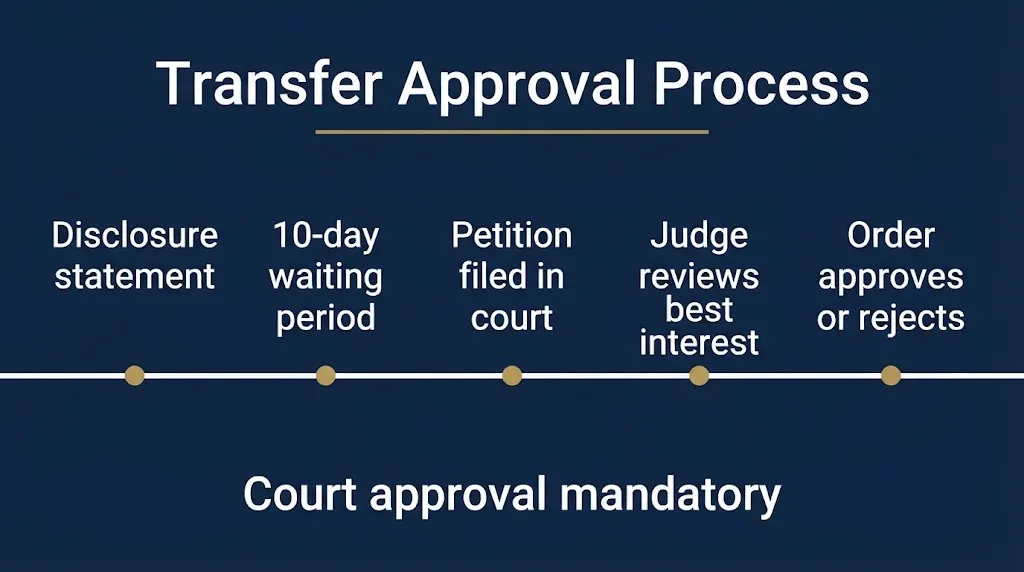
The process follows a specific sequence under state Structured Settlement Protection Acts :
- Disclosure statement: The buyer must provide you a written disclosure at least 10 days before you sign the transfer agreement. It must include the aggregate amount, discounted present value, gross advance, itemized fees, and net advance .
- Petition filing: The buyer files a special proceeding in the county where you live or where the settlement was approved.
- Service on interested parties: All parties with an interest in the payments must receive notice at least 20 days before the hearing.
- Court review: The judge examines whether the transfer complies with the statute, is in your best interest, and uses a fair discount rate.
- Hearing: The judge may hold a hearing to question the terms and your understanding.
- Order: If approved, the judge signs an order authorizing the transfer.
The federal tax code backs this up. IRC § 5891 imposes a 40% excise tax on any factoring company that completes a transfer without a qualified court order . That tax is punitive. It exists because Congress wanted to stop predatory transfers.
Key Takeaway: Court approval is not a formality. It’s the law’s primary protection against exploitation.
What is a fair discount rate in a structured settlement transfer?
A fair discount rate is one that leaves you with a substantial portion of the present value of your future payments. Courts have rejected deals where the discount exceeds 50%.
This is the number that matters most. The discount rate determines how much money the factoring company keeps versus how much you receive.
New York courts have held that transfers resulting in the transferee paying “less than half of its present discounted value” are not fair and reasonable under the SSPA . In plain terms: if you’re selling $100,000 in future payments and the present value is $60,000, a deal that pays you $25,000 is presumptively unfair.
The legislative history is blunt. The New York Attorney General noted that structured settlement factoring “can involve discounts corresponding to over 50% interest per year” .
John Oliver covered this industry on Last Week Tonight and called it “full of predators.” He noted that factoring companies “can take 60% of the money on average” .
Your attorney’s job is to calculate the present value and compare it to the offer. If the math doesn’t work, the judge shouldn’t approve it.
Key Takeaway: The discount rate is the single most important number in your transfer. If the buyer won’t disclose it clearly, walk away.
What does “best interest” mean in a structured settlement transfer?
“Best interest” means the transfer provides needed financial relief without destroying the long-term security your structured settlement was designed to provide.
The statute requires the judge to consider “the welfare and support of the payee’s dependents” along with whether the transaction is fair . It’s an individualized analysis, not a rubber stamp.
Courts look at several factors :
- Your age and capacity: Are you able to understand the transaction?
- Your income independent of the payments: Can you survive without selling?
- The stated purpose: What is the money for? Medical bills? Housing? Debt?
- Your ability to appreciate the consequences: Do you understand what you’re giving up?
The New York Attorney General’s office has noted “a very positive trend among members of the Judiciary to be sparing in approval of such sales” . Judges are not required to approve a transfer just because you signed the paperwork.
A structured settlement attorney can help you present a coherent case for why the transfer serves your best interest, or advise you to walk away if it doesn’t.
Key Takeaway: Best interest is not automatic. The judge looks at your whole situation, not just the paperwork.
What happens if you sell without court approval?
Any transfer without court approval is unenforceable. You can keep receiving your payments, and the buyer cannot enforce the deal.
This is the statutory consequence. New York law states that “any purported transfer entered into after July 1, 2002 without court approval is unenforceable, and payees may not waive their rights under the Act” .
The federal tax consequences fall on the buyer. IRC § 5891 imposes the 40% excise tax on the factoring company, not on you .
But the practical reality is messier. If you accept money and sign a transfer agreement without court approval, the buyer may still try to collect. You could face litigation. The safest path is never to sign anything before a judge approves it.
Some companies may pressure you to sign quickly and promise to “handle the court stuff later.” That’s a red flag. The disclosure statement must be delivered at least 10 days before you sign, and the petition must be filed before any transfer is effective.
Key Takeaway: Court approval is not optional. A transfer without a judge’s order is void, and you should not sign anything before the process is complete.
How do you choose the right structured settlement attorney?
You choose a structured settlement attorney who works for you, not for the factoring company, and who has experience with the SSPA in your state.
Here is what to look for:
- Independence: The attorney should have no financial relationship with the factoring company making the offer.
- SSPA experience: Structured settlement law is a niche. You want someone who has handled transfer petitions in your state.
- Court track record: Ask how many transfer petitions they’ve handled and whether any were rejected.
- Willingness to say no: A good attorney will tell you when a deal is bad and advise you not to sign.
- Clear fee explanation: You should know upfront who pays the attorney and how much.
The court rules in New York require plaintiff’s counsel to retain a structure broker before discussing a structured settlement. The same principle applies here: you need independent representation, not the buyer’s sales pitch .
If you already received a quote from a factoring company, take it to an attorney before signing anything. The consultation is often free.
Key Takeaway: Independence is the most important quality. If the attorney is paid by the buyer, they are not your attorney.
Reality Check
No one texts you a lump sum offer out of generosity. Factoring companies buy structured settlement payments because they make money on the discount. That’s not automatically bad, but it means the first offer is rarely the best offer. Court approval exists because the industry has a documented history of exploitation. An attorney’s job is to make the system work for you, not just for the buyer. And you never need to pay a factoring company a fee to “process” a transfer that a judge has to approve anyway.
What happens next in the structured settlement transfer process?
Step 1: You receive a quote from a factoring company. Do not sign anything yet.
Step 2: Consult an independent structured settlement attorney. Review the discount rate and net advance.
Step 3: If you proceed, the buyer provides a disclosure statement at least 10 days before you sign.
Step 4: The buyer files a court petition in your county.
Step 5: A hearing is held. The judge reviews whether the transfer is in your best interest.
Step 6: If approved, the judge signs an order. Funds are released.
Step 7: If rejected, the transfer is void. You keep your payments.
Frequently Asked Questions
Do I need a lawyer to sell my structured settlement?
You are not required to hire one, but the court must approve the transfer. An independent attorney helps ensure the deal is fair and the process complies with state law.
How much does a structured settlement attorney cost?
Fees vary. In some arrangements, commission splitting between brokers makes attorney involvement cost-neutral. Ask upfront who pays.
What is a Structured Settlement Protection Act?
It’s a state law that requires court approval before you can transfer your future payments. Every state except New Hampshire has one.
What happens if the court rejects my transfer?
The transfer is void. You keep receiving your payments. The buyer cannot enforce the deal.
What is a fair discount rate?
Courts have rejected deals where the payee receives less than half the present value. Discount rates over 50% are often found unfair.
Can I sell just part of my structured settlement?
Yes. Partial sales are common. You can transfer some payments while keeping others.
Is the 40% federal excise tax my responsibility?
No. IRC § 5891 imposes the tax on the factoring company if it fails to get court approval. It’s designed to punish non-compliant transfers.
What should I ask a structured settlement attorney?
Ask about their experience with the SSPA, who pays their fee, and whether they have any financial relationship with the factoring company.
If you’re considering selling your structured settlement payments, talk to an independent attorney before you sign anything. The court approval process is your protection. The discount rate determines whether the deal is fair. The single most important fact: any transfer without a judge’s order is unenforceable, and you never have to pay a factoring company to process a transfer that requires court approval.