Is selling my structured settlement legit or a scam
Quick Answer
- Selling your structured settlement is legal in nearly every state but always requires a judge’s approval first.
- You will not get full value. Buyers apply a discount rate, commonly reported between 9% and 18% in 2026, so you receive less than the total future payments.
- There is no fixed deadline. The timeline runs 30 to 60 days from signing a purchase agreement to receiving cash, based on how fast your local court schedules the hearing.
If you searched “I have a structured settlement and I need cash now,” you’re not looking at a class action. You’re facing a personal decision about your own money, and the process to unlock it is regulated, not automatic.
You can sell some or all of your future structured settlement payments to a factoring company for a lump sum. Federal law and structured settlement protection acts in 49 states plus Washington, D.C. require a judge to review and approve the sale before you get a dollar. That single fact trips up most first-time sellers, who expect a quick wire transfer like a payday loan.
This article covers what selling actually involves, how much you’ll lose to the discount rate, how the court hearing works, which red flags signal a bad deal, and what alternatives exist if you’d rather keep your payments intact. One detail that surprises most people: courts deny a real share of these petitions, not just rubber-stamp them.
The Facts
| Topic | What’s Confirmed |
|---|---|
| Is this a lawsuit or settlement fund | No. This is a personal transaction, not a class action or claims process |
| Legal basis | Federal Structured Settlement Protection Act plus state-level protection acts in 49 states and D.C. |
| Typical discount rate (2026) | Reported range of roughly 9% to 18%, varying by buyer, payment size, and years remaining |
| Court approval required | Yes, in nearly every state before a sale can close |
| Typical timeline | About 30 to 60 days from signed agreement to funded lump sum |
| Petition denial rate | Some industry sources report single-digit to mid-teens percentage of petitions denied or withdrawn; exact rate varies heavily by state and case |
| Tax impact | Selling a tax-free personal injury or wrongful death structured settlement is generally not itself a new taxable event, but confirm with a tax professional |
| Who regulates buyers | State attorneys general and structured settlement protection acts; the CFPB has pursued individual companies for deceptive practices |
Is selling my structured settlement legit or a scam
Selling your structured settlement is a legal, regulated transaction, not inherently a scam. It only becomes a scam when a specific company misleads you, hides fees, or pressures you before a judge signs off.
The transaction itself, called a structured settlement factoring transaction, has existed since the 1990s. Congress built federal tax rules around it under 26 U.S.C. § 5891, and every state except Wyoming has its own protection act layered on top.
What makes it risky isn’t the concept. It’s the sales tactics some buyers use.
What separates a legitimate sale from a scam:
- A legitimate buyer discloses the discount rate and total dollar loss in writing before you sign anything
- A legitimate buyer never asks you to skip the court hearing
- A legitimate buyer does not steer you to their own “independent advisor” who is secretly paid by them
The Consumer Financial Protection Bureau sued a structured settlement company, Access Funding, alleging it steered consumers to receive independent advice from an attorney who was paid directly by the company and indicated to consumers that the transactions required very little scrutiny. That case ended in a settlement barring the individuals involved from certain referral practices.
How much cash will I actually get for my structured settlement
You’ll typically receive somewhere between 70% and 91% of the total face value of the payments you sell, depending on the discount rate the buyer applies. There is no single “average check” figure because every settlement’s size, payment schedule, and remaining term is different.
The discount rate is the number that matters most. It’s the percentage a factoring company subtracts to account for the time value of money and its own cost of capital and profit.
Example math, using industry-reported 2026 ranges:
| Scenario | Total Future Value | Discount Rate | Estimated Lump Sum |
|---|---|---|---|
| Lower discount rate | $100,000 | 9% | Roughly $86,000 to $91,000 |
| Mid-range discount rate | $100,000 | 14% | Roughly $75,000 to $80,000 |
| Higher discount rate | $100,000 | 18% | Roughly $65,000 to $72,000 |
These are illustrative ranges pulled from industry sources reporting on the 2026 secondary annuity market. Your actual quote depends on your specific payment stream, so treat any number here as a starting point for comparison shopping, not a promise.
Key Takeaway: You will always receive less than your payments are worth on paper, so the real question isn’t whether you’ll lose money, it’s how much, and shopping multiple quotes is the main lever you control.
How do I sell a structured settlement, step by step
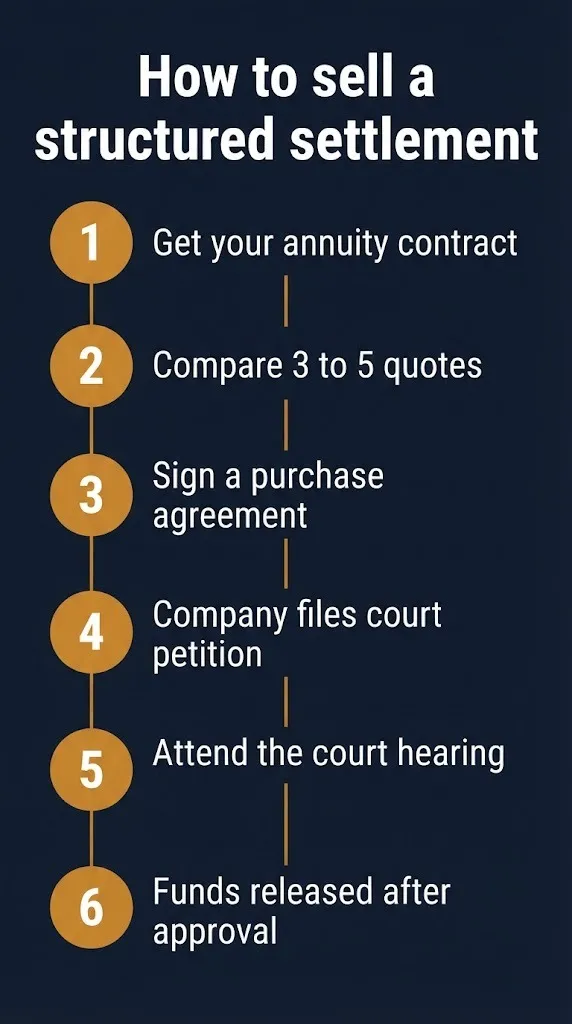
Selling requires a documented court process, not a phone call and a wire transfer. You petition a judge, the judge reviews whether the sale serves your best interest, and only after approval does the money move.
The general process:
- Request a copy of your annuity contract or settlement agreement from the insurance company that issues your payments.
- Get quotes from at least 3 to 5 licensed factoring companies, not just the first one that contacts you.
- Compare the effective discount rate and any fees, not just the headline cash offer.
- Sign a purchase agreement with the company offering the best net payout.
- The company files a petition with your local court under your state’s structured settlement protection act.
- Attend the court hearing, in person or sometimes by phone, where a judge asks about your reason for selling.
- If approved, the court issues an order authorizing the transfer.
- Funds are typically released within days to a few weeks after the order is signed.
Most sellers can choose a partial sale instead of selling every future payment. Selling only what you need keeps some income intact and can also make a judge more comfortable approving the petition.
Do I need a lawyer or court approval to sell my structured settlement
Yes, court approval is required in nearly every state, and several states specifically require you to consult an independent financial or legal advisor first. You generally do not need to hire your own separate attorney to file the petition, since the buying company’s legal team typically handles the filing, but independent advice protects your interests.
Some states, including Maryland, require that a consumer have consulted with an independent professional advisor before the court will approve a sale. That advisor is supposed to work for you, not the buyer.
Reality Check: A structured settlement company that tells you court approval is “just a formality” or offers to skip it is not being straight with you. Skipping the hearing isn’t an option under state law, and any company suggesting otherwise is a warning sign, not a shortcut.
What documents do I need to sell my structured settlement
You’ll generally need your original settlement agreement or annuity contract, proof of identity, and a written explanation of why you want to sell. Courts want to see the sale serves a real, current need, not just a preference for cash.
Commonly requested items:
- Copy of your structured settlement agreement or annuity contract
- Government-issued photo ID
- A written statement or affidavit explaining your reason for selling
- Supporting documents for that reason, such as medical bills, an eviction notice, or a debt statement
- Any prior court orders if you’ve sold payments before
Courts in states like California have published data on this process. A California Attorney General report found that of 632 petitions filed in a review period, 85.6% were approved, 3.8% were denied, and 10.1% were withdrawn, though that data reflects an earlier period and current approval patterns will vary.
Can I sell only part of my structured settlement instead of all of it
Yes, a partial sale is common and often preferred. You sell a specific number of payments or a fixed dollar amount, and your remaining structured settlement continues on its original schedule.
Why sellers choose partial sales:
- Keeps future income flowing for ongoing needs like medical care
- Can result in a slightly better discount rate since the buyer takes on less risk
- Signals financial responsibility to the judge reviewing your petition
- Leaves the door open to sell more later if needed
Think of it the way you’d think about refinancing part of a loan instead of the whole balance. You’re solving today’s problem without giving up every future dollar.
How long does it take to get cash from selling a structured settlement
Most transactions close in about 30 to 60 days from the day you sign a purchase agreement to the day funds arrive, though this varies by court backlog and state. Some companies advertise faster timelines, but the court hearing is the step you can’t control or skip.
What affects your timeline:
- Your state’s court calendar and how quickly hearings get scheduled
- Whether your paperwork is complete on the first submission
- Whether you’re selling from a state with additional disclosure or waiting-period rules
- Whether the buyer offers a cash advance while you wait
Some companies offer a pre-approval cash advance against your pending sale. That advance is still a loan or advance against the eventual proceeds, not free money, so read the terms before accepting one.
What is the discount rate and why does it matter so much
The discount rate is the percentage a factoring company applies to your future payments to calculate their present-day cash value, and it is the single biggest factor in your final payout. A lower rate always means more cash in your pocket for the same payment stream.
Industry sources reporting on the 2026 market describe discount rates typically ranging from 9% to 18%, according to the National Structured Settlements Trade Association. Rates vary based on your total payment size, how many years remain, and how many companies compete for your business.
What moves your rate:
| Factor | Effect on Rate |
|---|---|
| Larger total settlement value | Often lower rate |
| Payments already in progress vs. not yet started | Payments in progress often get better rates |
| Getting 3-5 competing quotes | Can lower your effective rate meaningfully |
| Smaller or unusual payment schedules | Often higher rate |
| Selling all payments vs. a partial sale | Partial sales sometimes get slightly better rates |
Always ask for the “effective discount rate,” which folds in fees, not just the headline number a company quotes you first.
Are there hidden fees when I sell a structured settlement
Sometimes, yes. Fees can include court filing costs, processing charges, and administrative fees that aren’t always broken out separately from the discount rate quote.
Ask every company directly:
- Is the discount rate you quoted the effective rate, including all fees?
- Are there separate processing or administrative charges?
- Who pays the court filing fee, you or the company?
- Is there a cost if the petition is denied and the deal doesn’t close?
A lower headline discount rate paired with several hundred or thousand dollars in fees can end up costing you more than a slightly higher rate with no fees. Get every offer in writing and compare the final net number, not the marketing number.
What happens if the judge denies my petition to sell
If a judge denies your petition, the sale does not go through and your structured settlement payments continue as originally scheduled. You can typically refile later, sometimes with a different buyer or better documentation of your need.
Judges most often raise concerns when the discount rate looks unusually high, the stated reason for selling seems weak, or the seller appears to be repeatedly cashing out payments in a pattern that suggests the underlying settlement’s purpose, often long-term medical or living support, isn’t being protected.
Steps if you’re denied:
- Ask the court or your advisor for the specific reason cited in the denial.
- Get a competing quote with a lower discount rate if that was the issue.
- Strengthen your documentation of financial need.
- Consider a smaller, partial sale instead of a full one.
- Consult an independent advisor before refiling.
What are the alternatives to selling my structured settlement
Selling isn’t your only option if you need cash. Depending on your situation, a personal loan, a structured settlement cash advance, or negotiating directly with creditors may cost you less over time than a permanent sale.
Options worth comparing before you sell:
- Personal loan or line of credit: Keeps your full structured settlement intact if you can qualify at a reasonable rate.
- Cash advance against a pending sale: Faster access, but it’s still borrowed money tied to a future transaction.
- Payment plans with creditors or medical providers: Many hospitals and creditors will negotiate before you need to touch settlement income.
- Emergency assistance programs: Local nonprofits or state programs sometimes cover the exact gap you’re trying to solve with a sale.
A structured settlement sale is permanent. Once payments are sold, they’re gone, the way a home equity loan permanently reduces what you’d walk away with when you sell your house. Exhaust reversible options first if time allows.
Which companies buy structured settlements and how do I compare them
Several licensed factoring companies operate nationally, and they compete on discount rate, fees, and speed, not on being fundamentally different products. No single company is confirmed here as “the best,” since rates change and vary by individual case.
How to actually compare them:
- Request written quotes from at least 3 to 5 companies for the same payment stream.
- Compare the effective discount rate, not the marketing headline.
- Ask each company to disclose all fees in writing.
- Check your state attorney general’s office for any complaints or actions against a company.
- Confirm the company is registered to do business, and to purchase settlements, in your state.
Key Takeaway: The single biggest thing within your control is getting multiple competing quotes, since identical payment streams can generate offers that differ by thousands of dollars.
Is my structured settlement money taxable if I sell it
Generally, no new tax is created simply by selling. Structured settlements from personal injury, physical sickness, or wrongful death cases are tax-free under federal law, and selling those payments typically does not change that.
That said, tax treatment can depend on the type of underlying settlement, so confirm your specific situation with a tax professional or accountant before finalizing a sale, especially if any portion of your settlement was not related to physical injury.
What Happens Next
Anytime you’re ready: Research and request quotes from multiple licensed factoring companies for your specific payment stream.
After you sign an agreement: The buyer typically files a petition with your local court under your state’s protection act.
Expected 2 to 6 weeks later: A court hearing is scheduled where a judge reviews whether the sale serves your best interest.
If approved: The court issues a transfer order authorizing the sale.
Typically within days to a few weeks after approval: Funds are released to you, completing the roughly 30 to 60 day process from signing to payout.
Frequently Asked Questions
Can I sell my structured settlement without going to court?
No, court approval is required in nearly every state before a sale can legally close.
Any company suggesting you can skip this step is not describing a legitimate transaction.
How much of my structured settlement will I lose if I sell it?
It depends on the discount rate applied, commonly reported between 9% and 18% in 2026 industry sources.
On a $100,000 payment stream, that can mean receiving roughly $65,000 to $91,000 depending on the rate and terms.
Is selling a structured settlement a scam?
The transaction itself is legal and regulated, but individual companies have faced regulatory action for deceptive practices.
Compare multiple offers in writing and use an independent advisor if your state requires or allows one.
How long does it take to sell a structured settlement?
Most transactions take about 30 to 60 days from signing a purchase agreement to receiving funds.
Court scheduling is usually the biggest variable in how fast the process moves.
Can I sell only some of my payments instead of all of them?
Yes, partial sales are common and let your remaining payments continue on their original schedule.
Many advisors suggest selling only the amount you actually need.
Will selling my structured settlement affect my taxes?
Generally no new tax liability is created by selling a tax-free personal injury or wrongful death structured settlement.
Confirm your specific case with a tax professional before finalizing anything.
What if a court denies my request to sell?
Your structured settlement payments simply continue as scheduled, and you can typically refile later.
Common reasons for denial include a high discount rate or a weak stated reason for selling.
Do I need my own lawyer to sell a structured settlement?
Not always, but several states require independent professional advice before a judge will approve the sale.
That advisor should be paid by you or truly independent, not selected and paid by the buying company.
Bottom Line
Needing cash now doesn’t mean you’re stuck waiting on your full structured settlement schedule, but it also doesn’t mean fast, full-value money. Expect a real discount, a real court hearing, and a real timeline of weeks, not days.
Compare several written quotes before you sign anything, and confirm your state’s specific court requirements. The 30 to 60 day process and 9% to 18% discount range are the two numbers to plan around.