Describe How Total Job Benefits and Total Employee Compensation Differ 2026
Quick Answer
- Total job benefits are one part of total employee compensation. Benefits are not separate from compensation.
- Total employee compensation equals wages and salaries plus all benefits. It is the complete employer cost.
- The most important number is the benefits share, which the Bureau of Labor Statistics puts near 30 percent of total compensation.
If you are searching this phrase, you are likely taking a business, HR, or economics course. Or you are reviewing a compensation report and need the distinction clearly.
The answer is straightforward. Total job benefits are a subset of total employee compensation. They are not two separate things. One is the part. The other is the whole.
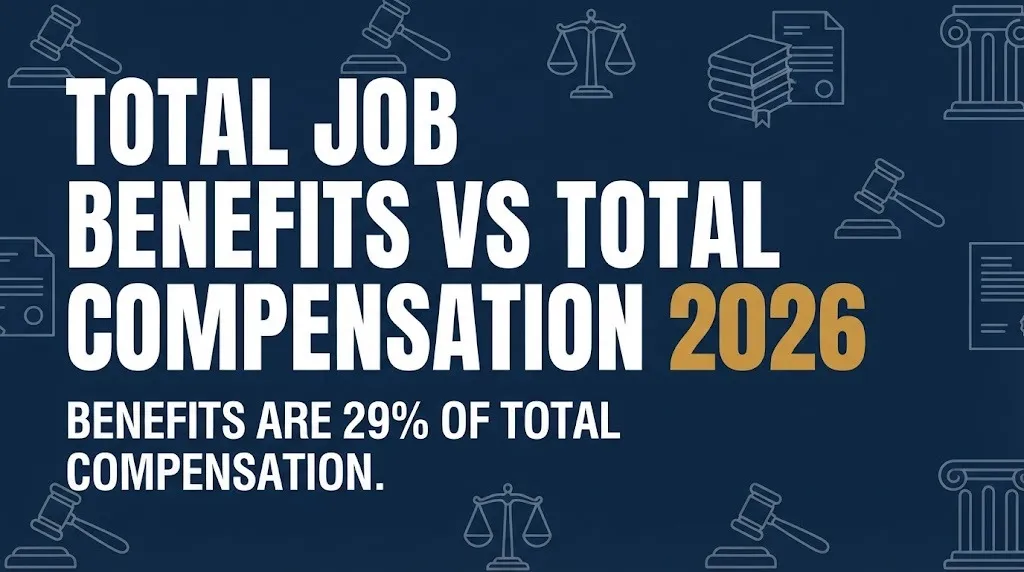
This article explains exactly how the two differ, what counts in each category, and what the federal data shows. One verified detail most explanations miss: the Bureau of Labor Statistics reports benefits averaged $13.43 per hour in 2025, while total compensation averaged $45.91 per hour. That means benefits are roughly 29 percent of the total.
The Facts
| Case | Not a legal case; labor economics definition |
| Status | Current federal data from Bureau of Labor Statistics |
| Fund Size | Not applicable |
| Est. Per Person | Benefits average $13.43 per hour in 2025 |
| Claim Deadline | Not applicable |
| Administrator | Bureau of Labor Statistics |
| Proof Needed | Employment cost data, compensation reports |
What Is Total Employee Compensation?
Total employee compensation is the complete cost of employing a worker.
It includes every dollar the employer spends on the worker, whether paid directly as cash or indirectly as benefits. The Bureau of Labor Statistics tracks this through the Employment Cost Index and the Employer Costs for Employee Compensation survey.
The two main categories are wages and salaries, and benefits. Wages and salaries are the direct pay for time worked. Benefits are everything else the employer provides.
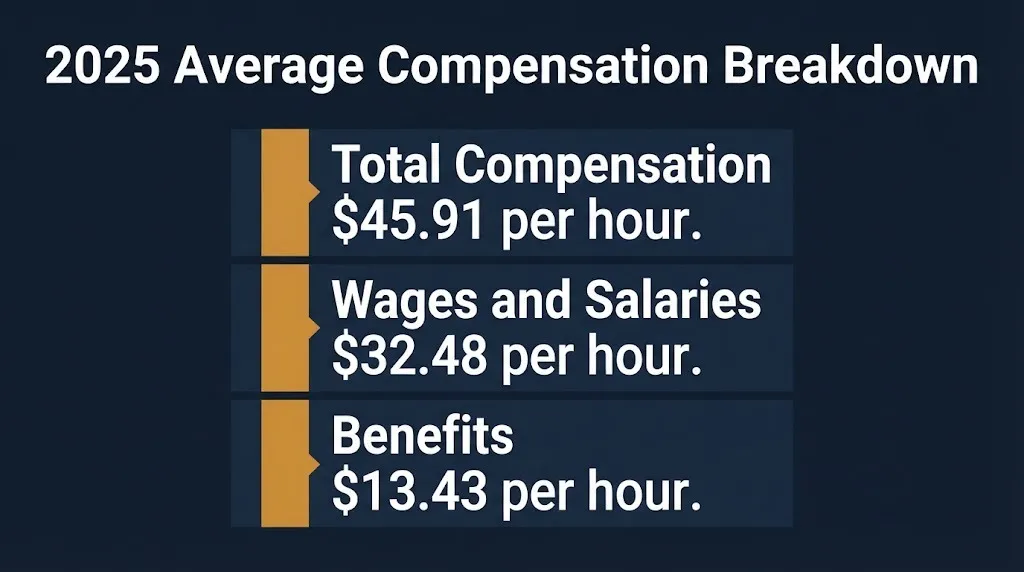
For the average U.S. private industry worker in 2025, total compensation was $45.91 per hour. Wages and salaries made up $32.48 of that. Benefits made up $13.43.
Total compensation is the number employers care about. It is the true cost of labor.
What Are Total Job Benefits?
Total job benefits are the non-wage portion of compensation.
Benefits include health insurance, retirement contributions, paid leave, and legally required payments like Social Security and Medicare taxes. They also include workers compensation insurance, unemployment insurance, and bonuses.
The Bureau of Labor Statistics breaks benefits into categories. Health insurance is the largest private benefit. Legally required benefits are the largest overall category.
For the average private industry worker, benefits averaged $13.43 per hour in 2025. That includes $3.00 per hour for health insurance, $2.85 for legally required benefits, and smaller amounts for retirement, paid leave, and other benefits.
Benefits are not optional extras from the employer’s perspective. They are part of the cost of employing someone.
Key Takeaway: Total job benefits are the non-wage portion of total compensation. Total compensation is the whole pie. Benefits are one slice.
How Do Total Job Benefits and Total Employee Compensation Differ?
The difference is scope.
Total employee compensation includes everything: wages, salaries, and all benefits.
Total job benefits include only the benefits portion: health insurance, retirement, paid leave, legally required payments, and supplemental pay.
Think of it like a receipt at a restaurant. The total bill is total compensation. The tip, tax, and service charge are the benefits. You cannot compare the tip to the total bill as if they are separate checks. The tip is part of the bill.
In labor economics, the distinction matters because workers often think only about their salary. Employers think about the total cost. The difference between the two is the benefits package.
What Does the Bureau of Labor Statistics Say About Benefits?
The Bureau of Labor Statistics publishes the Employer Costs for Employee Compensation survey quarterly.
The most recent full-year data for 2025 shows private industry employers spent an average of $45.91 per hour per worker. Of that, $32.48 went to wages and salaries. The remaining $13.43 went to benefits.
Benefits represented 29.3 percent of total compensation. That is the share employers paid beyond direct cash wages.
The largest benefit categories were health insurance at $3.00 per hour, legally required benefits at $2.85 per hour, and retirement at $1.47 per hour.
These are averages. The actual numbers vary by industry, occupation, union status, and employer size.
What Are Examples of Job Benefits?
Job benefits fall into several categories.
Health insurance is the largest private-sector benefit. It includes medical, dental, and vision coverage.
Retirement benefits include 401(k) matches, pension contributions, and profit-sharing.
Paid leave includes vacation, sick leave, holidays, and personal days.
Legally required benefits include Social Security, Medicare, workers compensation, and unemployment insurance. These are not optional. Employers must pay them.
Supplemental pay includes bonuses, overtime, and shift differentials.
Each of these is a benefit. Together, they form the benefits portion of total compensation.
How Much Do Benefits Add to Total Compensation?
Benefits add roughly 29 to 30 percent on top of wages.
For the average private industry worker in 2025, wages were $32.48 per hour. Benefits added $13.43. That means an employer paid about 41 cents in benefits for every dollar of cash wages.
The ratio varies by industry. Government workers receive higher benefits as a share of compensation. Private sector workers receive lower.
Union workers receive higher benefits than non-union workers. Full-time workers receive more than part-time workers.
If you are comparing job offers, do not compare only salary. Compare total compensation.
What Is the Difference Between Salary and Total Compensation?
Salary is the direct cash payment for work. Total compensation is salary plus benefits.
A job with an $80,000 salary and $20,000 in benefits has total compensation of $100,000.
A job with an $85,000 salary and $10,000 in benefits has total compensation of $95,000. The second job pays more in cash but less in total.
Most workers focus on salary because it is the number they see in their bank account. But the benefits package can be worth tens of thousands of dollars per year.
Health insurance alone costs employers an average of over $7,000 per year for single coverage and over $20,000 for family coverage.
Key Takeaway: Salary is the cash. Total compensation is cash plus benefits. Comparing jobs by salary alone misses a large part of the picture.
What Are Legally Required Benefits?
Legally required benefits are the payments employers must make by law.
They include the employer share of Social Security and Medicare taxes. They include federal and state unemployment insurance. They include workers compensation insurance.
These benefits do not show up as a paycheck line item for the worker. But they are real employer costs.
For the average private industry worker, legally required benefits averaged $2.85 per hour in 2025. That is over $5,900 per year for a full-time worker.
Legally required benefits are the largest category of benefits after health insurance. They are non-negotiable.
What Is the Difference Between Wages and Benefits?
Wages are direct cash compensation. Benefits are indirect, non-cash compensation.
Wages include hourly pay, salaries, commissions, tips, and piece rates. They are taxable income to the worker in the year received.
Benefits include health insurance, retirement contributions, paid leave, and legally required payments. Some benefits are taxable. Others are tax-deferred or tax-exempt.
Health insurance provided by the employer is generally not taxable to the worker. Retirement contributions are tax-deferred. Paid leave is taxable when taken.
The distinction matters for taxes and for understanding total compensation.
How Do You Calculate Total Employee Compensation?
The calculation is simple in concept.
Total employee compensation equals wages and salaries plus all benefits.
If a worker earns $60,000 in salary and the employer pays $15,000 for health insurance, $5,000 for retirement, $4,000 for legally required benefits, and $3,000 for paid leave, the total compensation is $87,000.
The Bureau of Labor Statistics does this calculation for the entire economy using survey data. The result is the $45.91 per hour figure for 2025.
Employers calculate total compensation internally to understand labor costs and to communicate the full value of a job to workers.
Reality Check: A job offer that says “total compensation” includes benefits. A job offer that says “salary” does not. Read the offer carefully before comparing.
Why Does the Distinction Matter in Lawsuits?
The distinction matters in employment lawsuits.
Wage and hour claims often involve disputes over what counts as wages. Overtime calculations use the regular rate of pay, which can include some benefits but not others.
Discrimination cases sometimes involve claims about unequal compensation. Total compensation is the measure used to compare what different workers receive.
Workers compensation cases use average weekly wage, which can include some benefits depending on state law.
If you are involved in an employment dispute, understand what is included in the compensation figure being used.
What Is the Trend in Benefits as a Share of Compensation?
The trend is stable to slightly rising.
Benefits have represented roughly 30 percent of total compensation for decades. The share rose during the pandemic as health care costs increased, then stabilized.
Health insurance costs continue to rise faster than wages. That puts upward pressure on the benefits share.
Retirement benefits have shifted from defined benefit pensions to defined contribution plans like 401(k)s. That changes the risk from employer to worker but does not change the total cost much.
The long-term trend matters for workers. If benefits rise faster than wages, the salary number grows more slowly even when total compensation rises.
What Happens Next in Compensation Data?
The Bureau of Labor Statistics continues to publish quarterly updates.
Expected late 2026: Third quarter Employer Costs for Employee Compensation data will be released. It will show updated wage and benefit figures.
Ongoing: Health insurance cost trends remain a key driver of the benefits share.
For workers, the next step is to review your own compensation statement, not just your paycheck. The total number tells a different story.
Frequently Asked Questions
What is the difference between total job benefits and total employee compensation?
Total job benefits are one part of total employee compensation.
Total compensation includes wages plus all benefits.
What are examples of total job benefits?
Health insurance, retirement contributions, paid leave, and legally required benefits.
These are the non-wage portion of compensation.
How much do benefits add to total compensation?
Benefits add about 29 to 30 percent on top of wages.
For the average private industry worker, benefits were $13.43 per hour in 2025.
What is included in total employee compensation?
Wages, salaries, health insurance, retirement, paid leave, bonuses, and legally required benefits.
It is the complete employer cost for a worker.
Is salary the same as total compensation?
No. Salary is the cash portion.
Total compensation is salary plus benefits.
What are legally required benefits?
Social Security, Medicare, unemployment insurance, and workers compensation.
Employers must pay these by law.
How do I calculate total compensation?
Add wages and salaries to all benefits.
The sum is total employee compensation.
The single most important point: benefits are a subset of total compensation. The full number, not the salary alone, is what the worker costs the employer.