Blurred Lines Lawsuit 2026: Copyright Ruling, Damages, and What Happens Next
Quick Answer
- The Blurred Lines lawsuit is a closed copyright infringement case, not an active consumer settlement.
- No claim form, settlement fund, or payout to the public exists or will exist.
- The final damages judgment of roughly $5 million was confirmed, with an ongoing royalty share ordered.
If you landed here after seeing a headline, a social post, or an ad about a “Blurred Lines lawsuit payout,” you may be looking at recycled news or a misleading ad. This was never a consumer class action. There is no money for the public, no claim to file, and no deadline to watch.
This article explains what the lawsuit actually was, what courts decided, how much the artists were ordered to pay, and why the case still generates search interest in 2026. One detail many headlines get wrong: the final judgment was not the $7.4 million a jury first awarded, and the difference matters.
The Facts
| Item | Detail |
|---|---|
| Case | Williams v. Gaye, U.S. District Court, Central District of California |
| Status | Closed, final judgment entered, appeals exhausted |
| Fund Size | No public settlement fund |
| Est. Per Person | Not applicable, no consumer claims |
| Claim Deadline | None, no claim process exists |
| Administrator | None |
| Proof Needed | Not applicable |
Is the Blurred Lines Lawsuit Still Active in 2026?
The Blurred Lines lawsuit is not active in 2026. The case concluded years ago, and no new filings or settlement negotiations are pending.
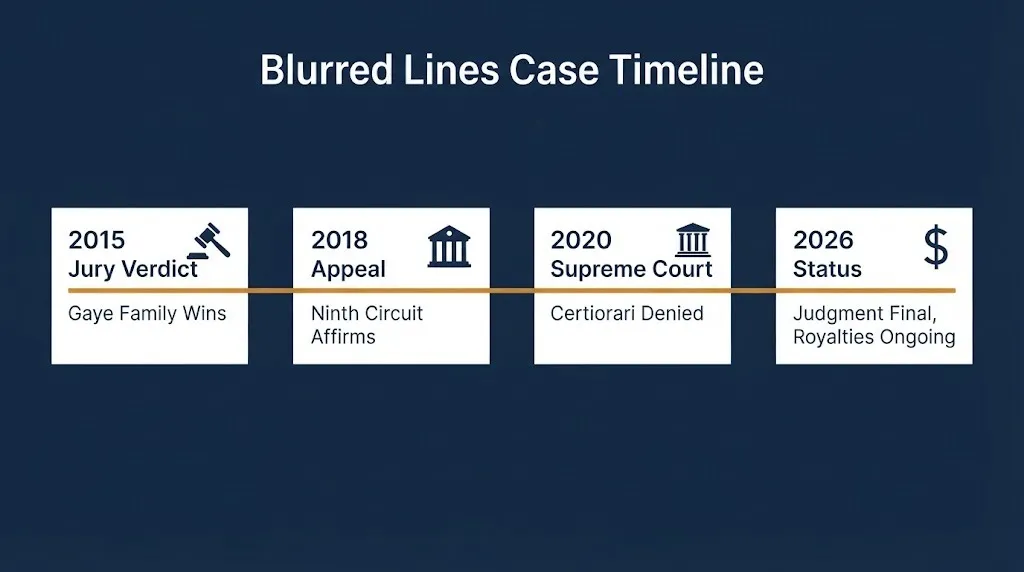
The trial ended in 2015 with a jury verdict. The appeals ran through 2018 and 2020. The Supreme Court declined to hear the case, which ended the litigation. What you may be seeing in 2026 is coverage of the song’s royalty stream or a documentary or a retrospective article.
Some ads and clickbait sites recycle the case to sell “copyright lawsuit payout” listings. Those pages are not connected to any real claim. If you see a site asking you to register for a Blurred Lines payout, it is not legitimate.
What Was the Blurred Lines Lawsuit About?
The lawsuit was a copyright infringement claim brought by the family of Marvin Gaye against Robin Thicke, Pharrell Williams, and others.
The Gaye family alleged that the 2013 hit song “Blurred Lines” copied protected elements of Marvin Gaye’s 1977 song “Got to Give It Up.” The case was not about identical lyrics or melody. It focused on the groove, the bass line, keyboard parts, and the overall feel of the recording.
A jury in the U.S. District Court for the Central District of California agreed with the Gaye family in March 2015. The verdict was controversial because it appeared to protect a general style or vibe rather than a specific sequence of notes. Music copyright cases before this one usually centered on melodic similarity, not production feel.
How Much Was the Blurred Lines Judgment Worth?
The jury first awarded $7.4 million in damages to the Gaye family, but the final judgment was reduced.
The trial judge later trimmed the total to roughly $5.3 million plus an ongoing royalty share. The royalty component is what keeps the case financially relevant in 2026. Thicke and Williams must pay a percentage of future royalties from the song to the Gaye estate.
Here is how the key numbers break down:
| Stage | Amount |
|---|---|
| Jury damages verdict | $7.4 million |
| Damages after judicial reduction | About $5.3 million |
| Ongoing royalty share | 50% of songwriting and publishing royalties to the Gaye estate |
| Profit award to Gaye family | Included in the judgment |
The royalty share was a major talking point. The court ordered that the Gaye family receive half of the songwriting and publishing royalties going forward. That decision turned a one-time damages case into a long-term income stream.
Why Do People Search for a Blurred Lines Settlement in 2026?
Search interest in 2026 likely comes from royalty reports, music industry retrospectives, or misleading payout ads.
Music royalty distributions are confidential. No public “settlement payment” to consumers ever existed. The parties settled nothing after the verdict. The case went to judgment and appeals, not to a class action settlement.
If you received an email or saw a post claiming you are owed money from the Blurred Lines case, treat it as spam. No administrator was ever appointed. No claim form was ever created.
Key Takeaway: The Blurred Lines case was a private copyright dispute between artists and estates, not a consumer action with public payouts.
Who Paid the Blurred Lines Judgment?
Robin Thicke and Pharrell Williams, along with the record label involved, were the paying parties.
The judgment ran against the songwriters, producers, and the distributor. T.I., who was originally named, was dismissed from the case before trial. The financial burden fell mainly on Thicke and Williams as the credited songwriters.
The Gaye family received the damages. Marvin Gaye’s children and estate were the plaintiffs. They argued the song crossed the line from inspiration to infringement, and the jury agreed.
Could the Blurred Lines Case Be Reopened?
The case cannot be reopened in any practical sense. The Supreme Court denied certiorari, and the judgment is final.
Reopening a closed copyright judgment would require extraordinary grounds, such as fraud on the court. Nothing of that kind has been filed. The 2026 status is the same as the 2020 status: final.
The only ongoing activity is royalty accounting. The Gaye estate continues to receive its court-ordered share. That is not a new lawsuit. It is the administration of a final judgment.
What Did the Blurred Lines Case Change in Copyright Law?
The case changed how courts and juries evaluate musical similarity, especially around groove and feel.
Before this case, most copyright claims centered on melody, lyrics, or a distinctive riff. The Blurred Lines verdict allowed a jury to find infringement based on a combination of less tangible elements. That outcome worried many songwriters and producers.
The legal community remains divided. Some argue the verdict chilled creativity by making musical style protectable. Others say it properly compensated the Gaye family for a real copying of a signature sound. The case is now taught in law schools and cited in music clearance decisions.
How Does the Royalty Share Work in 2026?
The royalty share means the Gaye estate receives a percentage of revenue every time the song earns money.
Streaming services, radio play, sync licenses, and sales all generate royalties. The court ordered that half of the songwriting and publishing royalties go to the Gaye family. That income continues in 2026.
You, as a listener or consumer, are not part of this. The royalty obligation runs between the rights holders and the royalty collection organizations. No consumer action is involved.
Reality Check: No website can sign you up for a Blurred Lines payout. The case never involved consumer claims, and any site asking for your information is running a scam or harvesting data.
What Was the Supreme Court’s Role in the Blurred Lines Case?
The Supreme Court declined to hear the appeal, which left the Ninth Circuit’s ruling in place.
Thicke and Williams petitioned for certiorari. The Court denied the petition. That denial did not mean the Court agreed with the verdict. It simply meant the case would not be reviewed.
The denial ended the appellate road. The judgment became final, and the royalty order took full effect. In 2026, there is no pending Supreme Court action and no chance of reversal.
What Happens Next: Timeline
- 2015: Jury returns a verdict for the Gaye family.
- 2018: Ninth Circuit affirms the judgment, with adjustments.
- 2020: Supreme Court denies certiorari, ending the appeals.
- 2026: No new legal action. Royalty payments continue under the final judgment.
This timeline is closed. No new dates are expected.
Frequently Asked Questions
Is the Blurred Lines lawsuit real?
Yes, the Blurred Lines copyright lawsuit was a real federal case that ended years ago.
Can I file a Blurred Lines settlement claim?
No, there is no settlement fund and no claim form for this case.
How much did the jury award in the Blurred Lines case?
The jury awarded $7.4 million, later reduced to about $5.3 million plus ongoing royalties.
Who won the Blurred Lines lawsuit?
The Marvin Gaye family won the copyright infringement verdict and the appeals.
Did Robin Thicke and Pharrell Williams pay the judgment?
Yes, the judgment ran against Thicke, Williams, and the record company.
Why am I seeing Blurred Lines payout ads?
Those ads are misleading and not connected to any real claim process.
Is there a Blurred Lines class action?
No, the case was a private copyright dispute, not a class action.
How does the royalty share work?
The Gaye estate receives half of the songwriting and publishing royalties from the song.
Closing
The Blurred Lines lawsuit is over. It was a copyright case between artists and an estate, not a consumer payout.
Ignore any ad or message promising you money from this case. The only ongoing financial effect is the royalty share paid to the Gaye family under a final judgment.