Debt Management vs Debt Settlement 2026: Real Costs, Credit Impact, and Which One Works
Quick Answer:
- Debt management plans pay creditors in full through a nonprofit credit counselor, typically over 3 to 5 years.
- Debt settlement negotiates reduced payoffs, often 40 to 60 percent of what you owe, but damages credit severely.
- Debt management preserves your credit score better; debt settlement triggers collections and charge-offs first.
Debt management and debt settlement are two different paths out of unsecured debt. They are not interchangeable, and choosing wrong can cost you thousands of dollars and years of credit damage.
Debt management means you pay everything you owe through a structured plan. Debt settlement means you stop paying, let accounts go delinquent, and negotiate lower payoffs. One protects your credit. The other trades credit damage for debt reduction.
This article breaks down the verified differences, the real costs, the credit impact, and how to choose between them based on your specific situation.
The Facts
| Item | Debt Management Plan | Debt Settlement |
|---|---|---|
| What You Pay | 100% of debt, sometimes reduced interest | 40% to 60% of debt typically |
| Credit Impact | Mild, accounts stay current | Severe, accounts go delinquent |
| Typical Timeline | 3 to 5 years | 2 to 4 years |
| Provider Type | Nonprofit credit counseling agency | For-profit company or law firm |
| Upfront Fees | Usually under $75 | Banned by FTC for telemarketed sales |
| Tax Consequence | None | Forgiven debt may be taxable |
| Success Rate | High if you complete the plan | Varies widely, many drop out |
Is debt management or debt settlement more legitimate?
Both debt management plans and debt settlement are legitimate debt relief options, but they operate under different rules and serve different situations. Neither is a scam when provided by a reputable organization.
Debt management plans run through nonprofit credit counseling agencies accredited by the National Foundation for Credit Counseling or the Financial Counseling Association of America. These agencies have been around for decades and work directly with creditors to reduce interest rates and waive fees.
Debt settlement companies are typically for-profit businesses regulated by the Federal Trade Commission’s Telemarketing Sales Rule. That rule bans upfront fees for most debt settlement services sold over the phone. Legitimate settlement companies charge only after they negotiate a settlement you approve.
The Consumer Financial Protection Bureau has repeatedly warned consumers about debt settlement risks. The industry has a higher complaint rate than nonprofit credit counseling.
What is a debt management plan?
A debt management plan is a structured repayment program run by a nonprofit credit counseling agency. You make one monthly payment to the agency, and the agency distributes it to your creditors.
The agency negotiates with creditors to reduce interest rates and eliminate late fees. Most plans cover credit card debt, though some include medical bills and personal loans. Student loans, mortgages, and auto loans usually don’t qualify.
Here’s how a typical plan works:
| Step | What Happens |
|---|---|
| Counseling session | Review your full financial picture |
| Plan proposal | Agency contacts creditors with proposed terms |
| Enrollment | You make one monthly payment to the agency |
| Repayment | Agency pays creditors over 3 to 5 years |
| Completion | All enrolled debts paid in full |
The plan closes credit card accounts. You keep the cards but can’t use them while enrolled. That’s a feature, not a bug, because it stops new debt while you pay off old debt.
Key Takeaway: Debt management pays creditors in full with reduced interest; it’s a structured repayment tool, not a debt reduction tool.
What is debt settlement?
Debt settlement is a negotiation process where you or a company you hire convinces creditors to accept less than the full amount owed. The typical settlement ranges from 40 to 60 percent of the original balance.
The process usually requires you to stop making payments and let accounts go delinquent. Creditors won’t negotiate with someone who’s current on their bills. Once accounts are 90 to 180 days past due, settlement talks can begin.
Here’s what the process looks like:
| Stage | What Happens |
|---|---|
| Enrollment | You stop paying enrolled debts |
| Savings phase | You save money in a dedicated account |
| Delinquency | Accounts go 90+ days past due |
| Negotiation | Company or you negotiate reduced payoffs |
| Settlement | Creditor accepts lump sum or payment plan |
| Resolution | Debt reported as settled for less than full balance |
The credit damage is real. Late payments, charge-offs, and settled accounts stay on your credit report for up to seven years.
Reality Check: No legitimate debt settlement company can guarantee a specific result before seeing your debts and creditors. Anyone promising to cut your debt by a specific percentage sight unseen is selling marketing, not reality.
What are the main differences between debt management and debt settlement?
The main differences between debt management and debt settlement come down to what you pay, what happens to your credit, and who provides the service.
Here’s the side-by-side comparison:
| Factor | Debt Management | Debt Settlement |
|---|---|---|
| Amount paid | 100% of debt | 40% to 60% typically |
| Credit impact | Accounts stay current | Accounts go delinquent |
| Timeline | 3 to 5 years | 2 to 4 years |
| Provider | Nonprofit agency | For-profit company |
| Fees | Low, under $75 setup, small monthly | Percentage of enrolled debt |
| Tax impact | None | Forgiven debt may be taxable |
| Completion rate | High, around 50 to 70 percent | Low, often under 30 percent |
The completion rate difference matters. Debt management plans have a much higher success rate because the monthly payment is often lower than what you were paying before, not higher.
Key Takeaway: Debt management preserves credit and has a higher completion rate; debt settlement reduces debt but damages credit and has a lower completion rate.
How much does debt settlement cost?
Debt settlement costs vary by company and state, but the industry standard is 15 to 25 percent of the total enrolled debt. That fee is charged only after a settlement is negotiated and you approve it.
For a $30,000 enrolled debt, a 20 percent fee means you pay $6,000 to the settlement company. That’s on top of the settled amount you pay the creditor. If the settlement is 50 percent of the debt, you pay $15,000 to the creditor and $6,000 in fees. Total: $21,000 instead of $30,000.
The Federal Trade Commission’s Telemarketing Sales Rule banned upfront fees for debt settlement sold over the phone. Companies can only charge after they deliver results. Some states have stronger rules.
How much does debt management cost?
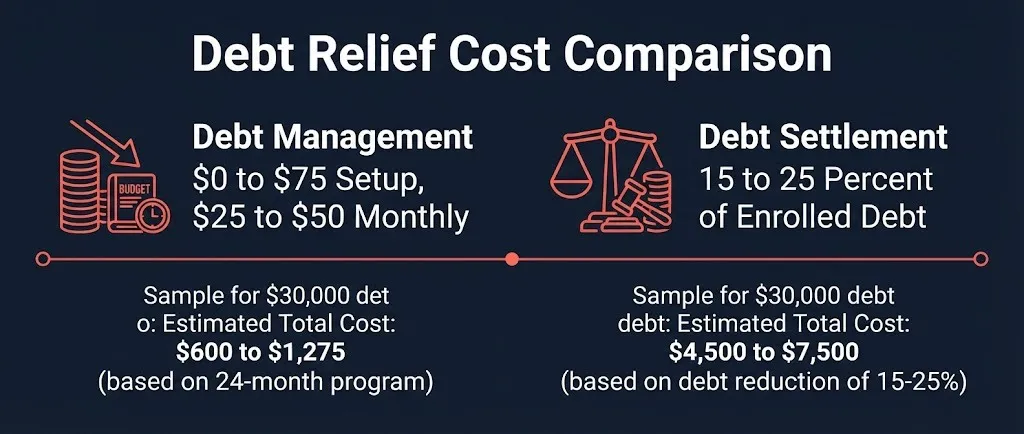
Debt management costs far less than debt settlement. Nonprofit credit counseling agencies typically charge a setup fee under $75 and a monthly maintenance fee of $25 to $50.
Here’s a cost comparison:
| Item | Debt Management | Debt Settlement |
|---|---|---|
| Setup fee | $0 to $75 | $0 upfront, banned by FTC |
| Monthly fee | $25 to $50 | None separately, built into percentage |
| Total cost for $30,000 debt | $900 to $1,800 over 3 to 5 years | $6,000 to $7,500 in fees alone |
| What creditors receive | 100% of debt | 40% to 60% of debt |
The fee structure reflects the provider’s business model. Nonprofit agencies are funded partly by creditor grants. Settlement companies are for-profit and charge accordingly.
Key Takeaway: Debt management costs a fraction of debt settlement in fees because nonprofits don’t profit from your enrollment.
How does debt settlement affect your credit score?
Debt settlement damages your credit score significantly. Late payments, charge-offs, and settled accounts remain on your credit report for up to seven years.
The damage starts when you stop paying enrolled debts. Each missed payment drops your score. Once accounts charge off, the negative marks are locked in. Even after settlement, the account shows as “settled for less than full balance,” which future lenders see as a red flag.
Here’s the typical credit score trajectory:
| Timeline | Credit Event |
|---|---|
| Month 1 to 3 | Late payments begin, score drops 50 to 100 points |
| Month 3 to 6 | Accounts charge off, score drops further |
| Month 6 to 12 | Settlement negotiations complete |
| Year 1 to 7 | Negative items remain on report |
By contrast, debt management keeps accounts current, which limits credit damage.
How does debt management affect your credit score?
Debt management affects your credit score mildly. The main impact comes from closing credit card accounts, which reduces your available credit and can lower your score temporarily.
Unlike debt settlement, debt management does not involve late payments or charge-offs. Your accounts stay current because the agency pays creditors on time every month. That’s the single biggest credit advantage.
Here’s what to expect:
| Factor | Impact |
|---|---|
| Account closure | Available credit drops, score may dip 10 to 30 points |
| On-time payments | Continue building positive history |
| Credit utilization | May increase as accounts close |
| Long-term recovery | Score typically recovers within 12 to 24 months |
Most people see a small initial dip followed by steady improvement as debt balances shrink.
When does debt settlement make sense?
Debt settlement makes sense only when you cannot afford debt management and your alternatives are worse. That usually means you’re facing bankruptcy or already behind on payments.
Debt settlement works best if you have a large amount of unsecured debt, no ability to keep up with monthly payments, and a lump sum or savings ability to fund settlements. It also works better if you’re judgment-proof, meaning you have few assets creditors could seize.
It’s a last resort before bankruptcy, not a first choice. The Consumer Financial Protection Bureau recommends exploring all other options first.
When does a debt management plan make sense?
A debt management plan makes sense when you can afford to pay your debts but need lower interest rates and a structured plan to do it. You have steady income but high credit card rates are burying you.
It works best for credit card debt with interest rates above 20 percent. The agency negotiates rates down to single digits, which makes the monthly payment affordable and shortens the payoff timeline.
If you have a steady job and can commit to 3 to 5 years of payments, debt management is the better path. It preserves your credit and gets you out of debt in full.
Key Takeaway: Debt management fits people with steady income who can pay over time; debt settlement fits people who can’t pay and face bankruptcy as the alternative.
What are the tax consequences of debt settlement?
Debt settlement has tax consequences. Forgiven debt of $600 or more is generally taxable income unless you qualify for an insolvency exclusion.
The creditor reports the forgiven amount to the IRS using Form 1099-C. If you settle a $10,000 debt for $5,000, the $5,000 forgiven is taxable income. At a 22 percent tax bracket, that’s $1,100 owed to the IRS.
The insolvency exclusion helps if your total debts exceed your total assets immediately before the settlement. Many people in debt settlement qualify, but you must document it carefully.
Debt management has no tax consequences because you pay everything back.
What happens next with debt relief regulation?
Here’s what to watch in the coming months:
2026 to 2027: The Consumer Financial Protection Bureau continues reviewing debt settlement industry practices.
Ongoing: State attorneys general pursue enforcement actions against deceptive settlement companies.
Case by case: Individual lawsuits over fee disclosure and misleading marketing remain active.
No major federal legislation is pending as of September 2026.
Frequently Asked Questions
Is debt management better than debt settlement?
For most people with steady income, yes, debt management is better because it preserves credit and costs less.
Debt settlement only wins when you can’t pay and face bankruptcy.
How much can debt settlement save me?
Debt settlement typically reduces unsecured debt by 40 to 60 percent before fees and taxes.
Your actual savings depend on your creditors, your debt type, and your negotiation leverage.
Does debt management hurt your credit?
Debt management has a mild, temporary credit impact from closing accounts.
Your score typically recovers within 12 to 24 months as balances shrink.
Can I do debt settlement myself?
Yes, you can negotiate directly with creditors without paying a settlement company.
The process is the same: stop paying, save money, and make settlement offers.
What debts qualify for debt management?
Credit cards, medical bills, and some personal loans qualify for debt management.
Student loans, mortgages, and auto loans typically do not.
What debts qualify for debt settlement?
Unsecured debts like credit cards, medical bills, and personal loans qualify for settlement.
Secured debts and most federal student loans do not.
How long does debt settlement take?
Debt settlement typically takes 2 to 4 years, assuming you complete the program.
Many people drop out before finishing, extending the timeline or leaving accounts unresolved.
Is debt settlement a scam?
Debt settlement itself is not a scam, but the industry has a high complaint rate.
Avoid any company that charges upfront fees or guarantees specific results.
Closing
The choice between debt management and debt settlement comes down to one question: can you pay your debts over time, or can’t you?
If you have steady income, choose debt management. If you’re drowning and bankruptcy is the only other option, debt settlement might be worth the credit damage. Either way, check the provider’s complaint history with the Consumer Financial Protection Bureau before you sign anything.