Notice of Settlement California 2026: What It Means, Deadlines, and Your Rights Explained
Quick Answer
- A notice of settlement is a mandatory court form (CM-200) filed when parties resolve a civil case before trial.
- The plaintiff must file a request for dismissal within 45 days of an unconditional settlement.
- Los Angeles County now schedules an Order to Show Cause hearing approximately 60 days after the notice is filed.
A notice of settlement in California is a mandatory court filing that tells the judge a civil case has been resolved without a trial. It is not a payout notice, not a check, and not proof that you personally have money waiting.
If you received a court document with “Notice of Settlement” on it, you are likely a party to a civil lawsuit that just ended. The clock is now running on a strict procedural deadline. Miss it, and the court can dismiss the case on its own terms.
This article explains exactly what that document means, who files it, what the 45-day rule requires, and how a new Los Angeles County procedure changes the timeline for thousands of cases. You will also find the warning signs of settlement scams, because fake notices are circulating.
The Facts
| Item | Detail |
|---|---|
| Official Form | CM-200, Notice of Settlement of Entire Case |
| Governing Rule | California Rules of Court, Rule 3.1385 |
| Key Deadline | Request for dismissal within 45 days of settlement |
| Court Role | Cancels pending trial dates, schedules dismissal review |
| LA County Change | OSC re Dismissal hearing about 60 days after NOS |
| Not a Payout | This form does not determine individual compensation |
Is a notice of settlement in California legitimate or a scam?
A notice of settlement is legitimate when it comes from a court or a party’s attorney and carries a case number, a court name, and a judge’s department. It is a real legal document, not junk mail.
That said, scammers copy real forms. The California Department of Financial Protection and Innovation issued a fraud alert about an entity calling itself “Hartman Cain & Associates” that sent fake settlement solicitations demanding upfront fees .
How to verify a real notice:
- Check the case number against the superior court’s online portal for the county named on the form.
- Look for a court address and department number. Fake notices often omit these.
- A real notice never asks you to pay a fee to release settlement money.
- Call the court clerk directly using a number you look up yourself, not one printed on the suspicious document.
If someone texts you a link saying you have settlement cash, that is not how a notice of settlement works. The form goes to the court, not to your phone.
Key Takeaway: A real notice of settlement is a court filing with a case number you can verify. If anyone asks for money first, it is a scam.
What does a notice of settlement actually mean for your case?
A notice of settlement means the entire case has been resolved by agreement and the parties are now in the cleanup phase. The lawsuit will not go to trial unless the settlement falls apart.
When this form lands on the judge’s desk, three things happen almost immediately.
Trial dates disappear. Any pending trial, final status conference, or mandatory settlement conference gets taken off the calendar. The court does not need to prepare for a trial that will not happen.
The clock starts on dismissal. The plaintiff has 45 days to file a formal request for dismissal if the settlement is unconditional. For a conditional settlement, the 45 days runs from the future date the plaintiff lists on the form.
The court keeps watch. If no dismissal is filed and no good cause is shown, the court can dismiss the case on its own. This protects the court’s calendar from stalled settlements.
This process is designed to move cases off the docket efficiently. It is not designed to distribute money to anyone. A notice of settlement is a procedural document, not a claims form.
Key Takeaway: The notice ends the litigation phase. It does not create a settlement fund or trigger payouts by itself.
Who files a notice of settlement in California?
The plaintiff or the party seeking affirmative relief files the notice of settlement in California state courts. The filing party must serve a copy on every other party and on any arbitrator or court-connected neutral involved in the case .
The rule is strict on this point. If the entire case settles, the plaintiff must file “immediately.” There is no waiting period and no strategic delay.
What the filing party must include:
- The case number, judge, and department.
- Whether the settlement is unconditional or conditional.
- The date of settlement for unconditional deals.
- The future date by which dismissal will be filed for conditional deals.
- The next scheduled hearing and whether a trial date exists.
The form is signed under penalty of perjury. That means the attorney or party swears the information is true and correct under California law.
A proof of service must accompany the notice. Someone who is not a party to the case (often a secretary or an attorney’s staff member) must sign that proof, confirming the notice was mailed or delivered to all other parties .
Key Takeaway: The plaintiff’s side files and serves the notice. If you are a defendant, you receive it, you do not file it.
What is the difference between an unconditional and conditional settlement?
An unconditional settlement means the deal is final and dismissal will be filed within 45 days. A conditional settlement means the deal depends on future events that will not be completed within that 45-day window.
The checkbox on the CM-200 form is critical. It tells the court how to manage the case and when to expect the dismissal paperwork.
| Type | What It Means | Dismissal Timing |
|---|---|---|
| Unconditional | Deal is done. No future conditions. | 45 days from settlement date |
| Conditional | Deal depends on future performance | 45 days from the date listed on the form |
A conditional settlement often involves installment payments, a plaintiff’s cooperation requirement, or regulatory approval that takes months. The plaintiff cannot simply dismiss immediately because the obligations are ongoing. The court retains jurisdiction to enforce the agreement if the defendant fails to perform.
The distinction matters because the court’s patience is not unlimited. If the dismissal does not come through on the timeline provided, the case gets flagged for an Order to Show Cause hearing.
Key Takeaway: Unconditional means done now. Conditional means done later, on a deadline you specify.
How does the Los Angeles County Superior Court notice of settlement procedure work?
Los Angeles County Superior Court set a new procedure effective May 23, 2025, that schedules an Order to Show Cause hearing about 60 calendar days after a notice of settlement is filed . This is a significant change for one of the busiest court systems in the country.
The court adopted the enhanced process because unlimited civil filings increased 48% since 2008. Managing the backlog required a firmer hand on stalled settlements.
How the LA County process works:
- A notice of settlement triggers the clock. The court does not wait indefinitely for dismissal paperwork.
- An OSC re Dismissal hearing gets scheduled roughly 60 days after the notice is filed.
- If the case is dismissed before the hearing, the hearing comes off calendar automatically.
- If the case is not dismissed, the court treats any “unconditional” notice as “conditional” and dismisses the case without prejudice.
- The court retains jurisdiction to enforce the settlement terms even after dismissal.
This new process does not apply to complex civil cases heard at the Spring Street Courthouse, or to settlements that require court approval (like class actions involving minors or certain consumer cases).
For anyone waiting on a settlement to finalize in LA County, this means the court will not let the case linger forever. Sixty days after the notice, either dismissal paperwork is on file or the judge takes action.
Key Takeaway: LA County gives you roughly 60 days from the notice of settlement to get the dismissal filed, or the court dismisses on its own.
What is the 45-day dismissal deadline and what happens if you miss it?
The 45-day deadline requires the plaintiff to file a request for dismissal of the entire case within 45 days after the settlement date (if unconditional) or within 45 days after the future date stated on the form (if conditional) .
If you are the plaintiff and you miss this deadline without good cause, the court can dismiss the case on its own terms. That sounds like relief, but it is not. A court-ordered dismissal may carry “without prejudice” language, which means the defendant can be sued again for the same claim. That is usually not what a plaintiff wants.
What can go wrong when the dismissal is late:
- The court sets an Order to Show Cause hearing and requires an appearance.
- The judge may impose sanctions for failure to comply with Rule 3.1385.
- The settlement’s enforceability can be complicated if the dismissal is entered on the court’s schedule rather than by agreement.
For a defendant, the 45-day window is the period when you should see the case formally closed. If you see an OSC on the calendar instead, something is stalling on the plaintiff’s side. You may need to appear at the hearing to protect your interests.
The court’s new procedures in LA County and the existing Rule 3.1385 both point to the same principle: a settlement is not complete until the dismissal is filed.
Key Takeaway: The 45-day window is not optional. File the dismissal or show good cause why you cannot.
How long does a notice of settlement take to finalize the case?
A notice of settlement typically leads to dismissal within 45 to 90 days in a straightforward, unconditional case. If the settlement is conditional or requires court approval, the timeline stretches much longer.
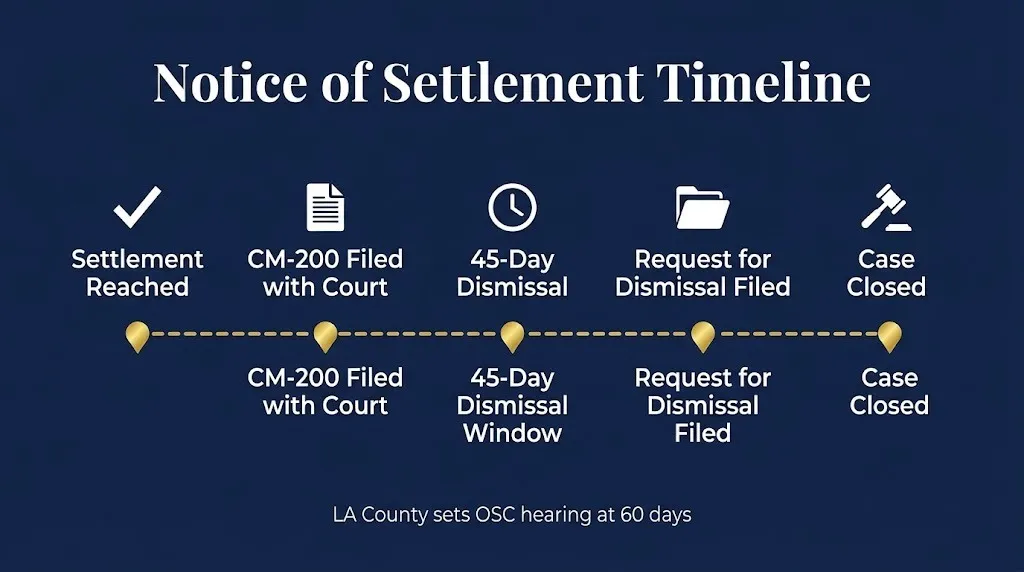
Typical timeline for an unconditional settlement:
- Day 0: Settlement is reached and the notice is filed with the court.
- Days 1-45: Plaintiff prepares and files the request for dismissal (form CIV-110).
- Days 45-60: Court processes the dismissal and closes the case file.
For conditional settlements, the timeline follows the future date the plaintiff lists on the CM-200. If the settlement requires the defendant to make payments over 12 months, the dismissal may not be filed for a year or more. The court retains jurisdiction under California Code of Civil Procedure section 664.6 to enforce the settlement if the defendant defaults.
The biggest delay risk is not the court. It is the parties. A settlement that is “agreed” but not documented, signed, and funded can stall for months. The notice of settlement tells the court the deal exists. It does not guarantee the deal performs.
Key Takeaway: Plan for 45 to 60 days in a simple case. Conditional deals can take much longer.
What should you do if you receive a notice of settlement?
Verify the case number and court on the document before taking any other step. Confirm that the filing is real and that the case involves you or a matter you recognize.
Steps to take after receiving a notice of settlement:
- Locate the case number on the top of the form.
- Go to the superior court’s website for the county named and search the case number.
- Confirm the parties and the judge match what you see on the document.
- Check the settlement type (unconditional or conditional) and note the relevant date.
- If you are the plaintiff, ensure your attorney files the dismissal within 45 days.
- If you are the defendant, calendar the OSC date if one is scheduled and monitor for the dismissal.
- Do not pay anyone who contacts you demanding a fee to “release” settlement funds.
If you are not a party to the case and the notice arrived unexpectedly, it may be a mistake or a scam. Contact the court clerk to confirm. Do not respond to anyone who reaches out asking for personal information.
Key Takeaway: Verify the case number. Then act based on your role in the case, not based on fear.
Reality Check
No one sends you a notice of settlement to give you money. This form goes to the court to close a case. If a text, email, or caller claims a settlement notice means you have cash waiting and asks for a fee, banking details, or a gift card, it is a scam. The California DFPI has already flagged fake law firms running this play . Real courts do not text you about settlement payouts.
What happens next after a notice of settlement is filed?
The next step after a notice of settlement is the filing of a request for dismissal, followed by the court closing the case. In Los Angeles County, an Order to Show Cause hearing may be set about 60 days out.
Expected timeline:
- Immediately: Trial dates and hearings are taken off calendar.
- Within 45 days: Plaintiff files Request for Dismissal (CIV-110).
- Around 60 days: LA County sets an OSC re Dismissal if no dismissal is on file.
- After dismissal: Case is closed. The settlement agreement remains enforceable if it includes a section 664.6 provision.
- If no dismissal is filed: The court may dismiss without prejudice, retaining jurisdiction to enforce the settlement terms.
If you are waiting on payment from a settlement, the notice of settlement is not the trigger. The dismissal is a milestone, but payment depends on the terms of the settlement agreement itself, not on the court’s procedural steps.
Frequently Asked Questions
Is a notice of settlement the same as a settlement check?
No. A notice of settlement is a court filing that tells the judge the case resolved. It does not issue money or create a payment schedule for individuals. Payment comes from the settlement agreement, not the court form.
How long after a notice of settlement do you get paid?
Payment timing depends on the settlement agreement. It is not determined by the notice of settlement. Some settlements pay within 30 days of signing. Others pay on a schedule that can last months or years. The notice of settlement does not set the payment date.
Can a notice of settlement be filed if only part of the case settles?
Rule 8.825 in the appellate division covers partial settlements. In trial courts, the CM-200 form is specifically for settlement of the entire case. If only some claims or parties settle, the notice may not apply to the whole action.
What happens if the plaintiff never files the dismissal?
The court can dismiss the case on its own. In Los Angeles County, an Order to Show Cause hearing is set about 60 days after the notice. If the plaintiff cannot show good cause, the court dismisses, often without prejudice but with jurisdiction retained to enforce the settlement.
Does a notice of settlement mean the judge approved the deal?
No. The notice of settlement is a procedural filing. It does not mean a judge reviewed or approved the terms. Court approval is only required in specific situations, such as class action settlements or settlements involving minors.
Can I file a notice of settlement myself?
If you are a party representing yourself and you have settled the entire case, you may file the CM-200 form. The form must be served on all other parties and signed under penalty of perjury. If you have an attorney, they handle the filing.
What is the difference between a notice of settlement and a notice of dismissal?
A notice of settlement says the case is resolved. A request for dismissal is the formal document that actually closes the case. The settlement comes first. The dismissal comes within 45 days.
Is a notice of settlement public record?
Yes. Court filings in California civil cases are generally public record. You can search the case number on the superior court’s website for the county where the case was filed.
Your Next Step
Do not treat a notice of settlement as a payout notice. It is a court deadline document. If you are the plaintiff, confirm your attorney filed the dismissal within 45 days. If you are a defendant, watch for the OSC hearing date if one is set. If you are not a party and the notice seems odd, call the court clerk to verify before you do anything else.
The single most important number to remember: 45 days. That is the deadline for dismissal after an unconditional settlement in California.