Garifuna Settlement Day 2026: What the November 19 Holiday Actually Commemorates (and What the Record Shows)
Quick Answer
- Garifuna Settlement Day is a Belizean national holiday held every November 19, not a lawsuit or settlement fund.
- There is no payout, claim deadline, or settlement administrator tied to this observance.
- The main verified date to know is Thursday, November 19, 2026, when public offices and banks in Belize close.
You searched for “garifuna settlement day” and landed here, likely because a headline, a calendar, or a search suggestion framed it as something legal. It is not. There is no class action, no compensation fund, and no claims process attached to this date. It is a cultural holiday.
The day honors the Garifuna people, descendants of West Africans and indigenous Carib and Arawak peoples, and their arrival in what is now Belize . The one number that matters for planning is simple: November 19, 2026, a Thursday.
This article explains what the holiday is, why the “settlement” in its name confuses search engines and readers, what actually happens on the day, and how the verified historical record differs from what some tourism pages claim. One detail worth flagging early: credible sources disagree on the arrival year by three full decades.
The Facts
| Item | Verified Detail |
|---|---|
| Event Name | Garifuna Settlement Day |
| Country | Belize (national public holiday) |
| 2026 Date | Thursday, November 19, 2026 |
| First Recognized | 1941, created by Thomas Vincent Ramos |
| National Holiday Status | Declared in 1977 |
| Primary Location | Dangriga Town, Stann Creek District |
| Core Ritual | Yurumein, a reenactment of the arrival by canoe |
| Legal Claim or Payout | None. This is a cultural observance, not a settlement. |
| Administrator | Not applicable |
Is Garifuna Settlement Day a Real Holiday or a Scam?
Garifuna Settlement Day is a real, officially recognized national public holiday in Belize, celebrated every November 19. It is not a scam, a class action, or a consumer claim event. The confusion comes from the word “settlement,” which in legal English suggests a payout, but here refers to the settling of a people on land.
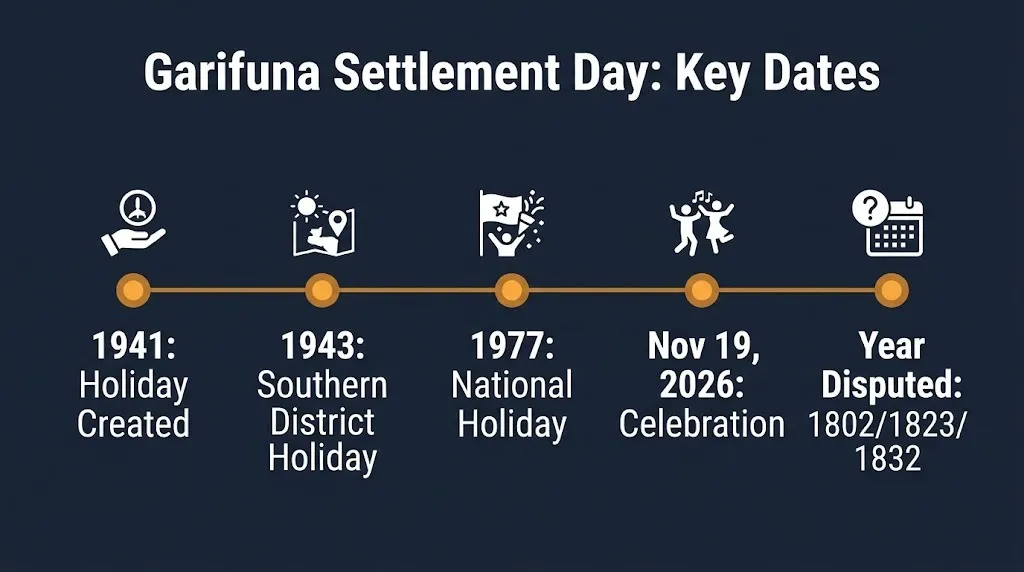
The holiday was created in 1941 by Belizean civil rights activist Thomas Vincent Ramos, first recognized as a public holiday in the southern districts in 1943, and elevated to national holiday status in 1977 . Those dates come from archived encyclopedia entries and Belizean news archives, not from any court docket or settlement administrator.
Nothing about this day involves filing a claim, hiring an attorney, or receiving compensation. If a website or message tells you otherwise, that message is false.
How Much Money Do You Get from Garifuna Settlement Day?
You get no money from Garifuna Settlement Day. There is no fund, no per-person payout, and no settlement amount. The holiday is a commemoration of cultural heritage, funded and organized by communities, the National Garifuna Council, and Belizean government cultural bodies, not by a claims process.
Not yet determined does not apply here, because there is nothing to determine. The absence of a payout is not a pending detail. It is the defining fact.
The verified financial activity around the holiday is public spending on celebrations and cultural support. In October 2026, Belize’s Minister of Culture met with the National Garifuna Council and the Institute for Creative Arts to discuss government support for the November 19 activities and for language preservation efforts, including support for Gulisi Primary School in Dangriga . That is public cultural funding, not a settlement distribution.
What Is the Garifuna Settlement Day Reenactment?
The Yurumein reenactment is the central ritual of Garifuna Settlement Day, a live staging of the Garifuna arrival by dugout canoe on the shores of Dangriga. It happens on the morning of November 19 and is the event most visitors and Belizeans associate with the holiday.
Participants in traditional dress paddle canoes to shore, recreating the landing that the holiday commemorates . The reenactment is followed by parades, street music, drumming, and traditional dancing, with Dangriga hosting the largest official festivities . Punta Gorda and other southern communities hold their own ceremonies, often including a Garifuna Mass and a parade .
If you want to see the core of the holiday, the Dangriga shoreline on the morning of November 19 is the verified location and time. The reenactment is open to the public as a cultural event, not a ticketed legal proceeding.
Key Takeaway: Garifuna Settlement Day is a cultural reenactment and national holiday, and the only “settlement” it involves is the historical settling of the Garifuna people on Belizean land.
When Did the Garifuna Actually Arrive in Belize?
The verified arrival year is disputed in the sources. Some credible records say 1802, others say 1823, and some say 1832. The disagreement is real and worth knowing, because tourism pages and encyclopedia archives both present their version as settled fact.
The 1802 date appears in Travel Belize content and in a BlackPast historical entry, which states the Garifuna had migrated to what is now Belize by 1802 . A separate Travel Belize page says about 500 Garinagu arrived on November 19, 1823 . Another Travel Belize PDF says the holiday honors the first arrival in 1832 . A Breaking Belize News piece from 2016 also cites 1832 .
| Claimed Arrival Year | Where It Appears |
|---|---|
| 1802 | Travel Belize blog, BlackPast.org |
| 1823 | Travel Belize tag page |
| 1832 | Travel Belize PDF, Breaking Belize News (2016) |
The safest verified statement is this: Garifuna Settlement Day commemorates the Garifuna arrival in Belize, and the exact year is reported differently across sources. The holiday itself is verified. The year attached to it is not consistent.
How Do You Celebrate Garifuna Settlement Day?
You celebrate by attending public events in Belize, particularly in Dangriga, or by engaging with Garifuna food, music, and language wherever you are. The holiday is built around community participation, not formal registration.
Verified activities on and around November 19 include:
- The Yurumein reenactment on the Dangriga shoreline, the signature event
- Parades and street music through Dangriga and other southern towns
- Garifuna Mass at St. Peter Claver Church in Punta Gorda, followed by an official ceremony
- Battle of the Drums, a drumming competition held in Punta Gorda on the Saturday before the holiday
- Traditional food, especially hudut, a coconut-based fish soup with plantains
If you are not in Belize, the verified remote options are limited to cultural content: listening to Garifuna artists, practicing the language (a common greeting is “Buiti Bunafi,” good morning), and watching recorded performances . There is no virtual claim form or official online settlement portal, because there is no claim.
What Is the History Behind Garifuna Settlement Day?
The holiday commemorates the exile and migration of the Garifuna people from St. Vincent through Honduras and along the Central American coast to Belize. The Garifuna are descendants of West Africans who escaped slave ships and intermarried with Carib and Arawak peoples on St. Vincent .
British colonial forces exiled the Garifuna from St. Vincent in 1798, and they dispersed to Roatán, mainland Honduras, and then along the coast to Guatemala, Nicaragua, and Belize . Thomas Vincent Ramos, a Belizean civil rights activist, created the holiday in 1941 to honor that history and to assert Garifuna cultural visibility .
The holiday’s recognition timeline is one of the more solid parts of the record: created 1941, southern district public holiday 1943, national holiday 1977 . Those dates are consistent across the archived sources.
What Happens Next
- October 2026: Government cultural meetings with the National Garifuna Council are already underway to support November events .
- Early November 2026: Week-long celebrations and preparatory events begin in Garifuna communities.
- Saturday before November 19, 2026: Battle of the Drums in Punta Gorda .
- Thursday, November 19, 2026: Yurumein reenactment, parades, and official ceremonies; public offices and banks in Belize close.
- After November 19, 2026: The holiday concludes for the year; no claims window follows.
Frequently Asked Questions
Is Garifuna Settlement Day a real holiday?
Yes. It is a national public holiday in Belize, celebrated every November 19, and has been a national holiday since 1977 .
Is Garifuna Settlement Day a lawsuit or settlement payout?
No. There is no lawsuit, no settlement fund, and no payout. The word “settlement” refers to the Garifuna settling on land in Belize, not a legal resolution.
When is Garifuna Settlement Day in 2026?
It falls on Thursday, November 19, 2026, in Belize .
Do banks and offices close on Garifuna Settlement Day?
Yes. It is a public and bank holiday in Belize, so government offices and banks are closed on November 19.
What is the Yurumein reenactment?
It is a live reenactment of the Garifuna arrival by dugout canoe, held on the Dangriga shoreline on the morning of November 19 .
Did the Garifuna arrive in Belize in 1802 or 1832?
Sources disagree. Some credible pages say 1802, others say 1823, and others say 1832. The arrival year is not consistently verified across records .
Where is the biggest Garifuna Settlement Day celebration?
Dangriga Town in the Stann Creek District hosts the largest official festivities, including the main reenactment and parade .
Who created Garifuna Settlement Day?
Belizean civil rights activist Thomas Vincent Ramos created the holiday in 1941 .