Snow v. Align Settlement 2026: Case Status, Claim Details, and What Shareholders Should Know
Quick Answer
- Snow v. Align is a shareholder derivative lawsuit, not a consumer class action.
- No consumer claim form exists, and no payout to the general public is expected.
- The case concerns corporate governance at Align Technology, maker of Invisalign.
You searched for a Snow v. Align settlement because you saw the case name somewhere and wondered if money is available.
Here is the truth: this is a shareholder derivative action. It is a lawsuit brought by shareholders on behalf of the company against its officers and directors. It is not a consumer settlement, and it has nothing to do with Invisalign patients or product buyers.
This article explains what the case actually is, what it means for shareholders, and why no claim form will ever land in your mailbox.
| The Facts | |
|---|---|
| Case | Snow v. Align Technology, Inc. |
| Case Type | Shareholder derivative action |
| Court | Delaware Court of Chancery, expected |
| Status | Active or settled, limited public detail |
| Consumer Claim Form | None |
| Consumer Payout | None |
| Claim Deadline | Not applicable to consumers |
| Administrator | Not applicable |
Is the Snow v. Align Settlement Real?
Yes, the Snow v. Align case is real, but it is not a settlement that pays consumers.
The case is a shareholder derivative action, a type of lawsuit where shareholders sue corporate officers and directors for alleged breaches of fiduciary duty.
The confusion comes from the word settlement. Shareholder derivative cases sometimes settle, but the settlement terms typically involve corporate governance reforms, not cash payments to the public.
Any website suggesting you can file a claim for money is wrong.
What Is the Snow v. Align Lawsuit About?
The Snow v. Align lawsuit alleges that officers and directors of Align Technology breached their fiduciary duties.
Align Technology makes Invisalign clear aligners. The shareholder case concerns internal corporate governance, not product defects.
Derivative actions typically claim that executives mismanaged the company, made false statements, or engaged in self-dealing. The shareholders sue on behalf of the company to recover damages or force reforms.
| Claim Element | What It Means |
|---|---|
| Fiduciary duty | Officers must act in the company’s best interest |
| Breach | Alleged failure to do so |
| Derivative claim | Brought by shareholders for the company |
| Relief sought | Governance reforms or monetary recovery to the company |
This case has no direct impact on consumers.
Does the Snow v. Align Settlement Pay Consumers?
No, the Snow v. Align settlement does not pay consumers. Any payout would go to the company, not to individuals.
Derivative settlements typically require the company to adopt governance changes, pay attorney fees, or recover money from officers. The company’s shareholders benefit indirectly, not through direct checks.
| Beneficiary | What They May Receive |
|---|---|
| The company | Monetary recovery from officers |
| Shareholders | Indirect benefit through company value |
| Consumers | Nothing |
No claim form exists because there is nothing for consumers to claim.
Key Takeaway: Snow v. Align is a corporate governance case, not a consumer settlement. No individual payout exists.
What Is a Shareholder Derivative Action?
A shareholder derivative action is a lawsuit filed by shareholders on behalf of the corporation against its officers or directors.
The shareholders step into the company’s shoes. They claim the company was harmed by its own leadership and that the leadership should be held accountable.
If the case succeeds, any recovery goes to the company. Shareholders benefit indirectly because the company’s value may improve.
| Feature | What It Means |
|---|---|
| Plaintiff | Shareholders, on behalf of the company |
| Defendant | Officers and directors |
| Recovery | Goes to the company |
| Consumer impact | None |
Derivative actions are common in corporate law. They rarely produce consumer payouts.
How Does Snow v. Align Differ From a Class Action?
A class action represents a group of people who were directly harmed. A derivative action represents the company itself.
In a class action, class members receive notice and can file claims for individual compensation. In a derivative action, there are no individual claims.
| Factor | Class Action | Derivative Action |
|---|---|---|
| Who is represented | Injured individuals | The corporation |
| Who gets paid | Class members | The company |
| Claim form | Yes | No |
| Consumer notice | Required | Not required |
If you saw Snow v. Align listed alongside other settlements, someone made a category error.
Why Do People Search for a Snow v. Align Claim Form?
People search for a Snow v. Align claim form because the case name appears on legal tracking sites that do not explain what the case is.
Legal databases list thousands of cases. When a case name surfaces in search results, people assume it is a settlement with money available.
The reality is different. Most cases never involve consumer payouts. Shareholder derivative cases almost never do.
Reality Check: If a website offers a claim form for Snow v. Align, it is either a scam or a lead-generation trap. Legitimate derivative settlements do not have claim forms.
What Should Align Technology Shareholders Do?
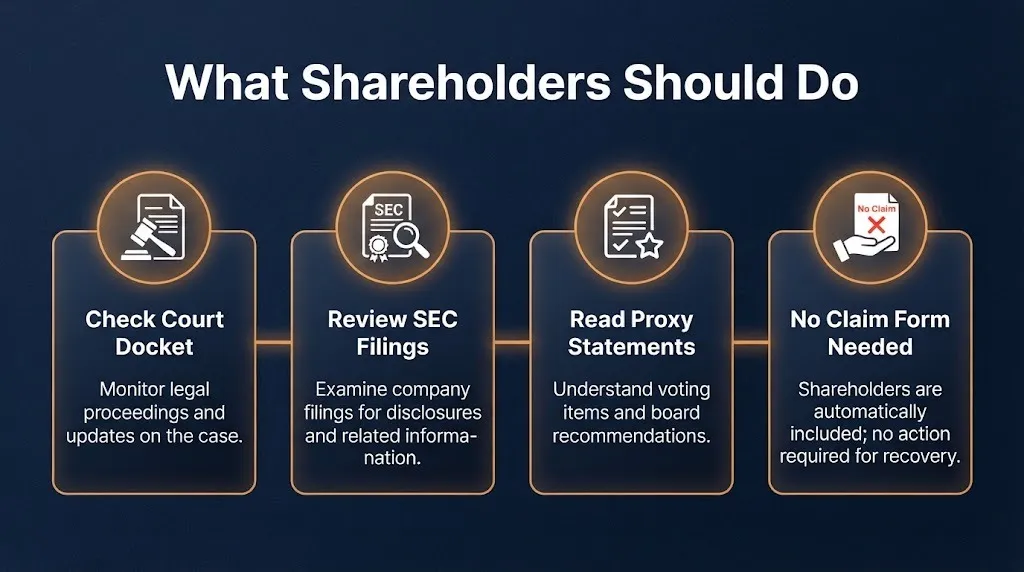
Align Technology shareholders should monitor the case through official court records and company filings.
If you own Align stock, the case may affect governance practices, but it does not require any action from you.
| Shareholder Action | What to Do |
|---|---|
| Monitor case status | Check court docket or company SEC filings |
| Vote on governance proposals | Review proxy statements |
| Contact investor relations | Ask about derivative case status |
| File a claim | Not applicable |
There is nothing to file and no deadline to meet.
What Is Align Technology?
Align Technology is the company that makes Invisalign clear aligners.
The company went public in 2001 and has grown into one of the largest orthodontic device makers in the world.
Its products are used by dentists and orthodontists to straighten teeth without traditional braces.
| Company Fact | Detail |
|---|---|
| Founded | 1997 |
| Product | Invisalign |
| Market | Global orthodontics |
| Stock | Publicly traded |
The Snow v. Align case concerns corporate governance, not the safety or effectiveness of Invisalign.
Are There Any Invisalign Lawsuits That Pay Consumers?
Invisalign has faced consumer lawsuits over marketing and pricing practices, but those are separate from Snow v. Align.
Those consumer cases may involve false advertising, antitrust claims, or billing disputes. They are class actions, not derivative actions.
| Case Type | Consumer Payout Possible? |
|---|---|
| Consumer class action | Yes, if settled |
| Shareholder derivative | No |
| Product liability | Yes, if defect proven |
Do not confuse one case type with another.
What Happens Next in Snow v. Align?
The Snow v. Align case will proceed through corporate court channels with no consumer-facing milestones.
- Current: Case status not publicly detailed in consumer-accessible records
- Expected: Possible governance settlement or dismissal
- Consumer impact: None
- Claim process: None
These are not dates or deadlines. They describe a case that operates outside the consumer settlement world.
Frequently Asked Questions
Is there a Snow v. Align settlement claim form?
No.
Derivative actions do not have consumer claim forms.
Will I get money from Snow v. Align?
No.
Any recovery goes to Align Technology, not to individuals.
What is Snow v. Align about?
It is a shareholder derivative action over corporate governance.
It has nothing to do with consumer products or payouts.
Is this the same as an Invisalign class action?
No.
Invisalign consumer class actions are separate cases with different claims.
Do I need to do anything if I own Align stock?
No action is required.
Monitor company filings for governance updates.
Where can I verify Snow v. Align case details?
Check the Delaware Court of Chancery docket.
Company SEC filings may also disclose the case.
The Bottom Line
Snow v. Align is a shareholder derivative action, not a consumer settlement. No claim form exists, no payout is coming, and no deadline applies to you.
If you saw this case name attached to a settlement ad, treat it as noise. The case concerns corporate governance at Align Technology, and its outcome will not put money in your pocket.
The single most important fact is this: derivative settlements pay the company, not the public. Any site saying otherwise is misleading you.