Elizabethan Settlement 2026: The 1559 Religious Compromise That Shaped Anglicanism
Quick Answer
- The Elizabethan Settlement was a 1559 compromise that made England officially Protestant while keeping some Catholic traditions.
- It was enacted through two key laws: the Act of Supremacy and the Act of Uniformity.
- The settlement created the “middle way” that still defines the Church of England today.
The Elizabethan Settlement is the name historians gave to the religious laws Queen Elizabeth I pushed through Parliament in 1559. Those laws ended the Catholic restoration under Mary I and established a Protestant Church of England that kept certain traditional practices.
This wasn’t a simple flip of the switch. Elizabeth inherited a country exhausted by decades of religious whiplash. Henry VIII broke from Rome, Edward VI pushed hard toward Protestantism, and Mary I dragged England back to Catholicism. Each swing left a trail of resentment.
What Elizabeth built in 1559 was a deliberate compromise. It’s the religious equivalent of a marriage settlement that both sides sign without loving every clause. This article breaks down what the settlement did, how it worked, and why it still matters in 2026.
The Facts
| Item | Verified Value |
|---|---|
| Official Name | Elizabethan Religious Settlement |
| Enacted | 1559 |
| Key Legislation | Act of Supremacy, Act of Uniformity |
| Parliament | 1559 Parliament |
| Queen | Elizabeth I |
| Archbishop of Canterbury | Matthew Parker (appointed 1559) |
| Doctrine | The Thirty-Nine Articles (1563) |
| Current Status | Framework of the Church of England |
What Was the Elizabethan Settlement?
The Elizabethan Settlement was a series of laws and policies passed in 1559 that re-established the Church of England as a Protestant institution under the monarch’s authority.
It had two legislative pillars. The Act of Supremacy declared Elizabeth the Supreme Governor of the Church of England, reversing Mary’s restoration of papal authority . The Act of Uniformity mandated the use of a new Book of Common Prayer, largely based on the second Edwardian Prayer Book of 1552 .
The settlement wasn’t just about doctrine. It was about control. The Act of Supremacy returned to the Crown uncontested control over church patronage and finances, reversing the cautious progress toward financial autonomy that had occurred under Mary .
Elizabeth also issued Royal Injunctions in July 1559 that clarified additional policies. These injunctions gave clergy a set of instructions, including bans on “fake” miracles and requirements to report recusants .
The result was a church that was Protestant in doctrine but conservative in ceremony. Historians have called it a “middle way,” though Elizabeth herself would have rejected that label if it implied indifference.
Why Did Elizabeth I Create the Religious Settlement?
Elizabeth created the settlement to end the religious conflict that had torn England apart since her father’s break with Rome.
The 1559 Parliament faced immediate opposition. Catholic activists led by the Marian bishops in the House of Lords mounted vigorous resistance. The supremacy and uniformity bills nearly failed .
Elizabeth won by mixing compromise with coercion. She made concessions to appease lay consciences and weakened episcopal solidarity through arrests and intimidation . When the bishops refused to accept the supremacy even after it became law, Elizabeth relied on Marian exiles and zealous Protestants to fill vacant church positions .
The settlement also had a financial dimension. One of the first government bills presented to Parliament was for the return of first-fruits and tenths to the Crown. This helped solve the new regime’s pressing financial problems while symbolically subjugating the clergy to royal authority .
What Did the Act of Supremacy and Act of Uniformity Do?
The Act of Supremacy made Elizabeth the Supreme Governor of the Church of England, replacing the Pope as its head. The Act of Uniformity required all churches to use the new Book of Common Prayer.
These two laws worked together. Supremacy controlled governance. Uniformity controlled worship.
The Act of Supremacy rolled back the ecclesiastical legislation passed under Mary and placed governance of the church back under the Crown . It also had political and economic consequences, returning to the Crown uncontested control over patronage within the church .
The Act of Uniformity mandated a new Book of Common Prayer, taken mostly from the second Edwardian Prayer Book. It was approved by Parliament on April 28, 1559. With its mandatory adoption at the end of June, the liturgical aspects of the Marian Church were officially swept away .
Elizabeth’s settlement was more conservative than Edward VI’s in certain areas. The vestments to be worn by priests and the ornaments allowable in churches were closer to Catholic practice .
Key Takeaway: The Elizabethan Settlement rested on two laws: Supremacy gave Elizabeth control over the church, and Uniformity dictated how worship would be conducted.
How Did the Thirty-Nine Articles Fit Into the Settlement?
The Thirty-Nine Articles were approved in 1563 and became the doctrinal statement of the Church of England, completing the Elizabethan Settlement’s theological framework.
The articles were drawn up in Latin and subscribed by both houses of convocation. In 1571, they were subscribed in both Latin and English, making both versions equally authentic .
Convocation played an underestimated role in this process. It met alongside Parliament throughout Elizabeth’s reign and hammered out the doctrine and discipline of the reformed church . Archbishop Matthew Parker searched the records to discover proper forms and adapted them to post-Reformation circumstances .
The queen refused to let Parliament be the arbiter of church affairs, which to her mind were beyond its remit. Yet she did nothing to suggest convocation might be an independent source of legal authority .
The Thirty-Nine Articles were based on earlier formulations, including the Forty-Two Articles published under Edward VI. They represented a distinctly Protestant doctrinal position while leaving room for traditional practices in worship.
What Were the Reactions to the Elizabethan Settlement?
Reactions to the Elizabethan Settlement were mostly positive at first, with about 250 out of 9,000 priests refusing the Oath of Supremacy and losing their jobs .
Many Catholic bishops resigned rather than accept the new order. Their positions were filled by loyal supporters . Matthew Parker, appointed Archbishop of Canterbury, was widely respected as a moderate Protestant .
Fines for refusing to attend church services weren’t strictly enforced. As long as people outwardly conformed, tolerance was allowed .
Elizabeth sent 125 commissioners to tour the country and check that the rules were followed . The 1559 Act of Exchange also allowed the Queen to take land and buildings from the church and force bishops to pay rent, adding to her purse .
Abroad, the reaction was muted. The French were consumed with their own religious problems. Spain, under Philip II, still hoped to maintain friendly relations with England in the hope that Catholicism would eventually be restored .
Why Did the Puritans Oppose the Settlement?
The Puritans opposed the Elizabethan Settlement because it didn’t go far enough in removing Catholic practices from the Church of England.
Puritans were strict Protestants who wanted to “purify” the church and eliminate all traces of Catholic worship . Many had fled abroad during Mary’s reign and returned when Elizabeth took the throne, hoping for a more thorough Reformation .
They were disappointed by Elizabeth’s compromise. The settlement kept vestments, ornaments, and ceremonies that Puritans considered idolatrous .
At first, many Puritans seemed to accept the settlement. But they soon organized campaigns to make it more Protestant . The Vestarian Controversy erupted in 1571 when Walter Strickland, leader of the Puritan group in Parliament, wanted to reform the Prayer Book and ban clergy vestments. Elizabeth silenced him by closing Parliament .
From 1575 to 1583, Puritan clergy organized prayer meetings called “prophesyings.” Elizabeth ordered Archbishop Grindal to ban them. He protested, so she suspended him and expelled 200 Puritan priests .
In 1583, Puritan John Stubbs published a pamphlet criticizing Elizabeth’s marriage negotiations with a Catholic French prince. He was sentenced to have his right hand cut off .
Elizabeth held strong against Puritan attempts to change the settlement. By 1590, most people accepted the Church of England as the national church .
Key Takeaway: The Puritans opposed the Elizabethan Settlement from the Protestant side, arguing it kept too many Catholic practices, but Elizabeth refused to budge.
What Was the Catholic Reaction to the Settlement?
The Catholic reaction to the settlement hardened over time, culminating in Pope Pius V’s 1570 bull excommunicating Elizabeth and releasing her subjects from allegiance.
The bull, “Regnans in Excelsis,” was issued in February 1570 . It proclaimed Elizabeth’s excommunication and deposition, declaring her a “pretended” queen because of her heresy .
The bull was flawed in several ways. It failed to give Elizabeth a chance to defend herself and pronounced deposition immediately rather than letting a year pass after excommunication . It denounced Elizabeth for taking a title (supreme head) which she had been careful to avoid .
Pius V acted from conviction rather than political sense. He published the bull without reference to Spain, depriving himself of the only champion capable of executing it. Philip II was annoyed both at the bull and at the discourtesy to himself .
Elizabeth had little difficulty representing the pope as the aggressor. The bull inadvertently added a powerful weapon to the Elizabethan anti-Catholic arsenal .
English Catholics were caught between loyalty to their monarch and obedience to Rome. The bull was binding on Elizabeth and heretics, but “in no way binding on Catholics under present circumstances” according to later Jesuit instructions. Catholics could acknowledge Elizabeth as queen “under present circumstances,” but those circumstances could end at the pope’s discretion .
Reality Check: The Elizabethan Settlement wasn’t a modern legal settlement with payouts or claim deadlines. It was a set of 16th-century laws that created the Church of England. No one is owed compensation from it, and there’s no administrator to contact.
How Did the Settlement Shape the Church of England?
The settlement shaped the Church of England for the next four centuries, establishing its “classical post-Reformation shape” .
Elizabeth’s “settlement” of the church in 1559-63 stood the test of time. In some fundamental ways, it shaped the church for the next four hundred years . Even after the upheavals of the Civil War, the Restoration, and the Glorious Revolution, the national reformed church began to operate within the Elizabethan framework .
The settlement was a compromise that held because it was adaptable. As one historian noted, the “apparently inchoate pieces have a way of subtly transforming themselves into an organism that is extremely adaptable to changing circumstances” .
Today, the Church of England is still the religion of the English monarchy but no longer enjoys privileges over other religions in British parliamentary democracy . The Archbishop of Canterbury is honored as the universal primate among the Anglican communion, which traces its heritage to the Elizabethan Settlement.
What Happens Next: Timeline of the Elizabethan Settlement’s Legacy
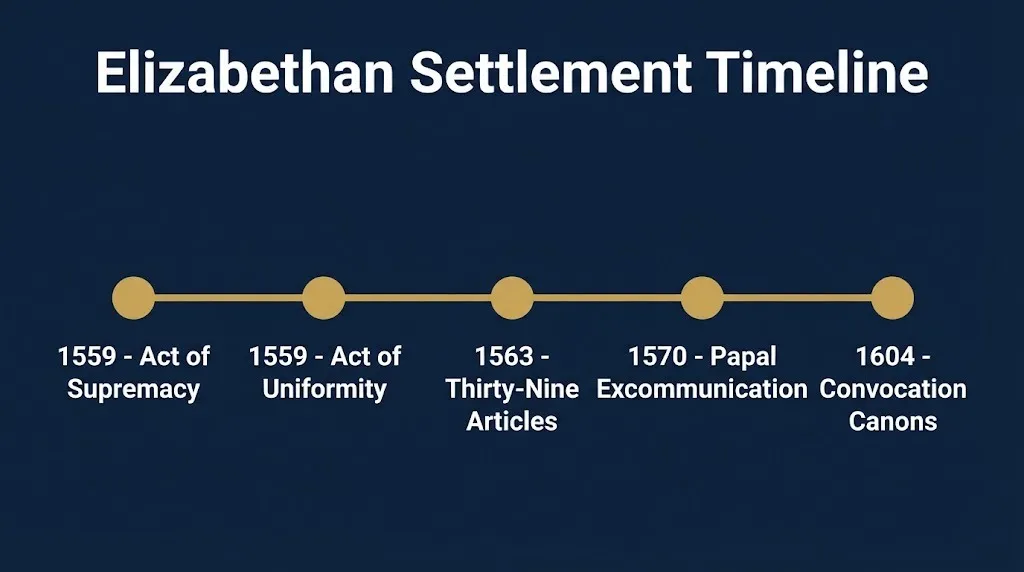
1559: Act of Supremacy and Act of Uniformity passed, establishing the settlement.
1563: Thirty-Nine Articles approved, completing the doctrinal framework.
1570: Pope Pius V excommunicates Elizabeth, hardening Catholic opposition.
1604: Convocation issues canons incorporating the settlement’s principles.
1662: Act of Uniformity confirms and adjusts the settlement after the Civil War.
Frequently Asked Questions
What was the Elizabethan Settlement?
The Elizabethan Settlement was a 1559 compromise that established the Church of England as Protestant while retaining some Catholic traditions.
Why was the Elizabethan Settlement created?
It was created to end the religious conflict between Catholics and Protestants that had torn England apart since Henry VIII’s break with Rome.
What did the Act of Supremacy do?
The Act of Supremacy declared Elizabeth I the Supreme Governor of the Church of England, replacing the Pope as its head.
What did the Act of Uniformity do?
The Act of Uniformity required all churches to use the new Book of Common Prayer, establishing a single form of worship.
What were the Thirty-Nine Articles?
The Thirty-Nine Articles were approved in 1563 and became the doctrinal statement of the Church of England.
Why did the Puritans oppose the settlement?
Puritans wanted a more thorough Protestant Reformation and objected to the Catholic practices the settlement retained.
How did the Pope respond to the Elizabethan Settlement?
Pope Pius V issued a bull in 1570 excommunicating Elizabeth and releasing her subjects from allegiance to her.
Does the Elizabethan Settlement still exist today?
Yes. The settlement’s framework still defines the Church of England’s structure, doctrine, and relationship to the monarchy.