Structured Settlement Funding 2026: The Real Cost of Selling Future Payments
Quick Answer
- Structured settlement funding is the sale of future tax-free annuity payments for immediate cash at a steep discount.
- You will not receive the full value. Factoring companies typically pay 35% to 75% of what your payments are worth.
- A judge must approve every structured settlement sale. Maryland’s reform shows that with the right guardrails, approvals can drop by 99%.
Structured settlement funding is a legal transaction where you sell your future annuity payments for a lump sum of cash today. You get immediate money. The factoring company gets your payments, often at a discount of 25% to 65%.
If you receive structured settlement payments from a personal injury or workers compensation case, you may have been contacted by a company offering cash now. The sales pitch sounds simple. The math is not.
Every structured settlement sale requires court approval. That means a judge reviews whether the deal is in your best interest. Maryland proved in 2026 that when judges ask real questions and require local hearings, predatory transactions collapse by 99%. This article breaks down what structured settlement funding actually costs you, how the court process works, and what to do before you sign anything.
The Facts
| Item | Details |
|---|---|
| What It Is | Sale of future structured settlement payments for immediate cash |
| Federal Law | IRC Section 5891; 40% excise tax on unapproved factoring transactions |
| Court Approval | Required in all 50 states plus DC under SSPAs |
| Typical Discount | 25% to 65% loss on total payment value |
| Court Costs | Filing fees around $400; attorney fees $4,000 to $5,000 |
| Payment Timeline | 45 to 90 days after court approval |
| Key Reform | Maryland reduced factoring approvals from 1,800 to 6 in one year |
Is structured settlement funding legitimate or a scam?
Structured settlement funding is legitimate, but the industry has a documented history of predatory practices. The transaction itself is legal under federal law and requires court approval in every state.
The problem is not the concept. The problem is how some companies execute it. Maryland courts approved approximately 1,800 factoring transactions in a single year before reforms took effect. After the state required home-court hearings and mandatory judicial questioning, that number fell to six.
That 99% drop tells you something important. Most of those 1,794 transactions that disappeared were not in anyone’s best interest. They were transactions that only happened because no one asked hard questions.
You should treat any unsolicited offer with suspicion. Legitimate factoring companies exist, but they contact you through advertising, not cold texts. If someone reaches out first and pressures you to sign, the deal is probably priced against you.
How much does structured settlement funding cost?
Structured settlement funding costs you the difference between what your future payments are worth and what the factoring company pays you today. That gap is called the discount.
Industry data shows factoring companies commonly pay 35% to 75% of the total value of the payments they buy. A payment stream worth $100,000 in future value might fetch only $35,000 in cash today.
Here is what that looks like in practice:
| Total Future Value | Typical Cash Offer | Your Loss |
|---|---|---|
| $50,000 | $17,500 to $37,500 | $12,500 to $32,500 |
| $100,000 | $35,000 to $75,000 | $25,000 to $65,000 |
| $250,000 | $87,500 to $187,500 | $62,500 to $162,500 |
The discount rate ranges from 6% to 29% depending on the buyer, your payment schedule, and market conditions. But the discount rate is not the only cost. You also pay court filing fees (around $400) and attorney fees that can reach $4,000 to $5,000. Those costs come directly out of your settlement value.
Key Takeaway: Every dollar you accept today is a dollar plus interest you will never see. The discount is permanent, and there is no undo button.
Can I sell just part of my structured settlement?
Yes, you can sell a portion of your structured settlement payments and keep the rest on the original schedule. Partial sales are common.
A partial sale lets you address a specific need without surrendering your entire income stream. You might sell two years of payments to cover a medical expense or a down payment, then keep receiving payments afterward.
The court evaluates partial sales the same way it evaluates full buyouts. A judge must find the transfer is in your best interest. Partial sales are often easier to approve because you retain some future income.
Some states require you to disclose every prior transfer application in your petition. A New York case in 2026 showed a payee who had filed three prior applications, with mixed results. Courts track repeat sellers, and a pattern of frequent sales can hurt your credibility.
Why does structured settlement funding require court approval?
Structured settlement funding requires court approval because federal and state laws were written specifically to protect injury victims from selling their financial security too cheaply.
Congress passed the structured settlement factoring tax in 2002 under IRC Section 5891. The law imposes a 40% excise tax on the factoring discount for any transaction that is not approved by a qualified court order.
States followed with Structured Settlement Protection Acts. Today, all 50 states plus the District of Columbia have SSPAs on the books. These laws require a judge to find that the transfer:
- Does not violate any federal or state statute
- Is in your best interest, considering your dependents
- Includes a fair and reasonable discount rate and fees
- Meets disclosure and independent advice requirements
The court is not supposed to be a rubber stamp. A New York appellate court put it plainly in 2026: the legislature did not intend for courts to be mere rubber stamps. But whether a judge actually asks hard questions depends on the state and the judge.
Reality Check: A court approval does not mean the deal is good. It means the deal met the legal minimum. Maryland courts were approving 1,800 transactions a year before anyone checked whether those deals actually helped people.
Who regulates structured settlement funding companies?
Structured settlement funding companies are regulated at both the federal and state levels. The primary federal regulator is the Internal Revenue Service, which enforces the 40% excise tax on unapproved transfers.
At the state level, regulators vary. Georgia, for example, requires structured settlement purchase companies to register with the Secretary of State and maintain active status. Other states rely on the court approval process itself as the primary check.
The National Association of Settlement Purchasers (NASP) is the industry’s self-regulatory body. NASP claims to set standards and best practices, but membership is voluntary. The National Structured Settlements Trade Association (NSSTA) represents the structured settlement industry and has pushed for stricter consumer protections, including the Maryland reforms.
If you are considering a factoring transaction, check whether the company is registered in your state. Ask for its BBB rating and search for complaints. A legitimate company will not hesitate to provide this information.
How do I file a petition for structured settlement funding?
Filing a petition for structured settlement funding involves a court process that typically takes 45 to 90 days from start to finish. Here are the steps:
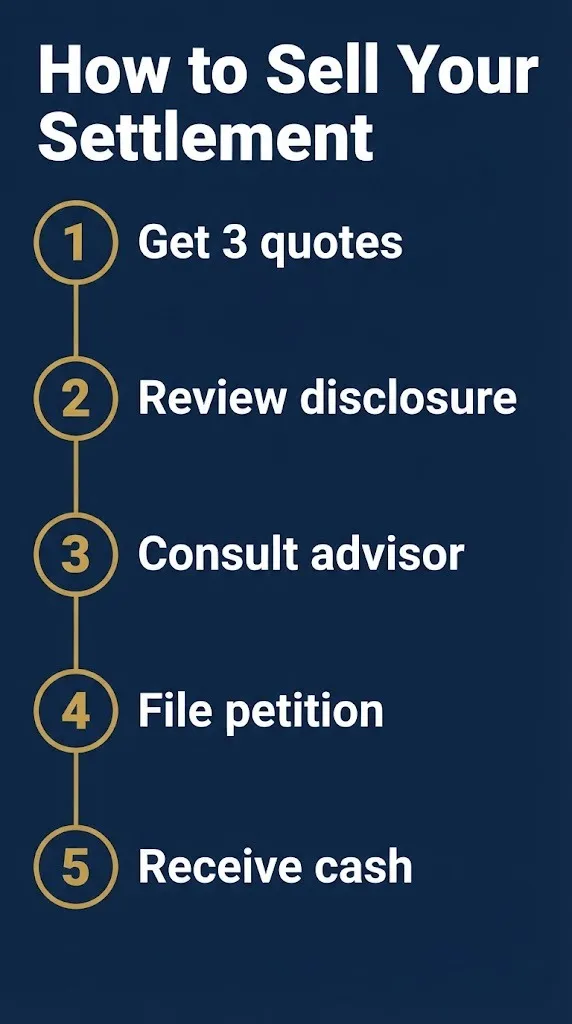
- Request quotes from at least three separate buyers. J.G. Wentworth operates under multiple names, so verify that your quotes come from different parent companies.
- Review the disclosure statement. You must receive it at least 10 days before signing any transfer agreement.
- Consult an independent attorney or financial advisor. The law requires the factoring company to advise you to seek independent advice, and you must either receive it or waive it in writing.
- Sign the transfer agreement if you decide to proceed.
- The factoring company files a petition in court. This must be in your home county under the Maryland model, or wherever your state requires.
- Attend the court hearing. You must appear unless the judge excuses you for good cause.
- Receive your lump sum after the judge approves the transfer.
The factoring company typically pays the court filing fees and its own attorney. But those costs are factored into the discount you accept. You pay them indirectly.
What happens at a structured settlement funding hearing?
At a structured settlement funding hearing, a judge reviews your petition and decides whether the sale is in your best interest. The hearing can take as little as two or three minutes in some courts, or much longer if the judge is thorough.
Maryland’s reforms required judges to ask specific questions directly to the payee. Those questions include:
- Is this your first factoring transaction or a repeat?
- How will you meet your ongoing financial obligations after selling these payments?
- What is the purpose of the lump sum?
- Have you received independent professional advice?
In practice, many hearings are non-adversarial. Only the factoring company’s attorney and the payee are present. There is no one arguing against the sale. That is why Maryland’s reforms were so effective: they forced judges to actively question the payee rather than accept the petition at face value.
If a guardian ad litem is appointed, approval rates drop significantly. A guardian protects the payee’s interests when the payee may not fully understand the transaction.
What alternatives exist to structured settlement funding?
Alternatives to structured settlement funding include partial sales, financial counseling, and waiting until your financial situation improves. Not every cash crunch requires selling your future.
You cannot borrow against a structured settlement. Banks will not accept future settlement payments as collateral. That restriction is written into the settlement agreement itself.
Your real alternatives are:
- Sell a smaller portion. Reduce the amount of future payments you surrender.
- Negotiate the discount rate. Some buyers will move on price, especially if you have competing offers.
- Consult a financial advisor first. An advisor may find a better solution for your specific problem.
- Wait if you can. If the expense is not urgent, selling now locks in a permanent loss.
Most structured settlement recipients never sell. Industry data suggests less than 15% of recipients ever complete a factoring transaction. The vast majority keep their payment schedules intact.
What happens next in structured settlement funding regulation?
The next stage of structured settlement funding regulation is happening at the state level, with Maryland as the template.
NSSTA and the National Consumers League are pushing similar reforms in Ohio, Oregon, and California. The Maryland model includes three core elements:
- Home venue requirement: Petitions must be heard in the payee’s home court.
- Mandatory judicial questioning: Judges must ask specific questions about prior transactions and financial circumstances.
- Tightened review standards: Courts get clearer authority to evaluate best interest.
The John Oliver segment on settlement factoring in 2026 brought national attention to the issue. Whether that attention translates into legislation in more states is not yet confirmed.
For now, the court approval requirement remains the primary protection for structured settlement recipients. Its effectiveness depends entirely on the judge in your case.
Frequently Asked Questions
Is structured settlement funding a good idea?
Usually not. You lose 25% to 65% of your future payments in the transaction. A court must approve the sale, but approval does not mean the deal is good for you.
How much cash can I get from selling my structured settlement?
The cash offer depends on your payment schedule and the discount rate. You can expect to receive 35% to 75% of the total value of the payments you sell.
Do I need a lawyer to sell my structured settlement?
You are not required to have your own lawyer, but the factoring company must advise you to seek independent professional advice. You can waive that advice in writing.
How long does structured settlement funding take?
The process typically takes 45 to 90 days from application to cash in hand. Court approval is the longest step.
Can I sell my structured settlement without going to court?
No. Every state requires court approval for a structured settlement transfer. Without a qualified court order, the buyer faces a 40% federal excise tax on the discount.
What happens if the judge denies my structured settlement sale?
You keep your original payment schedule. The judge’s denial means the transaction does not happen. You can file again later if your circumstances change.
Is J.G. Wentworth the only structured settlement buyer?
No. J.G. Wentworth is the largest and most heavily advertised, but fewer than 15 active buyers operate in the market. Other companies include Catalina Structured Funding, DRB Capital, and CBC Settlement Funding.
Can I sell my structured settlement if I have a brain injury?
Yes, but courts scrutinize these transactions closely. A guardian ad litem may be appointed to represent your interests. Approval rates are significantly lower when a guardian is involved.
What you should do now
If you are considering structured settlement funding, gather competing quotes from at least three separate buyers before you sign anything. Check whether the company is registered in your state. Consult an independent attorney or financial advisor who does not work for the factoring company.
The single most important fact to remember is Maryland’s 99% drop. When courts ask real questions, most deals fall apart. The same scrutiny should apply to your transaction, whether the judge imposes it or not.