Chester Weger Settlement 2026: Why No Payout Exists After His Death
Quick Answer
- Is it legit? No settlement exists. Weger died convicted in 2025, and Illinois only pays wrongfully imprisoned people after exoneration.
- How much could his family get? Not yet determined. Any payout depends on a posthumous pardon from Governor Pritzker.
- Most important date: October 6, 2026, when the Illinois Prisoner Review Board hears the family’s pardon request.
If you searched for a “Chester Weger settlement,” you’re looking for something that doesn’t exist yet. Chester Weger died on June 22, 2025, less than a week after a LaSalle County judge rejected his final bid to overturn his 1961 murder conviction.
That timing matters enormously. Under Illinois law, wrongful conviction compensation only flows after a pardon based on innocence or a certificate of innocence from a circuit court. Weger had neither when he died. His family is now fighting for a posthumous pardon that could, potentially, open the door to a claim.
But that’s a big “if.” This article breaks down what actually happened, why no settlement check exists, and what the October 6 hearing could mean for the family’s chances.
The Facts
| Case Name | Chester Weger wrongful conviction (Starved Rock murders) |
|---|---|
| Court | LaSalle County Circuit Court; Illinois Prisoner Review Board |
| Status | Weger died June 2025; posthumous pardon hearing set for October 6, 2026 |
| Fund Size | Not yet confirmed (no compensation awarded) |
| Est. Per Person | Not yet determined |
| Claim Deadline | Not applicable (no public claims process) |
| Administrator | Illinois Court of Claims (if pardon granted) |
| Proof Needed | Pardon based on innocence or certificate of innocence |
Is the Chester Weger Settlement Real or a Scam?
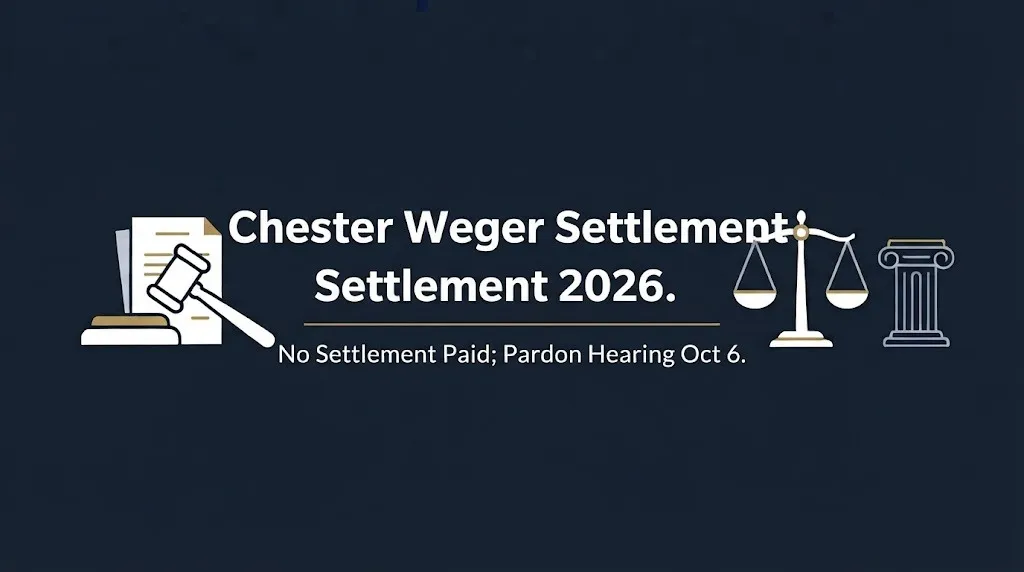
The Chester Weger settlement is not real because no settlement has been paid, awarded, or even legally triggered. This isn’t a scam, but it’s also not a source of money for anyone.
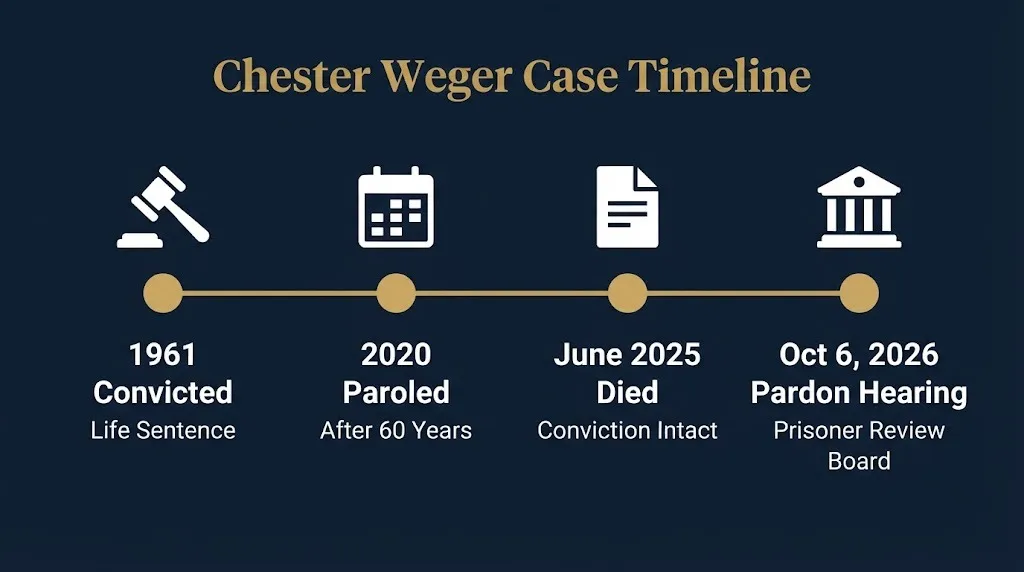
Weger was convicted in 1961 of murdering Lillian Oetting, one of three women found beaten to death at Starved Rock State Park in 1960. He confessed but recanted almost immediately, claiming detectives coerced him.
He spent nearly 60 years in prison before parole in 2020. He died in 2025 still fighting to clear his name.
Illinois doesn’t pay wrongfully convicted people automatically. You need either a gubernatorial pardon stating innocence or a certificate of innocence from a circuit court. Weger had neither when he died.
How Much Money Could the Weger Family Receive?
No amount has been approved or verified, but Illinois law sets a formula: up to $50,000 per year of wrongful imprisonment under a law signed in July 2026.
Weger served roughly 60 years. At the new rate, that’s a potential claim of $3 million. But he wasn’t exonerated before death, which complicates everything.
Here’s the current compensation structure in Illinois:
| Component | Rate |
|---|---|
| Wrongful imprisonment | Up to $50,000 per year |
| Wrongful parole/probation | Up to $25,000 per year |
| Attorney fees | Up to 25% of award |
The old law averaged just $11,190 per year, according to the Illinois Innocence Project. The new law significantly raises the ceiling.
But eligibility requires exoneration first. No exoneration, no claim.
Why There Is No Chester Weger Settlement Check
There is no settlement check because Weger died with his conviction legally intact. A LaSalle County judge rejected his post-conviction petition on June 18, 2025, citing insufficient evidence to proceed.
Weger died four days later. His attorney filed a motion to reconsider, but the judge ruled it void because it was filed after Weger’s death.
Illinois wrongful conviction compensation isn’t automatic. The Court of Claims Act requires a pardon based on innocence or a certificate of innocence before any payout. Without either, there’s no legal path to compensation.
Weger’s family is now pursuing a posthumous pardon, which is the only remaining avenue. If granted, it could open the door to a Court of Claims filing.
What Is the October 6 Pardon Hearing About?
The October 6 hearing is where the Illinois Prisoner Review Board will consider the family’s request for a posthumous pardon from Governor JB Pritzker. This is a rare proceeding.
The board has held posthumous clemency hearings for only two other people in the past seven years. Weger’s family filed a nearly 100-page petition in June 2026 arguing his innocence.
Attorney Andrew Hale says the family didn’t get a fair evidentiary hearing before Weger’s death. “I feel like this board and the governor’s office, if they take a fresh look at this, I should win,” Hale said.
The board will weigh testimony and send a confidential recommendation to Pritzker. He makes the final call. The process typically takes about two months.
What Evidence Supports Weger’s Innocence?
Weger’s legal team points to DNA evidence, witness testimony, and alternative theories about who killed the three women. A hair found on one victim’s finger didn’t match Weger or the victims.
His attorneys theorize a relative of one victim hired mobsters to kill her, and the other two women were killed as witnesses. Attorney Hale spent a decade reinvestigating and hosted a podcast about the case.
A key affidavit came from Roy Tyson, who said Harold “Smokey” Wrona told him he was contacted by underworld figures about disposing of a body. Wrona allegedly said Weger had nothing to do with it.
Prosecutors and victims’ families have opposed every effort to clear Weger’s name. The LaSalle County state’s attorney fought the post-conviction petition and continues to oppose the pardon.
How Does Illinois Wrongful Conviction Compensation Work?
Illinois wrongful conviction compensation requires a pardon based on innocence or a certificate of innocence from the circuit court, then a claim in the Court of Claims.
Here’s the process:
- Obtain exoneration. Either a gubernatorial pardon stating innocence or a judicial certificate of innocence.
- File in Court of Claims. The clerk dockets the case for consideration.
- Court of Claims hearing. The court hears the case and renders a decision within 90 days after docketing.
- Award calculation. Up to $50,000 per year of wrongful imprisonment under the new law.
- Attorney fees. Up to 25% of the award goes to legal counsel.
The certificate of innocence process was designed to give wrongfully convicted people a path to compensation without needing a pardon. But it requires the conviction to be vacated or reversed first.
Reality Check
No one is getting a “Chester Weger settlement check” from a website or text message. This is a wrongful conviction compensation case, not a class action. The only path to money runs through a posthumous pardon and then the Illinois Court of Claims. If you see anyone soliciting money or information related to a “Weger settlement,” that’s a scam.
What Happens Next for the Weger Family?
October 6, 2026: Illinois Prisoner Review Board hearing on the posthumous pardon request in Chicago.
Expected late 2026: Board sends confidential recommendation to Governor Pritzker, typically within two months of the hearing.
TBD: Pritzker’s decision on whether to grant the pardon. No timeline is guaranteed.
If pardoned: Family could file a claim in the Illinois Court of Claims for compensation.
If denied: The conviction stands permanently, and no compensation is possible.
Frequently Asked Questions
Is there a Chester Weger settlement?
No. Chester Weger died in 2025 with his conviction intact, and no settlement or compensation has been awarded.
How much money could Weger’s family get?
Under Illinois law, up to $50,000 per year of wrongful imprisonment. Weger served about 60 years, so a potential claim could exceed $3 million if exoneration occurs.
Did Chester Weger ever get exonerated?
No. A LaSalle County judge rejected his post-conviction petition days before his death in June 2025.
What happens at the October 6 hearing?
The Illinois Prisoner Review Board will hear testimony on the family’s posthumous pardon request and send a recommendation to Governor Pritzker.
Can you get wrongful conviction compensation after death in Illinois?
Only if a pardon based on innocence or certificate of innocence is granted first. Death doesn’t automatically trigger compensation.
Who is Chester Weger?
He was convicted in 1961 of murdering Lillian Oetting at Starved Rock State Park in 1960. He spent nearly 60 years in prison before parole in 2020.
Why is Weger called the Starved Rock Killer?
Three women were found beaten to death at Starved Rock State Park in March 1960. Weger was convicted of one of the murders.
What is the Illinois wrongful conviction payout rate in 2026?
Up to $50,000 per year of wrongful imprisonment under a law signed in July 2026.