Board Compensation in 2026: Public vs. Nonprofit Pay, Real Numbers, and the Delaware Ruling That Changed Board Pay Risk
Quick Answer
- Board compensation is pay for serving on a company’s board; it is not a lawsuit or settlement.
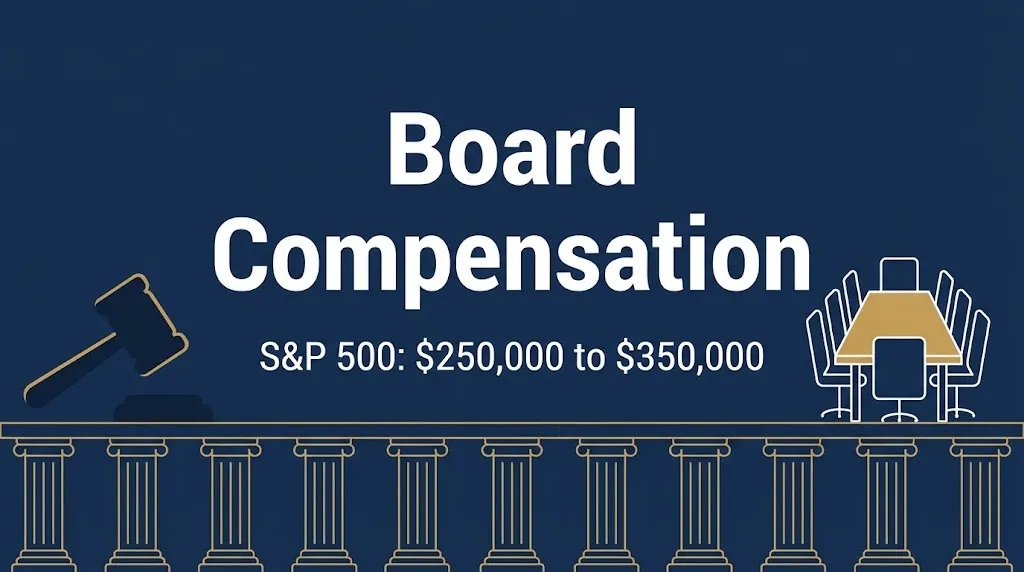
- S&P 500 directors typically earn $250,000 to $350,000 total, mostly in stock; nonprofit board pay is rare.
- The key 2026 date is June 15, when Delaware’s Chancery Court split a director pay case.
Board compensation is the money and stock a company pays its directors for serving on the board. The amount depends entirely on the type of organization, and the gap between sectors is enormous.
This affects corporate directors, nonprofit trustees, and shareholders who vote on pay packages. The number that matters most is the S&P 500 total, where directors typically receive $250,000 to $350,000, with a large share in restricted stock rather than cash .
This article covers verified 2026 pay figures across public companies, nonprofits, and international boards. It also explains the Delaware ruling that drew a new line between conflicted deals and director self-pay. One detail most competitors miss: in the Fidelity National Financial case, director pay allegedly ran 67% above peer median in 2024, and that allegation was enough to survive a motion to dismiss .
The Facts
| Item | Verified Detail |
|---|---|
| Product category | Governance pay, not a lawsuit or settlement |
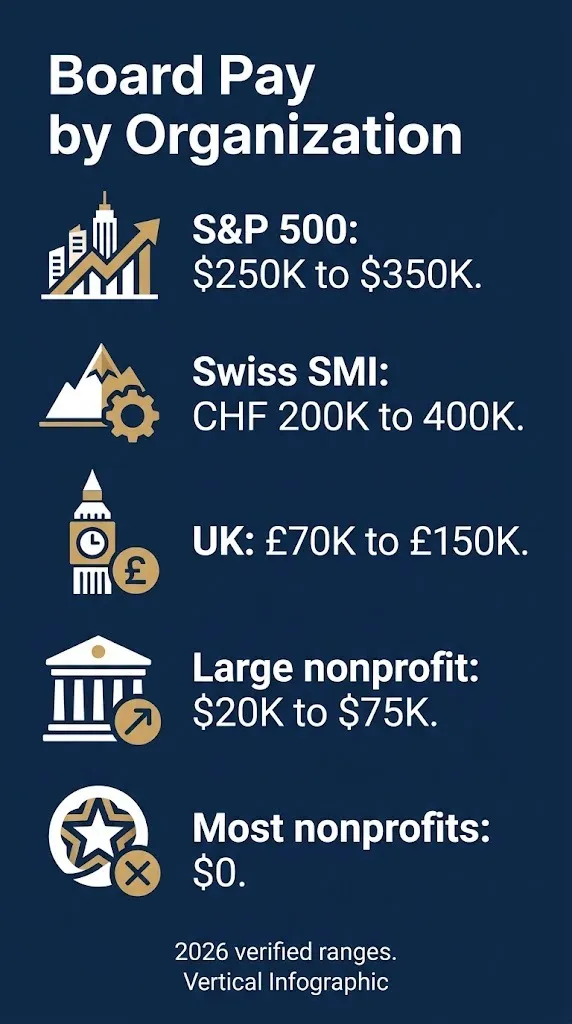
| S&P 500 director total pay | $250,000 to $350,000 typical, mostly restricted stock |
| Swiss SMI board member pay | CHF 200,000 to 400,000 |
| UK director fees | £70,000 to £150,000 |
| Large nonprofit health system retainers | $20,000 to $75,000 |
| Nonprofit board pay norm | Unpaid volunteer service |
| Key 2026 Delaware ruling | Ayers v. Foley, No. 2025-0650-LWW (Del. Ch. June 15, 2026) |
| Settlement fund | Not applicable; this is compensation, not litigation |
Is board compensation legit or a scam?
Board compensation is legitimate when it is approved through proper governance and disclosed in public filings. The scam risk sits with anyone who promises a board seat in exchange for a fee, or who offers “guaranteed director pay” without naming a company.
Public company board pay is heavily regulated. The SEC requires disclosure of director compensation in proxy statements. That is why verified figures like Garmin’s 2026 program exist in public filings, showing a $200,000 annual equity award and a $95,000 cash or stock retainer for non-employee directors .
The scam version looks different. No legitimate company charges you to join its board. No one cold-calls you offering a paid board seat. And no “board placement service” can guarantee compensation.
A simple comparison: a paid board seat is like a job offer. You don’t pay the employer to hire you.
How much do public company board members make in 2026?
Public company board members make between $250,000 and $350,000 in total compensation at S&P 500 companies, with most of that delivered as restricted stock rather than cash . The cash component is smaller, and the equity component is what aligns directors with shareholders.
Verified 2026 figures show the range:
| Company or Market | Director Pay Detail | Source |
|---|---|---|
| S&P 500 typical | $250,000 to $350,000 total, mostly stock | Gladwin |
| Garmin (fiscal 2026) | $200,000 RSU award plus $95,000 cash or RSU retainer | SEC filing |
| Garmin Board Chair | $150,000 annual, up from $130,000 | SEC filing |
| Garmin Audit Chair | $30,000 annual, up from $25,000 | SEC filing |
| OEM International (Sweden) | SEK 780,000 to Chair, SEK 420,000 to other directors | Nasdaq |
| Teleflex (2026) | $67,000 annual cash retainer | SEC filing |
The equity share matters because it changes the tax treatment and the actual value. A director who receives RSUs worth $200,000 may defer settlement, and the value at vesting can differ from the grant date value .
Not yet determined: Exact median total compensation for all public company directors. The S&P 500 range is verified, but smaller public companies pay less.
How much do nonprofit board members make in 2026?
Most nonprofit board members make nothing, because nonprofit boards are structured as volunteer service. The overwhelming majority of 501(c)(3) directors serve unpaid, and payment is the exception .
There are narrow exceptions. Large nonprofit health systems and foundations sometimes pay independent trustees, with retainers averaging $20,000 to $75,000 at large health systems . Staff members who also serve on the board, such as an executive director at a small nonprofit, may be paid for their staff role, not their board seat .
The IRS limits how much a nonprofit can pay insiders. Any board pay must be reasonable for comparable work, approved by people without a conflict, and documented. Excessive pay triggers intermediate sanctions and can jeopardize tax-exempt status .
Here is the nonprofit checklist:
- Most common: Unpaid volunteer service
- Allowed: Expense reimbursement with receipts
- Allowed but limited: Reasonable compensation for actual board work at large organizations
- Not allowed: Self-dealing or voting on your own pay
- Risk: Excessive pay can trigger IRS excise taxes
Reality Check: No one texts you about board compensation or asks for a fee to “release” director pay. Board pay is set by a compensation committee or the board itself, disclosed in proxy statements or tax filings, and paid through payroll or equity systems. If a stranger contacts you offering a paid board seat for an upfront fee, it is a scam. Verify any board opportunity through the company’s own governance documents and SEC filings.
What did the Delaware court rule on director pay in June 2026?
The Delaware Court of Chancery split a director pay case on June 15, 2026, allowing a claim against directors who approved their own compensation to proceed while dismissing a claim over a founder’s stock grant . The case is Ayers v. Foley, No. 2025-0650-LWW.
The founder grant survived because the directors who approved it were not the ones receiving it. A special committee negotiated William Foley’s award down from $60 million to $50 million, used an outside consultant, and got legal advice. The court found the plaintiff failed to show those directors lacked independence .
The directors’ own pay was different. When directors set their own compensation, they sit on both sides of the table, so the protective business judgment rule falls away. The plaintiff alleged director pay exceeded peer median by 21% in 2022, 38% in 2023, and 67% in 2024, while the company trailed peers on market cap, revenue, and net income. The court allowed the claim against the Compensation Committee members to proceed .
Key Takeaway: Delaware’s rewritten Section 144 shields independent directors on deals they don’t profit from, but it does nothing for directors who set their own pay.
How is board compensation set and approved?
Board compensation is set by the compensation committee or the full board, usually with input from an independent consultant and peer benchmarking. Shareholders at most public companies get a say-on-pay vote, but it is advisory and not binding .
The process varies by organization type. At public companies, the compensation committee reviews market data and recommends changes. Garmin’s filing shows the committee used Pearl Meyer as its independent consultant and increased the equity award from $185,000 to $200,000 for fiscal 2026 .
At nonprofits, the board or a committee must follow the IRS rebuttable presumption of reasonableness. That means advance approval by disinterested directors, reliance on comparability data, and documentation in the minutes .
The governance failure to watch for is self-dealing. A director should never vote on their own pay. That principle is what drove the Delaware ruling, and it is the same principle the IRS enforces for nonprofits .
What happens next for board compensation in 2026 and 2027?
The next stage for board compensation is the fallout from the Delaware ruling and the 2027 proxy season, when companies recalibrate their pay peer groups. No settlement or claim process exists, because this is a governance and compensation issue.
June 15, 2026: The Delaware Chancery ruling in Ayers v. Foley drew the line between conflicted deals and director self-pay .
Expected Q4 2026: Companies prepare 2027 proxy disclosures, and compensation committees review peer groups in light of the ruling.
Expected 2027: More litigation testing the amended Section 144 presumption, and potential challenges to director pay increases.
Ongoing: The IRS continues enforcing reasonable compensation rules for nonprofit boards .
Frequently Asked Questions
How much do board members get paid?
Public company directors at S&P 500 firms typically receive $250,000 to $350,000 in total compensation, mostly stock.
Nonprofit board members usually receive nothing .
Do nonprofit board members get paid?
Usually no, nonprofit board service is volunteer work.
Large health systems and foundations sometimes pay retainers of $20,000 to $75,000.
Payment must be reasonable and approved by disinterested directors .
Can directors vote on their own compensation?
No, self-dealing is a governance failure and can lead to liability.
In Delaware, directors who set their own pay face a stricter fairness test .
The IRS also prohibits nonprofit insiders from voting on their own pay .
What was the Ayers v. Foley ruling about?
It was a Delaware Chancery case over Fidelity National Financial’s director and founder pay.
The court dismissed the founder grant claim but allowed the director self-pay claim to proceed .
The ruling was the first to interpret amended DGCL Section 144.
Is board compensation a settlement or lawsuit?
No, board compensation is pay for governance service, not litigation.
There is no settlement fund, claim deadline, or administrator.
Lawsuits can challenge board pay, but the pay itself is not a settlement.
How much do Swiss or UK board members make?
Swiss SMI board members commonly earn CHF 200,000 to 400,000.
UK directors typically earn £70,000 to £150,000 .
Pay varies by market and company size.
The number to check before you join a board
Ask for the total compensation figure, not the cash retainer. At S&P 500 companies, the total is $250,000 to $350,000, and most of it is stock . At nonprofits, assume the seat is unpaid unless the organization can show you a written compensation policy approved by disinterested directors .