Post Trade Settlement in 2026: What Happens After You Click Buy, and Why T+1 Changes Everything
Quick Answer
- Post trade settlement is the back-office process that finalizes a trade after execution, moving cash and securities between parties.
- The US moved to T+1 in May 2024; Europe and the UK follow on October 11, 2027 .
- Settlement failure is the main risk, and T+1 compresses the window to fix errors from days to hours .
You bought a stock. The screen shows the trade. You assume it is done. It is not.
Post trade settlement is the machinery that turns a trade confirmation into actual ownership. It involves clearing, matching, confirmation, and the final exchange of cash for securities. Without it, your trade is just a promise.
This article breaks down the post trade settlement process step by step, what T+1 means for the timeline, who the key players are (custodians, central securities depositories, clearinghouses), and why the industry is racing to automate processes that used to take two days. The surprising part: up to 54% of post-trade processes must speed up to meet T+1 deadlines in Asia-Pacific, and 70% of custodians expect trade fails to climb by as much as 25% .
The Facts
| Item | Detail |
|---|---|
| What It Is | The back-office process that finalizes a securities trade after execution |
| Key Stages | Allocation, confirmation, clearing, settlement |
| Current US Cycle | T+1 (next business day) since May 2024 |
| Current European Cycle | T+2, moving to T+1 on October 11, 2027 |
| Pakistan Cycle | T+1 effective February 9, 2026 |
| Main Risk | Settlement failure, when securities or cash are not delivered on time |
| Key Infrastructure | Central Securities Depositories (CSDs), clearinghouses (CCPs) |
What Is Post Trade Settlement?
Post trade settlement is the final stage of a trade, when securities and cash are exchanged and ownership is officially updated in the central registry. The trade itself happens on the front end, but settlement is what makes it real.
The process begins after you click buy. Your broker confirms the trade details, matches them with the seller, and sends instructions to a clearinghouse. The clearinghouse validates the obligations and guarantees performance. Then the central securities depository (CSD) transfers the securities from the seller’s account to yours and moves the cash in the opposite direction .
Settlement is distinct from clearing. Clearing prepares the transaction by validating obligations, assessing risks, and guaranteeing performance. Settlement then finalizes the transfer. The two functions work together to contain disruptions and prevent them from spreading through the financial system .
A comparison: clearing is the referee checking that both teams are ready. Settlement is the final whistle that confirms the score.
What Is the Post Trade Settlement Process Step by Step?
The post trade settlement process runs through five main stages: allocation, confirmation, affirmation, clearing, and settlement. Each stage has its own players and its own failure points.
Here is how the process works for a typical institutional trade:
Step 1: Allocation. After execution, the investment manager tells the broker how to split the trade among different client accounts. This is the allocation message .
Step 2: Confirmation. The broker confirms the trade details, including the security, quantity, price, and settlement date. The two sides must agree on every field .
Step 3: Affirmation. The investment manager or its custodian affirms the confirmed trade. In central matching systems, the affirmation happens automatically when the allocation and confirmation match .
Step 4: Clearing. A clearinghouse validates the obligations, nets offsetting trades, and guarantees that the trade will settle even if one party defaults.
Step 5: Settlement. The CSD executes delivery-versus-payment, moving securities to the buyer’s account and cash to the seller’s account simultaneously. Ownership records are updated .
Each step has a deadline under T+1. What used to take two days must now happen in hours.
What Does T+1 Settlement Mean?
T+1 settlement means the trade must settle one business day after the trade date. If you buy a stock on Monday, settlement occurs on Tuesday. Under the old T+2 standard, it would settle on Wednesday.
The US moved to T+1 in May 2024 . Europe, the UK, and Switzerland are scheduled to follow on October 11, 2027 . Pakistan made the switch on February 9, 2026 .
The shift is not cosmetic. Under T+2, firms had roughly two days to validate, reconcile, allocate, and fund a trade. Under T+1, that window shrinks to one day. Processes that were distributed across two days must now run almost in real time .
The European Securities and Markets Authority has already issued revised guidelines requiring electronic, standardized communication for allocations and confirmations, removing references to oral or non-machine-readable methods except during temporary technical disruptions .
Key Takeaway: T+1 is not just a faster settlement date. It forces every upstream process, from allocation to funding, to compress into hours.
Who Are the Key Players in Post Trade Settlement?
The key players in post trade settlement are the investment manager, the broker-dealer, the custodian bank, the clearinghouse, and the central securities depository. Each has a defined role, and each can be the source of a failed trade.
The investment manager decides to trade and sends the allocation. The broker-dealer executes the trade and sends confirmation. The custodian bank holds the assets, affirms the trade, and ensures funds are available .
The clearinghouse, also called a central counterparty, steps between the buyer and seller and guarantees performance. If one side defaults, the clearinghouse absorbs the loss. The central securities depository maintains the official register of who owns what and executes the final transfer .
In Europe, the Post Trade Confirmation System operated by Euronext Securities Milan handles the agreement and refusal messages between parties. If the receiving party takes no action before the intended settlement date, a default refusal is applied .
Why Do Trades Fail to Settle?
Trades fail to settle when one party does not deliver the securities or the cash on the settlement date. The most common causes are inaccurate settlement instructions, funding shortfalls, and mismatched trade details.
Inaccurate or incomplete standing settlement instructions (SSIs) are one of the leading causes of settlement failures across the industry. Under T+1, the compressed timeline leaves little room for error .
Funding mismatches are another major risk. With settlement deadlines as early as 10 am to 1:30 pm local time in some markets, firms have roughly one and a half days to match, confirm, fund, and settle. Currency controls and cross-border timing pressures make this harder in Asia-Pacific markets .
The numbers are stark. Up to 54% of post-trade processes must speed up to meet T+1 deadlines, and 70% of custodians expect trade fails to climb by as much as 25% . And 70% of Asia’s settlement instructions will need to be automated to meet T+1 timelines .
Reality Check: No one calls you to fix a failed trade. Settlement failures are resolved between institutions through buy-ins, penalties, and collateral. Your broker’s app will not show you the back-office scramble.
What Is the Difference Between Clearing and Settlement?
Clearing is the process that validates and guarantees a trade before settlement. Settlement is the actual exchange of cash and securities. Clearing establishes certainty; settlement completes the transfer.
The clearinghouse assesses risk and nets offsetting obligations. If you bought 100 shares and sold 100 shares of the same security on the same day, the clearinghouse nets them and you settle the net difference. This reduces the amount of cash and securities that need to move .
Settlement is the final leg. The CSD moves the securities and the cash simultaneously through delivery-versus-payment. This ensures that neither party delivers without receiving .
Clearing and settlement are separate functions, but their coordination is essential. A failure in clearing can cause a failure in settlement. A failure in settlement can trigger collateral calls and penalties.
How Is Europe Preparing for T+1 in 2027?
Europe is preparing for T+1 through regulatory guidelines, industry testing, and infrastructure upgrades, with the October 11, 2027 deadline driving the timeline. The EU, UK, and Switzerland are coordinating to avoid misalignment across jurisdictions .
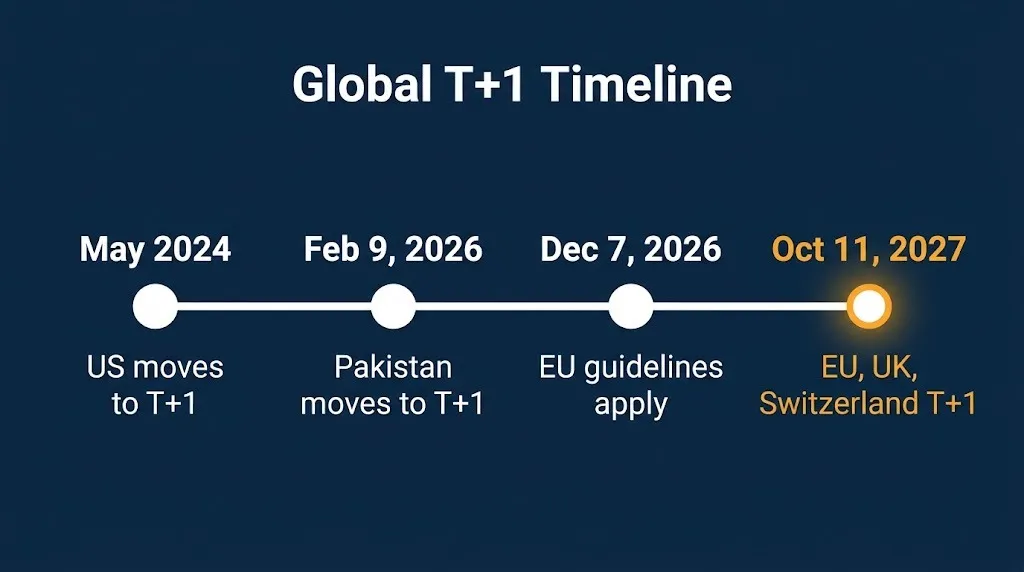
ESMA has finalized revised guidelines that apply from December 7, 2026, ahead of the T+1 go-live. These guidelines mandate electronic, standardized communication for allocations and confirmations, and remove references to non-electronic methods .
The industry is also focused on testing. The EU aims for full systems implementation by the end of 2026 and testing beginning in early 2027 . Coordination between CSDs, CCPs, and market participants is critical because Europe’s market is fragmented across multiple countries, currencies, and regulatory frameworks .
The scale of the change is significant. What previously took 12 to 14 working hours must now happen within a few hours. Automation alone is not enough; firms must also centralize exceptions and standardize data identifiers like LEIs and UTIs to reduce repairs .
What Happens Next in the Global T+1 Transition?
Here is the expected sequence for the next stages of the global settlement shift:
December 7, 2026: ESMA’s revised guidelines on allocations and confirmations apply in the EU .
End of 2026: EU aims for full systems implementation for T+1 readiness .
Early 2027: Industry-wide testing begins in Europe .
October 11, 2027: EU, UK, and Switzerland go live on T+1 .
Beyond 2027: Industry discussions shift toward T+0 or real-time settlement .
Frequently Asked Questions
What is post trade settlement?
Post trade settlement is the process that finalizes a securities trade after execution, moving cash and securities between the buyer and seller.
What does T+1 mean?
T+1 means the trade must settle one business day after the trade date. The US has been on T+1 since May 2024.
When does Europe move to T+1?
Europe, the UK, and Switzerland move to T+1 on October 11, 2027.
What happens if a trade fails to settle?
The failing party may face penalties, collateral requirements, or a buy-in, where the clearinghouse purchases the securities to complete the trade.
What is the difference between clearing and settlement?
Clearing validates and guarantees the trade. Settlement is the actual exchange of cash and securities.
Who are the key players in post trade settlement?
Investment managers, brokers, custodians, clearinghouses, and central securities depositories.
Why is T+1 so difficult for firms?
It compresses two days of processing into one, requiring faster allocation, confirmation, funding, and error correction.
The Bottom Line
Post trade settlement is the invisible machinery that makes your trade real. The global shift to T+1 is compressing that machinery into a single day, and the industry is not fully ready.
The date to watch is October 11, 2027, when Europe, the UK, and Switzerland join the US on T+1. Until then, firms are testing, automating, and bracing for a rise in failed trades. If you trade, know that the confirmation on your screen is not the final word. Settlement is.