Real Estate Settlement Procedures Act 2026: Rules, Violations, and Consumer Rights
Quick Answer
- RESPA is a federal law that bans kickbacks and requires disclosure of settlement costs in mortgage transactions.
- State AGs are now driving enforcement. The CFPB’s docket shrank sharply in 2025 and 2026.
- Consumers can sue for RESPA violations and recover three times the charge paid for the settlement service.
The Real Estate Settlement Procedures Act (RESPA) is a 1974 federal law that governs how mortgage settlement services are priced and disclosed. It covers most residential purchase and refinance loans .
You may be searching this because you just bought or refinanced a home. Something on your Closing Disclosure looked off. Or a title company charged you for a service you never agreed to use.
RESPA exists to stop exactly that. It bans kickbacks, limits escrow padding, and forces lenders to tell you what you’re paying for. This guide covers what the law actually says, what violations look like in 2026, and how enforcement is changing.
The Facts
| Item | What to Know |
|---|---|
| Full Name | Real Estate Settlement Procedures Act of 1974 |
| U.S. Code | 12 U.S.C. § 2601 et seq. |
| Implementing Rule | Regulation X (12 CFR Part 1024) |
| Primary Enforcer | Consumer Financial Protection Bureau (CFPB) |
| 2026 Enforcement Trend | State AGs filling the CFPB enforcement gap |
| Key Prohibition | Section 8: No kickbacks or referral fees |
| Private Right of Action | Yes, treble damages available |
What Is the Real Estate Settlement Procedures Act?
The Real Estate Settlement Procedures Act is a federal consumer protection law that regulates mortgage settlement services. Congress passed it in 1974 to stop abusive practices in the home buying process .
The law’s stated purpose is to give consumers more timely information about settlement costs and protect them from unnecessarily high charges . It applies to “federally related mortgage loans,” which covers almost every residential purchase-money or refinance loan secured by a first or subordinate lien on one-to-four family residential property .
RESPA is implemented by Regulation X, which the CFPB enforces. The law covers several areas: advance disclosure of settlement costs, elimination of kickbacks and referral fees, limits on escrow account deposits, and modernization of land title recordkeeping .
The law does not cover business, commercial, or agricultural loans. It also exempts loans on property of 25 acres or more and temporary construction loans .
What Does RESPA Section 8 Prohibit?
RESPA Section 8 prohibits giving or accepting any fee, kickback, or thing of value for the referral of settlement service business. The ban covers agreements or understandings that business will be referred to any person .
This is the most litigated and enforced provision of the law. It targets the hidden economy of referral payments in real estate. Title companies paying real estate agents for client referrals. Mortgage brokers sharing profits with agents who steer borrowers their way. Servicers charging borrowers for insurance they already have.
The penalty is severe. Anyone who violates Section 8 is liable to the person charged for the settlement service for three times the amount of any charge paid for that service . That is treble damages, and it is available to private consumers who sue.
Section 8 also has an exemption for “affiliated business arrangements.” A title company can refer you to its own affiliate, but only if three conditions are met: written disclosure of the ownership interest, no requirement that you use the affiliate, and only a return on ownership as payment .
What Are Common RESPA Violations in 2026?
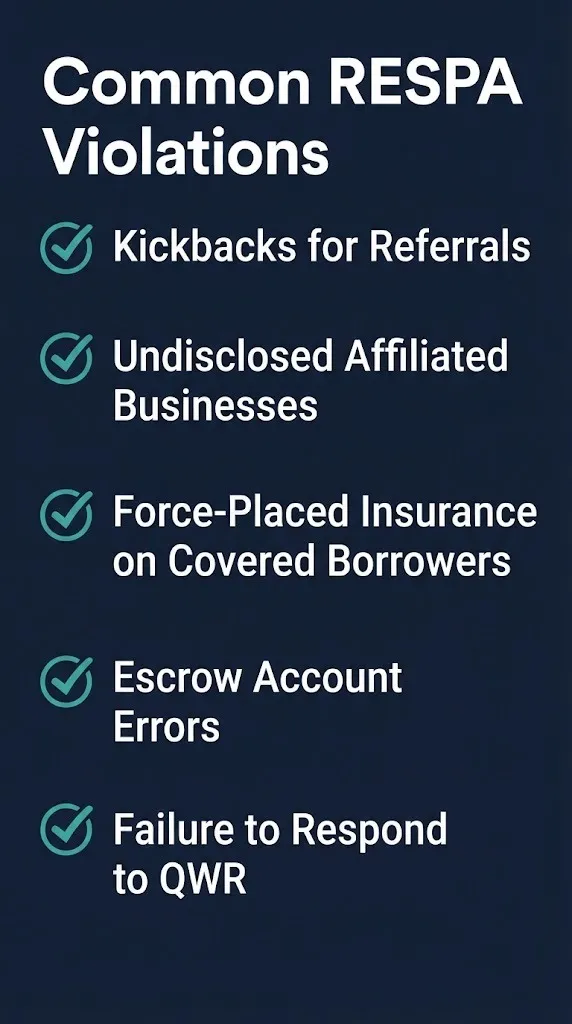
Common RESPA violations in 2026 center on kickbacks, force-placed insurance, and undisclosed affiliated business arrangements. State regulators are actively pursuing all three.
Force-placed insurance is a major area. A multi-state coalition fined a mortgage servicer $15.5 million in August 2026 for allegedly imposing force-placed insurance on more than 4,200 borrowers who already had active homeowners policies . The settlement included more than $4.5 million in borrower remediation .
Undisclosed joint ventures are another focus. Maryland’s attorney general settled with a title company and its joint ventures for $850,000 in restitution in January 2026. The state alleged the JVs paid fees to real estate agents and brokers in exchange for title insurance referrals .
Equity-sharing schemes are under scrutiny. A Pennsylvania federal court denied a motion to dismiss in August 2026 against mortgage brokerages that allegedly sold discounted equity shares to real estate agents at $450 per unit with returns up to 900% . The court found the arrangements fell outside RESPA’s safe harbor .
Key Takeaway: RESPA violations in 2026 cluster around hidden referral payments, force-placed insurance on borrowers who already have coverage, and joint ventures that disguise kickbacks as ownership returns.
How Do I File a RESPA Complaint?
You file a RESPA complaint with the CFPB, your state attorney general, or by filing a private lawsuit. The CFPB’s complaint system remains open even as its enforcement docket has shrunk.
The CFPB accepts complaints about mortgage servicers, lenders, and settlement service providers. You can submit online, by phone, or by mail. The agency forwards your complaint to the company and tracks the response.
State attorneys general are increasingly active in RESPA enforcement. Maryland, Pennsylvania, and the District of Columbia have all brought recent actions . If you suspect a kickback scheme in your transaction, your state AG’s consumer protection division is a direct path.
Private lawsuits are also available. Section 8 gives you a private right of action for treble damages . You do not need the CFPB or a state AG to sue. An attorney can evaluate whether your closing costs included an illegal referral payment.
Here is a checklist for filing:
- Gather your Closing Disclosure and any affiliated business disclosures you received.
- Identify any fees paid to companies with ownership ties to your agent or broker.
- Document any force-placed insurance charges on your mortgage statement.
- File with the CFPB online or by phone.
- Contact your state attorney general’s consumer division.
- Consult a consumer protection attorney about a private claim.
Who Enforces RESPA in 2026?
The CFPB is the primary federal enforcer, but its RESPA enforcement has dropped sharply in 2025 and 2026. State attorneys general and financial regulators are filling that gap .
In 2025, the CFPB rolled back its enforcement docket significantly. It dismissed many active cases, including a RESPA Section 8 action against Rocket Homes that alleged incentives to brokers for steering homebuyers to Rocket Mortgage . The bureau also terminated a handful of prior settlements .
The result is a multi-state enforcement surge. The Conference of State Bank Supervisors announced the $15.5 million force-placed insurance settlement with 46 states and Washington, D.C. in August 2026 . A coalition of 47 state financial regulators entered a consent order with the same servicer .
State AGs are also bringing their own actions. Maryland settled a joint venture case for $850,000. Pennsylvania’s attorney general survived a motion to dismiss in an equity-sharing case. The pattern is clear: the enforcement center of gravity has moved to the states .
What Damages Can I Recover Under RESPA?
You can recover actual damages, additional damages up to $2,000 for pattern or practice violations, and costs and attorney’s fees. For Section 8 kickback violations, treble damages are available .
The specific remedies depend on which RESPA provision was violated.
For Section 8 violations, the statute provides that the violator is liable to the person charged for the settlement service for three times the amount of any charge paid for that service . If you paid $1,000 in title insurance and a kickback was involved, your potential recovery is $3,000.
For servicing violations under Section 6, you can recover actual damages from the servicer’s failure to respond to a qualified written request . You can also recover additional damages up to $2,000 if there is a pattern or practice of noncompliance.
For escrow violations under Section 10, the servicer can be liable for actual damages and additional damages.
Attorney’s fees and costs are recoverable in successful RESPA actions.
Reality Check: No legitimate settlement administrator or government agency texts you asking for a fee to process a RESPA claim. The CFPB does not charge to file a complaint. Anyone demanding payment to “release” RESPA damages is running a scam.
What Happens Next?
Late 2026: State AG RESPA enforcement actions continue to rise as the CFPB remains sidelined .
Ongoing: The Rocket steering lawsuit proceeds after the CFPB dropped its case. Private plaintiffs are pursuing the claim independently .
Expected 2027: More multi-state settlements involving force-placed insurance and joint venture kickback schemes.
If you have a claim: The statute of limitations for RESPA private actions is generally three years from the violation, but courts are debating when that clock starts .
Frequently Asked Questions
What does RESPA stand for?
Real Estate Settlement Procedures Act. It is a 1974 federal law regulating mortgage settlement services.
Does RESPA apply to my mortgage?
RESPA applies to most residential purchase and refinance loans on one-to-four family properties. Business and agricultural loans are exempt.
What is a RESPA violation?
Common violations include kickbacks for referrals, failure to disclose affiliated business arrangements, force-placed insurance on covered borrowers, and escrow account errors.
Can I sue under RESPA?
Yes. Section 8 gives you a private right of action for treble damages. You can also sue for servicing violations.
How long do I have to file a RESPA claim?
The statute of limitations is generally three years, but courts disagree on when the clock starts. Consult an attorney promptly.
Who enforces RESPA in 2026?
The CFPB is the primary federal enforcer, but state attorneys general and financial regulators are driving most 2026 enforcement.
What is a qualified written request?
A written dispute about your mortgage account that triggers servicer obligations under RESPA. It must include your name, account number, and a statement of the error .
What is an affiliated business arrangement?
When a person in a position to refer settlement business has an ownership interest in the provider. RESPA exempts these only if three disclosure conditions are met .
If you just closed on a home, pull out your Closing Disclosure and look for fees paid to companies connected to your agent or broker. If something looks like a referral payment, file a complaint with your state attorney general. The most important deadline is the three-year window for private claims, and courts are still debating when that clock starts .