Taxes on a $500,000 Settlement in 2026: What You Actually Owe
Quick Answer
- Is it legit? Yes, IRS Publication 4345 confirms settlement tax rules based on the nature of damages recovered.
- How much could you owe? Physical injury settlements are typically tax-free; wage or punitive awards face ordinary income rates.
- Most important factor: The settlement agreement’s allocation language controls what the IRS treats as taxable.
A $500,000 settlement does not have a single tax answer. The IRS looks at what each dollar was meant to replace, and the difference between a tax-free recovery and a six-figure tax bill often comes down to how the settlement agreement describes your damages.
If your settlement compensates a physical injury from a car crash, you likely owe nothing on the compensatory portion. If it resolves an employment discrimination claim with no physical harm, much of that $500,000 is taxable as wages and subject to withholding. This article breaks down exactly which portions trigger tax, how the IRS allocation rules work, and what you need to do before you sign anything.
The Facts
| Case Type | Individual settlement tax treatment |
|---|---|
| Governing Law | IRC Section 104(a)(2) and IRS Publication 4345 |
| Status | Active IRS guidance; 2026 tax year rules apply |
| Fund Size | Not applicable (individual tax treatment) |
| Est. Per Person | 0% to 37%+ depending on damage type |
| Claim Deadline | Quarterly estimated payments may be required |
| Administrator | IRS |
| Proof Needed | Settlement agreement allocation, medical records, prior tax returns |
Is a $500,000 Settlement Taxable in 2026?
A $500,000 settlement is taxable only to the extent it compensates non-physical losses, and the IRS treats physical injury recoveries as excluded from gross income under IRC Section 104(a)(2).

The starting point is IRC Section 61, which says all income is taxable unless a specific exception applies. Section 104(a)(2) provides that exception for damages received on account of personal physical injuries or physical sickness.
The word “physical” matters. Since Congress amended the code in 1996, emotional distress alone does not qualify for the exclusion unless it stems from a physical injury or sickness.
Key Takeaway: The tax on your $500,000 settlement ranges from zero to over $150,000 depending on what the money compensates.
What Portions of a $500,000 Settlement Are Tax-Free?
Damages for personal physical injuries or physical sickness are excluded from taxable income, meaning the full compensatory portion is tax-free if you did not previously deduct related medical expenses.
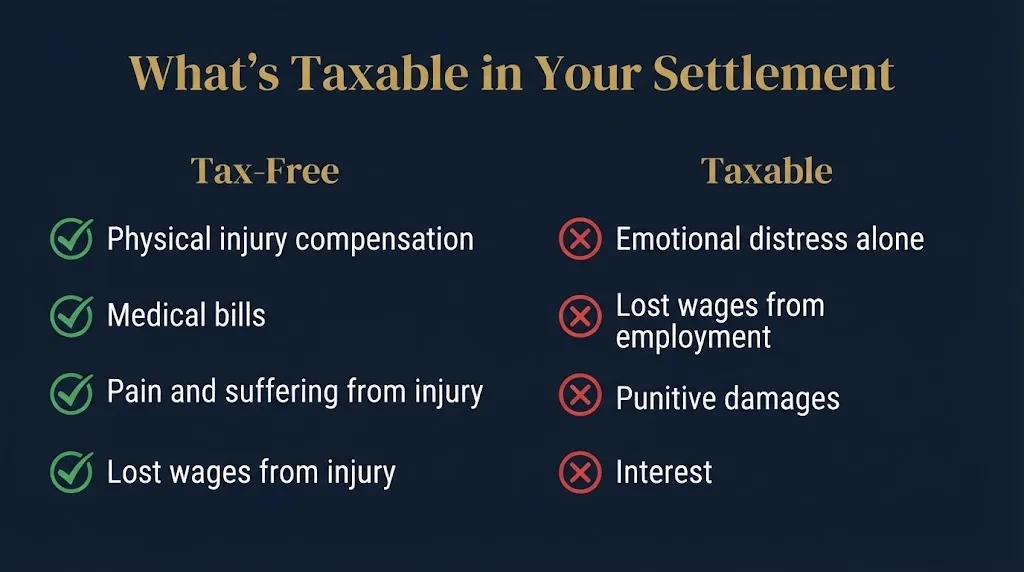
Here is what typically qualifies for the exclusion:
- Medical bills from treating the injury
- Pain and suffering tied to the physical harm
- Lost wages when a physical injury caused the work loss
- Emotional distress attributable to the physical injury
The IRS uses a substitution test. What did the money replace? If it replaced something that would have been tax-free, the settlement is tax-free. If it replaced taxable income, the settlement is taxable.
A car accident settlement that covers hospital bills and missed work due to a broken leg is tax-free. A defamation settlement for reputational harm is fully taxable.
What Portions of a $500,000 Settlement Are Taxable?
Lost wages from employment claims, emotional distress without physical injury, punitive damages, and interest are all taxable portions of a settlement.
| Settlement Component | Tax Treatment | Reporting Form |
|---|---|---|
| Physical injury compensation | Tax-free | Not reported |
| Emotional distress (no physical injury) | Taxable | Schedule 1, Line 8z |
| Lost wages (employment claim) | Taxable as wages | W-2 |
| Punitive damages | Always taxable | Schedule 1, Line 8z |
| Interest on settlement | Taxable as interest | Schedule 1, Line 2b |
| Attorney fees (taxable case) | Included in income | Varies |
In employment cases, the lost wages portion is subject to Social Security and Medicare taxes and should have employment tax withholding by the payer.
Not yet determined: Your exact tax liability depends on the allocation in your specific agreement. There is no one-size-fits-all formula.
How Does the IRS Decide Which Part of a Settlement Is Taxable?
The IRS looks at the settlement agreement’s language, the original complaint, and the payor’s intent to determine what each payment compensates.
If the agreement clearly allocates amounts to physical injury versus other damages, the IRS generally respects that allocation if it’s consistent with the substance of the claims.
When the agreement is silent or vague, the IRS does its own classification. A lump-sum settlement with no allocation for a wrongful termination case gets treated as fully taxable wages.
This is why tax attorneys say the most important time to plan for settlement taxes is before you sign. Once you accept a $500,000 lump sum with no tax language, arguing later that part was for physical injury becomes very difficult.
Reality Check: No legitimate tax preparer will tell you to hide settlement income. The IRS receives Forms 1099 and W-2 for taxable portions. If you receive a $500,000 settlement with taxable components and don’t report them, the IRS will match the forms and send a notice. Filing accurately with proper allocation is the only safe path.
How Much Tax Will You Pay on a $500,000 Settlement?
Your tax rate depends on your total income for the year, but taxable settlement portions are ordinary income subject to your marginal rate plus employment taxes where applicable.
Here’s a rough illustration for 2026 tax brackets using a single filer with $500,000 in taxable settlement income:
| Tax Type | Rate Range | Estimated Tax on $500,000 |
|---|---|---|
| Federal income tax | 35% to 37% | $175,000 to $185,000 |
| Social Security (wage portion) | 6.2% (up to cap) | Varies |
| Medicare | 1.45% to 2.35% | $7,250 to $11,750 |
| State income tax | 0% to 13%+ | Varies by state |
This is a simplified example. Your actual rate depends on filing status, deductions, and how much of the settlement is taxable.
For a physical injury settlement, the federal tax is $0. For a fully taxable employment settlement, you could owe $180,000 or more.
How Do You Report a $500,000 Settlement on Your Tax Return?
Taxable settlement portions go on Schedule 1 of Form 1040 as “Other Income” for non-wage damages, or on your W-2 if the settlement includes lost wages.
Here’s the reporting breakdown:
- Physical injury compensation: Not reported. No entry on your return.
- Emotional distress (no physical injury): Schedule 1, Line 8z, reduced by unclaimed medical expenses.
- Lost wages (employment): Reported on W-2, Line 1a of Form 1040.
- Punitive damages: Schedule 1, Line 8z.
- Interest: Schedule 1, Line 2b.
You should receive a Form 1099-MISC for non-wage taxable portions. If you don’t receive one, you still must report the income.
Attach a statement if you’re reducing emotional distress income by related medical expenses. The IRS wants to see the math.
What Happens If You Already Deducted Medical Expenses?
If you deducted injury-related medical expenses on a prior tax return and received a tax benefit, that portion of your $500,000 settlement becomes taxable under the tax benefit rule.
This prevents double-dipping. You can’t deduct a medical expense in one year and then receive that same expense back tax-free in another.
Most filers never face this issue because they take the standard deduction. For tax year 2023, only 2.4% of individual returns claimed medical expense deductions.
If you did itemize medical expenses related to your injury, the portion of the settlement reimbursing those expenses is taxable to the extent you received a tax benefit.
What About Attorney Fees in a $500,000 Settlement?
Attorney fees are generally included in your gross income if the underlying recovery is taxable, even when the money goes directly to your lawyer.
This creates a trap. If you settle a $500,000 employment case and your lawyer takes $150,000, you might still owe tax on the full $500,000, not just the $350,000 you receive.
The Supreme Court’s decision in Commissioner v. Banks confirmed this rule. You can deduct attorney fees in some cases, but the deduction doesn’t always offset the income one-for-one.
Key Takeaway: The settlement allocation language controls your tax bill more than any other factor. A $500,000 physical injury settlement can be tax-free while a $500,000 employment settlement can trigger over $150,000 in federal tax.
What Happens Next
Before you sign: Negotiate the tax allocation language in your settlement agreement. This is the single most important step.
Quarterly (if taxable): Make estimated tax payments to avoid underpayment penalties under IRC Section 6654.
January 2027: Receive Forms 1099 or W-2 from the payer for taxable settlement portions.
April 2027: File your return with proper allocation and any attached statements for emotional distress reductions.
If audited: Produce the settlement agreement, original complaint, medical records, and prior tax returns showing what each payment represents.
Frequently Asked Questions
Is a $500,000 personal injury settlement tax-free?
Yes, if the entire settlement compensates physical injuries or physical sickness. The full amount is excluded under IRC Section 104(a)(2).
How much tax will I pay on a $500,000 settlement?
That depends on what the money replaces. Physical injury recoveries are tax-free. Wage or punitive damages face ordinary income rates, potentially over $150,000.
Do I have to report a $500,000 settlement to the IRS?
Only the taxable portions. If you receive a Form 1099 or W-2, the IRS already knows about those amounts and you must report them.
What if my settlement agreement doesn’t say what the money is for?
The IRS may treat the entire settlement as taxable. That’s why negotiating allocation language before signing is critical.
Are emotional distress damages from a $500,000 settlement taxable?
Yes, unless the emotional distress stems from a physical injury or physical sickness. Distress alone is taxable.
Can I avoid taxes by having the defendant pay my lawyer directly?
No. Attorney fees are included in your gross income if the underlying recovery is taxable. Direct payment doesn’t change the tax treatment.
What happens if I don’t pay tax on a taxable settlement?
The IRS will send a notice based on Forms 1099 or W-2. You’ll owe the tax plus interest and potentially penalties.
Is punitive damages from a $500,000 settlement taxable?
Yes. Punitive damages are always taxable under IRC Section 104(a)(2), even when the compensatory damages are tax-free.