Compensation Package Example 2026: Real Numbers, Structures, and What to Expect
Quick Answer
- What it is: A compensation package is the total value of pay, benefits, and perks an employer provides.
- How much: Base salary is only part of the picture. Benefits and equity can add 20% to 40% on top.
- Key point: Always ask for the total compensation figure, not just the salary.
When you get a job offer, the number on the offer letter is rarely the whole story. That salary figure is just one piece of a larger compensation package that can be worth tens of thousands of dollars more.
Understanding what goes into a compensation package helps you negotiate better and compare offers fairly. A $120,000 salary with no benefits is not the same as a $110,000 salary with full health coverage, a 6% 401(k) match, and stock options.
This guide breaks down real compensation package examples, the components that matter most, and how to calculate the true value of any offer you receive.
The Facts
| Topic | What You Need to Know |
|---|---|
| Definition | Total pay, benefits, and perks provided by an employer |
| Core Components | Base salary, bonuses, health insurance, retirement, paid time off |
| Executive Additions | Stock options, equity grants, severance, deferred compensation |
| Typical Benefit Value | 20% to 40% on top of base salary |
| Product Manager Example | $160,500 total value on a $120,000 base salary |
| Public Disclosure Rule | Government employers must post packages over $75,000 |
What Is a Compensation Package Example?
A compensation package is the complete set of financial and non-financial rewards an employer provides in exchange for your work. It includes direct pay like salary and bonuses, plus indirect benefits like health insurance and retirement contributions .
The term covers everything from your base wage to your gym membership subsidy. Salary.com defines it as the total set of pay, benefits, and other incentives that an employee receives from their employer .
What makes this concept important is that base salary alone is a misleading comparison tool. Two jobs with identical $100,000 salaries can differ by $30,000 or more in actual value once benefits and equity are counted.
For executive roles, the package expands dramatically. Public companies must disclose these packages in SEC filings. One CEO at a major government contractor received a 2026 compensation package totaling over $17 million when salary, stock awards, and incentive pay were combined .
What Is Included in a Standard Compensation Package?
A standard compensation package includes base salary, performance bonuses, health insurance, retirement contributions, and paid time off. These are the elements most employers consider baseline .
Direct compensation refers to cash payments. This includes your base salary or hourly rate, overtime pay, annual bonuses, commissions, and profit-sharing distributions . These are the numbers that show up on your paycheck.
Indirect compensation covers the benefits that carry monetary value but don’t appear as cash. Health insurance premiums paid by your employer, retirement plan matches, life insurance, and disability coverage all fall into this category .
Paid time off sits in a middle ground. It has clear dollar value, but you receive it as time rather than money. A worker earning $100,000 annually with 20 vacation days receives roughly $7,700 in paid leave value.
Here is a breakdown of typical components:
| Component | Typical Value | Tax Treatment |
|---|---|---|
| Base salary | Varies by role and market | Taxable income |
| Annual bonus | 5% to 20% of salary | Taxable income |
| Health insurance | $7,500 to $25,000 employer cost | Tax-advantaged |
| 401(k) match | 3% to 6% of salary | Tax-deferred |
| Paid time off | Value of days off | Tax-free benefit |
| Stock options/RSUs | Varies, often $5,000+ | Taxable when vested |
Total Compensation Package Example: Product Manager Role
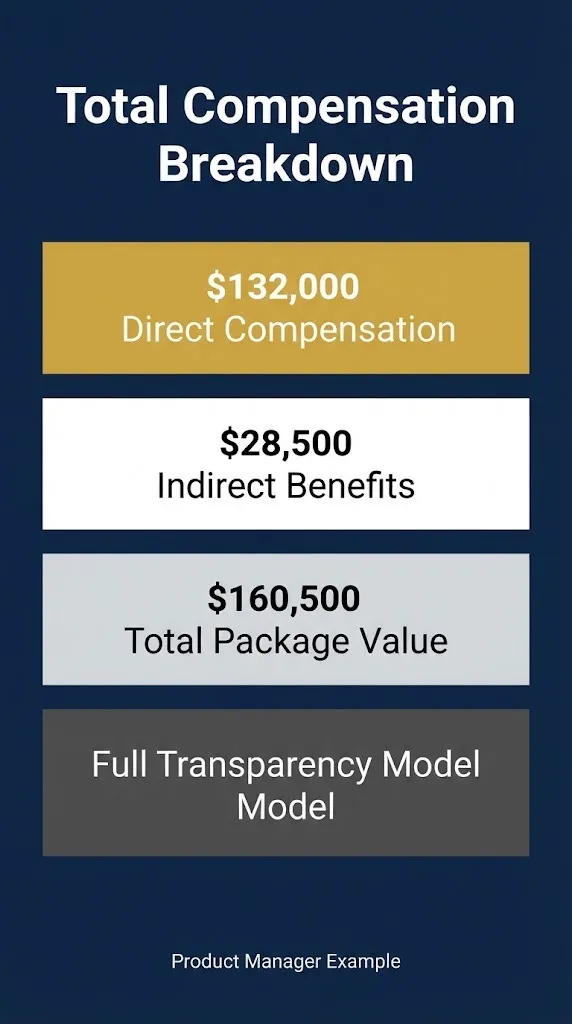
A Product Manager role with a $120,000 base salary can carry a total compensation value of $160,500. That figure includes cash, benefits, equity, and perks .
The AIHR compensation glossary provides this detailed breakdown. It shows how each component adds to the total:
Direct Compensation: $132,000
- Base salary: $120,000
- Performance bonus: Up to $12,000 (10% of salary)
Indirect Compensation: $28,500
- Health and dental insurance: $7,500 employer cost
- Paid time off: 20 vacation days, 10 sick days, 12 weeks parental leave ($6,000 value)
- 401(k) match: $7,200 (6% of salary)
- Stock options: $5,000 equivalent value
- Commuter benefits and wellness: $600
- Professional development: $3,000
Total Compensation Package: $160,500
This example illustrates a critical point. The salary represents 75% of the total package value. The remaining 25% comes from benefits and perks that many candidates overlook during negotiation.
A plain-life comparison: think of it like buying a car. The sticker price gets your attention. But the warranty, maintenance plan, and fuel costs determine what you actually pay over time.
Key Takeaway: Base salary is just the starting point. Benefits, retirement matches, and equity can add 20% to 40% to the real value of any job offer.
Executive Compensation Package Example: What Changes at the Top?
Executive compensation packages include equity grants, deferred compensation, and severance protections that far exceed standard employee benefits. The scale changes dramatically.
SEC filings reveal the structure. At one major government contractor, the CEO’s 2026 package included a $1.39 million salary, $13 million in stock awards, $3.48 million in non-equity incentive pay, and $655,946 in other compensation . The total exceeded $18 million.
A Chief Financial Officer at the same company received a $768,282 salary, $2 million in stock awards, and $1.05 million in incentive pay .
These packages typically include components that ordinary employees never see:
- Performance-restricted stock units (PRSUs): Shares that vest only if specific financial targets are met
- Deferred compensation plans: Income set aside for retirement with tax advantages
- Change-in-control provisions: Enhanced payments if the company is acquired
- Severance agreements: Guaranteed payouts if terminated without cause
One executive employment agreement specifies severance equal to 200% of base salary plus 200% of target bonus if termination follows a change in control .
Compensation Example Chart: Comparing Job Offers
A compensation chart helps you compare offers beyond the salary line. Here is a side-by-side example of two hypothetical offers for the same role:
| Component | Offer A | Offer B |
|---|---|---|
| Base Salary | $115,000 | $105,000 |
| Annual Bonus | 10% target | 15% target |
| Health Insurance | Fully covered | 80% covered |
| 401(k) Match | 3% | 6% |
| Stock Options | None | $10,000/year value |
| PTO | 15 days | 25 days |
| Total Value | $130,000 | $145,000 |
Offer B has the lower salary but the higher total value. The retirement match alone is worth $3,150 more per year. The additional PTO is worth roughly $4,800. The equity adds $10,000.
This is why asking for the full benefits package before accepting any offer matters. The salary negotiation gets the attention. The benefits package often carries more long-term value.
How to Calculate Your Total Compensation Package
Calculating total compensation requires adding the dollar value of every benefit to your base salary. Here is the step-by-step process :
- Start with base salary: The fixed annual amount before taxes.
- Add expected bonuses: Use the target percentage, not the maximum.
- Value your health insurance: Ask the employer for the monthly premium contribution.
- Calculate retirement match: Multiply your salary by the match percentage.
- Value paid time off: Divide salary by workdays, multiply by PTO days.
- Add equity value: Divide total grant value by vesting years.
- Include other perks: Commuter benefits, tuition reimbursement, wellness stipends.
- Sum all components: The result is your total compensation package.
Government employers must follow similar calculations. Illinois law requires public bodies to post total compensation packages for employees earning over $75,000. The definition includes salary, health insurance premiums, vehicle allowances, bonuses, vacation days, and sick days .
What Makes a Good Compensation Package?
A good compensation package offers competitive base pay, meaningful benefits, and incentives that reward performance. The exact mix depends on your priorities and life stage .
For early-career workers, health insurance and retirement matching often matter most. These benefits provide security and build long-term wealth. A 6% 401(k) match on a $60,000 salary adds $3,600 per year, which compounds significantly over decades.
Mid-career professionals may prioritize equity and flexibility. Stock options create ownership. Remote work arrangements save commuting costs and time. One compensation glossary notes that flexible work has become an important part of many employment packages .
Senior executives focus on deferred compensation and severance protection. These elements protect wealth during transitions and provide tax advantages.
A good package should align with your needs, not just the market average. A generous salary means little if the health insurance has massive deductibles. A strong retirement match is less valuable if you can’t afford to contribute.
Reality Check: No legitimate employer will ask you to pay for your own benefits paperwork or background check. If a company requests payment before you start work, it is a scam. Real compensation packages are offered at no cost to you.
What Happens Next When You Receive an Offer
Once you receive a job offer, you have a limited window to evaluate and negotiate. Here is the typical sequence:
Days 1 to 3: Review the written offer and request the full benefits summary.
Days 3 to 7: Calculate the total compensation value using the steps above.
Days 5 to 10: Identify your negotiation priorities and prepare your counter.
Days 7 to 14: Submit your response before the offer expiration date.
After acceptance: Complete onboarding paperwork and enroll in benefits.
Frequently Asked Questions
What is a compensation package example?
A compensation package example is a detailed breakdown of all pay and benefits for a specific role. A Product Manager package might include $120,000 salary, $12,000 bonus, $7,500 health insurance, $7,200 retirement match, and $5,000 equity .
What are the 5 components of a compensation package?
The core components are base salary, bonuses, health insurance, retirement contributions, and paid time off. Additional elements include equity grants, commissions, and fringe benefits like gym memberships .
What is included in total compensation?
Total compensation includes direct pay like salary and bonuses, plus indirect benefits like insurance and retirement matching. It also covers equity, paid leave, and perks with monetary value .
How do you calculate total compensation package value?
Add your base salary to the dollar value of every benefit you receive. Health insurance premiums, retirement matches, PTO value, and equity grants all count toward the total .
What is a good compensation package?
A good package offers competitive salary, quality health coverage, retirement matching, and performance incentives. The best package aligns with your personal needs and career stage .
What is the difference between compensation and benefits?
Compensation is direct pay like salary and bonuses. Benefits are indirect rewards like health insurance and retirement plans .
What do executive compensation packages include that others don’t?
Executive packages often include stock options, deferred compensation, and enhanced severance. These elements can add millions to the total value .
Are compensation packages negotiable?
Yes, most elements of a compensation package are negotiable. Salary, signing bonuses, equity grants, and start dates are common points of discussion. Benefits like health insurance plans are usually fixed.
Closing
Your action is simple: never accept an offer without seeing the full benefits summary. Calculate the total compensation value, not just the salary. The difference between two offers can be $15,000 or more once you count retirement matching, equity, and paid leave. Ask for the total package in writing before you sign.