Regular Way Settlement on Treasury Bonds Is T+1: The Complete 2026 Guide
Quick Answer
- What is it? Regular way settlement is the standard delivery timeframe for a security after a trade.
- Treasury standard? T+1, one business day after the trade date for secondary market trades .
- Key rule? For newly issued Treasuries, settlement occurs on the issue date, not T+1 .
If you trade Treasury bonds, understanding regular way settlement is not optional. It determines when your cash and securities actually change hands. It affects your funding requirements. It dictates when you can access proceeds from a sale.
The phrase itself comes from securities industry rules. The Legal Information Institute defines regular way settlement as “delivery of a security from a seller to a buyer within the time frame that the securities industry has established for immediate delivery of that type of security” . For Treasury securities, that timeframe is specific and has changed in recent years.
This article explains exactly what regular way settlement means for Treasury bonds in 2026. It covers the T+1 standard, how when-issued securities work differently, what happens when settlement fails, and how the Fedwire system processes Treasury transfers.
The Facts
| Term | Definition |
|---|---|
| Regular Way Settlement | Delivery within the industry-established timeframe for immediate delivery |
| Treasury Secondary Market | T+1, one business day after trade date |
| Trade Date Settlement | Permitted under the regulation for Treasury securities |
| Skip Day | Second business day after trade date, also permitted |
| When-Issued Securities | Settlement on the issue date, not T+1 |
| Forward Trades | T+N where N is greater than or equal to two business days |
What Does Regular Way Settlement Mean for Treasury Bonds?
Regular way settlement for Treasury bonds means the trade settles on a timeline that the securities industry has established for immediate delivery. For Treasury securities specifically, the regulation defines this as including settlement on the trade date, the next business day (regular way), and the second business day (skip day) .
That definition is broader than what most traders experience. In practice, secondary market trades of Treasury securities typically settle on T+1, one business day after the trade date . The Federal Reserve’s guidance confirms this: “Settlement of secondary market trades of Treasury securities typically occurs on T+1, but can, by agreement between counterparties, settle anytime from trade date to T+N” .
The distinction matters because “regular way” is a regulatory term with a specific definition, while T+1 is the market convention that has become standard. The regulation allows trade-date settlement and skip-day settlement as part of the regular way framework. The market has chosen T+1 as the default.
How Long Does Treasury Bond Settlement Take in 2026?
Treasury bond settlement takes one business day for secondary market trades in 2026. This is the T+1 standard that applies to most U.S. securities.
The settlement date calculation is straightforward. If you trade on Monday, settlement is Tuesday. If you trade on Friday, settlement is the next business day, which is Monday unless a holiday intervenes.
For when-issued securities, the calculation is different. According to CME Group’s settlement date rules for U.S. Treasury benchmarks:
- If Trade date > Auction date and < Issue date, then Settlement date = Issue date
- If Trade date => Issue date, then Settlement date = T+1
This means if you buy a Treasury at auction before it is issued, settlement occurs on the issue date. If you buy the same security after it has been issued and is trading in the secondary market, settlement is T+1.
Key Takeaway: Secondary market Treasury trades settle T+1. Newly auctioned Treasuries settle on the issue date. The distinction determines when you need cash or securities ready.
What Happens If a Treasury Bond Trade Fails to Settle?
If a Treasury bond trade fails to settle, the failing party faces a fails charge calculated at an annual rate of 3% on the settlement value of the trade, minus the target federal funds rate .
A failure-to-deliver occurs when the seller does not deliver the securities on time or the buyer does not deliver the funds. The Depository Trust & Clearing Corporation tracks these failures. The consequences extend beyond the charge itself. As DTCC explains: “Not only does the original trade fail, but the party that bought the securities may have already pledged them in a subsequent trade, and now that trade too will involve a failure-to-deliver, thus creating a cascading effect” .
Here is how the fails charge calculation works, using DTCC’s example:
| Factor | Value |
|---|---|
| Position value | $50,000,000 |
| Amount owed | $50,100,000 |
| Target Fed funds rate (previous day) | 1% |
| Fails charge rate | 2% per year (3% minus 1%) |
| Daily charge | $2,783.33 |
The Treasury Market Practices Group designed this formula to give sellers an economic incentive to borrow securities to cure fails. The TMPG noted that “fails have rarely become widespread and chronic if the general collateral rate is above about 3 percent” .
What Is the Difference Between Regular Way and When-Issued Settlement?
Regular way settlement applies to securities already trading in the secondary market. When-issued settlement applies to securities that have been announced but not yet issued.
When-issued trading begins when the Treasury announces a forthcoming auction. Trading continues until the settlement date, when securities are delivered and the issuer is paid . During this period, the exact price and terms of the security are known after the auction, but the security itself does not exist yet.
The settlement timeline differs fundamentally:
| Type | Settlement Timing |
|---|---|
| Regular Way (Secondary Market) | T+1 after trade date |
| When-Issued (New Issue) | On the issue date |
| Forward Trades | T+N where N is greater than or equal to 2 |
The FFIEC’s reporting guidance notes that when-issued contracts can qualify for the “regular-way security trade exclusion” if they are expected to settle within the normal timeframe . But the actual settlement date is tied to the issuance, not the trade date.
How Does Fedwire Process Treasury Bond Settlement?
Fedwire processes Treasury bond settlement through the Federal Reserve’s book-entry securities transfer system. Participants use Fedwire Securities Service to transfer securities to settle secondary market trades and move collateral .
The system processes transfers on a gross basis in real time. The Treasury’s self-assessment notes that “transfers of securities and any related funds are final and irrevocable when a Reserve Bank” processes them . There is a limitation on the maximum value that can be sent in one transfer message: $50 million in par value .
Settlement occurs through a netting system. The Fixed Income Clearing Corporation (FICC) calculates the net obligation of each member to receive or deliver securities on an issue-by-issue basis. Through “novation,” FICC steps in as the counterparty to every member . This allows members to deliver only their net sales rather than both delivering gross sales and receiving gross purchases.
On an average day in 2001, the Government Securities Clearing Corporation compared and netted about 55,000 transactions with a market value of about $1.4 trillion. Those netted down to about 11,000 deliveries worth about $400 billion .
What Are the Different Settlement Timelines for Treasury Securities?
Treasury securities have multiple settlement timelines depending on the type of trade. Regular way is one option, but not the only one.
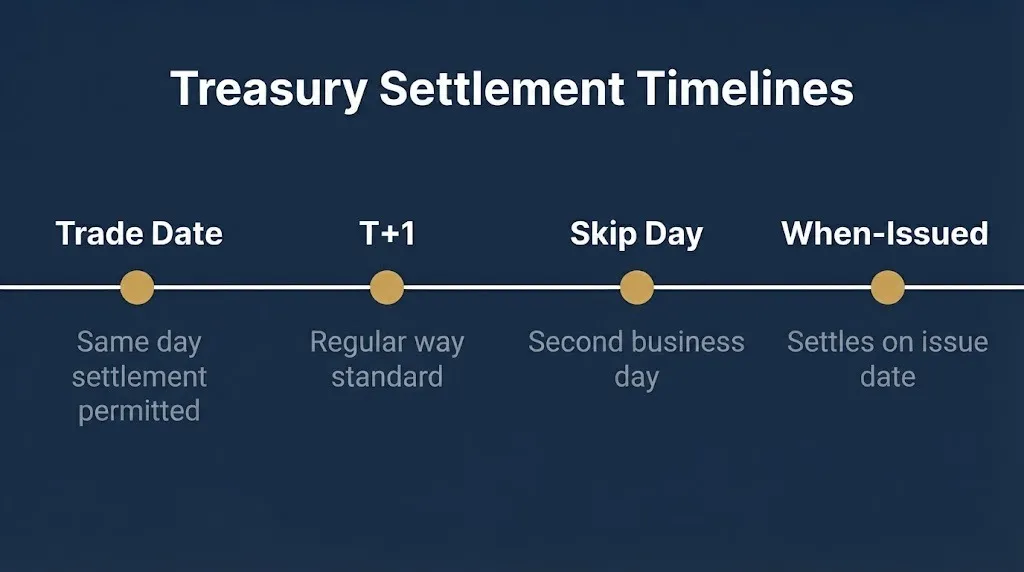
| Settlement Type | Timing | When It Applies |
|---|---|---|
| Trade Date | Same day | Permitted under regulation, rare in practice |
| Regular Way (T+1) | Next business day | Standard for secondary market trades |
| Skip Day | Second business day | Permitted under regulation |
| When-Issued | Issue date | New auction securities |
| Forward | T+N (N ≥ 2) | By agreement between counterparties |
The regulation’s definition of regular way settlement includes trade date, next business day, and skip day . That means a trade settling on any of those three days qualifies as “regular way” for regulatory purposes. In practice, T+1 is the market standard.
What Happens Next With Treasury Settlement Rules?
Treasury settlement rules may continue to evolve as regulators and market participants assess the impact of the T+1 transition and consider further changes.
Expected timeline:
- Ongoing 2026: Market participants continue adapting to the T+1 standard implemented in May 2024.
- Expected future: The Treasury Market Practices Group may review the fails charge formula and settlement conventions.
- Ongoing: International markets may consider moving to T+1, following the U.S. lead.
The Bank of Canada moved its Government of Canada securities auctions to T+1 settlement in June 2024, following the Canadian secondary market’s own transition . That suggests a broader trend toward shorter settlement cycles in major markets.
Frequently Asked Questions
What does regular way settlement mean on Treasury bonds?
Regular way settlement means delivery of the security from seller to buyer within the timeframe the securities industry has established for immediate delivery. For Treasury securities, this includes trade date, next business day, and second business day settlement .
How long does it take to settle a Treasury bond trade?
Secondary market Treasury bond trades typically settle on T+1, one business day after the trade date .
What is the difference between regular way and when-issued settlement?
Regular way settlement applies to existing securities in the secondary market. When-issued settlement applies to new securities before issuance and settles on the issue date, not T+1 .
What happens if a Treasury trade fails to settle?
The failing party faces a charge at 3% annual rate minus the target federal funds rate, applied to the settlement value of the trade .
Can Treasury trades settle on the trade date?
Yes. The regulation permits trade date settlement as part of the regular way framework, though it is rare in practice .
What is the skip day in Treasury settlement?
The skip day is the second business day following the trade date. Settlement on that day is permitted under the regulation’s definition of regular way settlement .
How does Fedwire handle Treasury settlement?
Fedwire Securities Service processes transfers on a gross basis in real time. Settlement occurs through a netting system administered by FICC .
Do forward trades have different settlement rules?
Yes. Forward trades in Treasury securities settle on a T+N basis, where N is greater than or equal to two business days .
What You Should Do Now
If you trade Treasury bonds, verify your settlement timeline before executing. For secondary market trades, plan for T+1. For when-issued securities, settlement occurs on the issue date.
The single most important number is T+1. That is the standard settlement window for secondary market Treasury trades. Make sure your cash and securities are ready one business day after the trade date.
Check with your broker or clearing firm about their specific settlement procedures. The regulatory framework applies broadly, but operational details can vary by institution.