Compensation Benchmarking: 2026 Guide to Salary Data, Legal Risks, and Compliance
Quick Answer:
- Compensation benchmarking is legal and standard, but how you collect data matters more than ever.
- No single payout or settlement exists. The risk is regulatory fines and private litigation for misuse.
- The most important deadline is the effective date of new state pay transparency laws, several active in 2026.
Compensation benchmarking is the process of comparing your company’s pay rates against external market data. It is how employers decide what a role is worth, what to offer a new hire, and when to adjust salaries.
If you searched this term, you likely work in HR, run a business, or want to know whether your own pay is fair. The practice is legal, but it has become a legal minefield. Antitrust regulators have cracked down on salary sharing between competitors, and state pay transparency laws now require disclosure that changes how benchmarking data gets used.
This article covers how compensation benchmarking works, the legal risks, the data sources, and how to run the process without inviting a lawsuit. One verified fact most employers miss: sharing compensation data directly with a competitor can violate antitrust law, even if no formal price-fixing agreement exists.
The Facts
| Item | Detail |
|---|---|
| Practice | Compensation benchmarking |
| Legal Status | Legal with compliance constraints |
| Key Laws | Sherman Act, state pay transparency laws, state pay equity laws |
| Enforcement Agencies | DOJ, FTC, state labor departments, EEOC |
| Primary Risk | Antitrust violations, pay discrimination claims |
| Data Sources | Published surveys, government data, third-party vendors |
| Deadline | Varies by state law effective dates |
Is Compensation Benchmarking Legal?
Yes, compensation benchmarking is legal. The practice of comparing pay against market data is standard across industries and widely accepted by regulators and courts.
The legal line is not whether you benchmark. It is how you collect the data. Gathering pay information directly from competitors raises antitrust concerns. Using published, aggregated survey data from a neutral third party does not.
The Department of Justice and Federal Trade Commission have issued guidance warning companies against sharing compensation data in ways that reduce competition for workers. Even informal conversations about pay between competing employers can draw scrutiny.
Key Takeaway: Benchmarking is legal. Collusion is not. The difference is the source and structure of your data.
What Is Compensation Benchmarking Used For?
Compensation benchmarking is used to set salary ranges, make hiring offers, adjust existing employee pay, and defend pay decisions in audits or litigation.
Employers use benchmarking to stay competitive in the labor market. If they pay too little, they lose candidates. If they pay too much, they waste budget. The benchmark gives them a data-backed target.
Employees use benchmarking data to negotiate salaries, understand their market value, and spot pay gaps. The same data that helps employers also helps workers.
- Set salary bands for new and existing roles.
- Make competitive job offers to candidates.
- Adjust pay for retention and internal equity.
- Defend pay decisions in audits or litigation.
- Identify pay gaps that may indicate discrimination.
- Plan annual compensation budgets.
What Are the Legal Risks of Compensation Benchmarking?
The legal risks of compensation benchmarking fall into two main buckets: antitrust and discrimination. Both can trigger government enforcement and private lawsuits.
Antitrust risk comes from sharing pay data with competitors. If two companies agree to cap wages or share salary information to suppress pay, that is illegal under the Sherman Act. The DOJ has brought criminal charges in some cases.
Discrimination risk comes from using benchmark data to perpetuate pay gaps. If your benchmark locks in lower pay for women or minority workers, you may face a pay equity claim under state or federal law.
| Risk Type | What Triggers It |
|---|---|
| Antitrust | Sharing pay data directly with competitors |
| Pay discrimination | Using benchmarks that reflect biased market rates |
| Regulatory violation | Missing state pay transparency filing deadlines |
| Private litigation | Employee claims based on benchmark-driven pay gaps |
Reality Check: A benchmarking study is not a shield. If your pay decisions discriminate, pointing to a survey will not save you in court.
How Does the Compensation Benchmarking Process Work?
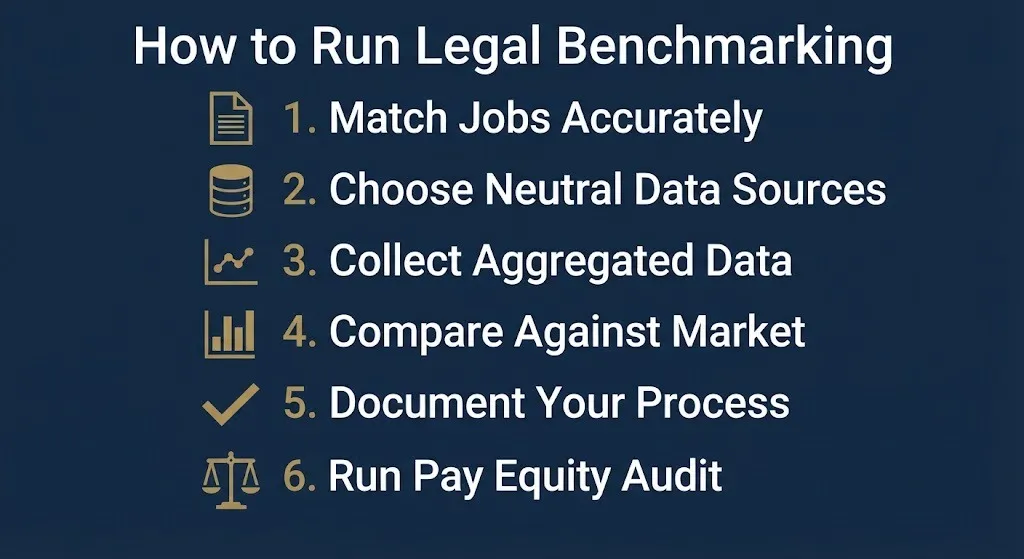
The compensation benchmarking process starts with job matching, then data collection, then analysis, then application to pay decisions.
Job matching means comparing your roles to similar roles in the market. A software engineer at your company may not match a software engineer at a different company if the responsibilities differ. Getting the match right matters.
Data collection uses published surveys, government databases, or third-party vendors. The data is typically aggregated and anonymized. The more specific the data, the more useful it is, but the more legal risk it may carry.
- Identify the roles you need to benchmark.
- Match each role to external job descriptions.
- Select data sources: surveys, government data, vendors.
- Collect salary data for the matched roles.
- Compare your pay against the benchmark.
- Adjust salary bands or offers based on findings.
- Document the process and rationale.
Key Takeaway: A defensible benchmarking process is documented, consistent, and based on neutral data sources.
What Are the Main Compensation Benchmarks in 2026?
The main compensation benchmarks in 2026 come from published salary surveys, government wage data, and commercial benchmarking platforms.
Government sources include the Bureau of Labor Statistics Occupational Employment and Wage Statistics program. That data is free, reliable, and updated regularly. It provides median and percentile wages by occupation and region.
Commercial sources include salary surveys from consulting firms and data vendors. These cost money but offer more granular cuts by industry, company size, and location.
| Source Type | Example | Cost |
|---|---|---|
| Government | Bureau of Labor Statistics | Free |
| Industry survey | Association salary surveys | Varies |
| Commercial vendor | Published benchmarking platforms | Subscription |
What Is the Difference Between Benchmarking and Salary Surveys?
Salary surveys are a data source. Benchmarking is the process of using that data to make pay decisions. They are related but not the same.
A salary survey collects pay data from participating employers and publishes aggregated results. The survey itself is neutral. The benchmark is what you do with it.
Some companies confuse the two. They buy a survey and think they have benchmarked. But benchmarking requires matching jobs, adjusting for location and industry, and applying the data to specific decisions.
How Do State Pay Transparency Laws Affect Benchmarking?
State pay transparency laws require employers to disclose salary ranges in job postings. Several states have active laws in 2026, and more are pending.
These laws change benchmarking because the salary range you post must reflect a good-faith estimate of what the role actually pays. If your benchmark says the market range is $70,000 to $90,000, you cannot post $40,000 to $60,000 without risking a violation.
The laws also create a record. If your posted range is far from your benchmark data, employees and regulators may ask why. Documentation matters.
- Know which states where you operate have pay transparency laws.
- Confirm the salary range for each posted role is based on current benchmark data.
- Document the benchmark source and date for each posting.
- Update ranges when benchmark data changes.
- Train hiring managers on the posting requirements.
What Is the Antitrust Risk in Compensation Benchmarking?
The antitrust risk comes from direct information sharing between competing employers. Even informal conversations about pay can violate the Sherman Act.
The DOJ has made labor market competition a priority. It has brought cases against companies that agreed not to poach each other’s employees or that shared pay data to suppress wages.
To avoid risk, never share your company’s actual pay data directly with a competitor. Use neutral third-party surveys or government data. If you participate in a survey, the data should be aggregated and anonymized by the survey administrator.
What Are the Pay Equity Implications of Compensation Benchmarking?
Pay equity laws require equal pay for substantially similar work, regardless of gender, race, or other protected characteristics. Benchmarking can either support or undermine pay equity.
If your benchmark data reflects historical pay gaps, using it to set new pay can perpetuate discrimination. A market rate that is lower for female-dominated roles may not be a legal defense if the roles are comparable.
Employers should audit their pay practices against benchmark data and internal equity. If the benchmark says one rate but your internal analysis shows unexplained pay gaps, the internal analysis should win.
- Run pay equity audits alongside benchmarking.
- Compare pay by gender, race, and other protected categories.
- Identify unexplained pay gaps.
- Investigate whether the gap is driven by the benchmark or by bias.
- Adjust pay where the benchmark cannot explain the gap.
Key Takeaway: Benchmarking explains the market. Pay equity explains your company. Both matter.
What Are the Best Data Sources for Compensation Benchmarking in 2026?
The best data sources are neutral, reliable, and specific to your industry and location. Government data is the safest legally because it is collected and published by a neutral agency.
Commercial survey vendors add value by aggregating data across participating employers. The key is that no single employer sees another employer’s actual data. The vendor anonymizes and aggregates.
For employees, free sources like the Bureau of Labor Statistics and state labor department wage data provide solid benchmarks. Commercial platforms may offer more granular detail for a fee.
| Source | Best For |
|---|---|
| Bureau of Labor Statistics | Broad occupational and regional data |
| State labor departments | Local wage data |
| Industry associations | Niche or specialized roles |
| Commercial survey vendors | Detailed cuts by company size and industry |
How Often Should You Run Compensation Benchmarking?
Most companies run compensation benchmarking annually. Some run it more frequently for high-turnover or competitive roles.
Annual benchmarking aligns with budget cycles and performance review seasons. It gives you enough data to spot market movement without overreacting to noise.
For fast-moving fields like technology or healthcare, quarterly benchmarking may be warranted. The labor market shifts quickly in those sectors, and pay that was competitive six months ago may be stale.
What Happens If You Get Compensation Benchmarking Wrong?
Getting benchmarking wrong can mean underpaying or overpaying employees. It can also trigger legal exposure.
Underpaying leads to turnover, low morale, and difficulty hiring. Overpaying wastes budget and can create internal equity problems when long-tenured employees discover new hires earn more.
The legal exposure comes from using benchmark data that is stale, inaccurate, or biased. A pay discrimination claim built on a flawed benchmark is hard to defend.
Reality Check: A benchmark is only as good as the job match and data quality. Garbage in, garbage out.
What Should You Do Right Now About Compensation Benchmarking?
If you are an employer, document your benchmarking process and verify your data sources. If you are an employee, use free government data to understand your market value.
For employers, the priority is compliance. Know the pay transparency laws in your state, avoid direct data sharing with competitors, and run pay equity audits alongside benchmarking.
For employees, the priority is information. The more you know about market rates for your role, the better you can negotiate and spot problems.
- For employers: document your benchmarking process.
- For employers: verify your data sources are neutral and current.
- For employers: run a pay equity audit.
- For employees: check the Bureau of Labor Statistics for your role.
- For employees: compare your pay to the market range.
- For everyone: keep records of pay decisions and rationale.
What Happens Next With Compensation Benchmarking?
2026: More states implement pay transparency laws. Employers adjust their posting practices.
2026 to 2027: Pay equity enforcement increases. More audits and litigation.
2027: Benchmarking platforms integrate AI-driven job matching and real-time data.
Beyond: Antitrust scrutiny of labor market practices continues.
These projections reflect current trends. The legal landscape will keep shifting.
Frequently Asked Questions
Is compensation benchmarking legal?
Yes, benchmarking is legal when done through neutral data sources and without direct competitor collusion.
What is the best free compensation benchmarking tool?
The Bureau of Labor Statistics Occupational Employment and Wage Statistics program is free and reliable.
Can compensation benchmarking cause a lawsuit?
Yes, if it perpetuates pay discrimination or involves illegal data sharing with competitors.
How often should compensation benchmarking be done?
Most companies benchmark annually, with more frequent updates for competitive roles.
What is the difference between benchmarking and salary surveys?
Salary surveys are a data source. Benchmarking is the process of using that data to set pay.
Do pay transparency laws require benchmarking?
No, but the salary ranges you post must reflect a good-faith estimate, which benchmarking supports.
Is sharing salary data with competitors illegal?
Yes, if it reduces competition for workers or amounts to a wage-fixing agreement.
What is a pay equity audit?
A pay equity audit compares pay by gender, race, and other categories to identify unexplained gaps.
Compensation benchmarking is a tool. Used correctly, it helps employers pay fairly and helps employees understand their worth. Used carelessly, it creates legal risk and entrenched pay gaps.
The single most important action is documentation. Write down your process, your sources, and your rationale. The record is your defense.