Class Action Park Documentary in 2026: What It Covers, Where to Watch, and the Real Lawsuits
Quick Answer
- Class Action Park is a 2020 HBO Max documentary about Action Park, a New Jersey water park notorious for injuries and at least six deaths.
- The film is streaming now on HBO Max; it runs 90 minutes and holds a 96% Rotten Tomatoes score .
- The park faced more than 100 lawsuits before closing in 1996, and the documentary captures why .
The Facts
| Film Title | Class Action Park |
|---|---|
| Release Year | 2020 (premiered August 27 on HBO Max) |
| Runtime | 90 minutes |
| Directors | Seth Porges and Chris Charles Scott |
| Narrator | John Hodgman |
| Streaming Platform | HBO Max |
| Rotten Tomatoes Score | 96% |
| Subject | Action Park, Vernon Township, New Jersey (1978-1996) |
| Deaths Documented | Six confirmed deaths from 1980 to 1987 |
Is the Class Action Park Documentary Real?
Yes, the Class Action Park documentary is real, and it’s streaming on HBO Max. The film is the first feature-length documentary about Action Park, the notorious New Jersey amusement park that operated from 1978 to 1996 .
The documentary premiered on August 27, 2020, and immediately became the #1 movie on HBO Max . It was directed by Seth Porges and Chris Charles Scott, with narration by John Hodgman .
The film’s title comes from one of the park’s many nicknames. Locals also called it “Traction Park” and “Accident Park” because of the sheer volume of injuries and legal claims it generated .
The documentary balances two competing narratives. On one side, it captures the nostalgia of a place where 1980s teenagers had unprecedented freedom. On the other, it documents the real human toll: six deaths, countless injuries, and a business model built on dodging accountability .
What Is the Class Action Park Documentary About?
The Class Action Park documentary is about Action Park, a New Jersey water park that became infamous for dangerous rides, injuries, and deaths. It explores how the park operated for nearly two decades despite its safety record .
The film traces the park’s history from its founding by Gene Mulvihill, a former Wall Street penny-stock broker, through its heyday in the 1980s and its eventual closure in 1996 .
Mulvihill’s philosophy was simple: danger was part of the fun. He rejected safety proposals from employees and designed rides that were, by modern standards, deathtraps . The park’s liability insurance was with a company Mulvihill set up for himself in the Cayman Islands .
The documentary interviews former employees, park visitors, journalists, and family members of those who died. It uses archival footage from the 1980s and 1990s to recreate the atmosphere of the park .
One of the most striking segments covers the death of George Larsson Jr., a 19-year-old who was thrown from the Alpine Slide in 1980 and died of a head injury. His family settled with Mulvihill for $100,000 . The documentary reveals that the park tried to cover up the circumstances of his death to avoid reporting it to state authorities .
Key Takeaway
Key Takeaway: The Class Action Park documentary is a 90-minute HBO Max film that chronicles Action Park’s history, its dangerous rides, and the human cost of a park built on avoiding responsibility.
How Many People Died at Action Park?
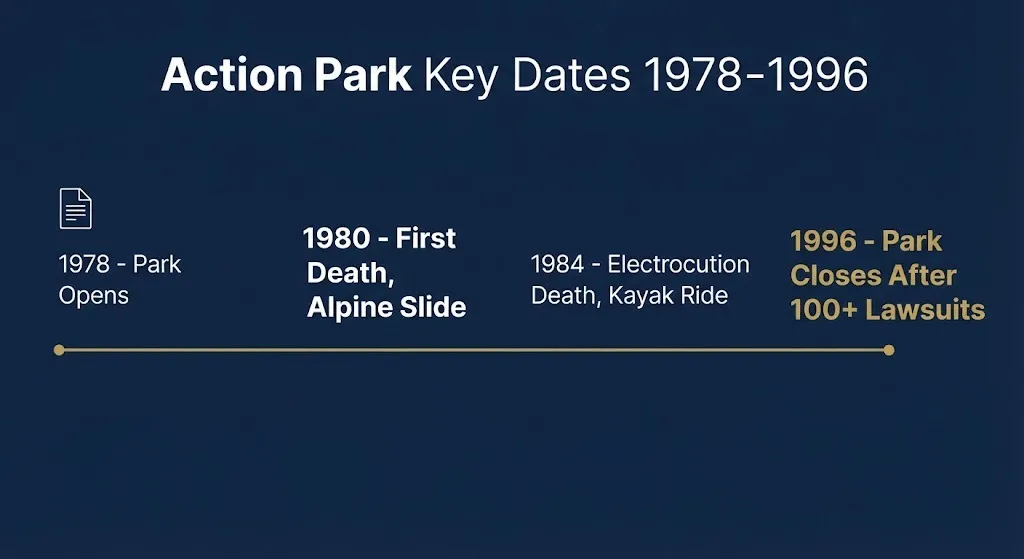
At least six people died at Action Park between 1980 and 1987, according to the documentary and contemporaneous news reports . The park operated from 1978 to 1996.
The deaths documented in the film include:
- George Larsson Jr. (1980): Thrown from the Alpine Slide when his cart derailed and he struck his head on a rock .
- Three drownings in the Tidal Wave Pool: The pool, nicknamed the “Grave Pool,” was so dangerous that lifeguards rescued up to 30 people per day .
- A 27-year-old man (1984): Electrocuted after falling out of a kayak and touching exposed live wiring underwater .
- A Tarzan Swing victim (1984): Suffered a fatal heart attack after the shock of the cold water .
The documentary notes that the park had to buy its own ambulances because it was overwhelming local emergency services .
The Tidal Wave Pool was particularly deadly. It could hold 1,000 people, and the waves and suction created a “death zone” that lifeguards monitored from a chair nicknamed the “death chair” . The pool’s bottom was painted white to make bodies easier to spot .
Why Was Action Park Called “Class Action Park”?
Action Park earned the nickname “Class Action Park” because of the sheer volume of lawsuits filed against it. More than 100 lawsuits were connected to the park before it closed in 1996 .
The park’s owner, Gene Mulvihill, had a strategy for dealing with lawsuits: fight them all. According to the documentary, if you sued Mulvihill, he fought. If you won, he didn’t pay until marshals came to the park to collect .
Mulvihill’s liability insurance was with a company he set up for himself in the Cayman Islands, which meant there was often no real insurance backing the claims .
The park’s legal troubles were compounded by Mulvihill’s broader financial issues. He was a disgraced former penny-stock broker with a history of legal problems .
The nickname stuck because it captured both the park’s business model and its legacy. Action Park wasn’t just dangerous by accident. It was dangerous because the people running it prioritized thrills and profits over safety, and they had a legal strategy designed to outlast anyone who complained .
Key Takeaway
Key Takeaway: Action Park earned the “Class Action Park” nickname because it faced over 100 lawsuits, and owner Gene Mulvihill fought every claim rather than settling.
What Was the Most Dangerous Ride at Action Park?
The most dangerous ride at Action Park was arguably the Cannonball Loop, a waterslide with a full vertical loop that injured so many riders the park had to cut an escape hatch in the side .
The Cannonball Loop was designed by Mulvihill, who reportedly sketched the loop on a cocktail napkin and hired local welders to build it . Test dummies came out dismembered during trial runs .
Riders hit their heads on the top of the loop so hard they left teeth in the padded walls. One woman got stuck inside the loop, forcing the park to cut an escape hatch. The ride only stayed open for a month before the Advisory Board on Carnival Amusement Ride Safety shut it down .
Other rides were nearly as dangerous:
| Ride | Known Injuries |
|---|---|
| Alpine Slide | 26 head injuries and 14 fractures in two years |
| Tidal Wave Pool | Three drownings; up to 30 rescues per day |
| Tarzan Swing | One fatal heart attack from cold-water shock |
| Kayak Experience | One electrocution death from exposed wiring |
| Roaring Rapids | Fractured femurs, collar bones, dislocated shoulders and knees |
The documentary’s structure reflects this: nearly every ride segment begins with someone saying, “This was the most dangerous ride at the park” .
What Does the Class Action Park Documentary Get Right?
The Class Action Park documentary is widely praised for its accuracy, balancing nostalgia with accountability. Director Seth Porges told the New York Daily News that he was skeptical of the park’s legends at first, but found that “the truth is so crazy that there’s no reason to make anything up” .
The film includes interviews with people who were actually there. One IMDb reviewer who worked as a lifeguard at Action Park in 1990 confirmed the documentary’s credibility, writing that he personally rescued “ten or more kids a day” from the Tarzan Swing .
The documentary also captures a key insight from law professor Bill Childs, who teaches a course on Action Park at Mitchell Hamline School of Law. Childs notes that fixed-site parks like Action Park had no federal oversight on rides at the time, and state regulation varied dramatically. The park exploited that gap .
Critics praised the film’s first two-thirds for its humor and archival footage. The New York Times noted that the film “loses its footing somewhat in the closing passages” as it shifts from nostalgic fun to the grim reality of deaths and cover-ups . The Austin Chronicle described it as “bouncing along on a kiddy coaster that suddenly turns into a brutal corkscrew with a massive drop at the end” .
How Does the Documentary Handle the Lawsuits and Legal Issues?
The documentary covers the legal issues but doesn’t drown viewers in legalese. It focuses on the human stories behind the lawsuits and the system that allowed the park to operate .
Law professor Bill Childs uses the park as a teaching tool for tort law. He explains that tort law is “a civil action where somebody believes they’ve been injured by somebody else acting negligently” and that it’s “a way that regular people can stand the chance of some kind of redress from a bigger organization” .
The film documents Mulvihill’s strategy of fighting every claim. According to the documentary, he used his political influence in Vernon Township to avoid accountability, and his Cayman Islands insurance company meant there was often no money to collect even when plaintiffs won .
The documentary also touches on the park’s labor practices. Employees as young as 14 were put in charge of operating dangerous rides, in violation of labor laws. Many were untrained and some were intoxicated on the job .
Key Takeaway
Key Takeaway: The documentary shows how Action Park’s legal strategy, fighting every lawsuit and using a sham insurance company, allowed it to operate for nearly two decades despite its safety record.
Where Can You Watch the Class Action Park Documentary in 2026?
The Class Action Park documentary is streaming on HBO Max as of October 2026 . The film is also available on other platforms in some regions.
The documentary runs 90 minutes and is rated TV-MA for its discussion of injuries, deaths, and adult themes .
For viewers outside the United States, availability varies. The film aired on Sky One and Sky Documentaries in the UK and Ireland in 2021 . Check your local streaming services for current availability.
The film is not rated by the MPAA, but HBO Max lists it under Documentaries, Crime, and Investigations .
What Happens Next with the Action Park Legacy?
The Action Park site in Vernon Township, New Jersey, has been redeveloped. The park closed in 1996 amid mounting lawsuits and financial problems .
A new water park, Mountain Creek Waterpark, now operates on part of the former Action Park site. It has modern safety standards and bears no resemblance to the original park .
The documentary’s legacy continues through academic use. Law professor Bill Childs’ course, “Recreation and Risk: Lessons from Action Park,” uses the park to teach tort law, regulatory gaps, and the intersection of business and safety .
No new lawsuits related to Action Park are active as of October 2026. The park’s legal saga is closed, but the documentary keeps its story alive.
Frequently Asked Questions
Is Class Action Park streaming in 2026?
Yes. The documentary is streaming on HBO Max as of October 2026 .
How long is the Class Action Park documentary?
The film runs 90 minutes .
How many people died at Action Park?
At least six people died at Action Park between 1980 and 1987 .
Why is it called Class Action Park?
The park earned the nickname because it faced more than 100 lawsuits before closing in 1996 .
Who directed the Class Action Park documentary?
Seth Porges and Chris Charles Scott directed the film, with narration by John Hodgman .
What was the most dangerous ride at Action Park?
The Cannonball Loop, a waterslide with a vertical loop, was arguably the most dangerous. It injured so many riders that the park cut an escape hatch in the side .
Can you visit Action Park today?
No. The park closed in 1996. A different water park, Mountain Creek Waterpark, now operates on part of the site .
What is the Class Action Park Rotten Tomatoes score?
The film holds a 96% score on Rotten Tomatoes .
Your Next Step
If you want to understand how a place like Action Park existed for nearly two decades, watch the documentary on HBO Max. It’s 90 minutes, and it pairs archival footage with firsthand accounts from people who worked and survived there.
The film’s most important lesson isn’t about the 1980s. It’s about what happens when regulators look the other way, when insurance is a sham, and when a business model depends on outlasting victims in court. Those conditions can exist anywhere.