Post Settlement Funding in 2026: Rates, Rules, and the New York Cap Taking Effect
Quick Answer
- What it is: Post-settlement funding is a cash advance against money you’ve already won but haven’t received yet. It is not a loan and repayment is non-recourse.
- Typical rates: Nonprofit funders charge 10% simple interest. For-profit funders can charge 30% to 100% APR, with compounding that inflates the total owed .
- Key rule change: New York’s new law caps funder recovery at 25% of your settlement and requires plain-language contracts .
If you’re searching for post settlement funding, you’re in a specific kind of limbo. The case is over. The settlement is signed. But the check hasn’t arrived, and the bills haven’t stopped.
Post-settlement funding exists to bridge that gap. It’s a cash advance against money that’s already yours, in theory. The settlement agreement is signed, the amount is fixed, and the only remaining question is when the funds get disbursed.
That lower risk profile is why post-settlement rates are typically lower than pre-settlement rates . But “lower” is relative. Some funders charge rates that would make a payday lender blush.
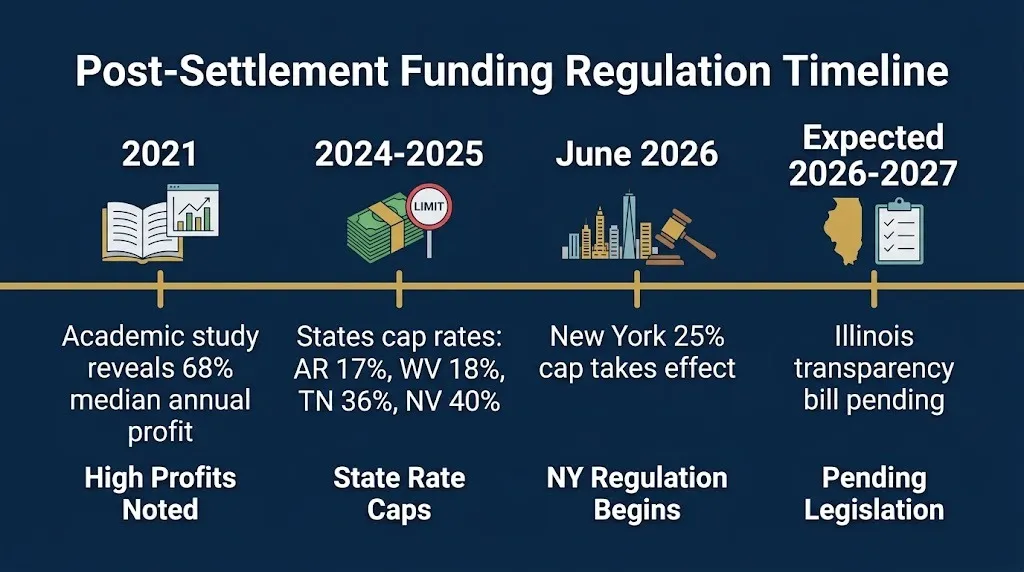
A 2021 academic study of one large funder’s archive found that post-settlement funding generated a median annual actual profit of 68% for the funder . That’s the real cost of “lower risk” funding.
This article explains how post-settlement funding works, what it costs, what the new regulations require, and how to tell the difference between a fair deal and a predatory one.
The Facts
| Topic | 2026 Verified Data |
|---|---|
| Nonprofit Rate | 10% simple interest (Milestone Foundation) |
| For-Profit Rates | 30% to 100%+ APR, often compounded |
| New York Cap | 25% of settlement maximum, effective June 2026 |
| Default Rate (Post-Settlement) | 1% |
| Haircut Frequency | 27% of cases, median haircut 8% |
| Regulated States | AR, IN, NV, TN, WV cap rates; NY caps total recovery |
What Is Post Settlement Funding and How Does It Work?
Post-settlement funding is a cash advance against a settlement you’ve already won but haven’t received. The funder buys a portion of your anticipated proceeds at a discount, and repayment only happens when you get paid.
The mechanics are straightforward. You apply, the funder reviews your settlement agreement and confirms the amount and timeline, and if approved, you get cash within days.
The key difference from pre-settlement funding: there’s no litigation risk. The case is resolved. The only uncertainty is timing .
RapidFunds, which has operated in this space for nearly 20 years, describes its due diligence process as taking 24 to 48 hours, with funds wired the same day . The funder doesn’t contact the defendant or opposing counsel. It’s a private transaction between you and the funding company.
Repayment happens when your settlement funds are disbursed. The funder takes its agreed-upon share, and you receive the rest. If something goes wrong and the settlement doesn’t pay out, you owe nothing. That’s the non-recourse structure.
But “non-recourse” doesn’t mean “risk-free” for you. It means the funder absorbs the risk of non-payment. You still pay for that risk through the rate.
How Much Does Post Settlement Funding Cost in 2026?
Post-settlement funding costs range from 10% simple interest at nonprofit funders to over 100% APR at for-profit companies that compound interest. The difference over time is enormous.
The Milestone Foundation, a 501(c)(3) nonprofit, charges 10% simple interest on post-settlement funding . Interest never compounds. There are no hidden fees. A $10,000 advance repaid after one year costs $11,000.
For-profit funders operate differently. A 2026 analysis by the Milestone Foundation showed how the same $10,000 advance can balloon under different structures :
| Structure | Owed After 3 Years |
|---|---|
| 15% simple interest | $14,500 |
| 30% compounded | $24,325 |
| 50% compounded | $43,000+ |
The academic research confirms the gap. A study of one large funder found post-settlement cases had a 1% default rate and a median actual profit of 68% annualized . The risk was nearly nonexistent, but the pricing didn’t reflect it.
That’s why the researchers concluded: “Post-settlement litigant funding [should] be subject to the same regulations as conventional consumer credit” .
Reality Check: Post-settlement funding is not a loan, and no one is going to text you offering it. If you get an unsolicited message saying you’ve been “pre-approved” for settlement funding, it’s a scam. Legitimate funders work through your attorney or directly with you after you seek them out.
What Are the Average Post Settlement Funding Rates?
Average post-settlement rates vary widely. Nonprofit funders charge 10% simple interest. For-profit funders typically charge 30% to 60% APR, but some exceed 100% when compounding and fees are included.
There is no single industry-wide rate. The 2026 landscape is fragmented .
The Milestone Foundation’s 10% simple interest represents the low end . It’s available because the organization operates as a nonprofit focused on access to justice, not profit maximization .
For-profit funders typically quote monthly rates that translate to higher annual costs. A 4% monthly rate sounds reasonable until you calculate the annualized cost. That’s 48% APR on a simple interest basis, and more if compounded.
The academic data from one large funder showed an average interest rate of about 3.2% per month on post-settlement contracts . That translates to roughly 38% APR simple, or higher with compounding.
Some states have stepped in. Arkansas caps the rate at 17% per annum. Indiana allows 36% plus fees. Nevada permits up to 40%. Tennessee caps at 36%. West Virginia limits it to 18% .
New York’s approach is different. Instead of capping the rate, it caps the total amount the funder can take: no more than 25% of the settlement or judgment .
How Do You Choose a Post Settlement Funding Company?
Choose a post-settlement funding company that charges simple interest, discloses the effective annual rate, and doesn’t compound. Compare the total amount you’ll owe after 6 months, 12 months, and 24 months, not just the monthly rate.
The academic research recommends a specific disclosure format that would make comparison shopping possible :
- The amount advanced and the date
- The total amount due after 1 month, 6 months, 1 year, and up to 3 years
- The effective annual interest rate including all fees
- A clear statement that this is similar to other consumer credit
If a funder won’t provide that information upfront, walk away.
Here’s what to check:
- Simple or compound? Ask directly. Compounding turns a 4% monthly rate into a debt that grows faster than you expect .
- What’s the total due after one year? Ask for a dollar figure, not a rate.
- Are there fees? Application fees, processing fees, and “accrued fees” all add to the cost .
- Is it non-recourse? Confirm in writing that you owe nothing if the settlement doesn’t pay.
- What happens if I pay early? Some contracts include “make-whole” provisions that penalize early repayment .
The Milestone Foundation’s nonprofit model charges 10% simple interest with no compounding and no hidden fees . That’s the benchmark to compare against.
Key Takeaway: Post-settlement funding costs vary wildly. Nonprofit funders charge 10% simple interest. For-profit funders can charge 3 to 10 times that when compounding and fees are included. Always ask for the total amount due after 12 months, not the monthly rate.
What Are the New Post Settlement Funding Regulations in 2026?
New York’s Consumer Litigation Funding Act takes effect in June 2026, capping funder recovery at 25% of the settlement and requiring plain-language contracts with a 10-day rescission right. Illinois is considering similar transparency legislation.
The regulatory landscape is shifting. For years, post-settlement funding operated in a gray area because non-recourse advances aren’t technically loans, which exempted them from consumer credit laws .
New York changed that. The Consumer Litigation Funding Act, effective June 2026, introduces :
- A 25% cap on what funders can take from a settlement or judgment
- Plain-language contracts that disclose all terms
- A 10-day right of rescission
- Registration requirements with the New York Department of State
- Restrictions on misleading practices
The law doesn’t cap interest rates, which the Milestone Foundation notes is a remaining gap . But the 25% total recovery cap functions as a de facto limit.
Illinois is considering the Litigation Financing Transparency Act (HB5244), introduced in February 2026. It would add disclosure requirements and scrutiny of funder incentives . A 2026 Seventh Circuit case involving Burford Capital, where a funder blocked a $50 million settlement to maximize returns, has fueled momentum for reform .
Other states have taken different approaches. Arkansas, Indiana, Nevada, Tennessee, and West Virginia cap rates. Maryland requires licensure. Colorado and South Carolina treat the funds as loans subject to interest caps .
What Happens Next in Post Settlement Funding Regulation?
Expected next steps include New York’s law taking effect in June 2026, possible Illinois legislation, and continued academic pressure for standardized disclosures and rate caps.
The timeline:
- June 2026: New York’s Consumer Litigation Funding Act takes effect
- Expected 2026-2027: Illinois may advance HB5244
- Ongoing: Federal courts continue to grapple with disclosure requirements in litigation funding
- Expected 2027+: More states may follow New York’s total-recovery cap model
For consumers, the trend is toward more transparency and lower total costs. The nonprofit model, with 10% simple interest, offers a benchmark that for-profit funders will have to compete against as regulations tighten.
Frequently Asked Questions
What is post-settlement funding?
Post-settlement funding is a cash advance against a settlement you’ve already won but haven’t received.
It bridges the gap between when the settlement is signed and when funds are disbursed.
Repayment is non-recourse, meaning you owe nothing if the settlement doesn’t pay out.
How much does post-settlement funding cost?
Nonprofit funders charge 10% simple interest.
For-profit funders typically charge 30% to 60% APR, but some exceed 100% with compounding.
New York caps total funder recovery at 25% of the settlement starting June 2026.
What’s the difference between pre-settlement and post-settlement funding?
Pre-settlement funding happens while your case is still pending.
Post-settlement funding happens after the case resolves but before you receive the money.
Post-settlement rates are lower because the risk is lower.
Is post-settlement funding a loan?
No. It’s a non-recourse cash advance.
You only repay if you receive your settlement funds.
That non-recourse structure is why it’s not regulated as a traditional loan in most states.
What is simple vs. compound interest in settlement funding?
Simple interest is calculated only on the original amount you borrowed.
Compound interest is calculated on the balance, including interest already owed.
Compounding can double or triple the total cost over time.
Does New York cap post-settlement funding rates?
New York’s new law caps the total amount a funder can take at 25% of the settlement.
It does not cap the interest rate directly.
The law takes effect in June 2026.
Can I pay off post-settlement funding early?
Some contracts allow early repayment.
Others include “make-whole” provisions that penalize early payoff.
Ask about prepayment terms before signing.
What happens if my settlement doesn’t pay out?
With non-recourse funding, you owe nothing if the settlement doesn’t pay.
The funder absorbs the loss.
That’s the defining feature of this type of funding.
If you’re considering post-settlement funding, ask for the total amount due after 12 months in dollars, not just the rate. Compare that number against the nonprofit benchmark of 10% simple interest. If the gap is large, keep shopping or wait if you can.
The most important date to remember is June 2026, when New York’s 25% cap takes effect. If you’re in New York, that law may change what funders can offer you.