Ryan Upchurch Lawsuit 2026: $17.5M Verdict, Appeal Update
Quick Answer
- A Nashville federal jury found Ryan Upchurch liable for defaming Kiely Rodni’s family on May 18, 2026.
- The award is $17.5 million in compensatory damages, or $18 million with reported $500,000 punitive damages.
- No public claim form or deadline exists; only Daniel Rodni and David Robertson were awarded money.
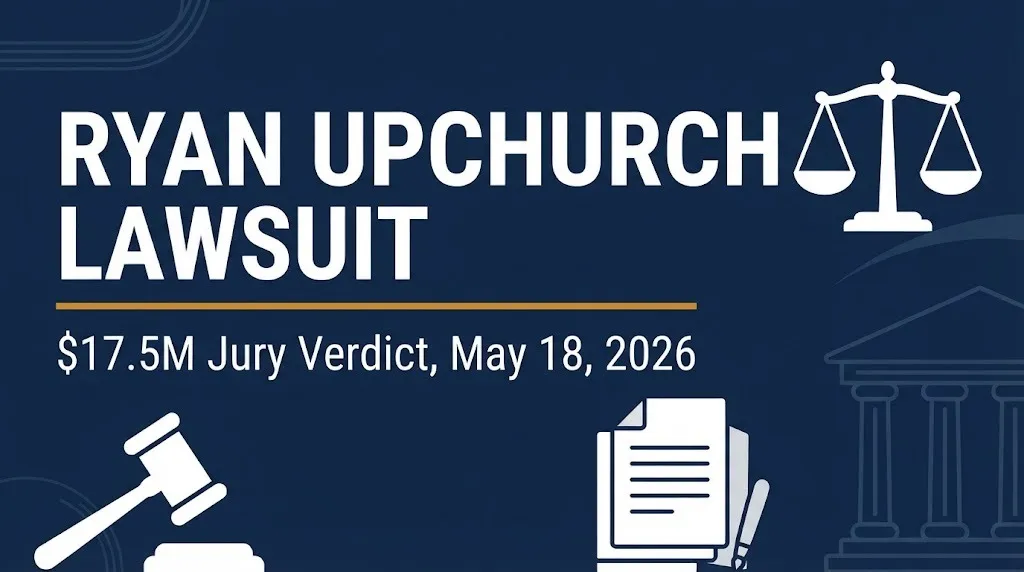
The Ryan Upchurch lawsuit reached a verdict on May 18, 2026. A Nashville federal jury found the YouTuber and musician liable to Kiely Rodni’s father and grandfather.
This is not a class action. Only two plaintiffs were awarded money, so there’s nothing for the public to claim. The figure that matters most is $17.5 million, with some outlets reporting $18 million once punitive damages are counted.
Below, you’ll find the verdict math, the court’s earlier rulings, and what could still change the number. One surprising detail: the court ordered Upchurch to pull deposition clips from social media before trial.
| The Facts | |
|---|---|
| Case | Robertson v. Upchurch, No. 3:23-cv-00770, a defamation suit by Daniel Rodni and David Robertson |
| Status | Jury verdict May 18, 2026; post-trial and appeal outcome not yet confirmed |
| Fund Size | Not applicable. This is a jury award, not a settlement fund |
| Est. Per Person | Rodni: $6.5M compensatory. Robertson: $11M compensatory |
| Claim Deadline | None. No public claim process exists |
| Administrator | None. No claims administrator is involved |
| Proof Needed | Not applicable to the public |
Is the Ryan Upchurch lawsuit real?
Yes, the Ryan Upchurch lawsuit is a real federal case that reached a jury verdict on May 18, 2026. It’s captioned Robertson v. Upchurch, case number 3:23-cv-00770, in the U.S. District Court for the Middle District of Tennessee. Daniel Rodni and David Robertson sued in July 2023. They claimed the videos caused reputational injury, financial losses and emotional distress.
Rodni is Kiely Rodni’s father. Robertson is her grandfather. The complaint listed defamation, false light invasion of privacy, and intentional and negligent infliction of emotional distress. Reports say the jury found for the family on every count.
Be careful with pages that describe several active cases or business disputes. We found no court record behind those descriptions. This one has a docket, a judge, and a verdict.
Is the Ryan Upchurch verdict final?
No, the verdict isn’t final, because post-trial motions and appeals can still change it. A docket entry dated June 17, 2026 lists a motion by Upchurch for judgment as a matter of law, with a supporting memorandum. That motion asks the judge to override the jury’s findings.
Whether the court has ruled on it is not yet confirmed. We found no confirmed notice of appeal either. Early coverage said an appeal was expected, but an expectation isn’t a filing.
A verdict and an entered judgment are two separate steps. The judgment entry date is not yet confirmed.
His lawyer’s statement offered sympathy to the Rodni, Robertson and Nieman families. It gave no comment on the verdict itself.
Think of it like a referee review after the final whistle. The score is posted, but a protest can still change it.
How much does Ryan Upchurch have to pay?
The jury awarded $17.5 million in compensatory damages, and some outlets report $18 million once punitive damages are added. Reports say jurors awarded Daniel Rodni $6.5 million and David Robertson $11 million.
Those are jury awards, not cash in hand. A judge can reduce or reject parts of an award. An appeals court can do the same.
Here’s the split in plain numbers:
- $6.5 million: Daniel Rodni, compensatory damages
- $11 million: David Robertson, compensatory damages
- $500,000: reported punitive damages, $250,000 for each plaintiff
The jury’s money covers three kinds of harm. Those are the defamatory statements themselves, reputational harm, and severe emotional distress. The next section shows how each plaintiff’s total breaks down.
Why do some reports say $17.5 million and others say $18 million?
Both numbers appear because $17.5 million counts compensatory damages and $18 million adds reported punitive damages. One verdict breakdown lists $250,000 in punitive damages for each plaintiff. Here’s how that math works:
| Category | Daniel Rodni | David Robertson |
|---|---|---|
| Actual damages | $500,000 | $1,000,000 |
| Assumed damages (reputation, shame) | $2,000,000 | $4,000,000 |
| Severe emotional distress | $4,000,000 | $6,000,000 |
| Compensatory subtotal | $6,500,000 | $11,000,000 |
| Punitive damages | $250,000 | $250,000 |
| Total with punitive | $6,750,000 | $11,250,000 |
The compensatory subtotals add up to $17.5 million. With punitive damages, the total is $18 million.
Coverage conflicts here. Hoodline reported that the case moved into a separate punitive-damages phase. The docket shows Upchurch asked on May 1, 2026 to split liability from damages. We couldn’t confirm how the court ruled.
Treat $17.5 million as the safe figure and $18 million as reported. The verdict form on the docket settles it.
Key Takeaway: The verdict is $17.5 million in compensatory damages, and the reported $18 million figure only appears once punitive damages are added.
Who gets the money from the Ryan Upchurch verdict?
Only the two plaintiffs, Daniel Rodni and David Robertson, were awarded money. The verdict form lists those two recipients. Nothing in the reports we checked names anyone else.
GoFundMe donors aren’t plaintiffs. Fans and viewers aren’t plaintiffs either. The public gets no share, and no one can add themselves to the case.
Payment flows through the court process and the plaintiffs’ lawyers. A March 2026 order shows how that can look in this case. An earlier award was payable directly to plaintiffs’ counsel by March 31, 2026, unless the parties agreed otherwise.
What happens to the verdict money after collection is a private matter for the plaintiffs. No court filing we reviewed says how they plan to use it. We won’t guess.
Can I file a claim in the Ryan Upchurch lawsuit?
No, you can’t file a claim, because this isn’t a class action and no claims process exists. There’s no settlement website, no claim form, and no administrator collecting paperwork.
In a class action, a claims administrator collects forms from thousands of people. Here, two named plaintiffs sued one defendant. That’s a different kind of case.
Here’s what you can do:
- Follow the public docket for updates.
- Read the verdict figures from court records, not social posts.
- Ignore any “claim your share” message tied to this case.
If you donated to the Rodni family’s GoFundMe, that doesn’t create a claim here. The lawsuit concerned statements about the family, not refunds to donors.
Key Takeaway: The verdict pays two named plaintiffs, so no one else can file a claim or collect from it.
Reality Check: Nobody will text, email or message you offering a share of this verdict. There’s nothing to file, so any “filing fee” is a scam. Anyone asking for a Social Security number or bank login over this case isn’t legitimate.
How do you follow the Ryan Upchurch case docket?
You follow the case by searching its federal docket under Robertson v. Upchurch, number 3:23-cv-00770. It works like package tracking. Each entry is a scan showing where the case is.
- Search the case name, Robertson v. Upchurch, or the number 3:23-cv-00770.
- Open the free CourtListener docket, or use PACER, the federal records system.
- Sort entries so the newest filings appear first.
- Look for a ruling on the June 17, 2026 post-trial motion.
- Watch for a notice of appeal to the Sixth Circuit.
- Read the verdict form, not a headline, for damage amounts.
- Note entry dates, because a filing date and a ruling date differ.
PACER charges small per-page fees. CourtListener’s free docket was blocked from our automated check, so verify entries on your own screen.
Can Ryan Upchurch appeal the verdict?
Yes, Upchurch can appeal to the U.S. Court of Appeals for the Sixth Circuit once the district court enters final judgment. Federal rules generally give 30 days after judgment to file a notice of appeal. Certain post-trial motions pause that clock.
Appeals review legal errors, not whether a jury felt fair. The docket shows several legal fights that could return. In early May 2026, Upchurch filed a motion to apply Tennessee procedural law and California substantive law.
He also filed a trial brief responding to the plaintiffs’ public-versus-private figure brief. Those filings point to a dispute over which legal standards govern the case. We couldn’t confirm how the court ruled on either.
Appeals often take many months. A notice of appeal isn’t confirmed as of this check.
What is the latest Ryan Upchurch lawsuit update?
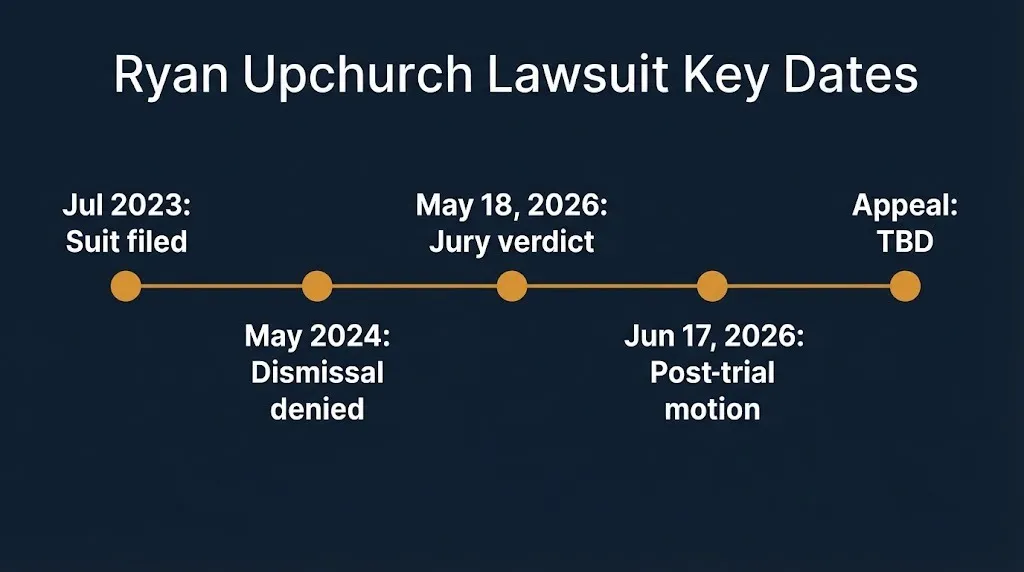
The latest confirmed update is a June 17, 2026 docket entry showing Upchurch’s motion for judgment as a matter of law. Nothing newer is confirmed in the records we reviewed. Here’s the verified timeline:
- July 2023: Suit filed in Nashville federal court.
- May 2024: Judge William Campbell denies the motion to dismiss.
- March 2, 2026: Order on deposition clips; an award payable by March 31.
- May 1, 2026: Upchurch moves to split the trial into phases.
- May 18, 2026: Jury verdict for the family.
- June 17, 2026: Motion for judgment as a matter of law.
Not yet confirmed: a ruling on that motion, a notice of appeal, the final punitive amount, and any payment.
That gap matters. A page claiming “the case is over” or “the check was paid” has no support from the record we found.
Key Takeaway: The last confirmed court action is a June 17, 2026 post-trial motion, and no ruling or appeal is confirmed.
Has Ryan Upchurch paid anything yet?
Payment of the jury award is not confirmed. The only payment deadline on record is from March 2026. That order made an award payable to plaintiffs’ counsel by March 31, 2026, unless the parties agreed otherwise.
The amount and the legal basis for that award weren’t visible in the docket text we reviewed. We won’t guess at either.
The same order carried a second demand. Upchurch had to remove protected portions of his deposition from social media by March 4, 2026. That tells you the court was already policing his online posting before trial.
Collecting a large verdict isn’t automatic. A defendant can ask to pause enforcement while appeals run, often by posting a bond. We found no filing showing a bond, a payment plan or a deal.
What did the judge rule before the Ryan Upchurch trial?
Before trial, Judge William Campbell denied Upchurch’s motion to dismiss, so the case moved forward. The court found his statements were expressed with absolute certainty and could be proven false. That ruling rejected the argument that the videos were only opinion.
The judge relied on context. Upchurch had earlier said Kiely was real and had died, and that more posting could traumatize her family. The court also agreed the GoFundMe comments concerned the plaintiffs as family members.
Remember the standard. At that stage, the court treats the plaintiffs’ allegations as true. The jury later had to decide the facts for itself.
Magistrate Judge Holmes handled pretrial matters, including the March 2026 order. April 2026 filings show motions in limine and proposed jury instructions from Upchurch’s side.
What did Ryan Upchurch say in the video?
The video was titled “ZERO proof of Kiely Rodni situation being REAL.” According to the lawsuit, Upchurch suggested the case was fake and a scam to raise money through GoFundMe. The video is now deleted, per Dexerto.
He posted it while Kiely was still missing and her family didn’t know whether she was alive. That timing is central to how the case was framed.
The complaint says he began posting about her disappearance on August 13, 2022. It adds that he offered theories blaming other YouTube personalities. After her body was found on August 21, he reportedly posted a “prayer” for the family.
Lawyers for the family argued the videos spread false claims. Upchurch’s side argued opinion and commentary. A jury sided with the family.
Key Takeaway: At the dismissal stage, the court treated the video’s claims as statements of fact that could be proven false, not protected opinion.
What happened to Kiely Rodni?
Kiely Rodni was a 16-year-old who disappeared on August 6, 2022, after a party near Tahoe National Forest in California. Her body was later found inside her SUV in a nearby lake. Authorities ruled her death accidental and said there was no evidence of foul play.
Her family set up a GoFundMe during the search. Upchurch’s comments about that fundraiser became part of the lawsuit. The court said those comments concerned the family members who sued.
We’re keeping this section short on purpose. The facts matter because they show what the family knew while the videos spread. Beyond that, the case is about the videos, not the tragedy itself.
Are there other lawsuits against Ryan Upchurch?
Public records point to one confirmed major case, Robertson v. Upchurch, though earlier disputes exist. Artist Jacob LeVeille sued Upchurch over a 2018 video that showed him shooting at paintings with an assault rifle. We didn’t confirm the outcome of that case.
Some web pages list contract disputes and several active cases. We found no docket or court record confirming them. Treat those claims as unverified.
His feud with Jelly Roll and Bunnie Xo is a public argument, not a lawsuit. Coverage describes it as a public feud. Don’t confuse the two.
A quick test works here. If a page names a court, a case number and a filing date, you can check it. If it doesn’t, you can’t.
What does the Ryan Upchurch verdict mean for true crime creators?
The verdict shows that stating provable falsehoods about real families can cost millions. The case centered on where online commentary ends and defamation begins. A jury answered that question against Upchurch.
The ruling isn’t binding national law. A district court jury verdict doesn’t set precedent the way an appeals decision can. An appeal could change the outcome.
Still, the record shows what the judge found risky. Statements made with certainty, about checkable facts, aimed at identifiable people, got past a motion to dismiss. “Just asking questions” didn’t protect them there.
For creators, the practical lesson is simple. Separate opinion from factual claims, and check facts before accusing named people.
Key Takeaway: A jury treated certain, checkable claims about a grieving family as defamation, though an appeal could still change the result.
What Happens Next
- Expected, date not confirmed: The court rules on Upchurch’s post-trial motion for judgment as a matter of law.
- Expected, date not confirmed: The court enters final judgment, if it hasn’t already.
- Expected after judgment: Upchurch may file a notice of appeal to the Sixth Circuit, generally within 30 days.
- Expected, months later: Appeal briefing and a decision, if an appeal is filed.
- Not yet confirmed: Any payment, bond or settlement between the parties.
Frequently Asked Questions
Is the Ryan Upchurch lawsuit a class action?
No, it’s an individual defamation lawsuit by two plaintiffs.
Daniel Rodni and David Robertson sued Upchurch directly.
No one else can join or file a claim.
How much was the Ryan Upchurch verdict?
The jury awarded $17.5 million in compensatory damages.
Some outlets report $18 million, which adds $500,000 in punitive damages.
Check the verdict form on the docket for the final figure.
Why was Ryan Upchurch sued?
He was sued over videos about Kiely Rodni’s death.
The plaintiffs said he falsely suggested the case was fake and a GoFundMe scam.
They claimed defamation and emotional distress.
Did Ryan Upchurch appeal the verdict?
An appeal is expected by some outlets, but a notice of appeal is not confirmed.
A June 17, 2026 docket entry shows a post-trial motion.
Check the docket for any Sixth Circuit filing.
Can I get money from the Ryan Upchurch lawsuit?
No, only the two named plaintiffs were awarded money.
There’s no claim form, deadline or administrator.
Treat any message offering a share as a scam.
Which court heard the Ryan Upchurch case?
The U.S. District Court for the Middle District of Tennessee in Nashville heard it.
The case number is 3:23-cv-00770.
Judge William Campbell ruled on the motion to dismiss.
Has Ryan Upchurch commented on the verdict?
His lawyer released a statement offering sympathy to the families.
The statement gave no comment on the verdict itself.
We found no later public comment confirmed.
Closing
Check the federal docket for Robertson v. Upchurch, case 3:23-cv-00770, before you trust any headline number. Compare it to the verdict form, because reports split between $17.5 million and $18 million.
Skip anyone selling a claim, because nothing exists to file. The date to remember is May 18, 2026, the day the jury ruled.