Compensation Consulting Services Under Fire: The 2026 ERISA Lawsuit Wave Explained
Quick Answer
- Is it legit: Yes. Four federal ERISA lawsuits filed December 23, 2025, target benefits consultants over voluntary benefit commissions.
- How much: Not yet determined. No settlement fund exists; litigation is in early stages.
- Key deadline: None set. Monitor the official court dockets for scheduling updates.
A new wave of ERISA litigation is testing whether benefits consultants owe fiduciary duties when they help employers select voluntary insurance products. The lawsuits, filed by Schlichter Bogard LLC on December 23, 2025, name some of the largest consulting firms in the country as defendants .
You may be affected if you work for one of the named employers and enrolled in accident, critical illness, cancer, or hospital indemnity insurance through your workplace. The cases seek to recover alleged overcharges, but no money has been ordered or set aside yet.
This article breaks down what’s confirmed versus speculative, who the defendants are, what the plaintiffs must prove, and what the early litigation timeline looks like. One detail stands out: the complaints allege that in some arrangements, more money went to consultant commissions than to paying claims .
The Facts
| Case | Four coordinated ERISA class actions filed December 23, 2025 |
| Status | Filed; no class certification yet |
| Fund Size | Not yet confirmed (no settlement) |
| Est. Per Person | Not yet determined |
| Claim Deadline | TBD, watch official court dockets |
| Administrator | Not yet appointed |
| Proof Needed | Not yet determined |
Is the Compensation Consulting Services Lawsuit Legitimate?
Yes, the lawsuits are real federal court filings, but they are not a settlement and no money is available to claim right now. The cases were filed on December 23, 2025, in the U.S. District Court for the Northern District of Illinois and the Southern District of New York .
The plaintiff’s firm, Schlichter Bogard LLC, has a long track record in ERISA litigation, particularly in 401(k) fee cases. This filing represents an expansion into voluntary benefits, a new target area for fiduciary breach claims .
What makes these cases unusual is that benefit consultants are named as defendants alongside employers. Historically, consultants operated as intermediaries protected from ERISA fiduciary liability. The plaintiffs argue that changed when consultants began exercising discretion over carrier selection and plan structure to maximize their own commissions .
The defendants have not admitted any wrongdoing. The litigation is in its earliest stages.
How Much Could You Get from the Voluntary Benefits ERISA Lawsuits?
Not yet determined. No settlement fund exists, no payout tiers have been proposed, and the cases have not reached class certification or summary judgment.
The complaints seek disgorgement of alleged excessive profits, removal of breaching fiduciaries, and recovery for all losses to the plans . If the plaintiffs prevail or the cases settle, a court would need to approve any distribution formula.
Key Takeaway: There is no compensation available today. Anyone promising a payout from these specific cases is ahead of the court record.
For comparison, ERISA class action settlements can take years to resolve. The 401(k) fee cases that inspired this litigation wave often took three to five years from filing to settlement distribution. That timeline is not a prediction for these cases, just context for how ERISA litigation typically unfolds.
Who Is Sued in the 2026 Benefits Consultant Fiduciary Cases?
Four employer-defendant pairs were named in the December 2025 filings, each with a corresponding benefits consulting firm. The complaints are substantially similar and allege the same core theories .
| Employer Defendant | Consulting Firm Defendant | Court |
|---|---|---|
| Community Health Systems Inc. | Gallagher Benefit Services Inc. | N.D. Illinois |
| Laboratory Corp. of America Holdings | Willis Towers Watson US LLC | N.D. Illinois |
| United Airlines Inc. | Mercer Health and Benefits Administration LLC | N.D. Illinois |
| Universal Services of America LP (Allied Universal) | Mercer and Lockton Companies LLC | S.D. New York |
The consulting firms named are not small operations. Gallagher, Mercer, Lockton, and Willis Towers Watson are among the largest benefits advisory firms in the country . Their involvement as defendants, not just witnesses, marks a shift in how plaintiffs are structuring these cases.
What Are Voluntary Benefits and Why Are They at the Center of This Lawsuit?
Voluntary benefits are insurance products employees pay for entirely through payroll deductions, with no employer subsidy. Common examples include accident-only coverage, critical illness insurance, cancer policies, and hospital indemnity plans .
These products grew in popularity as health insurance deductibles and out-of-pocket costs rose. The complaints note that nearly one-third of eligible employees participated in voluntary benefits by 2018, up from 21% in 2014 .
Because employers don’t pay the premiums, many assumed these arrangements fell outside ERISA’s fiduciary requirements under a Department of Labor safe harbor. The plaintiffs argue that assumption fails when employers endorse the products, select the carriers, and allow consultants to collect commissions from the premiums .
The core allegation is that commissions consumed too much of the premium dollar. According to one analysis of the complaints, some arrangements featured commissions above 30% while loss ratios, the share of premiums paid out as claims, fell below 35% .
How Do You Know If You’re Affected by the ERISA Voluntary Benefits Lawsuits?
You may be affected if you worked for one of the four named employers and enrolled in voluntary benefits through your workplace. The proposed classes are not yet certified, so no one is officially a class member at this point .
The cases target employees who paid premiums for accident, critical illness, cancer, or hospital indemnity insurance through payroll deduction. If you only had traditional health, dental, or vision coverage, you likely fall outside the proposed class definition.
The complaints focus on employees who bought these products, not all workers at the named companies. The plaintiffs argue that participants overpaid because the consultants and employers failed to negotiate lower premiums or select more efficient carriers .
What Must Plaintiffs Prove in a Benefits Consultant Fiduciary Duty Case?
Plaintiffs must prove three core elements: that the voluntary benefit programs are ERISA plans, that the defendants acted as fiduciaries, and that those fiduciaries breached their duties by causing participants to overpay .
The ERISA plan question: Employers traditionally relied on a safe harbor at 29 C.F.R. § 2510.3-1(j), which excludes voluntary plans from ERISA if the employer receives no consideration, allows employee-payroll-deduction-only participation, and doesn’t endorse the program. Plaintiffs argue endorsement occurred through plan bundling, carrier selection, and commission structures .
The fiduciary question: Consultants are typically not fiduciaries when they merely provide information or recommendations without discretion. Plaintiffs allege the consultants had discretion over carrier bids and plan structures, making them functional fiduciaries .
The breach question: If fiduciary status attaches, defendants owed duties of prudence and loyalty. Plaintiffs claim those duties were violated by failing to monitor commissions and loss ratios .
Step-by-Step: How Would You File a Claim If a Settlement Happens?
No claims process exists today. If a settlement is reached in any of these cases, here’s how these processes typically work:
- Wait for court approval. A judge must preliminarily approve any settlement and certify a class.
- Watch for official notice. The settlement administrator would mail or email notice to identified class members.
- Confirm your eligibility. The notice would state which employer, which benefit products, and which time period apply.
- Gather payroll records. Proof of premium payments through payroll deduction would likely be required.
- Submit the claim form by the deadline. The deadline would be stated in the notice, not announced on social media.
- Wait for review and distribution. Claims are typically reviewed against employer records before payment.
Reality Check: No one from a court or settlement administrator will text you about money from these cases. Filing a claim is always free. Third-party “claim helpers” charging upfront fees for a case that hasn’t settled are unnecessary.
What Are the Key Dates in the 2026 ERISA Voluntary Benefits Litigation?
The timeline is early and most dates remain “expected” rather than confirmed .
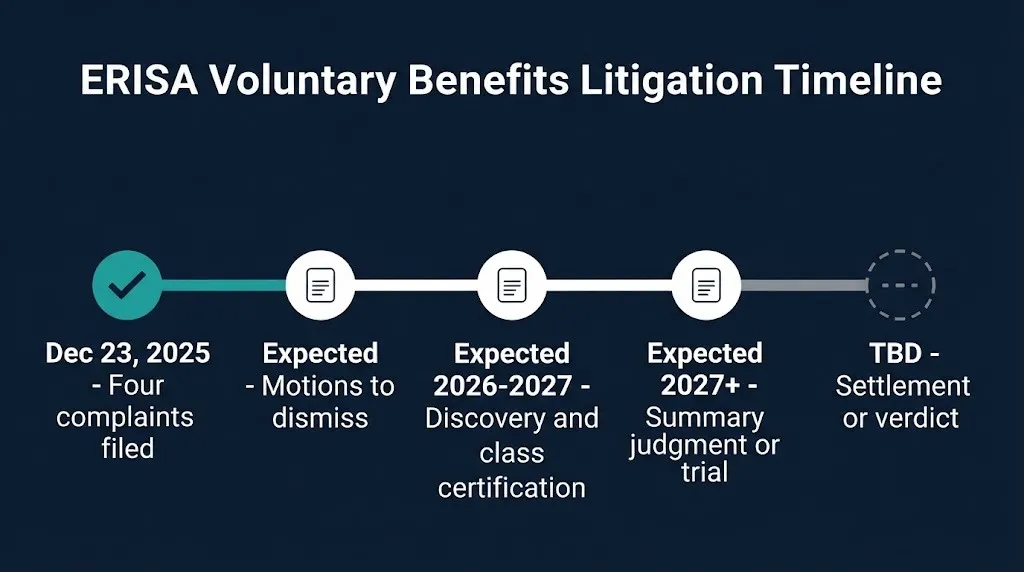
December 23, 2025: Four complaints filed in federal courts in Illinois and New York.
Expected 2026: Defendants’ motions to dismiss. These cases will likely face challenges on whether voluntary benefit programs fall under ERISA at all.
Expected 2026-2027: Discovery and class certification briefing. This phase is often where ERISA cases settle or narrow.
Expected 2027 or later: Summary judgment or trial, if the cases proceed that far.
No settlement discussions have been publicly disclosed. No claim deadline exists because no settlement fund has been created.
How Are Benefit Consultant Commissions Structured in Voluntary Insurance?
Consultants typically earn commissions as a percentage of the premiums paid by employees. The complaints allege these commissions were excessive relative to the value delivered and created conflicts of interest .
The plaintiffs claim consultants sometimes received more in commissions than the insurers paid out in claims. According to one summary, some voluntary benefit arrangements had commissions north of 30% while loss ratios were below 35% .
This structure differs from typical fee-for-service consulting, where the advisor is paid a flat fee regardless of which product the client selects. Commission-based compensation creates an incentive to recommend higher-premium products, the plaintiffs argue .
The defendants have not publicly responded to these specific allegations in the search results available.
What Does the Department of Labor Say About Voluntary Benefits Under ERISA?
The Department of Labor has not issued new guidance specifically addressing these lawsuits as of the search date. The existing safe harbor at 29 C.F.R. § 2510.3-1(j) remains the governing framework .
Under that regulation, voluntary benefit arrangements can avoid ERISA coverage if the employer meets specific conditions: no contributions from the employer, participation completely voluntary, no employer endorsement, and no compensation to the employer beyond reasonable administrative fees.
The litigation tests whether employer conduct, such as bundling voluntary products with medical plans or negotiating carrier discounts, crosses the line from “ministerial” to “endorsement.” Courts have not yet ruled on this question in the voluntary benefits context.
What Happens Next in the Compensation Consulting Services Lawsuits?
The immediate next stage is the defendants’ response to the complaints. Motions to dismiss are expected, and those rulings will shape whether the cases proceed.
Expected late 2026: Defendants’ motions to dismiss and plaintiffs’ oppositions. Court rulings on whether voluntary benefits fall under ERISA would be significant.
Expected 2027: If motions to dismiss are denied, discovery begins. This is often when settlement discussions accelerate in complex ERISA cases.
Expected 2027-2028: Class certification briefing and ruling. No class exists until a judge certifies one.
TBD: Settlement, trial, or dismissal. No outcome is guaranteed.
Frequently Asked Questions
Is the compensation consulting services lawsuit a scam?
No. The lawsuits are real federal court filings from December 2025. However, no money is available yet, and anyone claiming otherwise is misrepresenting the case status.
How much will I get from the ERISA voluntary benefits lawsuit?
Nothing is determined. There is no settlement fund, no payout formula, and no confirmed eligibility list. Any figure you see online is speculation.
Who qualifies for the voluntary benefits class action?
If a class is certified, it would likely cover employees of the four named employers who enrolled in voluntary benefits through payroll deduction during a specific period. That period is not yet defined.
Do I need to hire a lawyer to file a claim?
No claims process exists. If a settlement is reached, filing is typically free and doesn’t require a lawyer. Third-party claim services charging fees are unnecessary.
What is the deadline to file a claim?
No deadline exists because there is no settlement. Do not rely on dates shared on social media or by claims aggregators.
Which consulting firms are defendants?
Gallagher Benefit Services, Willis Towers Watson, Mercer, and Lockton are named in the four complaints .
What are the named employers in the lawsuit?
Community Health Systems, Laboratory Corp. of America, United Airlines, and Universal Services of America (Allied Universal) .
Has any settlement been reached?
No. The cases were filed in December 2025 and remain in early litigation. No settlement has been announced.
What Should You Do Now?
If you worked for one of the named employers and enrolled in voluntary benefits, keep your payroll records and benefit enrollment documents. Those will help establish premium payments if a class is certified and a claims process opens.
Do not pay anyone who promises to file a claim for you. Do not share personal information with social media accounts claiming to represent the case. The official court dockets are the only source of confirmed updates.
The single most important fact right now: no claim deadline exists, no settlement fund has been created, and no payout is available. That will remain true until a federal judge approves otherwise.