Johnson & Johnson Vaccine Lawsuit: The Real 2026 Status
Quick Answer
- There is no confirmed Johnson & Johnson COVID vaccine class action lawsuit or settlement fund active in 2026.
- The federal PREP Act generally blocks lawsuits against J&J for COVID vaccine injuries, so most claims go through the CICP, not a payout you’d see from a class action.
- CICP claims must be filed within 1 year of vaccine administration, a deadline that has already passed for most people vaccinated in 2021 through 2023.
If you searched for a “Johnson & Johnson vaccine lawsuit” or a “COVID vaccine class action,” you probably want to know if you can get compensated for a reaction to the shot. The honest answer is more complicated than a typical settlement story.
Federal law shields COVID-19 vaccine makers like J&J from most lawsuits, which is why you won’t find a class action to join. What you will find is a government compensation program with a track record worth understanding before you file anything.
This guide breaks down why a lawsuit isn’t the normal path here, what is actually confirmed about compensation, and one detail that surprises most people: the government’s own program has paid out on less than 1% of the COVID vaccine claims filed against it.
The Facts
| What You Need to Know | Verified Answer |
|---|---|
| Case | No certified class action exists against J&J for COVID vaccine injuries |
| Status | Vaccine’s emergency use authorization revoked June 1, 2023; claims route through CICP |
| Fund Size | Not applicable, this is not a class action settlement fund |
| Est. Per Person | Not yet determined; CICP payouts for common injuries have run roughly $1,000 to $5,500 per attorney-reported case data |
| Claim Deadline | 1 year from vaccine administration for CICP claims |
| Administrator | Health Resources and Services Administration (HRSA) runs the CICP |
| Proof Needed | Medical records connecting a covered injury to a covered COVID-19 countermeasure |
Every number here reflects a government compensation program, not a lawsuit payout. Treat any site promising a guaranteed class action check as unverified until it names a real court case.
Is there a real Johnson & Johnson COVID vaccine class action lawsuit in 2026
No certified class action lawsuit against Johnson & Johnson over COVID-19 vaccine injuries is confirmed as active in 2026. If you’ve seen ads suggesting otherwise, they aren’t describing a real, certified case.
The reason ties back to federal law. The Public Readiness and Emergency Preparedness Act, known as the PREP Act, grants broad legal immunity to vaccine manufacturers for claims tied to a declared public health emergency countermeasure.
Multiple courts have confirmed this immunity applies to COVID-19 vaccines specifically. A Maine court, for instance, held that PREP Act immunity language is “plain, broad, and unambiguous” regarding tort liability for vaccine administration.
That doesn’t mean zero legal activity exists. It means the activity looks different from a typical product liability class action, and understanding that difference matters before you search for a “J&J vaccine settlement.”
Can you sue Johnson & Johnson for a COVID vaccine injury
Generally, no, not through an ordinary lawsuit, because the PREP Act blocks most standard tort claims against covered vaccine manufacturers.
The Act’s immunity covers claims “caused by, arising out of, relating to, or resulting from” the administration of a covered countermeasure during the declared emergency period. COVID-19 vaccines, including J&J’s Janssen shot, are covered countermeasures under this framework.
There is one narrow exception: a claim alleging “willful misconduct.” That path is real, but it’s far more restrictive than a normal lawsuit, covered in detail further below.
Key Takeaway: The absence of a J&J COVID vaccine class action isn’t a loophole or a conspiracy, it’s the direct result of a federal immunity law that applies to all COVID-19 vaccine manufacturers, not just J&J.
Is this the same as the Johnson & Johnson talc powder lawsuit
No, the J&J talc and baby powder litigation is a completely separate legal matter from anything involving the COVID-19 vaccine.
The talc litigation involves allegations that J&J’s talcum powder products caused ovarian cancer and mesothelioma, and it moves through standard product liability courts, not the PREP Act framework. That litigation has its own case history, bankruptcy maneuvers, and settlement discussions entirely disconnected from vaccine injury claims.
If you searched “Johnson and Johnson vaccine lawsuit” hoping to find talc-related information, or vice versa, know that these are two entirely different legal situations involving different products, different courts, and different compensation paths. Confusing the two can lead you toward inaccurate claim advice.
How much money can you get for a COVID vaccine injury claim
Not yet determined is the accurate answer for any individual case, since the amount depends entirely on your specific injury, documentation, and whether the CICP finds your claim eligible.
What is confirmed is the program’s overall payout pattern. As of March 1, 2026, HRSA data shows the CICP had received 14,129 COVID-19 related claims and made decisions on 6,827 of them.
| CICP COVID-19 Claims (as of March 1, 2026) | Number |
|---|---|
| Total COVID-19 claims filed | 14,129 |
| Claims decided | 6,827 |
| Found eligible for compensation | 95 |
| Claims actually compensated | 44 |
Attorney-reported analysis of program data from early 2025 found average payouts, excluding two high-value outlier cases, ran around $4,000, with most myocarditis claims paid between $1,000 and $5,500. One reported TTS blood clot case reportedly received a payout in the millions, but that appears to be a rare exception rather than a typical outcome.
How to file a COVID vaccine injury claim through the CICP
Filing means submitting a Request for Benefits form to HRSA’s Countermeasures Injury Compensation Program, not filing a lawsuit in court.
- Confirm your injury falls within the one-year filing window from your vaccination date.
- Complete the Request for Benefits form through the CICP.
- Identify the countermeasure you received, though the specific manufacturer isn’t strictly required on the form itself.
- Gather medical records documenting your injury and treatment.
- Submit supporting documentation, including your vaccination record if available.
- Track your claim status, since a large share of claims currently sit in pending review.
- Respond promptly to any HRSA requests for additional records, a common reason claims get denied.
Unlike a lawsuit, this process doesn’t involve a jury, a judge hearing live testimony, or the right to appeal to a higher court in most circumstances.
What is the deadline to file a COVID vaccine injury claim
The CICP requires claims to be filed within 1 year of the date you received the covered countermeasure, a firm administrative deadline.
Because J&J’s Janssen COVID-19 vaccine was administered mainly between 2021 and 2023, that one-year window has already closed for the vast majority of people who received it. HRSA data confirms that missed filing deadlines account for a substantial share of all CICP denials nationwide.
If you believe you have a covered injury:
- Check the exact date you received your vaccine.
- If it’s been less than one year, file immediately, since the deadline doesn’t extend for gathering paperwork later.
- If more than one year has passed, a CICP claim is very likely time-barred, and a consultation with an attorney familiar with vaccine injury law is the next reasonable step to review any remaining options.
Key Takeaway: For most people vaccinated with J&J’s shot years ago, the CICP’s one-year clock has already run out, which is different from typical class action deadlines that can open years after exposure.
Reality Check
No legitimate settlement administrator or law firm can promise you a guaranteed payout for a Johnson & Johnson COVID vaccine class action, because no certified class action currently exists to pay out from. Be skeptical of ads or texts claiming otherwise, and never pay an upfront fee to “register” for a compensation program; filing with the CICP directly through HRSA is free.
What is the willful misconduct exception to PREP Act immunity
Willful misconduct is the one legal path around PREP Act immunity, but it comes with unusually strict procedural requirements that don’t apply to typical lawsuits.
To bring this type of claim, a case must be filed exclusively in the United States District Court for the District of Columbia. The complaint must include a sworn verification, a doctor’s affidavit, and certified medical records supporting the allegation.
The claim must also allege conduct more culpable than negligence or recklessness, and it must be proven by clear and convincing evidence, a higher bar than typical civil cases. Filers generally must first pursue an administrative CICP claim before this option becomes available.
Recent 2026 development: In August 2026, the D.C. Circuit Court of Appeals vacated a lower court’s dismissal of a willful misconduct case involving a teenager’s death after vaccination. The appellate court found that such motions to dismiss must be heard by a three-judge panel, not a single judge, a procedural requirement the lower court had skipped.
That ruling doesn’t create new liability for J&J specifically, but it shows the willful misconduct pathway remains actively contested in federal court.
Is the Johnson & Johnson COVID vaccine still available in 2026
No, the Janssen COVID-19 vaccine made by J&J is no longer available in the United States, following a voluntary withdrawal request in 2023.
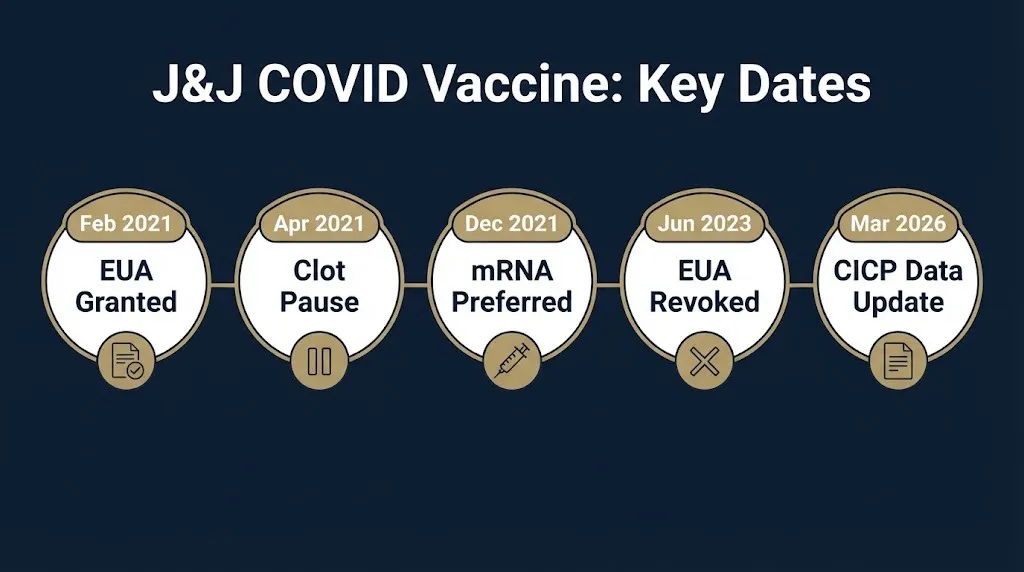
On May 22, 2023, Janssen Biotech requested that the FDA voluntarily withdraw its emergency use authorization. The FDA formally revoked EUA 27205 on June 1, 2023.
According to the FDA and J&J, the withdrawal reflected expired inventory and lack of demand as mRNA vaccines became dominant, not new safety findings. The company also stated it did not intend to update the vaccine’s formulation for newer variants.
Key Takeaway: J&J’s COVID vaccine hasn’t been distributed in the U.S. since 2023, meaning any new claims can only relate to doses administered before that withdrawal.
What legal challenges to the PREP Act are happening in 2026
Several ongoing lawsuits are challenging whether PREP Act immunity itself is constitutional, though none have overturned it as of this writing.
In September 2025, a federal court in Alabama dismissed a wrongful death case in Searcy v. Pfizer that had challenged the PREP Act’s constitutionality, finding the manufacturer defendant and federal actors were protected. In November 2025, a Louisiana federal court dismissed a separate case seeking a declaratory judgment that PREP Act immunity was unconstitutional, ruling the plaintiffs lacked standing for that specific legal theory.
Separately, advocacy groups including React19 and Moms for America have pending litigation against the federal government challenging PREP Act immunity and CICP’s structure more broadly. None of these cases are Johnson & Johnson class actions specifically, they challenge the underlying federal framework that shields all COVID vaccine manufacturers.
A separate 2025 federal lawsuit pushed HHS to move COVID-19 vaccines into the Vaccine Injury Compensation Program (VICP) instead of the CICP, which would give claimants stronger court-based appeal rights. That case’s current outcome is not yet confirmed in available reporting.
What happened with J&J’s COVID vaccine and blood clots
The J&J Janssen vaccine was linked to a rare clotting condition called thrombosis with thrombocytopenia syndrome, or TTS, identified shortly after the shot’s rollout.
The FDA and CDC paused use of the vaccine on April 13, 2021, after early clot reports, then lifted the pause on April 23, 2021, with an added warning label. By 2022, federal safety monitoring had confirmed 60 TTS cases, including 9 deaths, among more than 18.7 million doses administered.
In December 2021, the CDC’s vaccine advisory committee issued a preferential recommendation favoring mRNA vaccines over the Janssen shot for nearly all adults. The FDA further limited the vaccine’s authorized use in May 2022, restricting it to adults who couldn’t access or wouldn’t take another vaccine option.
Why can’t you sue J&J directly for COVID vaccine side effects
You generally can’t sue J&J directly because Congress built specific liability protection into the law authorizing rapid vaccine deployment during the pandemic.
The PREP Act was designed to encourage fast vaccine development by removing the threat of standard tort lawsuits against manufacturers, in exchange for creating the no-fault CICP as an alternative compensation path. This trade-off applies equally to every COVID-19 vaccine maker, not uniquely to J&J.
Think of it like a warranty claim where the fine print already redirected you to a specific repair program instead of small claims court. The redirection might feel frustrating, but it followed rules set well before your individual claim existed.
What counts as a covered COVID vaccine injury under CICP
A covered injury under CICP generally means a serious physical injury or death that medical evidence directly connects to a covered COVID-19 countermeasure, including the vaccine itself.
Commonly reported and compensated COVID-19 vaccine injury categories in HRSA data include myocarditis (heart inflammation) and, in rarer high-value cases, TTS-related blood clotting. Anaphylaxis and other acute reactions have also appeared among CICP claim categories tied to vaccines generally.
What CICP typically requires to establish a covered injury:
- Medical documentation showing a diagnosed injury.
- A plausible causal link between the vaccine and that specific injury, based on medical evidence.
- Records submitted within the required timeframes, since incomplete submissions are a leading cause of denial.
HRSA’s own data shows that missing medical records and unmet standards of proof, not just missed deadlines, account for the majority of claim denials industry-wide.
What Happens Next
Now through late 2026: HRSA continues processing the roughly 7,300 pending COVID-19 CICP claims still awaiting a decision.
Ongoing: federal courts continue hearing PREP Act constitutional challenges, including the D.C. Circuit’s August 2026 procedural ruling on willful misconduct claims.
Expected, no confirmed date: any outcome on the 2025 lawsuit seeking to move COVID vaccines into the VICP framework, which could change future claimants’ options if successful.
If you were injured by a J&J COVID vaccine and never filed: check your vaccination date now, since CICP’s one-year deadline has already passed for most 2021 to 2023 doses.
Frequently Asked Questions
Is there a Johnson & Johnson COVID vaccine class action lawsuit?
No certified class action lawsuit against Johnson & Johnson for COVID vaccine injuries is confirmed as active in 2026.
Federal PREP Act immunity generally blocks this type of lawsuit against COVID-19 vaccine manufacturers.
Can I still file a claim for a J&J COVID vaccine injury?
You can file with the CICP, but only within one year of your vaccination date, a deadline that has passed for most people vaccinated in 2021 through 2023.
If more than a year has passed, consult an attorney about whether any narrow exceptions might still apply to your situation.
How much does the CICP pay for vaccine injuries?
Reported average payouts for common injuries like myocarditis have run roughly $1,000 to $5,500, based on attorney analysis of HRSA data.
Only 44 of 14,129 filed COVID-19 CICP claims had been compensated as of March 1, 2026.
Why can’t I sue Johnson & Johnson over COVID vaccine side effects?
The PREP Act grants vaccine manufacturers broad immunity from standard lawsuits tied to a declared public health emergency.
A narrow willful misconduct exception exists, but it requires filing in Washington, D.C. federal court with strict evidentiary requirements.
Is the J&J COVID vaccine still being given in 2026?
No, the FDA revoked the Janssen COVID-19 vaccine’s emergency use authorization on June 1, 2023.
The withdrawal was tied to expired inventory and low demand, not new safety concerns, according to the FDA and J&J.
What’s the difference between the J&J vaccine lawsuit and the J&J talc lawsuit?
These are two completely separate legal matters involving different products and different courts.
The talc litigation concerns cancer claims tied to talcum powder, unrelated to any COVID-19 vaccine claim or the PREP Act framework.
What injuries has the J&J COVID vaccine been linked to?
The vaccine has been linked to thrombosis with thrombocytopenia syndrome, a rare blood clotting condition, with 60 confirmed cases and 9 deaths reported by 2022 among over 18.7 million doses.
Myocarditis has also appeared among reported CICP claim categories tied to COVID-19 vaccines broadly.
If you believe you were injured by a J&J COVID vaccine, the most useful next step is confirming your exact vaccination date against the CICP’s one-year filing window. That single date, not a class action headline, determines what options you may still have.