Optima Tax Relief Lawsuit 2026: Class Action Status, Scam Claims & What You Need to Know
Quick Answer
- Is it legit: Yes, multiple real federal lawsuits are active against Optima Tax Relief, but no settlement exists.
- How much: Not yet determined. No class has been certified and no fund has been created.
- Key deadline: None for claims. A motion to dismiss hearing is set for October 14, 2026.
Optima Tax Relief faces multiple class action lawsuits alleging spam text messages and deceptive business practices, but none have reached settlement. The most recent case, filed March 19, 2026, accuses the company of sending unsolicited commercial emails with falsified header information in violation of California law .
You may be affected if you received promotional texts or emails from Optima Tax Relief without consent, or if you paid the company for tax resolution services that weren’t delivered. No money is available yet, and no claim deadline exists because no settlement has been approved.
This article breaks down what’s actually confirmed in the court records versus what consumer complaint sites claim, who the plaintiffs are, what the lawsuits allege, and why you should ignore anyone promising a payout. One detail stands out: the company has faced hundreds of consumer complaints alleging it charged thousands upfront while doing little to resolve actual IRS debts .
The Facts
| Case | Thomas Purscelley v. Optima Tax Relief LLC (most recent active case) |
| Status | Filed March 19, 2026; motion to dismiss pending |
| Fund Size | Not yet confirmed (no settlement) |
| Est. Per Person | Not yet determined |
| Claim Deadline | TBD, watch official court dockets |
| Administrator | Not yet appointed |
| Proof Needed | Not yet determined |
Is the Optima Tax Relief Lawsuit Legitimate?
Yes, the Optima Tax Relief lawsuit is a real federal court filing, but it is not a settlement and no compensation is available to claim right now. The most recent case was filed March 19, 2026, in the U.S. District Court for the Central District of California .
The lawsuit alleges Optima violated California’s anti-spam law by sending commercial emails with forged or misrepresented header information. The complaint claims the company used domains like “richardwacker.com” that have no legitimate connection to Optima, specifically to evade spam filters and conceal the sender’s identity .
This isn’t Optima’s first legal challenge. A separate case filed in August 2025 (Robert Scheven et al v. Optima Tax Relief LLC) was voluntarily dismissed without prejudice in October 2025 . Another case from 2023 (Peter Melito et al v. Optima Tax Relief LLC) reached a settlement agreement in early 2024, though the terms were not publicly disclosed .
The current active case is before Judge Serena R. Murillo, with a motion to dismiss hearing set for October 14, 2026 .
How Much Could You Get from the Optima Tax Relief Class Action?
Not yet determined. No settlement fund exists, no payout tiers have been proposed, and the court has not certified a class.
The spam-text lawsuit seeks statutory damages under California Business and Professions Code § 17529.5, which allows for $1,000 per unsolicited commercial email under certain conditions. The complaint alleges Optima sends over 100,000 spam emails annually to recipients across all fifty states .
If the case settles or the plaintiffs prevail, any distribution formula would need court approval. Data privacy and anti-spam settlements typically produce per-person payments ranging from a few dollars to under $100, depending on the number of valid claims and the total fund size.
Key Takeaway: There is no money available today from any Optima Tax Relief lawsuit. Any website promising a payout is ahead of the court record.
Is Optima Tax Relief a Scam? What the Complaints Actually Say
Optima Tax Relief is not officially classified as a scam by any court or regulator, but consumer complaints describe a pattern of high fees and disappointing results. The Better Business Bureau shows the company holds an A rating and responds to complaints, while Trustpilot reviews average around 4.5 stars .
The negative reviews tell a different story. Dozens of consumers report paying between $3,000 and $13,500 for services that didn’t materialize .
Common complaints include:
- High upfront fees for an “investigation phase,” often $295 to $495, before any resolution work begins
- Promises of tax debt reduction that the company later claims it never guaranteed
- Poor communication with weeks of silence and rotating case managers
- No actual contact with the IRS despite months of payments to Optima
One Reddit user who claimed to be a former employee alleged that the “resolution” fee is based not on case difficulty but on what the client can afford .
Optima’s own CEO, David King, has stated the company’s mission is to “take the stress out of tax” . Whether the company’s results match that mission is what the lawsuits and complaints will ultimately test.
Who May Qualify for the Optima Tax Relief Spam Text Class Action?
You may qualify for the Optima Tax Relief spam text class action if you received unsolicited commercial emails from Optima Tax Relief or its marketing agents in California. The proposed class covers California residents who received emails promoting Optima’s services without giving direct consent .
The named plaintiff, Thomas Purscelley, filed the case through Pacific Trial Attorneys, a firm that specializes in consumer protection litigation. The complaint alleges the emails used falsified domains and misrepresented header information to conceal the true sender .
If you received promotional texts or emails from Optima and you never gave the company your contact information, you may fall within the proposed class. If you’re outside California, you may not qualify under the current class definition, which is limited to California email addresses.
No class has been certified yet, so no one is officially a class member at this point.
Reality Check: No one from a court or settlement administrator will text you about money from these cases. Filing a claim is always free once a settlement exists. Third-party “claim helpers” charging upfront fees for cases that haven’t settled are unnecessary.
Who May Qualify for the Optima Tax Relief Refund Claims?
You may qualify for separate refund claims if you paid Optima Tax Relief for services and believe you were misled or didn’t receive what you paid for. This is different from the class action lawsuits, which focus on spam emails.
Consumer attorneys have advised that individuals with documented losses should file complaints with the Federal Trade Commission, the Consumer Financial Protection Bureau, the California Attorney General’s Office, and the Better Business Bureau .
If you paid Optima and got no results, your options include:
- Document everything including contracts, payment records, emails, and call logs
- File formal complaints with the FTC, CFPB, and your state attorney general
- Consider small claims court if your losses fall within your state’s limits
- Contact consumer protection attorneys who handle cases on contingency
The class action email address that circulates online ([email protected]) is actually for Optima’s own lawsuit against scammers impersonating the company, not for complaints against Optima .
Step-by-Step: What to Do If You Think You Have a Claim
No claims process exists for any Optima lawsuit today. But if you believe you were harmed, here’s how to protect yourself:
- Gather your records. Collect contracts, payment receipts, emails, and notes about phone calls.
- Check your email history. Search for messages from Optima or unfamiliar domains promoting tax relief.
- File agency complaints. Submit reports to the FTC, CFPB, and your state attorney general.
- Watch the court dockets. The Purscelley case is the most active; monitor for settlement news.
- Avoid upfront-fee “helpers.” Legitimate class action participation never requires payment to join.
- Consider a consultation. Consumer attorneys often offer free case reviews for potential individual claims.
What Are the Key Dates in the Optima Tax Relief Lawsuits?
The timelines for the various Optima cases are scattered, and most dates remain expected rather than confirmed.
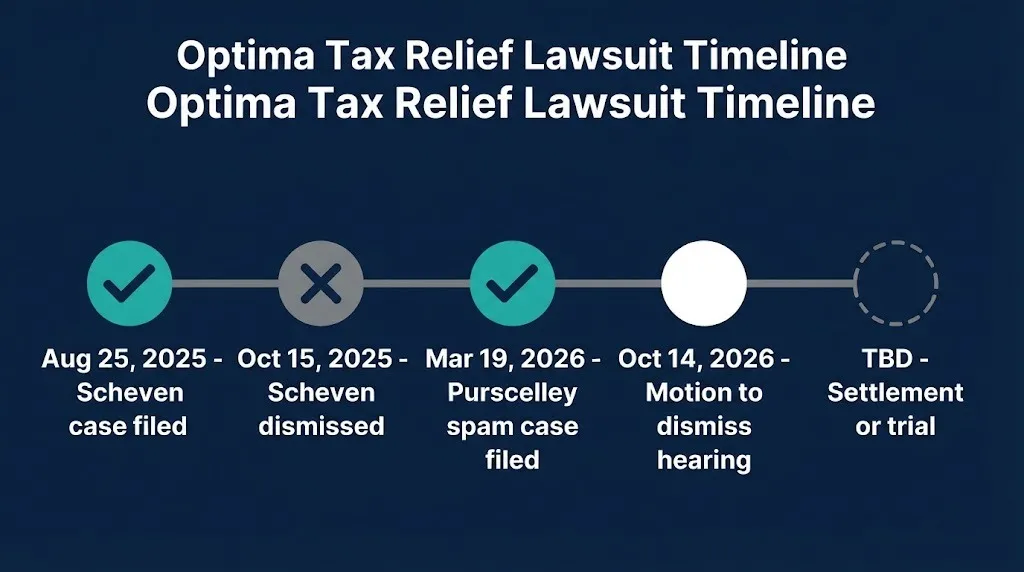
August 25, 2025: Robert Scheven files a lawsuit against Optima in the Central District of California .
October 15, 2025: The Scheven case is voluntarily dismissed without prejudice .
March 19, 2026: Thomas Purscelley files the spam-text class action (Case No. 2:26-cv-02989) .
June 5, 2026: Optima files its first motion to dismiss .
June 8, 2026: Optima withdraws the first motion and files a corrected motion to dismiss .
October 14, 2026: Hearing scheduled on Optima’s motion to dismiss before Judge Serena R. Murillo .
TBD: Class certification, settlement, or trial in any active case.
What Are the Allegations Against Optima Tax Relief in the Spam Text Lawsuit?
The lawsuit alleges Optima Tax Relief violated California’s anti-spam statute by sending commercial emails with falsified header information. The complaint claims the company used domains with no legitimate relationship to Optima, specifically to evade spam filters and conceal the sender’s identity .
California Business and Professions Code § 17529.5 prohibits commercial emails with falsified, misrepresented, or forged header information. The law applies when the domain used doesn’t identify the actual sender and isn’t authorized by the advertiser whose goods are being promoted .
The complaint describes a specific example: an email promoting Optima’s services sent from “[email protected].” The domain “richardwacker.com” has no semantic, commercial, or traceable connection to Optima, according to the filing .
The plaintiffs argue this lack of traceability isn’t incidental. It’s the intended effect of using fabricated header information to mask the sender’s identity and evade accountability. California courts have repeatedly held that header information is misrepresented when it fails to identify the actual sender on its face .
What Does Optima Tax Relief Say About the Lawsuits?
Optima Tax Relief has not issued public statements addressing the specific spam-text allegations. The company’s public communications focus on its services and disaster relief guides .
In court filings, Optima has moved to dismiss the Purscelley case under Rule 12(b)(6), arguing the complaint fails to state a claim. The motion was originally filed June 5, 2026, then withdrawn and refiled with corrections on June 8, 2026 .
The company’s CEO, David King, has emphasized Optima’s mission to “take the stress out of tax” and its recognition from the Better Business Bureau, including the International Torch Award for Ethics . Optima also maintains an A rating with the BBB and responds to customer complaints through that platform .
What Happens Next in the Optima Tax Relief Lawsuits?
The immediate next stage is the October 14, 2026 hearing on Optima’s motion to dismiss the Purscelley case. That ruling will determine whether the spam-text class action proceeds.
October 14, 2026: Hearing on Optima’s motion to dismiss in the Purscelley case .
Expected late 2026 or early 2027: If the motion is denied, discovery begins and class certification briefing follows.
Expected 2027: Potential settlement discussions if the case survives dismissal.
TBD: Settlement, trial, or dismissal. No outcome is guaranteed.
Separately, consumers with individual refund claims against Optima can pursue complaints through the FTC, CFPB, and state attorneys general. Those processes operate independently of the class action.
Frequently Asked Questions
Is the Optima Tax Relief lawsuit a scam?
No. The lawsuit is a real federal court filing. No money is available yet, and anyone claiming otherwise is misrepresenting the case status.
How much will I get from the Optima Tax Relief class action?
Nothing is determined. There is no settlement fund, no payout formula, and no confirmed eligibility list.
What is the Optima Tax Relief lawsuit about?
The most recent case alleges Optima sent spam emails with falsified header information in violation of California law. Other lawsuits have involved data breaches and consumer complaints.
Do I need to hire a lawyer to file a claim?
No claims process exists. If a settlement is reached, filing is typically free and doesn’t require a lawyer.
What is the deadline to file a claim?
No deadline exists because no settlement has been reached in any Optima case.
Can I sue Optima Tax Relief for a refund?
Potentially. If you paid Optima and didn’t receive promised services, you may have grounds for a breach of contract claim. Consider consulting a consumer attorney.
Has Optima Tax Relief settled any lawsuits?
A 2023 case (Melito v. Optima) reached a settlement agreement in early 2024, but terms were not publicly disclosed. The 2025 Scheven case was voluntarily dismissed .
Where are the Optima Tax Relief lawsuits filed?
The active cases are in the U.S. District Court for the Central District of California .
What Should You Do Now?
If you received unsolicited emails from Optima Tax Relief, save those messages and note the dates you received them. If you paid Optima for services and believe you were misled, gather your contracts, payment records, and any communications.
Do not pay anyone who promises to file a claim for you. Do not share personal information with social media accounts claiming to represent these cases. The official court dockets are the only source of confirmed updates.
The single most important fact right now: no claim deadline exists, no settlement fund has been created, and no payout is available. The next significant date is October 14, 2026, when a federal judge will hear Optima’s motion to dismiss the active spam-text class action .