What Is an Example of an Unfair Claims Settlement Practice in 2026?
Quick Answer
- What it is: An unfair claims settlement practice is when an insurer mishandles your claim, such as delaying payment, refusing to investigate, or offering far less than what you’re owed.
- Common example: Failing to acknowledge or act reasonably promptly on claim communications, which is a violation in nearly every state’s insurance code .
- Where to report: File a complaint with your state’s Department of Insurance. These agencies fine insurers for violations, as seen in the 2026 USAA and Allstate penalties .
What Is an Example of an Unfair Claims Settlement Practice?
A clear example of an unfair claims settlement practice is when an insurance company fails to acknowledge and act reasonably promptly on communications about your claim. That specific conduct is listed as a violation under Virginia’s insurance code and dozens of other state laws modeled on the National Association of Insurance Commissioners’ Unfair Claims Settlement Practices Act .
This isn’t a minor paperwork issue. When an insurer ignores your calls, loses your documents, or delays for months without explanation, it can leave you unable to pay medical bills, repair your home, or replace a totaled car. The state insurance department can fine the company for these practices, but in most states, you cannot sue directly under the unfair claims statute itself. Virginia’s law is explicit: “No violation of this section shall of itself be deemed to create any cause of action in favor of any person other than the Commission” .
That means your remedy usually comes through a separate bad faith lawsuit or a breach of contract claim, not the regulatory violation alone.
This article breaks down specific verified examples, how regulators penalized insurers in 2026, what you can do if it happens to you, and the difference between a regulatory complaint and a lawsuit.
The Facts
| Detail | Information |
|---|---|
| Legal Basis | State Unfair Claims Settlement Practices Acts, based on NAIC model |
| 2026 Enforcement Example | USAA fined $140,000; Allstate fined $90,000 in Washington |
| California Example | State Farm accused of 432 violations after wildfire claims |
| Common Violation | Failing to act promptly on claim communications |
| Your Main Remedy | State insurance department complaint; bad faith lawsuit where allowed |
| Key Deadline | Varies by state, often 2 to 3 years for bad faith claims |
What Are Specific Examples of Unfair Claims Settlement Practices?
Specific examples of unfair claims settlement practices include misrepresenting policy facts, failing to investigate claims reasonably, refusing to pay without justification, and compelling insureds to sue to recover what they’re owed. Virginia’s statute lists 17 separate prohibited acts, and most states use similar language .
Here are the most common violations with real-world examples:
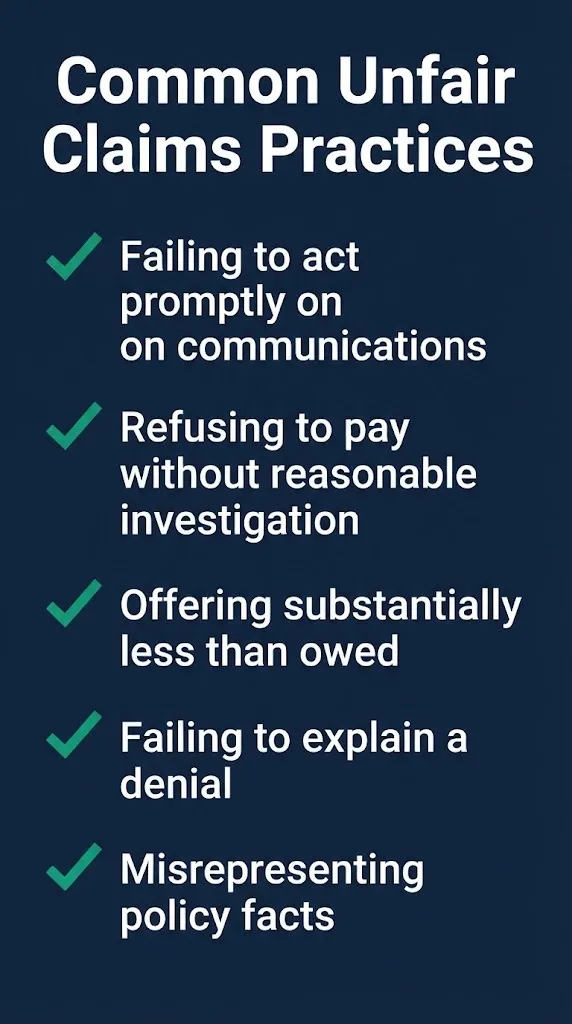
| Unfair Practice | What It Looks Like |
|---|---|
| Failing to act promptly | Ignoring your calls and emails for weeks or months |
| Refusing to pay without reasonable investigation | Denying a claim without reviewing medical records or police reports |
| Offering substantially less than owed | Lowballing a totaled car’s value or a home repair estimate |
| Failing to explain a denial | Sending a rejection letter with no reason or policy citation |
| Compelling litigation | Offering so little that you have to sue to get fair value |
| Misrepresenting facts | Telling you a procedure isn’t covered when your policy says it is |
The Washington State Office of the Insurance Commissioner documented these exact patterns in its September 2026 enforcement actions. USAA was fined for 19 confirmed violations including “not responding to consumers and acting timely on their claims” and “refusing to pay claims without a reasonable investigation” .
What Did the 2026 USAA and Allstate Fines Show?
The 2026 USAA and Allstate fines show that regulators are actively penalizing insurers for unfair claims practices. Washington Insurance Commissioner Patty Kuderer fined USAA Casualty Insurance Co. $140,000 and Allstate Vehicle and Property Insurance Co. $90,000 in September 2026 .
The USAA violations stemmed from auto claims handled between 2019 and 2024. After reviewing 125 consumer complaints, the OIC found at least one potential violation in 31 claims. USAA confirmed 19 violations, including failing to act timely on claims 11 times and refusing to pay without reasonable investigation five times .
Allstate’s $90,000 fine covered claims handling violations plus a separate premium transparency issue affecting 86,705 policies. The OIC found Allstate “misrepresented important facts when issuing a payment to a consumer for much less than its own estimate” .
Key Takeaway: The 2026 USAA and Allstate fines prove that unfair claims practices carry real regulatory consequences. But the fines go to the state, not to you. Your compensation requires a separate complaint or lawsuit.
How Do Unfair Claims Practices Differ From Bad Faith?
Unfair claims practices are regulatory violations enforced by state insurance departments, while bad faith is a legal claim you can bring against your own insurer for breaching the duty of good faith and fair dealing. The two overlap, but they have different consequences.
A state insurance department can fine an insurer for unfair claims practices, suspend its license, or order corrective action. That’s what happened to USAA and Allstate in Washington . The money from those fines goes to the state treasury, not to consumers who were harmed.
Bad faith, on the other hand, is a civil claim. If your own insurer unreasonably delays or denies a valid claim, you may be able to sue for the policy benefits plus additional damages, including emotional distress or punitive damages in some states. Illinois law describes bad faith as conduct showing “the insurance company was never going to pay you in the first place,” such as cancelling your policy after you file a claim or refusing to answer your calls .
Not every state allows first-party bad faith claims. Some require you to sue for breach of contract instead, which limits damages to the policy benefits you should have received.
What Should You Do If Your Insurer Uses Unfair Claims Practices?
If your insurer uses unfair claims practices, your first step should be filing a complaint with your state’s Department of Insurance. That agency has the power to investigate, fine the insurer, and order corrective action .
Here’s a step-by-step action plan:
- Document everything. Keep a log of every call, email, and letter, including dates, names, and what was said.
- Send a written demand. Reference your policy number, the claim number, and the specific conduct you believe is unfair.
- File a complaint with your state insurance department. Most states accept complaints online. Attach your documentation.
- Contact a consumer law attorney. If the insurer’s conduct has caused you financial harm, a lawyer can evaluate whether you have a bad faith claim.
- Consider small claims court for clear breaches. For straightforward denial of a valid claim, small claims may be faster and cheaper than litigation.
- Preserve your rights. If you’re in a state with a short deadline for bad faith claims, don’t wait. Some allow only 2 years from the denial.
Reality Check: Filing a complaint with the insurance department is free and doesn’t require a lawyer. But the department cannot force the insurer to pay you. It can only fine them or order them to fix the problem. If you want compensation, you need a separate legal claim or settlement.
What Happens Next With Unfair Claims Enforcement in 2026
October 18, 2026: Washington’s updated minimum claim handling standards take effect, tightening rules on insurer response times .
Ongoing 2026: California Department of Insurance enforcement action against State Farm for 432 alleged violations remains pending, with potential license suspension .
Ongoing 2026: Oklahoma and Illinois investigations into State Farm practices continue .
Expected 2027: More state insurance departments expected to publish market conduct exam results and fines.
Frequently Asked Questions
What is one clear example of an unfair claims settlement practice?
Failing to acknowledge and act reasonably promptly on claim communications is a textbook example listed in Virginia’s insurance code and many other state laws .
Can I sue my insurance company for unfair claims practices?
In most states, no. The unfair claims statute is enforced by the insurance commissioner. You need a separate bad faith or breach of contract claim to recover money.
What did USAA and Allstate get fined for in 2026?
Washington fined USAA $140,000 for failing to respond timely and not investigating claims properly. Allstate was fined $90,000 for claim handling and transparency violations .
How do I file a complaint against my insurance company?
Contact your state’s Department of Insurance. Most accept complaints online, and you can attach documentation of the insurer’s conduct.
What is the difference between unfair claims practices and bad faith?
Unfair claims practices are regulatory violations enforced by the state. Bad faith is a civil claim you can bring against your own insurer for damages.
How long do I have to file a bad faith claim?
It varies by state, typically 2 to 3 years from the date of the denial or the unfair conduct. Check your state’s statute of limitations.
What counts as “refusing to pay without reasonable investigation”?
Denying a claim without reviewing medical records, police reports, or other relevant evidence. USAA was fined for this exact violation in 2026 .
Is “adjuster roulette” an unfair claims practice?
California regulators cited “adjuster roulette” in their action against State Farm, describing it as part of a pattern of delays and poor assessments in wildfire claims .