USAA Lawsuit 2026: Active Cases, $5M Late Fee Settlement, and What You Need to Know
Quick Answer
- USAA agreed to a $5 million settlement over late fees charged to policyholders during the COVID-19 pandemic.
- The settlement class includes policyholders who received late fee refunds per a consent order, with payments made via statement credit or check.
- Separate active class actions involve rank-based auto insurance rates in California and other pending litigation.
USAA is not one lawsuit. It is a stack of active and settled cases spanning insurance pricing, data breaches, and fee disputes. The biggest current development is a $5 million class action settlement resolving claims that USAA charged late fees during the COVID-19 pandemic when policyholders should have received refunds.
That settlement received final approval on April 28, 2026, after a fairness hearing . Class members who did not opt out are receiving payments now. Current policyholders get statement credits. Former policyholders get mailed checks.
But USAA also faces other active litigation. A major class action over rank-based auto insurance pricing for military members is pending before the California Supreme Court. And a data breach settlement from 2025 has already expired.
This article breaks down each verified USAA lawsuit, what it means for you, and how to tell if you qualify for any compensation.
The Facts
| Case | Black v. USAA General Indemnity Company (Late Fee Litigation) |
|---|---|
| Status | Settled, final approval granted April 28, 2026 |
| Fund Size | $5,000,000 |
| Est. Per Person | Minimum $5, plus proportional share based on late fee interest |
| Claim Deadline | Closed (class members automatically included) |
| Administrator | Settlement administrator handling credits and checks |
| Proof Needed | None for class members who did not opt out |
Is the USAA Lawsuit Legit or a Scam?
The USAA lawsuits are legitimate. Multiple federal and state court records confirm active and settled class actions against USAA and its subsidiaries. The $5 million late fee settlement was approved by a federal judge in Maryland .
The scam risk comes from fake settlement websites. USAA class members do not need to pay anyone to receive their settlement payment. The late fee settlement automatically includes class members who did not opt out. If someone contacts you demanding payment to “process” a USAA settlement, that is a scam.
Legitimate settlement administrators contact class members through official court-approved notices. They do not ask for upfront fees.
Key Takeaway: The USAA lawsuits are real court cases. The late fee settlement was approved in April 2026, and payments are automatic for class members.
How Much Can You Get From the USAA Late Fee Settlement?
The USAA late fee settlement creates a $5 million fund divided among class members . Each class member receives a minimum $5 payment, plus a proportional share based on the amount of interest they would have earned on their late fee refund .
The allocation formula works like this. The settlement administrator calculates each member’s late fee interest, then divides the net settlement fund proportionally. Members with larger late fee refunds receive larger payments.
Current USAA policyholders receive their payment as a statement credit. Former policyholders receive a mailed check valid for 180 days .
| Class Member Type | Payment Method | Minimum Payment |
|---|---|---|
| Current Policyholders | Statement Credit | $5 |
| Former Policyholders | Mailed Check | $5 |
Not yet determined: The exact per-person amount varies because it depends on each member’s late fee history. The $5 minimum is confirmed, but most payments will be higher.
Key Takeaway: The minimum payment is $5, but actual amounts depend on your late fee history. Current policyholders get credits; former policyholders get checks.
Who Qualifies for the USAA Late Fee Settlement?
Class members in the USAA late fee settlement are all individuals who received late fee refunds per the Consent Order . The class includes both current and former USAA policyholders.
Excluded from the class are Judge Lydia Kay Griggsby, court staff, Plaintiffs’ Counsel, and Defendants’ Counsel who would otherwise qualify .
The settlement resolved claims that USAA charged late fees during the COVID-19 pandemic when it should have refunded them. The Consent Order referenced in court documents established which policyholders were entitled to refunds.
If you received a late fee refund from USAA per the Consent Order, you are likely a class member. You did not need to file a claim form. The settlement automatically includes you unless you opted out by March 30, 2026 .
Key Takeaway: If you received a late fee refund from USAA, you are likely a class member. The opt-out deadline was March 30, 2026.
Reality Check: No one will text you USAA settlement money first. Class members receive payments automatically. If someone contacts you claiming they can “expedite” your USAA payment for a fee, that is a scam. Filing a claim or receiving a payment never requires upfront payment.
What Is the USAA Rank-Based Insurance Class Action?
The USAA rank-based insurance class action is a separate, active lawsuit alleging USAA charged enlisted military members higher auto insurance rates than officers. The Ninth Circuit Court of Appeals certified questions to the California Supreme Court on September 10, 2026, putting the case on hold until the state court answers .
The plaintiffs are current and former enlisted service members. They allege USAA violated California’s Proposition 103 by placing lower-ranking enlisted personnel with USAA General Indemnity Company, which charged higher rates than United Services Automobile Association offered to officers .
Nearly 200,000 California policyholders are affected, according to court documents . The plaintiffs seek refunds and an order stopping the practice.
The case hinges on two conflicting California Insurance Code provisions. One requires insurers under common ownership to offer the lowest rate available. The other allows insurers to limit coverage to military members and segments of the military . The California Supreme Court will decide how these provisions interact.
Key Takeaway: The rank-based pricing case affects nearly 200,000 California policyholders. The California Supreme Court will decide whether USAA’s practice was lawful.
What Happened to the USAA Data Breach Settlement?
The USAA data breach settlement was a $3.25 million settlement resolving claims that USAA compromised customer data in May 2021. The claim deadline was April 7, 2025, and the settlement has since expired .
The settlement stemmed from a data breach where third parties accessed USAA’s insurance quote platform. Class members could receive approximately $100, and the original plaintiff was expected to receive up to $10,000 .
The deadline to file a claim, opt out, or object was April 7, 2025. The final approval hearing was scheduled for May 21, 2025 . Class Action Buddy lists the settlement as expired with a filing deadline of April 7, 2025 .
If you missed that deadline, you cannot file a new claim. The settlement is closed.
What Other USAA Lawsuits Are Active in 2026?
Several other USAA lawsuits are active or pending in 2026. These include individual cases, regulatory matters, and patent disputes.
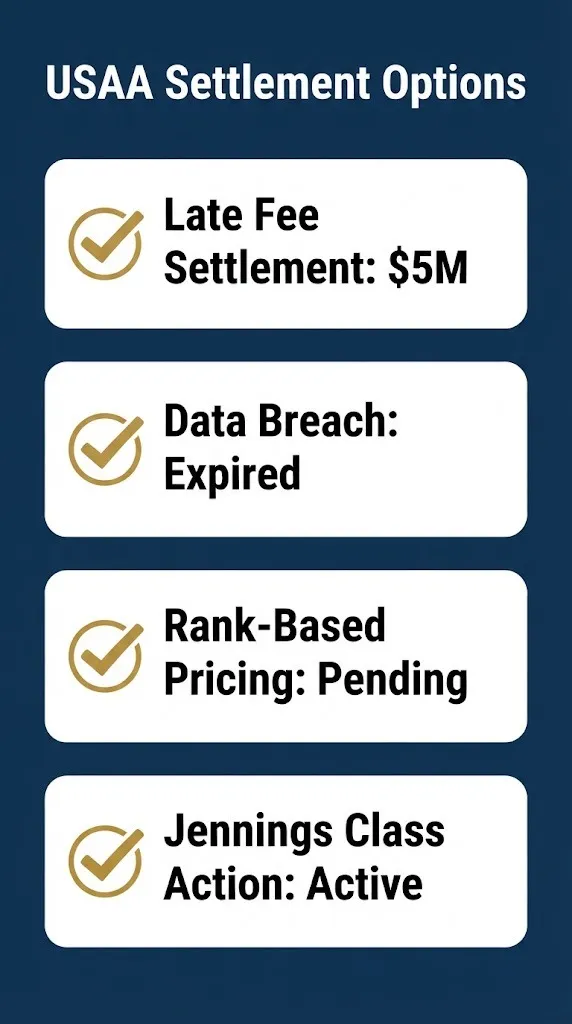
A federal court records report from March 2026 lists Jennings et al v. USAA Casualty Insurance Company with a pending motion for class certification, described as complex with voluminous briefs and awaiting additional materials .
A new case, Meier v. USAA General Indemnity Company, was filed in Arizona federal court in September 2026. The docket shows a Notice of Settlement filed on September 17, 2026, indicating the parties reached an agreement .
Coleman v. United Services Automobile Association is the rank-based pricing case now before the California Supreme Court . The Ninth Circuit stayed proceedings pending the state court’s decision.
A patent dispute between USAA and Regions Bank was terminated after the parties settled in March 2026 .
Key Takeaway: Multiple USAA lawsuits remain active. The largest is the rank-based pricing class action affecting nearly 200,000 California policyholders.
What Happens Next
Ongoing: The USAA late fee settlement is in distribution. Current policyholders receive statement credits. Former policyholders receive checks.
Ongoing: The California Supreme Court will decide whether to accept the certified questions in the rank-based pricing case. If accepted, a ruling is expected in 2027.
Pending: The Jennings class certification motion remains under review in federal court.
Filed September 2026: The Meier case in Arizona shows a Notice of Settlement filed September 17, 2026.
Frequently Asked Questions
Is there a USAA class action settlement in 2026?
Yes. A $5 million settlement over late fees received final approval on April 28, 2026. Payments are being distributed to class members.
How much is the USAA late fee settlement worth?
The settlement fund is $5 million. Each class member receives a minimum $5, plus a proportional share based on their late fee history.
Who qualifies for the USAA late fee settlement?
All individuals who received late fee refunds per the Consent Order are class members. This includes current and former USAA policyholders.
When is the deadline to claim USAA settlement money?
The opt-out deadline was March 30, 2026. Class members did not need to file a claim. Payments are automatic.
What is the USAA rank-based insurance lawsuit about?
The lawsuit alleges USAA charged enlisted military members higher auto insurance rates than officers. Nearly 200,000 California policyholders are affected.
Did USAA settle a data breach lawsuit?
Yes. A $3.25 million data breach settlement had a claim deadline of April 7, 2025. That settlement has expired.
How do I know if I am a class member?
If you received a late fee refund from USAA per the Consent Order, you are likely a class member. Check your USAA account statements for a “Late Fee Litigation Credit.”
Can I still file a claim for the USAA data breach settlement?
No. The claim deadline was April 7, 2025. That settlement is closed.