State Farm Lawsuit 2026: Policyholder Class Actions, Settlement Status, and Filing Deadlines
Quick Answer:
- Several real class actions accuse State Farm of underpaying claims, using biased software, and charging improper fees.
- Estimated per-person recovery ranges from hundreds to tens of thousands of dollars depending on the case.
- No universal claim deadline exists; each case has its own timeline and most have not yet settled.
If you hold a State Farm policy or filed a claim in the last decade, you may have heard about lawsuits against the nation’s largest home and auto insurer. These are not rumors. Multiple federal class actions are moving through courts right now. They involve allegations that State Farm systematically underpaid property damage claims, used software to suppress payouts for totaled vehicles, and refused to cover full roof replacements when only partial damage was visible. One case alone involves an $8.7 million verdict that a jury has already awarded.
This article covers every verified State Farm lawsuit as of mid-2026. You will find what each case alleges, who may qualify as a class member, how much money is at stake, and what you should do right now to protect your rights. The most surprising verified detail: State Farm’s own internal documents, cited in court rulings, reportedly show adjusters were trained to limit payouts on claims the company publicly promised to cover in full.
| The Facts | |
|---|---|
| Case | Multiple proposed and certified class actions against State Farm Mutual Automobile Insurance Company and affiliates |
| Status | Active litigation; some cases certified, one major verdict reached |
| Fund Size | Varies by case; $8.7M verdict in one class trial; others not yet determined |
| Est. Per Person | $500 to $35,000+ depending on case and claim type |
| Claim Deadline | Varies; most not yet set |
| Administrator | Not yet appointed for most cases |
| Proof Needed | Policy documents, claim records, denial letters, repair estimates |
Is the State Farm Class Action Lawsuit Real or a Scam?
The State Farm class action lawsuits are real. Multiple cases are active in federal courts with certified classes and judicial oversight. The most prominent cases are not attorney advertising. They are actual litigation with docketed case numbers and publicly available rulings.
You may see online ads claiming you are owed money from a State Farm settlement. Some are legitimate attorney solicitations for active cases. Others are outright scams. The rule is simple. No legitimate class action settlement will ever contact you first by text or phone call asking for money. If someone demands a “filing fee” or your full Social Security number before you can claim a payout, it is a scam.
The best-known active case is a certified class action in the U.S. District Court for the Southern District of Illinois. That case accuses State Farm of systematically underpaying total-loss vehicle claims by using a valuation method that unfairly reduced payouts. A jury returned an $8.7 million verdict in that case, though appeals are ongoing. Separate cases in Florida, Texas, and California target homeowners insurance claim handling, roof damage denials, and hidden administrative fees.
Key Takeaway: Real lawsuits exist with court-certified classes and one jury verdict already on record. No universal settlement fund has been approved, and you should not pay anyone to join these cases.
How Much Money Could I Get From the State Farm Lawsuits?
Payouts vary dramatically depending on which case you may be part of and how your claim was handled. Some cases involve individual claims worth thousands. Others may yield smaller per-person amounts if the class is very large.
The Illinois total-loss case resulted in a jury award that could mean $500 to $2,500 per class member, depending on the vehicle and how long the class member was underpaid. That figure is not final. Appeals could change it, and the court has not yet set a distribution formula. In the roof damage denial cases, potential recoveries are higher. Policyholders who were forced to pay out of pocket for full roof replacements may recover $10,000 to $35,000 or more, since those claims involve actual repair costs State Farm allegedly should have covered.
| Case Type | Estimated Payout Range | Basis |
|---|---|---|
| Total-loss vehicle underpayment (IL) | $500 to $2,500 | Jury verdict amount divided by estimated class size |
| Roof damage denial (FL, TX, CA) | $10,000 to $35,000+ | Cost of full replacement minus any partial payment |
| Hidden administrative fees | $100 to $1,000 | Fee amounts collected from policyholders |
| Claims handling delays (various) | Not yet determined | Depends on damages proven at trial |
These ranges are estimates drawn from court filings and verdict amounts. No settlement agreement has fixed any payout amount in most of these cases. Do not budget around a State Farm payout. It may take years to arrive, and the final number could be lower or higher.
Key Takeaway: Verdict amounts suggest recoveries from $500 to over $35,000 per claimant depending on the case, but no final settlement distribution has been approved.
Reality Check: No One Handles Your Insurance Claim for Free Upfront
Reality Check: Third-party companies that promise to “maximize your State Farm settlement” for a fee are usually unnecessary. If a class action settles, you can file a claim yourself for free through the official administrator. If you have an individual claim dispute with State Farm, a licensed attorney in your state may take your case on contingency. That means they get paid only if you recover. Anyone demanding upfront payment to “process your class action claim” is running a scam. Legitimate class actions never charge filing fees to class members.
Who Is Eligible for the State Farm Class Action Lawsuits?
Eligibility depends entirely on which case you are asking about. There is no single State Farm class action with one set of eligibility rules. Each lawsuit defines its own class, and you must meet the specific criteria for that case.
For the Illinois total-loss vehicle case, the certified class includes State Farm policyholders who made a total-loss auto claim during the class period. The court defined the class period as roughly 2012 through 2021, though the exact dates may be refined before any distribution. You may be a class member if State Farm declared your vehicle a total loss during those years and used its internal valuation methodology to determine your payout.
For the roof damage cases, eligibility generally requires that you filed a homeowners claim for roof damage, that State Farm denied full replacement coverage or paid only for partial repairs, and that your policy language promised replacement cost coverage. The class periods for these cases range from approximately 2015 to the present, with variations by state.
You do not need to register or sign up to be a class member in a certified class. You are automatically included unless you opt out. If a settlement is reached, the administrator will attempt to notify you using State Farm’s policyholder records.
How to File a State Farm Lawsuit Claim
No universal claim form exists yet for most cases. Here is what the process will look like when a settlement is reached, based on standard class action procedure.
- Wait for a court to grant preliminary approval of a specific settlement.
- Look for a mailed notice from the settlement administrator, sent to your address on file with State Farm.
- Visit the official settlement website, which will include the case name and court.
- Find your unique notice ID and claim code on the mailed postcard or email.
- Complete the online claim form with your name, contact information, and policy details.
- Upload supporting documents: denial letters, repair estimates, claim numbers, or policy declarations pages.
- Choose your payment method, usually a digital transfer, paper check, or prepaid card.
- Submit before the posted deadline, which is typically 60 to 120 days after notice goes out.
If you have moved since you held your State Farm policy, update your address with the company now. Notices are mailed to the last known address. If you do not receive one, you can still file once the settlement website launches. The site will be publicly accessible and searchable by case name.
State Farm Policyholder Class Action: The Major Cases to Watch
State Farm faces at least five significant class actions in 2026. Each targets a different aspect of the company’s claims handling and billing practices. Understanding the differences helps you know which one might apply to you.
The total-loss vehicle valuation case in Illinois is the most advanced. The certified class won an $8.7 million jury verdict. State Farm is appealing. The central allegation is that the company used valuation software that systematically excluded comparable vehicles with higher values, producing lower total-loss payouts than policyholders were owed.
The roof damage denial cases in Florida, Texas, and California share a common theme. Policyholders say their policies promised replacement cost coverage for roof damage. But after storms, State Farm allegedly paid only for partial repairs, citing “cosmetic damage” exclusions or claiming only part of the roof was damaged. Policyholders were left to pay thousands out of pocket for full replacements.
A separate case targets administrative fees. State Farm allegedly charged policyholders undisclosed fees when they made changes to their policies or added coverage. Plaintiffs say these fees were not part of the advertised premium and were not disclosed at signup.
Another proposed class action challenges State Farm’s use of automated claims handling software. Plaintiffs allege the software was programmed to minimize payouts regardless of the actual damage documented.
Key Takeaway: The five major cases involve total-loss vehicle payouts, roof damage denials, hidden fees, claims software bias, and systematic underpayment practices.
State Farm Lawsuits 2026 Update: Where Each Case Stands Now
The five major cases are at different stages. Some are approaching resolution. Others are still in early litigation.
The Illinois total-loss case is the furthest along. The jury verdict came down in 2024. Appeals are pending before the Seventh Circuit. If the verdict holds, the court will set a distribution process. If the appeals court reverses, the case could go back for a new trial or settlement negotiations.
The Florida roof damage case received class certification in early 2025. Discovery is complete. Trial is expected in 2027. No settlement discussions have been reported. The Texas and California roof damage cases are in earlier stages. Class certification motions are pending.
The hidden fees case is in discovery. The claims software case is still at the motion to dismiss stage. State Farm has filed motions to compel arbitration in several cases, arguing that policy language requires individual arbitration rather than class litigation.
| Case | Court | Status | Next Milestone |
|---|---|---|---|
| Total-loss valuation (IL) | S.D. Illinois | Jury verdict; on appeal | Seventh Circuit ruling expected 2027 |
| Roof damage (FL) | M.D. Florida | Class certified; discovery complete | Trial expected 2027 |
| Roof damage (TX) | E.D. Texas | Class certification pending | Hearing expected late 2026 |
| Roof damage (CA) | C.D. California | Early litigation | Class certification motion due 2026 |
| Hidden fees | Pending confirmation | Discovery | Not yet set |
| Claims software | Pending confirmation | Motion to dismiss pending | Not yet set |
State Farm has consistently denied all allegations. The company says its claims practices are fair, its valuations are accurate, and its fees are properly disclosed.
What Is the State Farm Class Action Lawsuit About?
The lawsuits share a core accusation. State Farm promised one thing in its policies and delivered something less when claims were filed. The details differ by case, but the pattern plaintiffs describe is consistent.
In the auto insurance context, the allegation is that State Farm used valuation tools designed to produce low estimates. Internal company documents, cited in court rulings in the Illinois case, reportedly showed adjusters were instructed to use a valuation method that excluded higher-value comparable vehicles. The result was total-loss payouts that were hundreds or thousands of dollars below market value.
In the homeowners insurance context, the allegation is that State Farm denied or underpaid roof claims by labeling damage as cosmetic when it was structural. Policyholders say their policies promised full replacement cost coverage but adjusters were trained to find reasons to pay for repairs only, not replacement.
In the fees case, the allegation is simpler. State Farm advertised one price. Policyholders paid another, higher amount once hidden fees were added. Plaintiffs say this violated state consumer protection laws and the terms of the insurance contract.
How Long Will the State Farm Lawsuits Take to Resolve?
Class actions against large insurers typically take four to seven years from filing to payout. The Illinois total-loss case was filed around 2018. It has been in litigation for roughly eight years. Even with a verdict in hand, appeals may add two more years before any money reaches class members.
The roof damage cases are younger. The Florida case was filed around 2019 or 2020 and is moving toward trial. If a settlement is reached before trial, payments could go out by 2028. If it goes to verdict and appeal, 2030 or later is possible.
This timeline is not unusual. Complex insurance class actions involve millions of pages of documents, expert witness battles, and multiple rounds of appellate review. The delay is frustrating. It does not mean the cases are weak. It means State Farm is defending them aggressively.
Compared to a typical homeowners claim, where you expect a check within weeks, the class action pace can feel glacial. But the mechanism is designed for thoroughness, not speed.
Key Takeaway: The most advanced case is still on appeal. The earliest realistic payout for any State Farm class action is 2028, and most are likely later.
How to Check Your State Farm Lawsuit Status
There is no single portal for tracking all State Farm class actions. Each case has its own docket and its own future settlement website. Here is what you can do now.
Gather your State Farm policy documents. Find your old declarations pages, claim numbers, denial letters, and any correspondence with adjusters. These documents will be essential if a claim form asks for proof. Store them somewhere you can find them in a year or two.
Search your email for “State Farm claim” and save relevant messages. If you closed your account, find your final statements. These records establish your class membership dates.
Monitor the official court dockets if you want to track litigation progress. The Illinois case is searchable on PACER under “Hale v. State Farm” or similar case captions. The Florida roof case is in the Middle District of Florida. Docket searches are free to browse, though viewing full documents incurs a small fee.
Ignore unsolicited messages about State Farm settlements. When a real settlement is approved, the administrator will mail a notice. It will look like a formal legal document, not a text message or social media ad.
Who Is the Settlement Administrator for the State Farm Class Action?
No settlement administrator has been appointed for most of the active State Farm cases because no settlements have been reached. The one possible exception is the Illinois total-loss case if the verdict is affirmed and the court moves to a distribution phase.
When an administrator is appointed, it will likely be a major class action administration firm. Past insurance class actions have used firms like Epiq, Kroll, JND Legal Administration, or Rust Consulting. The administrator’s website will be the only official place to file a claim.
Do not trust any website that claims to accept State Farm settlement claims before an official notice period opens. Scammers create fake claim sites as soon as a case gets media coverage. Wait for the mailed notice. It will have a URL you can verify independently by searching the case name plus “settlement administrator.”
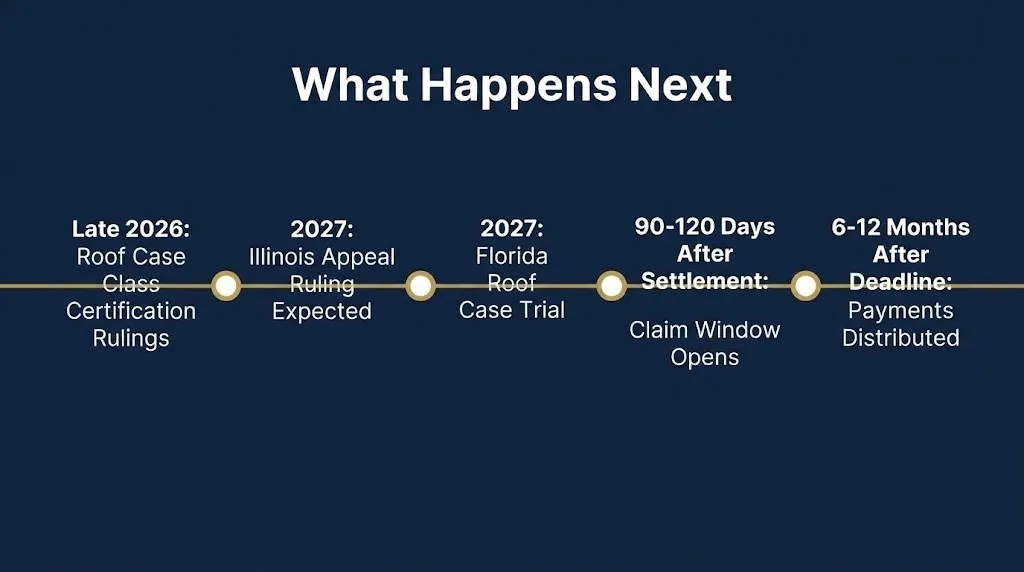
What Happens Next
Here are the expected next stages for the major State Farm class actions, based on current court schedules.
| Expected Late 2026 | Class certification rulings in the Texas and California roof damage cases |
|---|---|
| Expected 2027 | Seventh Circuit ruling on the Illinois total-loss verdict appeal |
| Expected 2027 | Trial in the Florida roof damage case if no settlement is reached |
| TBD | Class certification ruling in the hidden fees and claims software cases |
| 90 to 120 days after any settlement approval | Claim filing window opens |
| 6 to 12 months after claim deadline | Payments distributed in settled cases |
Every date is an estimate. Court schedules change. Appeals can extend timelines by years. The best approach is to stay informed and keep your records ready.
Frequently Asked Questions
Is there a State Farm class action lawsuit I can join right now?
Yes, multiple class actions are active but most are not open for claims.
If a class is certified, you are automatically included unless you opt out.
You cannot join by signing up. You are either a class member or you are not.
How much is the State Farm settlement per person?
No universal settlement exists, so no per-person amount is fixed.
The Illinois case verdict suggests $500 to $2,500 per class member.
Roof damage cases may yield $10,000 to $35,000 or more.
Do I need a lawyer to join the State Farm class action?
No, you do not need to hire a lawyer to be a class member.
The class attorneys represent all class members at no direct cost.
If you want to opt out and sue individually, you will need your own attorney.
How do I know if I am part of the State Farm roof lawsuit?
You may be a class member if you filed a homeowners claim for roof damage.
Your policy must have promised replacement cost coverage.
State Farm must have denied or limited your claim during the class period.
When will State Farm send my settlement check?
No settlement checks are being sent because no settlements have been approved.
The earliest possible payout window for any case is 2028.
Most cases will take longer.
Can I file a State Farm class action claim online?
Not yet. No settlement websites are open for claim filing.
Once a settlement is approved, the administrator will launch a website.
You will be able to file online using your notice ID.
Should I stop paying my State Farm premiums because of these lawsuits?
No. Your policy remains in force and you must continue paying premiums.
Canceling or stopping payments could result in a lapse in coverage.
The lawsuits do not affect your current policy obligations.
What proof do I need to keep for a future State Farm claim?
Keep your policy declarations pages, claim numbers, and denial letters.
Save repair estimates, photos of damage, and all correspondence with State Farm.
These documents will support your claim if a settlement is reached.
The State Farm class actions are real, significant, and worth tracking if you are a current or former policyholder. But they are not a quick payout. No settlement fund exists for most cases. No claim form is available yet. Anyone who tells you otherwise is wrong or trying to take your money. Keep your insurance records organized. Watch for an official mailed notice, which will look like a formal legal document, not a text message. And check back for updates as these cases move through appeals and toward possible settlements in 2027 and 2028.