Hurricane Claims Lawsuit 2026: Deadlines, Denials, and How to Fight Back
Quick Answer
- What is it? A lawsuit filed by a policyholder against an insurer for denying, underpaying, or delaying a hurricane damage claim.
- How much can you get? Not yet determined. Awards depend on policy limits, damages, and whether bad faith is proven.
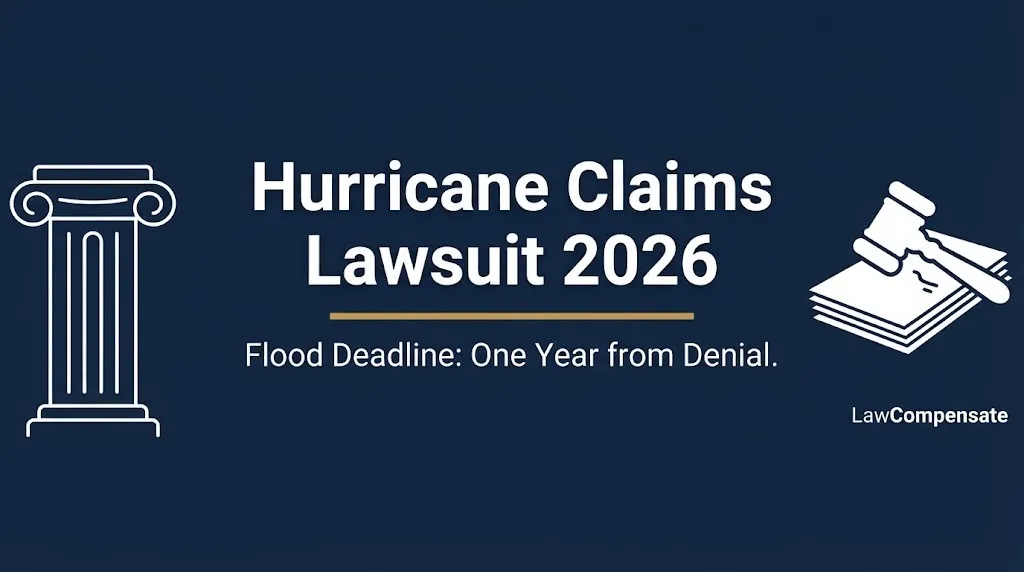
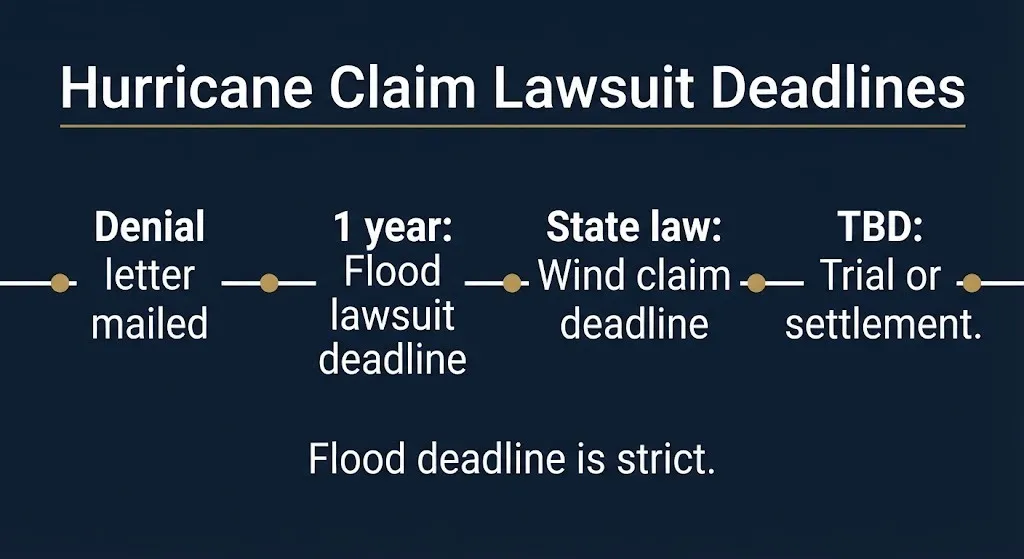
- Key deadline: Flood claims: one year from the partial denial letter. Wind claims: varies by state, often one to five years.
If a hurricane damaged your home and your insurer underpaid or denied your claim, you have legal options. But the deadlines are brutal, and courts enforce them strictly.
The hurricane claims lawsuit landscape in 2026 is crowded. Cases range from a $9.8 million judgment for a Hurricane Michael policyholder to a RICO class action against the Texas Windstorm Insurance Association alleging that estimates were secretly slashed by 66% . On the defense side, insurers are suing policyholders for alleged fraud, including a $29 million Hurricane Ian claim that Princeton Excess wants voided .
This article breaks down how hurricane claims lawsuits work in 2026, what deadlines you face, how to fight a denial, and what separates a strong case from one that gets dismissed on procedural grounds.
The Facts
| Item | Detail |
|---|---|
| Common Defendant | Insurers, WYO flood carriers, state-backed insurers like TWIA and Citizens |
| Common Claims | Breach of contract, bad faith, unfair settlement practices, RICO |
| Flood Claim Deadline | 1 year from partial denial letter (42 U.S.C. § 4072) |
| Wind Claim Deadline | Varies by state and policy |
| Recent Verdict | $9.8 million for insured in Hurricane Michael case |
| Recent Class Action | RICO suit against TWIA over Beryl estimate cuts |
Is a hurricane claims lawsuit worth filing?
A hurricane claims lawsuit is worth filing when your insurer denied or underpaid a valid claim, and you filed within the deadline. The value depends on your damages and whether you can prove the insurer acted in bad faith.
Not every dispute is worth litigating. If the gap between the offer and your damages is small, the cost of litigation may exceed recovery. But when insurers systematically underpay, lawsuits are the only leverage.
Recent cases show the stakes:
- A federal judge entered a $9,817,232.97 judgment for an insured in a Hurricane Michael coverage dispute, severing a bad faith claim so it could proceed separately .
- A Texas apartment owner sued Topa Insurance for more than $2.4 million in underpaid Hurricane Beryl damages, alleging the insurer’s adjuster inspected only one of eight buildings .
- A Miami Beach hotel operator sued its insurer for mishandling a Hurricane Irma claim .
The common thread: insurers often make initial offers far below what policies actually cover.
Key Takeaway: A lawsuit makes sense when the denial or underpayment is substantial and you filed on time.
How much can you recover in a hurricane claims lawsuit?
Recovery depends on your policy limits, proven damages, and whether bad faith is established. There is no standard amount.
| Claim Type | What It Covers |
|---|---|
| Breach of Contract | Unpaid policy benefits, up to policy limits |
| Bad Faith | Extra-contractual damages, sometimes multiplied |
| Unfair Settlement Practices | Statutory penalties, attorney fees |
| RICO | Treble damages if pattern of fraud proven |
In Texas, the Prompt Payment of Claims Act allows 18% interest on overdue claims . Florida’s bad faith statute allows recovery beyond policy limits in some cases.
The $9.8 million judgment shows what’s possible when damages are well-documented . But most cases settle for less than the demand.
Key Takeaway: Recovery varies. Policy limits cap contract damages, but bad faith and statutory claims can exceed them.
How do you file a hurricane claims lawsuit?
You file a hurricane claims lawsuit by consulting an attorney, documenting your damages, and filing in the correct court before the deadline. The specific steps depend on whether your claim is flood or wind.
For flood insurance (NFIP policies):
- Review your denial letter. The one-year clock starts from the date of mailing .
- Appeal to FEMA if you disagree with the denial.
- File suit in the U.S. District Court where the property is located, within one year of the denial .
- You cannot recover attorney fees for flood claims under NFIA .
For windstorm/homeowners claims:
- Document everything. Get independent estimates.
- Demand appraisal if your policy has an appraisal clause.
- File suit in state or federal court depending on jurisdiction and amount.
- Deadlines vary. Florida allows one year for new claims, 18 months for supplemental .
Key Takeaway: Flood claims have a strict one-year federal deadline. Wind claims follow state rules.
What is the flood insurance lawsuit deadline?
The deadline for flood insurance lawsuits is one year from the date of mailing of the partial or full denial letter. This is set by 42 U.S.C. § 4072 and cannot be extended .
Courts enforce this strictly. A Hurricane Helene flood claim was dismissed in May 2026 because the homeowner filed suit on March 10, 2026, more than one year after the January 17, 2025 partial denial . The court wrote that “the math is simple and unforgiving” .
Another case, Potter-Martino v. ABIC, was dismissed with prejudice because the plaintiff filed in state court on January 20, 2026, and the case was removed to federal court on February 23, 2026, more than one year after the February 4, 2025 denial . Filing in state court does not toll the deadline .
Key Takeaway: For flood claims, one year from the denial letter is absolute. File in federal court, not state.
Can you sue for bad faith in a hurricane claim?
Yes, you can sue for bad faith in most states, but the rules vary and the burden is higher than breach of contract.
Bad faith claims allege the insurer unreasonably denied or delayed payment. In Louisiana, the Reynolds-Stevens case shows how courts scrutinize these claims. The Fifth Circuit affirmed summary judgment for the insurer, finding that the denial was based on legitimate coverage questions about pre-existing damage from a prior hurricane .
In Texas, the GKS Enterprises v. Topa case includes claims under the Texas Unfair Settlement Practices Act and the Prompt Payment of Claims Act . The plaintiff seeks three times actual damages plus 18% interest.
In Florida, bad faith claims often proceed separately from breach of contract claims. The $9.8 million judgment was entered on contract so the bad faith claim could proceed as its own case .
Key Takeaway: Bad faith requires showing the insurer acted unreasonably. It’s harder than proving breach of contract but can yield higher damages.
What is the TWIA lawsuit about?
The TWIA lawsuit alleges the Texas Windstorm Insurance Association secretly cut Hurricane Beryl claim estimates by up to 66% and hid who made the changes .
Three Galveston-area homeowners filed a federal RICO class action in August 2026. The complaint alleges a field adjuster built an estimate in Xactimate, then a reviewer who never visited the property took control and reduced it. The lower estimate was sent to the homeowner bearing the field adjuster’s name .
Examples from the complaint:
- One estimate fell from $90,948.48 to $30,816.74, a 66% cut .
- Another dropped from $55,406.38 to $31,012.95, a 44% reduction .
- A third went from $22,463.85 to $10,389.31, a 54% cut .
TWIA has reported paying $336 million to about 34,000 Beryl policyholders . The lawsuit alleges the practice “may have wrongfully withheld hundreds of millions of dollars” .
Key Takeaway: The TWIA case is about alleged systematic fraud, not individual disputes. It seeks class certification and treble damages.
What is the Louisiana Citizens class action?
The Louisiana Citizens class action resolved claims from Hurricanes Katrina and Rita, with a final set of claims approved in 2026 after decades of litigation .
The class action settled in 2013, establishing a claims-made process administered by a Special Master. Valid claims receive $4,500 from Citizens .
In 2026, the Louisiana Fifth Circuit denied Citizens’ writ application challenging the Special Master’s final determinations on Submission “R,” the 18th and final batch of claims . The court found no basis to disturb the Special Master’s rulings.
This case is a reminder that hurricane litigation can span decades.
Key Takeaway: The Citizens class action is nearly resolved. Valid claims receive $4,500.
Reality Check
A denial letter is not the end of your claim, but it does start a clock. For flood claims, you have exactly one year from the denial date to file in federal court. Missing that deadline means dismissal, no matter how valid your claim. For wind claims, deadlines vary by state. If your insurer underpaid, get an independent estimate and consult an attorney before the deadline passes. And no one needs to pay a fee to file a lawsuit.
What happens next in hurricane claims litigation?
Ongoing: TWIA RICO class action in Texas. Motion to dismiss likely .
Ongoing: GKS Enterprises v. Topa in Texas. Discovery .
Ongoing: Princeton v. Aspen FM fraud case in Florida. Early stages .
TBD: Louisiana Citizens final claim distributions .
TBD: Individual policyholder lawsuits across Gulf Coast states.
Frequently Asked Questions
How long do I have to sue my flood insurance company?
One year from the date of mailing of the partial or full denial letter. This deadline is strict and cannot be extended .
Can I sue for hurricane damage if my claim was denied?
Yes, if you file within the deadline. Flood claims go to federal court. Wind claims follow state rules.
What is a bad faith insurance claim?
A bad faith claim alleges the insurer unreasonably denied or delayed a valid claim. It can yield damages beyond policy limits.
What is the TWIA lawsuit about?
A RICO class action alleging TWIA secretly reduced Hurricane Beryl claim estimates by up to 66% and hid the changes .
How much did the Hurricane Michael verdict award?
A federal judge entered a $9.8 million judgment for the insured in a Hurricane Michael coverage dispute .
Can I recover attorney fees in a flood insurance lawsuit?
No. Attorney fees are not available for flood claims under the National Flood Insurance Act .
What is the Louisiana Citizens class action?
A settled class action from Hurricanes Katrina and Rita. Valid claims receive $4,500 .
What should I do if my hurricane claim was underpaid?
Get an independent estimate, review your denial letter for the deadline, and consult an attorney promptly.
If your hurricane claim was denied or underpaid, act fast. The flood claim deadline is one year from the denial letter. For wind claims, check your state’s statute of limitations. Document everything, get independent estimates, and consult an attorney before the deadline passes. The single most important fact: the one-year flood deadline is unforgiving, and courts dismiss late claims without exception.