Getting Rear-Ended While Stopped Settlement 2026: Payout Ranges, Claim Steps, and What Insurers Don’t Tell You
Quick Answer
- What this is: A personal injury claim against the at-fault driver’s insurer, not a class action settlement with a claim form and deadline.
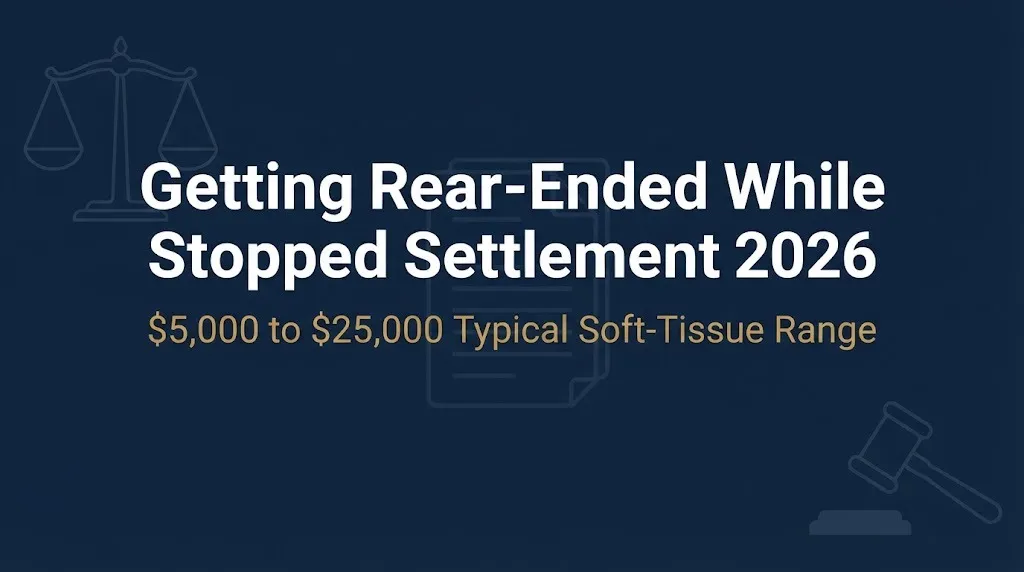
- How much: Soft-tissue cases often settle for $5,000 to $25,000; herniated discs can reach $50,000 to $150,000, depending on medical proof and policy limits.
- Deadline: Your state’s statute of limitations controls, commonly 2 to 3 years from the crash date, but waiting hurts your case.
If you were sitting at a red light and someone slammed into your bumper, the law is mostly on your side. A rear-end collision with a stopped vehicle establishes a presumption of negligence against the rear driver in most states. That legal head start doesn’t guarantee a fair offer, though. Insurance adjusters still try to minimize payouts, and the gap between what they offer first and what your claim is actually worth can be enormous.
This guide covers what you can recover, how settlement value gets calculated, what steps to take now, and the traps that cost injured drivers thousands. It’s built from court opinions, insurance claim data, and attorney-reported settlement ranges, not marketing spin. One detail that surprises most people: the first offer is almost never the final offer, and accepting a check can end your right to pursue more money forever.
The Facts
| Case | Individual insurance claim or personal injury lawsuit (no single class action) |
|---|---|
| Status | Active claims filed daily; no global settlement |
| Fund Size | Varies by case; at-fault driver’s policy limits control |
| Est. Per Person | $5,000 to $25,000 (soft tissue) up to $150,000+ (serious injury) |
| Claim Deadline | State statute of limitations, commonly 2 to 3 years |
| Administrator | The at-fault driver’s insurance company |
| Proof Needed | Police report, medical records, photos, repair estimates |
Key Takeaway: There’s no class action to join, no administrator to call, and no universal claim deadline. Your case is individual, and the at-fault driver’s insurance policy limit is the ceiling unless you sue the driver personally.
Is a Getting Rear-Ended While Stopped Settlement Legit or a Scam?
A getting rear-ended while stopped settlement is legitimate, but it’s not a class action payout and no one will text you a claim code. This is a liability insurance claim against the driver who hit you. Scammers sometimes exploit confusion around “settlement” language, sending fake texts or emails claiming you have unclaimed money from a crash. Real settlements come from insurance adjusters, not random messages.
The legitimate path starts when you file a claim with the at-fault driver’s insurer. They investigate, you provide medical records and proof of damages, and they make an offer. If negotiations stall, you can file a lawsuit. Court records show these cases move through state courts constantly, with some appellate decisions reinforcing that a rear driver who hits a stopped car bears the burden of proving they weren’t negligent .
One caveat: if the at-fault driver has minimum coverage, your recovery may be capped at a low number. Many states require only $10,000 to $25,000 in bodily injury liability coverage per person . If your injuries exceed that, your own uninsured/underinsured motorist coverage becomes the next source of recovery.
How Much Can You Get From a Rear-End Settlement in 2026?
Settlement amounts depend heavily on injury severity, medical documentation, and available insurance coverage. There is no universal average, but attorney-reported ranges give a realistic picture .
| Injury Type | Typical Settlement Range |
|---|---|
| Minor soft tissue (resolves in weeks) | $2,500 to $10,000 |
| Whiplash with ongoing symptoms | $15,000 to $75,000 |
| Sprains and strains | $2,000 to $25,000 |
| Herniated disc (no surgery) | $50,000 to $150,000 |
| Herniated disc (with surgery) | $100,000 to $500,000+ |
| Traumatic brain injury | $150,000 to $1,000,000+ |
| Broken bones | $40,000 to $200,000 |
| Permanent disability | $500,000 to $3,000,000+ |
These ranges assume clear liability and strong medical evidence. Gaps in treatment, pre-existing conditions, or disputed fault can drop the value significantly. Insurers also apply a pain-and-suffering multiplier, often 1.5 to 5 times your medical expenses, then adjust for fault and policy limits .
Key Takeaway: The single biggest factor in your settlement is the quality and consistency of your medical records. A documented herniated disc with surgery recommendations is worth many times more than vague neck pain with no treatment plan.
What Factors Determine Your Settlement Value?
Settlement value is calculated by adding economic damages (medical bills, lost wages, property damage) and non-economic damages (pain, suffering, emotional distress), then adjusting for fault and insurance limits. An adjuster doesn’t pick a number from thin air. They use a formula, and your job is to make sure every input is documented .
Medical expenses form the starting point. This includes ER visits, doctor appointments, imaging, physical therapy, prescriptions, and future care. The longer your recovery and the more consistent your treatment, the higher the value.
Lost wages matter, especially if you missed weeks of work. Get a letter from your employer confirming missed days and your pay rate. If your injury affects your long-term earning capacity, an economist may calculate that loss .
Pain and suffering is often the largest component of a rear-end settlement. It compensates for physical pain, emotional distress, and reduced quality of life. Insurers resist paying this category fully, which is why documentation of how the injury disrupted your daily life matters.
Property damage is usually straightforward: repair estimates, rental car costs, and diminished value claims if applicable.
Comparative fault can reduce your payout. If you’re found partially at fault, your recovery drops by that percentage in most states . In a pure rear-end-while-stopped case, comparative fault is rare, but insurers sometimes argue you stopped too abruptly or had faulty brake lights.
Who Is at Fault When You’re Rear-Ended While Stopped?
The rear driver is presumed at fault in most rear-end collision cases, especially when the front vehicle was stopped or stopping. Courts in New York and other states have repeatedly held that a rear-end collision with a stopped vehicle establishes a prima facie case of negligence, shifting the burden to the rear driver to provide a non-negligent explanation .
That presumption is strong but not absolute. A rear driver can try to rebut it by claiming the front driver stopped suddenly without reason, had broken brake lights, or reversed. Appellate courts have generally rejected the “abrupt stop” defense when the front driver was reacting to traffic conditions .
Comparative fault rules vary by state. Some states bar recovery entirely if you’re more than 50% at fault. Others reduce your award proportionally. In a stopped-vehicle rear-end case, your fault percentage should be zero in most scenarios, but insurers still probe for reasons to assign some blame.
How to File a Claim After Being Rear-Ended While Stopped
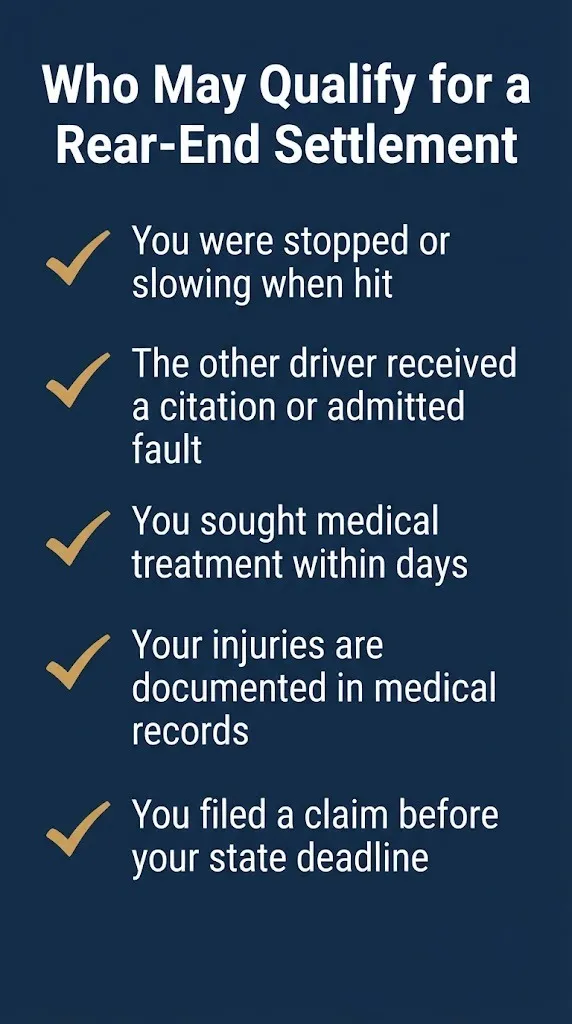
Filing a claim means notifying the at-fault driver’s insurer and providing documentation to support your damages. Do this promptly, even if you feel fine at first. Symptoms from whiplash and soft tissue injuries often appear hours or days later .
- Report the accident to the at-fault driver’s insurance company. Give them the facts, but don’t discuss your injuries or give a recorded statement without understanding the risks.
- Notify your own insurer as well. Your policy may require prompt notice, and your uninsured/underinsured coverage may come into play later.
- Gather documentation including the police report, photos of damage, medical records, bills, and wage loss verification.
- Seek medical attention and follow your treatment plan. Gaps in care give insurers ammunition to argue your injuries aren’t serious.
- Don’t accept the first offer. Initial offers are typically low and may not account for future medical needs or pain and suffering.
- Negotiate with documentation. Present a demand package that ties every dollar to a record or bill.
- Consider an attorney if liability is disputed, injuries are serious, or the insurer refuses to negotiate fairly.
Key Takeaway: Filing is free. You don’t need to pay anyone to open a claim. Third-party “claim helpers” charging upfront fees are unnecessary for a straightforward rear-end claim.
Reality Check: What Insurance Adjusters Won’t Tell You
Reality Check: No legitimate settlement process requires you to pay money upfront to receive a payout. If someone texts or calls demanding a fee to “release” your settlement funds, it’s a scam. Also, cashing a check from an insurer often means signing a release that ends your claim forever. Once you sign, you cannot go back for more money even if your injury turns out worse than expected .
How Long Does a Rear-End Settlement Take?
Most straightforward rear-end cases settle within 3 to 6 months after you finish medical treatment. The timeline depends on how long your recovery takes and whether liability is disputed .
| Case Type | Estimated Timeline |
|---|---|
| Minor soft tissue, clear liability | 3 to 6 months after treatment ends |
| Moderate injuries, ongoing care | 6 to 12 months |
| Severe injuries, surgery, long-term rehab | 1 to 2 years |
| Cases that go to litigation | 18 months to 3+ years |
The biggest variable is treatment duration. Attorneys typically won’t finalize a demand until you reach maximum medical improvement, because they need to know the full extent of your injuries. Once a settlement is agreed, payment often arrives within 2 to 6 weeks, with checks issuing 10 to 21 business days after you sign the release .
What Happens Next: Timeline for Your Claim
Now to 30 days: File the claim, document everything, begin medical treatment if needed.
Months 2 to 6: Continue treatment, collect records, and reach maximum medical improvement.
After treatment ends: Submit a demand package with all documentation. Insurer responds within 30 days typically.
Negotiation phase: Expect back-and-forth. Most cases settle after one or two counteroffers.
Settlement and payment: Sign the release, receive payment within 2 to 6 weeks.
If no agreement: File a lawsuit before the statute of limitations expires. Litigation adds 18 months to 3 years.
Frequently Asked Questions
Is the rear driver always at fault when they hit me while I’m stopped?
The rear driver is presumed at fault, but they can try to rebut it with evidence of an abrupt stop, faulty brake lights, or other factors. In most stopped-vehicle cases, the presumption holds.
Can I get a settlement if I wasn’t injured?
Yes, but only for property damage and related costs. Pain and suffering and medical expenses require documented injuries. Without medical treatment, your settlement will be limited to vehicle repair and rental costs.
How much is my whiplash claim worth?
Whiplash settlements range from $2,500 for mild cases to $30,000 or more for severe cases with ongoing treatment and long-term effects . The value depends on treatment duration, documentation, and whether symptoms persist.
Should I give a recorded statement to the other driver’s insurance?
No, you’re not required to give a recorded statement to the at-fault driver’s insurer. Anything you say can be used to minimize your claim. Provide the facts in writing or through your attorney.
What if the at-fault driver has no insurance?
Your own uninsured motorist coverage may apply. If you don’t have UM coverage, you may need to sue the driver personally, though collecting from an uninsured driver is often difficult.
Do I need a lawyer for a rear-end settlement?
Not always. Clear liability, minor injuries, and cooperative insurers can settle without an attorney. But if liability is disputed, injuries are serious, or the insurer makes a lowball offer, an attorney can often increase the net recovery even after fees.
How long do I have to file a claim?
The statute of limitations varies by state, commonly 2 to 3 years from the accident date. Waiting risks losing your right to recover entirely.
Can I settle and then reopen my claim if I find more injuries?
No. Once you sign a release and accept payment, your claim is closed permanently. That’s why it’s critical to wait until you know the full extent of your injuries before settling.