Sutter Health Premium Lawsuit 2026: Status, Allegations, and Consumer Impact
Quick Answer:
- The Sutter Health premium lawsuit is real, alleging anticompetitive practices that inflated healthcare costs for employers and consumers.
- A $575 million settlement was reached in the main antitrust case, with funds distributed to affected parties.
- Deadlines for the main settlement have passed, but ongoing compliance monitoring continues through 2026 and beyond.
Sutter Health is one of California’s largest healthcare systems. For years, it faced allegations that its contracting practices drove up healthcare premiums and out-of-pocket costs for millions of Californians.
The main antitrust case settled for $575 million, one of the largest healthcare antitrust settlements in California history. But the story does not end there.
This article covers what is verified about the Sutter Health litigation, the settlement terms, who benefited, and what compliance obligations remain. One surprising detail: the settlement included behavioral remedies that reshaped how Sutter contracts with insurers, not just a monetary payout.
The Facts
| Case | UFCW & Employers Benefit Trust v. Sutter Health, et al. |
| Status | Settled, compliance monitoring ongoing |
| Fund Size | $575 million |
| Est. Per Person | Varies by claim type and payer |
| Claim Deadline | Passed for main settlement |
| Administrator | Court-appointed settlement administrator |
| Proof Needed | Insurance records, premium payment documentation |
Is the Sutter Health Lawsuit Real?
The Sutter Health lawsuit is real, with a $575 million settlement approved and paid in one of California’s largest healthcare antitrust cases.
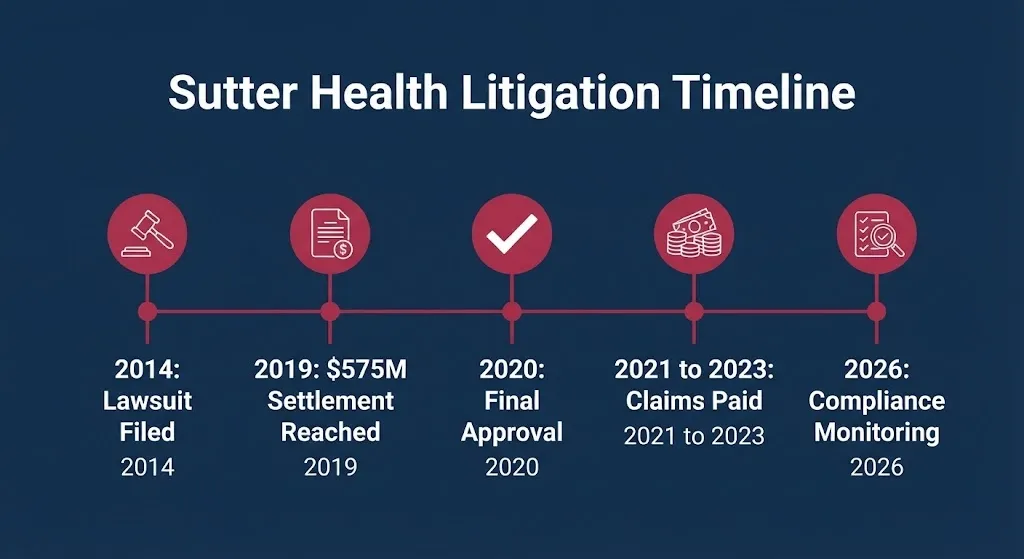
The litigation began in 2014 when the UFCW & Employers Benefit Trust, a union health plan, filed a class action against Sutter Health. The lawsuit alleged that Sutter abused its market power to inflate healthcare prices.
The case was filed in San Francisco Superior Court. It sought damages for employers and consumers who paid inflated premiums and out-of-pocket costs due to Sutter’s contracting practices.
After years of litigation, the parties reached a $575 million settlement in 2019. The court granted final approval, and the settlement became effective.
The monetary settlement resolved the damages claims. A separate settlement with the California Attorney General’s office addressed injunctive relief and behavioral changes.
The case is now in the compliance monitoring phase. Sutter must adhere to specific contracting restrictions through at least 2026.
Key Takeaway: The lawsuit is real, the settlement is paid, and compliance obligations continue.
What Was the Sutter Health Lawsuit About?
The Sutter Health lawsuit alleged that the healthcare system used anticompetitive contracting practices to inflate prices across Northern California.
The core allegation involved all-or-nothing contracting. Sutter allegedly required insurers to include all Sutter facilities in their networks if they wanted any. This practice prevented insurers from negotiating lower prices at individual hospitals.
The lawsuit also alleged price gouging. Sutter’s prices were reportedly 25 to 56 percent higher than comparable hospitals in Northern California. Some studies found even larger disparities for certain procedures.
The plaintiffs argued that these practices violated California’s Cartwright Act, the state’s antitrust law. The practices allegedly harmed competition and drove up costs for employers and consumers.
Sutter denied the allegations. The healthcare system argued its integrated model improved care quality and that its prices reflected the value of that care.
The case never reached a trial verdict. The settlement resolved the dispute without an admission of liability.
Key Takeaway: The lawsuit targeted contracting practices that allegedly eliminated competition and inflated healthcare costs.
How Much Was the Sutter Health Settlement?
The Sutter Health settlement totaled $575 million, paid to resolve the antitrust class action claims.
The $575 million fund was distributed to class members after court approval. The settlement administrator processed claims and issued payments.
The distribution structure was complex. Different categories of class members received different amounts based on their premium payments and the specific insurance products involved.
Large employers with fully insured plans received significant payments. Some individual consumers received smaller amounts. The exact per-person payout varied widely.
The settlement also included a separate $575 million in value from behavioral remedies negotiated with the California Attorney General. The behavioral remedies were not cash payments but rather changes to Sutter’s contracting practices.
The combined value of the monetary settlement and behavioral remedies made this one of the most significant healthcare antitrust resolutions in California history.
Reality Check: The settlement claims period has passed. You cannot file a new claim for the $575 million fund. Be wary of any service that claims to help you recover money from this settlement now.
Who Qualified for the Sutter Health Settlement?
Qualification for the Sutter Health settlement depended on payer status and the type of health plan involved.
The class included:
- Employers who paid premiums for fully insured health plans that included Sutter providers
- Individual consumers who paid out-of-pocket costs for care at Sutter facilities
- Self-funded health plans that contracted with Sutter
- Union health plans and other benefit trusts
The class period covered specific years during which the alleged anticompetitive practices occurred. The exact dates were defined in the settlement agreement.
Class members were identified through records from health insurers and Sutter. Most class members received notice through the settlement administrator.
The deadline to file a claim has passed. Class members who missed the deadline generally lost the right to recover from the settlement fund.
If you are unsure whether you were a class member, you can check the official settlement website for historical information. No new claims are being accepted.
Key Takeaway: Qualification was based on payer status and plan type, and the claim deadline has passed.
What Behavioral Changes Did Sutter Agree To?
Sutter agreed to significant behavioral changes as part of the settlement with the California Attorney General.
The behavioral remedies include:
- Ending all-or-nothing contracting practices
- Capping out-of-network prices for certain services
- Limiting what Sutter can charge insurers for out-of-network emergency care
- Increasing pricing transparency
- Appointing a compliance monitor to oversee the changes
These remedies are designed to restore competition in Northern California healthcare markets. They prevent Sutter from using its market power in the ways the lawsuit alleged.
The compliance monitor submits regular reports to the court and the Attorney General. The monitoring period extends through at least 2026.
The behavioral remedies apply prospectively. They affect how Sutter contracts with insurers going forward, not how past claims are paid.
The remedies represent a significant shift in Sutter’s market practices. The changes are intended to benefit all consumers in Northern California, not just the class members who received monetary compensation.
Key Takeaway: The behavioral remedies reshape Sutter’s contracting practices and remain in effect through 2026.
What Is Sutter Health?
Sutter Health is a nonprofit healthcare system based in Sacramento, California, operating hospitals, medical groups, and outpatient facilities across Northern California.
Sutter operates more than 20 hospitals and employs thousands of physicians. Its network spans from the San Francisco Bay Area to the Central Valley.
The system is one of the largest healthcare providers in California. Its market share in certain Northern California regions exceeds 50 percent, giving it significant pricing power.
Sutter’s nonprofit status does not exempt it from antitrust laws. The settlement demonstrated that nonprofit healthcare systems face the same legal obligations as for-profit entities.
The lawsuit and settlement have had lasting effects on Sutter’s operations. The system restructured its contracting practices and increased price transparency.
Despite the litigation, Sutter remains a major healthcare provider. Patients continue to receive care at Sutter facilities throughout Northern California.
Key Takeaway: Sutter is a dominant healthcare system whose market power made its contracting practices a target for antitrust enforcement.
How Did the Sutter Health Lawsuit Affect Premiums?
The Sutter Health lawsuit targeted practices that allegedly inflated premiums by 25 percent or more in some Northern California markets.
The alleged all-or-nothing contracting forced insurers to accept Sutter’s prices at all facilities. Insurers passed those higher prices to employers through higher premiums.
Studies cited in the litigation found that Sutter’s prices were significantly higher than comparable hospitals. One widely cited study found that Sutter’s inpatient prices were 40 to 70 percent higher than competitors in some markets.
The behavioral remedies are designed to reduce future premium inflation. By ending all-or-nothing contracting, insurers can negotiate selectively and push back on prices.
The actual premium impact of the settlement is difficult to measure. Healthcare pricing is complex, and multiple factors affect premiums.
Some analyses have suggested the settlement’s behavioral remedies could save consumers hundreds of millions in future healthcare costs. Those projections are estimates, not verified savings.
Key Takeaway: The lawsuit targeted practices that inflated premiums, and the behavioral remedies aim to reduce future cost growth.
Is Sutter Health Still Under Compliance Monitoring?
Yes, Sutter Health remains under compliance monitoring as of January 2026, with the monitor reporting to the court and the California Attorney General.
The compliance monitor was appointed as part of the settlement. The monitor reviews Sutter’s contracting practices and reports on compliance with the behavioral remedies.
The monitoring period was scheduled to last through at least 2025 and likely extends further. The exact end date depends on Sutter’s compliance record.
The monitor’s reports are filed with the court and the Attorney General. Some reports are public. Others contain confidential information.
The compliance monitoring is significant because it ensures the behavioral remedies have teeth. Sutter faces enforcement action if it fails to comply.
The monitoring represents a long-term regulatory relationship between Sutter and the state. That relationship continues to shape Sutter’s operations in 2026.
Key Takeaway: Compliance monitoring continues, ensuring the behavioral remedies remain in effect.
What Happens Next for Sutter Health Litigation?
Here is the expected timeline for Sutter Health litigation and compliance in 2026:
Throughout 2026: Compliance monitor continues filing reports with the court and Attorney General.
Mid 2026: Potential review of compliance data and any enforcement actions.
Late 2026: Monitoring may approach its scheduled conclusion or be extended.
Ongoing: Healthcare antitrust enforcement continues nationwide, with the Sutter case serving as a model.
The main damages settlement is complete. No new payments are expected from the $575 million fund.
The most significant remaining activity is compliance monitoring. Sutter must continue adhering to the behavioral remedies or face potential enforcement.
Frequently Asked Questions
Is the Sutter Health lawsuit settled?
Yes, the main antitrust case settled for $575 million.
Can I still file a claim for the Sutter settlement?
No, the claim deadline has passed.
How much did people get from the Sutter settlement?
Payouts varied by payer type and premium amount, with no single per-person amount.
What was Sutter Health accused of?
Sutter was accused of anticompetitive contracting practices that inflated healthcare prices.
Did Sutter admit wrongdoing?
No, the settlement included no admission of liability.
Is Sutter still under compliance monitoring?
Yes, compliance monitoring continues as of January 2026.
What were the behavioral remedies in the Sutter case?
The remedies ended all-or-nothing contracting and required pricing transparency and out-of-network price caps.
How did the Sutter settlement affect healthcare costs?
The behavioral remedies aim to reduce future premium growth, though exact savings are difficult to measure.
The Sutter Health case reshaped healthcare antitrust enforcement in California and beyond. The $575 million settlement plus behavioral remedies created a template for addressing dominant healthcare systems.
The most important fact for consumers: the monetary claims period has passed, but the behavioral remedies continue to affect healthcare pricing in 2026.