Kyle Busch Lawsuit Settlement: Pacific Life IUL Case Status in 2026
Quick Answer
- The Kyle Busch Pacific Life lawsuit is real and settled, but it’s a private case, not a class action with a claim form.
- Settlement terms are confidential; neither side disclosed how much Pacific Life agreed to pay.
- The settlement notice was filed February 26, 2026 in federal court in Charlotte, North Carolina.
If you’ve seen headlines about “Kyle Busch lawsuit settlement” and wondered whether you can file a claim, here’s the direct answer: you can’t, at least not through this case. This is a private lawsuit between the Busch family and one insurance company, not a consumer class action.
Kyle and Samantha Busch sued Pacific Life Insurance in October 2025, claiming they lost more than $8.5 million after being sold indexed universal life policies marketed as safe retirement plans. The case settled in February 2026 with terms kept confidential, so there’s no public payout list tied to it.
This article breaks down what actually happened, what’s still unconfirmed, and what options exist if you bought a similar policy and think you were misled too. One detail worth noting: Pacific Life had already lost a separate IUL case to an Idaho retiree in 2024, for more than $1.5 million.
The Facts
| Case | Busch v. Pacific Life Insurance Company, et al. |
| Court | U.S. District Court for the Western District of North Carolina (Charlotte) |
| Status | Settled out of court; case closed |
| Fund Size | Not applicable, this is a private settlement, not a class fund |
| Est. Per Person | Not disclosed; original claimed loss was $8.5 million |
| Claim Deadline | Not applicable; no public claim form exists for this case |
| Administrator | Not applicable; no settlement administrator involved |
| Proof Needed | Not applicable to the public; individuals with similar complaints should consult an attorney |
Is the Kyle Busch Pacific Life lawsuit settlement real?
Yes, this is a real, verified lawsuit that ended in a confidential out-of-court settlement. It is not a scam, a rumor, or a class action recruiting claimants.
Kyle Busch, the two-time NASCAR Cup Series champion, and his wife Samantha filed suit against Pacific Life Insurance Company in October 2025. A notice of settlement was filed with the U.S. District Court for the Western District of North Carolina on February 26, 2026. Court records confirm both sides agreed to resolve the matter, with each side covering its own fees and costs.
Key Takeaway: The Kyle Busch Pacific Life settlement is a confirmed, confidential private lawsuit resolution, not a class action anyone else can join.
Is there a public claim you can file from the Kyle Busch settlement?
No. This case never involved a class of policyholders, a settlement fund, or a claims administrator, so there is nothing for the public to file.
The Busches sued individually, along with insurance agent Rodney Smith, over their own specific policies. Unlike a class action settlement with a website and claim deadline, this case resolved privately between named parties. If you’re searching for a way to submit a claim tied to this exact lawsuit, none exists.
Reality Check: Anyone contacting you claiming you’re owed money from the “Kyle Busch Pacific Life settlement” is not describing a real process. This was a private, confidential settlement with no public fund, no claims administrator, and no claim form. Treat unsolicited messages referencing it as a red flag, not an opportunity.
How much did Kyle Busch get in the Pacific Life settlement?
That figure has not been disclosed. Court filings confirm the settlement but not its dollar amount.
The lawsuit originally sought damages related to $8.5 million in claimed losses, tied to premiums exceeding $10.4 million paid into the policies. Pacific Life’s public statement described the outcome only as a mutually acceptable, confidential resolution. Neither side has commented further on the specific payment, if any.
Not yet determined: No verified per-person or total dollar figure exists for this settlement, and speculation online about a specific payout number is not confirmed by any court filing.
How much money did the Busches say they lost?
The Busches claimed losses exceeding $8.5 million after paying more than $10.4 million in premiums into Pacific Life indexed universal life policies.
Court filings state the couple expected the policies to function as self-funding retirement vehicles. Instead, Busch has said the funds were on track to be exhausted in roughly 16 months once a sixth-year premium notice arrived unexpectedly. That notice, on a policy structured for five payments, is what first triggered his suspicion.
| Claim Detail | Amount |
|---|---|
| Premiums paid | Over $10.4 million |
| Claimed losses | More than $8.5 million |
| Settlement amount | Not disclosed |
How do you file your own claim against Pacific Life over an IUL policy?
If you believe you were misled by similar policy illustrations, you’d need to pursue your own individual claim, since no class action or shared fund covers this dispute.
Steps commonly used in complaints like this one include:
- Pull your original policy illustrations and compare projected versus actual cash value.
- Request an in-force illustration from Pacific Life showing current policy performance.
- Document any premium notices that changed from the original payment schedule.
- Check your state’s statute of limitations for insurance fraud or unfair trade practice claims.
- File a complaint with your state insurance department if you suspect misrepresentation.
- Consult an attorney who handles IUL or insurance misrepresentation cases before taking legal action.
- Keep records of all agent communications, especially promises about “guaranteed” returns.
This process is not connected to the Busch case and won’t result in any payment tied to their settlement.
What should you do if you have a similar Pacific Life IUL complaint?
You have the same legal options the Busches used, pursuing an individual claim, though outcomes depend entirely on your own policy facts and state law.
Indexed universal life disputes generally hinge on what was actually illustrated to you versus how the policy performed. A gap between “guaranteed” language and disclosed risk is often central to these cases. This is similar to disputing a bank fee that wasn’t disclosed at account opening: the paperwork you signed matters as much as what you were told verbally.
Key Takeaway: There’s no shared fund from the Busch case, but the same legal path they used, an individual lawsuit, remains open to anyone with their own valid complaint and time left on the statute of limitations.
What is the current status of the Kyle Busch Pacific Life case?
The case is closed. Both parties filed a notice of settlement on February 26, 2026, and are finalizing dismissal paperwork.
The notice told the court the parties intended to file a stipulation or motion for dismissal within 30 days, with each side bearing its own fees and costs. As of this writing, the litigation itself is concluded, with only administrative closing steps remaining.
Did Pacific Life admit wrongdoing?
No. Pacific Life has not admitted any fault, and the settlement was framed as a mutual, confidential resolution.
In its public statement, Pacific Life said both sides worked to reach a confidential result that avoided further legal proceedings. Busch’s attorney has separately pushed back on public commentary he called a distorted narrative around the couple’s coverage, without disclosing settlement specifics.
What happened to Pacific Life’s motion to dismiss?
Pacific Life filed a motion to dismiss in January 2026 before the case settled the following month. That motion was never ruled on.
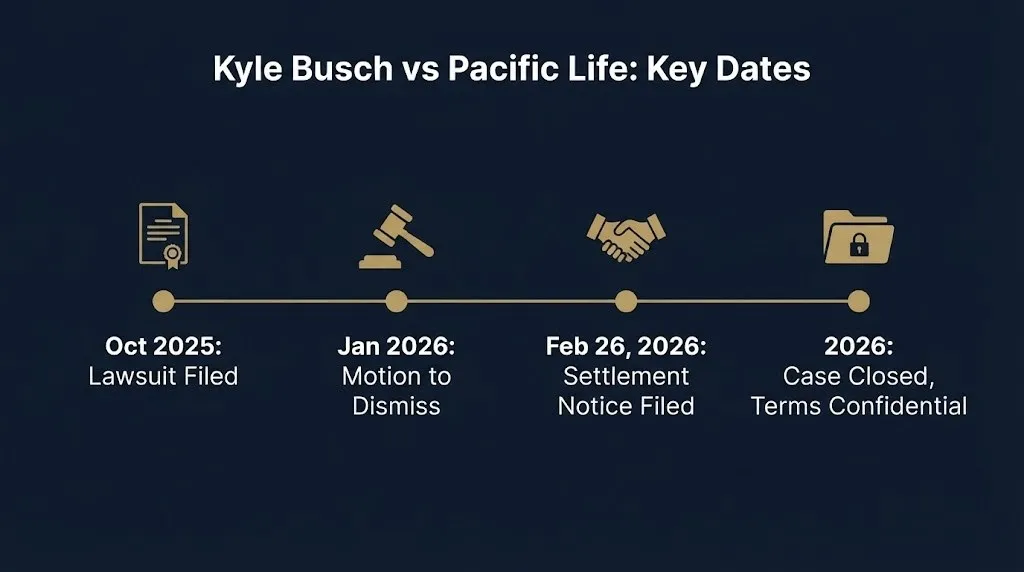
The company argued the Busches failed to fully fund their policies as required and had signed documents accepting the terms. Pacific Life also argued the claims fell outside a three-year statute of limitations, since the policies were purchased roughly seven years before the lawsuit was filed. The settlement mooted the motion before a judge issued a ruling on it.
Key Takeaway: Pacific Life disputed the claims and raised a statute of limitations defense, but the case ended in settlement before any court ruled on the merits.
Why did Kyle Busch sue Pacific Life?
Busch sued because he says Pacific Life and an agent misrepresented indexed universal life policies as safe, self-funding “tax-free retirement plans.”
The dispute traces back to a video Busch and his wife posted in October 2025, describing what they called a financial trap. Busch has said he only grew suspicious after receiving a sixth premium notice on a policy structured for five payments, then couldn’t get straight answers from the agent who sold it.
What is an indexed universal life (IUL) policy?
An indexed universal life policy is a type of permanent life insurance where cash value growth is tied to the performance of a market index, rather than a fixed interest rate.
These policies have grown in popularity, now representing roughly a quarter of life insurance sales industry-wide. Financial advisors are split on them: many say IUL products fit specific planning situations, while critics point to complex fee structures and speculative growth projections as sources of investor confusion.
Is Pacific Life facing other IUL lawsuits?
Yes. The Busch case isn’t isolated. In May 2024, an Idaho jury ordered Pacific Life and an agent to pay more than $1.5 million to a retiree over a separate IUL dispute.
That earlier verdict, unlike the Busch settlement, went to trial and resulted in a jury finding against the company. Together, the two cases have drawn added scrutiny to how IUL products are illustrated and sold across the industry.
Who is Rodney Smith, the insurance agent named in the suit?
Rodney Smith is the Arizona-based insurance agent named alongside Pacific Life in the Busch lawsuit.
Court filings describe Smith as the agent who promoted the IUL strategy the Busches say exposed them to risks concealed by misleading projections and unrealistic assumptions. His individual role in the settlement, including whether he separately resolved any claims, was not detailed in the public court filing.
What is the statute of limitations issue in this case?
Pacific Life argued the Busch lawsuit was filed too late, since it came roughly seven years after the policies were purchased, beyond what it called a three-year limit.
This defense was never resolved by a court ruling because the case settled first. For anyone considering a similar claim, this is the detail worth understanding early: waiting too long after purchasing a policy, even if losses surface later, can bar a claim entirely depending on your state’s rules.
What Happens Next
- February 26, 2026 (confirmed): Notice of settlement filed in federal court in Charlotte.
- Expected within 30 days of that filing: Formal stipulation or motion for dismissal closes the case administratively.
- Ongoing: Broader scrutiny of IUL sales practices continues industry-wide following both the Busch and Idaho cases.
- Unconfirmed: Whether any regulatory bodies open a separate inquiry into Pacific Life’s IUL sales practices as a result of this attention.
Frequently Asked Questions
Is the Kyle Busch Pacific Life lawsuit a class action?
No, it was an individual lawsuit filed by Kyle and Samantha Busch, not a class action.
There is no shared settlement fund or public claim form tied to this case.
How much was the Kyle Busch Pacific Life settlement for?
The settlement amount was not disclosed in court filings or by either party.
The original lawsuit claimed losses exceeding $8.5 million.
Can I still file a claim in the Kyle Busch settlement?
No, this settlement only resolved claims between the Busches, Pacific Life, and agent Rodney Smith.
If you have your own IUL complaint, you’d need to pursue an individual claim, not join this case.
Did Pacific Life admit fault in the settlement?
No, Pacific Life did not admit wrongdoing and described the outcome as a mutual, confidential resolution.
The case ended before any court ruled on the merits of either side’s arguments.
Why did Kyle Busch sue Pacific Life?
Busch alleged Pacific Life and an agent misrepresented indexed universal life policies as safe, tax-free retirement plans.
He said the couple paid over $10.4 million in premiums based on misleading projections.
What happens if I have a similar Pacific Life complaint?
You can pursue an individual lawsuit or file a complaint with your state insurance department.
Check your state’s statute of limitations first, since Pacific Life raised a timing defense in the Busch case.
Is Pacific Life facing other lawsuits over IUL policies?
Yes, an Idaho jury ordered Pacific Life and an agent to pay over $1.5 million in a separate 2024 case.
IUL sales practices industry-wide are facing increased scrutiny following both cases.
Where can I verify details of the settlement?
Check the U.S. District Court for the Western District of North Carolina’s public docket for the case filing.
Established outlets that covered the court filing directly, such as Insurance Journal and ESPN, are also reliable references.
There’s no claim to file here, but there is a lesson worth acting on. If you hold an IUL policy, pull your original illustrations and compare them to your current statement now, before a small discrepancy becomes a much bigger one.
The case closed with the February 26, 2026 settlement filing, and that’s likely the last public detail we’ll get on the dollar amount.