Permanent Partial Disability Settlement Calculator 2026: How PPD Payouts Are Actually Calculated
Quick Answer
- PPD settlements vary by state and use your impairment rating times a scheduled number of weeks times your compensation rate.
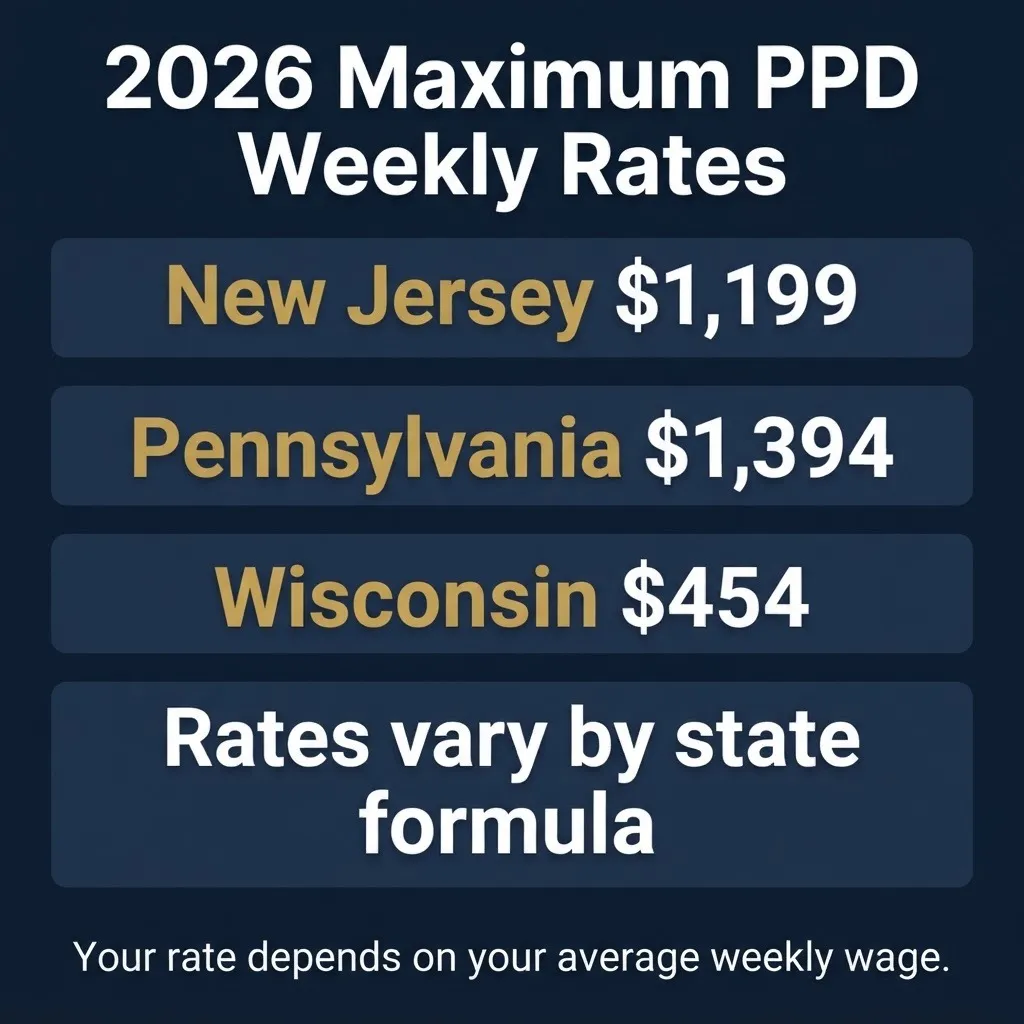
- Maximum weekly PPD rates for 2026 range from $454 in Wisconsin to $1,199 in New Jersey.
- The AMA Guides edition your state uses directly affects your impairment percentage and your final payout.
What Is a Permanent Partial Disability Settlement Calculator?
A permanent partial disability settlement calculator is a tool or formula that estimates what you may receive when a work injury leaves you with a lasting impairment but you can still work in some capacity. Unlike a simple online calculator, the real math happens through a state-mandated formula. No single national calculator exists because every state sets its own rules, rates, and schedules.
The core formula in most states looks like this: Impairment Rating × Scheduled Weeks × Compensation Rate = PPD Award. Virginia uses this exact structure. A 20% loss of use of the arm equals 200 weeks times 20%, which is 40 weeks due. Multiply 40 weeks by your compensation rate and you have your award.
Tennessee operates differently. All injuries are worth 450 weeks. Your impairment rating is multiplied by 450 weeks, then by your compensation rate. If you don’t return to work at the same pay, your original award gets multiplied by 1.35, and additional factors for age, education, and local unemployment can push it higher.
Key Takeaway: PPD calculators aren’t one-size-fits-all. Your state’s formula, your impairment rating, and your wage base determine everything.
How Much Is a Permanent Partial Disability Settlement in 2026?
Most PPD settlements range from a few thousand dollars for minor impairments to well over $100,000 for severe permanent injuries. The spread depends on your state’s maximum weekly rate, your impairment percentage, and how many weeks your injury is scheduled for.
State maximum weekly PPD rates for 2026 vary widely:
| State | 2026 Max Weekly PPD Rate | Source |
|---|---|---|
| New Jersey | $1,199 | NJ Department of Labor |
| Pennsylvania | $1,394 (wage-loss max) | PA Department of Labor |
| Wisconsin | $454 | Wisconsin Act 145 |
| Virginia | Varies by compensation rate | VA Workers’ Comp Commission |
New Jersey’s maximum weekly rate for temporary disability, permanent total disability, and permanent partial disability rose from $1,159 to $1,199 effective January 1, 2026. Pennsylvania’s maximum compensation rate for 2026 is $1,394 per week, up from the prior year, reflecting the updated statewide average weekly wage. Wisconsin increased its maximum PPD rate to $454 for 2026 injuries, with a further increase to $462 planned for 2027.
What you actually receive is almost never the maximum. Your compensation rate is typically two-thirds of your average weekly wage, capped at the state maximum. Pennsylvania pays 66 2/3% of your average weekly wage, with lower earners getting 90% under certain brackets. New Jersey pays 70% of average earnings for wage-loss benefits.
Key Takeaway: The state maximum weekly rate is a ceiling, not a guarantee. Your actual rate depends on your pre-injury earnings and your state’s wage replacement percentage.
How Do You Calculate PPD Using an Impairment Rating?
Your impairment rating is the starting number for every PPD calculation. A doctor assigns it using the American Medical Association’s Guides to the Evaluation of Permanent Impairment. Different states use different editions of the Guides, and the edition matters.
California uses the 2005 Permanent Disability Rating Schedule with changes from Senate Bill 863. For injuries on or after January 1, 2013, a 1.4 modifier replaces the old Future Earning Capacity adjustments. The formula multiplies whole person impairment by 1.4, then adjusts for occupation and age.
Tennessee uses the AMA Guides Sixth Edition but prohibits pain from being considered in impairment ratings for injuries on or after July 1, 2014. This means a condition that would rate higher in another state because of pain may rate lower in Tennessee.
Wisconsin, Pennsylvania, and New Jersey each have their own schedules and rating methodologies. The AMA Guides edition your state mandates can swing your impairment percentage by several points, and those points translate directly into dollars.
| State | AMA Guides Edition | Key Rule |
|---|---|---|
| California | 2005 PDRS (SB 863 modified) | 1.4 multiplier replaces FEC |
| Tennessee | 6th Edition | Pain excluded from ratings |
| Wisconsin | State-specific schedule | 2026 PPD max $454 |
Key Takeaway: Your impairment rating isn’t universal. The AMA Guides edition and your state’s specific rules determine the starting number that drives your entire calculation.
What Is the Formula for PPD Settlement in Your State?
The formula changes at the state line. Virginia multiplies your impairment rating by the scheduled weeks for the body part, then by your compensation rate. Tennessee multiplies your impairment rating by 450 weeks, then by your compensation rate, with potential multipliers for job loss.
Here’s a worked example using Virginia’s schedule. Say you have a 20% loss of use of the arm. The arm is scheduled at 200 weeks. Twenty percent of 200 weeks equals 40 weeks. If your compensation rate is $500 per week, your award is $20,000.
Tennessee’s formula works differently. If your impairment rating is 10% and your compensation rate is $400 per week, your original award is 450 × 10% × $400, which equals $18,000. If you can’t return to work at the same pay, that original award gets multiplied by 1.35, bringing it to $24,300. If you also lack a high school diploma, another 1.45 multiplier applies.
Oklahoma uses a similar structure. A 2026 Workers’ Compensation Commission award combined a 10% neck impairment and 20% hip impairment for 108 weeks of compensation at $360 per week, totaling $38,880. After taxes, attorney fees, and court costs, the net award was $37,713.60.
Reality Check
No online calculator can give you a binding PPD number. The real calculation requires your actual impairment rating from a qualified physician, your verified average weekly wage, and your state’s current rate schedule. If a website promises an exact dollar amount without those three inputs, it’s guessing. Use calculators only to estimate a range, then confirm with your state’s workers’ compensation board or an attorney.
How to File a Permanent Partial Disability Claim
Filing a PPD claim starts before your case closes and follows a sequence that protects your right to benefits. The steps are similar across states, though deadlines and forms differ.
- Report the injury promptly. Most states require notice within 30 days.
- Complete treatment and reach maximum medical improvement. PPD can’t be rated until your condition stabilizes.
- Get an impairment rating from your treating physician or a state-approved evaluator.
- File the claim form with your state’s workers’ compensation board.
- Review the compensation calculation your employer’s insurer provides.
- Negotiate or dispute if the rating is low. You may request an independent evaluation.
- Accept or appeal the final award within your state’s deadline.
Tennessee requires a new petition for increased benefits within one year after the initial compensation period expires if you want to pursue multipliers. Nevada gives you 20 days to reaffirm or retract a lump-sum election after receiving notice. Missing these windows can cost you the difference between a lump sum and an installment plan.
Key Takeaway: The clock on your PPD claim starts ticking before you think it does. Deadlines for appeals and elections can be as short as 20 days.
What Is the Maximum PPD Benefit in 2026?
The maximum weekly PPD rate is the ceiling on what you can receive per week, but your total award depends on how many weeks your injury is scheduled for. A higher weekly rate with a short scheduled period can pay less than a lower rate over many weeks.
New Jersey’s maximum weekly PPD rate for 2026 is $1,199, up from $1,159. Pennsylvania’s maximum compensation rate is $1,394 per week. Wisconsin’s maximum PPD rate is $454 for 2026 injuries, rising to $462 in 2027.
The number of weeks matters as much as the weekly rate. Virginia schedules the arm at 200 weeks, the leg at 175 weeks, the hand at 150 weeks, and the foot at 125 weeks. A 50% loss of use of the leg equals 87.5 weeks due, even at the maximum weekly rate. A small impairment to a high-value body part can pay more than a large impairment to a low-value one.
What Happens Next
January 1, 2027: Wisconsin’s maximum PPD rate rises to $462 for 2027 injuries.
Expected 2027: New Jersey and Pennsylvania will announce updated maximum rates based on new statewide average weekly wage calculations.
Ongoing: State legislatures will continue adjusting PPD schedules and AMA Guides editions, with pain rating rules and multiplier formulas most likely to see changes.
Frequently Asked Questions
Is there a free permanent partial disability settlement calculator?
No official calculator exists because PPD formulas vary by state. Some law firm websites offer estimators, but they only provide rough ranges.
How is permanent partial disability calculated?
Most states multiply your impairment rating by a scheduled number of weeks, then by your compensation rate. Tennessee uses 450 weeks as the base.
What is the maximum PPD rate in 2026?
New Jersey’s maximum weekly PPD rate is $1,199. Pennsylvania’s wage-loss maximum is $1,394 per week. Wisconsin’s PPD maximum is $454.
Can I get a lump sum for permanent partial disability?
Yes, many states allow lump-sum elections. Nevada requires you to reaffirm the election within 20 days before payment.
Does pain count toward my impairment rating?
It depends on your state. Tennessee prohibits pain from being considered in ratings for injuries on or after July 1, 2014. Other states allow pain ratings under the AMA Guides.
What happens if I return to work after a PPD rating?
Returning to work at the same or greater pay may reduce or eliminate increased benefits. Tennessee denies increased benefits if you return to work at equal pay.
How long does a PPD settlement take?
Timelines vary. Rating and negotiation can take months. Lump-sum elections add processing time, including mandatory reaffirmation periods in some states.